电商

Search documents
2025,告辞!2026,你好!
创业邦· 2026-01-01 03:19
Group 1 - In January, the Chinese AI company DeepSeek gained significant attention with its open-source model DeepSeek-V3, which reportedly approaches GPT-4 performance at a training cost only one-twentieth of its counterpart [5][6] - In February, the animated film "Nezha 2" achieved a record box office of 15.4 billion, showcasing China's industrial capabilities in animation, with nearly 2000 out of 2427 shots being special effects [7][8][11] - In March, the competition between JD and Meituan in the food delivery sector reignited, indicating a shift from traffic wars to efficiency and fulfillment capabilities in the local lifestyle market [12][17] Group 2 - In April, the American influencer IShowSpeed's tour in China highlighted the power of authentic experiences, leading to a 77.2% increase in inbound tourists in Chongqing [18][21] - In May, the Jiangsu province's local football league, "Su Chao," became a national sensation, demonstrating how low-barrier events can drive local economic activity and consumer spending [22][25] - In June, the IP LABUBU gained immense popularity, illustrating a successful industrialization of IP through mechanisms that foster repurchase and emotional engagement [27][29] Group 3 - In July, the public inheritance dispute within Wahaha revealed the complexities of family businesses, emphasizing the clash between professional reforms and traditional networks [30][32] - In August, the World Robot Conference showcased a record number of humanoid robots, signaling a transition of AI from theoretical concepts to practical applications in various sectors [34][36] - In September, a controversy over pre-prepared meals highlighted the importance of transparency in the food industry, shifting the focus from taste to trust [39][41] Group 4 - In October, the rise of the "Chicken Chop Guy" in Jingdezhen underscored the value of individual expertise and emotional connection in a saturated market [42][45] - In November, a letter from Yu Minhong sparked discussions about management practices, revealing a disconnect between management narratives and employee expectations [49][51] - In December, the domestic GPU companies Moores Threads and Muxi reached significant market valuations, but challenges remain in integrating products into major computing frameworks [55][57] Conclusion - The year 2025 marked a return to genuine value, with market dynamics increasingly defined by efficiency and emotional engagement, setting the stage for a more competitive and challenging 2026 [59]


12月数字零售:抖音电商陷高退货率困境 贾乃亮售假事件反转
Sou Hu Cai Jing· 2026-01-01 00:30
Group 1 - The digital retail sector is experiencing significant changes, with various platforms facing challenges and opportunities in 2025 [1] - Douyin e-commerce is seeing an alarming daily return volume of millions of packages, indicating a shift in the dynamics between e-commerce and logistics industries [6] - Alibaba's anti-counterfeiting alliance reported a 58.5% decrease in counterfeit complaints on the Taotian platform compared to the previous year [8] Group 2 - The second-hand mobile phone recycling platforms are under scrutiny for practices like "high price estimation and low price upon receipt," raising user concerns about fairness and privacy [3] - The "old for new" service on Taobao reportedly saw a 32.7% reduction in the recycling price for an iPhone 15 Pro Max, highlighting issues of price manipulation [11] - A well-known women's clothing store with over 10 million followers announced its closure due to continuous losses, despite significant sales figures [12] Group 3 - Pinduoduo is tightening regulations on promotional language related to free gifts, requiring merchants to use official tools for compliance [15] - Pinduoduo has launched a special governance initiative to combat the use of pre-recorded videos masquerading as live streams, aiming to protect consumer rights [16] - Pinduoduo's new "delivery to village" service aims to enhance competitiveness in rural markets by facilitating logistics for merchants [17] Group 4 - Douyin e-commerce has introduced a new intelligent marketing product, "Qianchuan Chengfang," which integrates AI technology to optimize marketing strategies [30] - Douyin's nine support policies have reportedly saved merchants nearly 29 billion yuan in operating costs from January to November 2025 [32] - Douyin e-commerce's "treasure shop" report indicates a 165% year-on-year increase in GMV for participating merchants [29] Group 5 - The online retail sector in China saw a total online retail sales figure of 144.582 billion yuan from January to November 2025, reflecting a 9.1% year-on-year growth [67] - The Ministry of Commerce reported that online service consumption grew significantly, with a notable increase of 21.7% [77] - The National Development and Reform Commission has issued new rules prohibiting platforms from selling products below cost to prevent market disruption [68]

筑牢安全底线 激发市场活力——益阳市“十四五”时期市场监管工作综述
Sou Hu Cai Jing· 2026-01-01 00:01
Core Viewpoint - The article outlines the efforts and achievements of the market regulation system in promoting high-quality development during the "14th Five-Year Plan" period, focusing on various regulatory frameworks and reforms to enhance market vitality and ensure fair competition. Group 1: Market Entry and Business Environment - The city has implemented comprehensive reforms to facilitate market entry and business deregistration, including dynamic updates to the "multi-certificates in one" directory and the promotion of "one-stop" services for business registration [4][5] - The time required to establish a business has been reduced to within half a working day, making the process more efficient and convenient for market participants [5] - By the end of 2025, the total number of market entities is expected to reach 475,000, with an average annual growth rate of 8.9% [7] Group 2: Market Competition Order - A fair competition review mechanism has been established, leading to the evaluation and cleaning of 5,105 documents that hinder a unified market and fair competition [9] - The regulation of pricing and fees in sectors such as commercial banking and electricity supply has been strengthened, contributing to a more orderly market environment [11] Group 3: Quality Improvement Initiatives - The "Quality Strong City" strategy has been implemented, resulting in significant improvements in product quality, with the manufacturing quality pass rate reaching 94.16% in 2024, up from 91.20% in 2020 [12][14] - The city has established two national-level quality inspection centers and four provincial-level centers, significantly enhancing quality infrastructure [16] Group 4: Intellectual Property Development - The city has made strides in intellectual property, with 2,748 valid invention patents and a target of 1,192 high-value invention patents by 2024 [19] - The number of geographical indication trademarks has reached 28, with 16 protected products, positioning the city as a leader in this area within the province [21] Group 5: Market Safety and Consumer Protection - Safety regulations have been prioritized, with food safety monitoring achieving a compliance rate of over 98% for major agricultural products [27] - The consumer complaint resolution system has been enhanced, with a 99.98% on-time resolution rate for complaints in 2024 [34] Group 6: Regulatory Mechanisms and Innovations - The market regulation system has been improved through the integration of smart and credit-based supervision, with 17,500 individual businesses marked for operational anomalies [33] - The implementation of "Internet + AI supervision" in food and special equipment sectors has been accelerated, enhancing regulatory efficiency [35]
2026年格隆汇“下注中国”十大核心资产名单,重磅揭晓!
Ge Long Hui· 2025-12-31 20:53
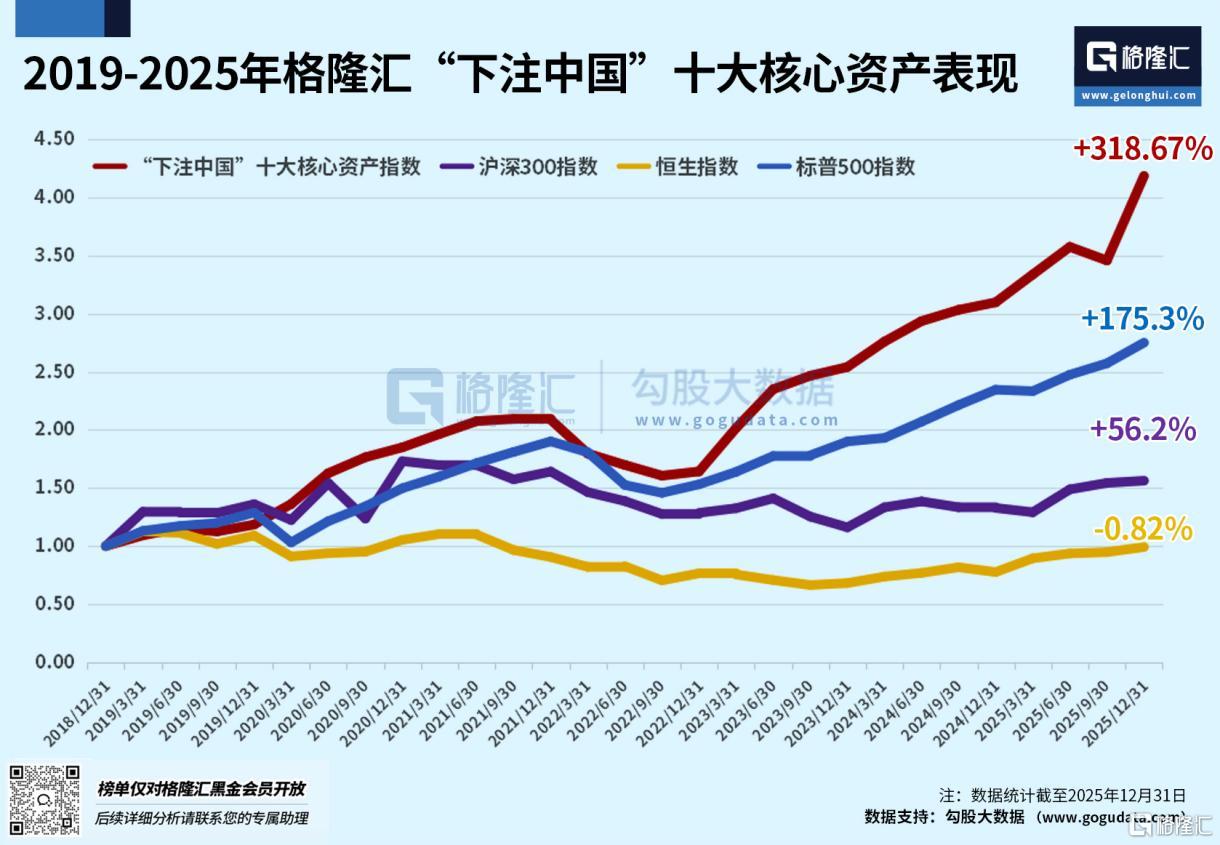
Core Insights - The 2026 "Bet on China" top ten core assets have been announced by Gelonghui, a well-known independent research institution in China, based on votes from millions of members across over 70 countries [1][3] - The selection process involved over half a month of voting, resulting in hundreds of thousands of valid votes, emphasizing the collective wisdom of global investors [3] Selection Criteria - The selected listed companies must meet four key principles, reflecting the uncertainties in the Chinese investment market for 2025, including fluctuating recovery expectations, real estate stability concerns, and the ambiguity in investment directions related to AI and new energy [2] Performance Metrics - Since the end of 2018, the "Bet on China" top ten core assets index has achieved a cumulative increase of 318.67%, significantly outperforming the CSI 300 index (+56.2%), Hang Seng index (-0.82%), and S&P 500 index (+175.3%) [3] - In 2025, the equal-weighted return of the top ten core assets reached 35.1%, again surpassing the CSI 300 index (+17.7%), Hang Seng index (+27.8%), and S&P 500 index (+17.3%) [3] Core Assets Overview 1. **Zhongji Xuchuang (300308)**: Expected to benefit from the acceleration of AI computing infrastructure in China, with a projected demand for optical modules reaching 18 billion yuan, and a 50% annual growth in domestic demand for 800G optical modules [5] 2. **Tencent Holdings (00700.HK)**: With a massive user base, Tencent is expected to see its advertising revenue exceed 40 billion yuan in 2026, driven by its social media platforms and AI efficiency improvements [6][7] 3. **Alibaba (09988.HK)**: Anticipated to achieve 170 billion yuan in revenue from cloud services, with a growth rate of 34%, while also focusing on domestic consumption upgrades [7][8] 4. **Gold ETF (518880)**: Positioned as a key hedging tool for domestic investors, with a forecasted gold price potentially reaching 5,000 USD per ounce, supported by liquidity and geopolitical factors [8] 5. **Luoyang Molybdenum (603993/03993.HK)**: Expected to produce 660,000 tons of copper and 120,000 tons of cobalt in 2026, benefiting from the growth of the domestic electric vehicle market [9] 6. **Ping An Insurance (601318/02318.HK)**: Projected to see a 20%-25% increase in market value, benefiting from the domestic interest rate cycle and a focus on quality equity assets [10] 7. **Dongfang Caifu (300059)**: Anticipated to see a 22%-28% growth in market value, driven by increased capital market activity and AI-driven wealth management services [11] 8. **Wanhua Chemical (600309)**: Expected to achieve a net profit of 15.5-16.2 billion yuan in 2026, supported by domestic demand for MDI and new materials [12] 9. **WuXi AppTec (02268.HK)**: Positioned as a leader in the ADC field, with over 60% of its pipeline serving domestic clients, reflecting the growth of China's biopharmaceutical industry [13] 10. **Trip.com Group (09961.HK)**: Projected to see a revenue growth of over 25%, benefiting from the recovery of domestic travel and tourism [14] Conclusion - The ten core assets are aligned with China's key sectors such as AI computing, new energy, consumption, finance, and biomedicine, reflecting the country's new productive forces and upgrading of livelihoods [14]





东南亚研究:东南亚12月报告:宏观、互联网与消费
2025-12-31 16:02
Southeast Asia December Report: Macro, Internet, and Consumer Sectors Industry Overview - The report focuses on the Southeast Asian region, specifically six countries: Indonesia, the Philippines, Vietnam, Malaysia, Thailand, and Singapore [1][2][3]. Key Points and Arguments Monetary Policy - The Federal Reserve lowered the policy interest rate by 25 basis points to a target range of 3.50%-3.75%, the lowest level in three years. Southeast Asia is expected to maintain a loose monetary policy [1]. - The Philippines' central bank cut rates by 25 basis points to 4.50% due to weak economic growth and declining business confidence. Other countries maintained their rates: Indonesia (4.75%), Vietnam (4.50%), Malaysia (2.75%), and Thailand (1.50%) [1]. Bond Market - In November, the 10-year government bond yields in Southeast Asia showed a mixed trend. Indonesia's yield rose from 6.08% to 6.30%, while the Philippines' yield fell to 5.86% due to strong foreign net buying in the bond market [2]. - Vietnam's yield increased to 3.79%, with foreign outflows totaling $1.2 billion for the quarter. The yields for the Philippines, Malaysia, and Thailand were 5.86%, 3.47%, and 1.68%, respectively [2]. Purchasing Managers' Index (PMI) - The PMI for the six Southeast Asian countries indicates a continued recovery in production activities, with Thailand and Indonesia's PMIs rising to 56.8% and 53.3%, respectively. Malaysia's PMI reached 50.1%, indicating expansion [2]. - Conversely, the Philippines' PMI dropped significantly to 47.4% due to a sharp decline in new orders and production disruptions caused by typhoons [2]. Export Performance - Despite a slowdown in exports for Thailand and Indonesia in October, overall export growth in Southeast Asia remained strong. Singapore recorded a significant year-on-year growth of 25.2%, while the Philippines, Vietnam, and Malaysia maintained double-digit growth rates of 19.4%, 17.5%, and 15.7%, respectively. Thailand's growth was 5.3%, and Indonesia's exports declined by 2.3% [2]. Retail Market - The retail market in Southeast Asia is generally expanding. Malaysia's retail sales growth accelerated from 6.42% in September to 7.11% in October. Singapore's sales growth increased from 2.82% to 4.46%, while the Philippines saw a significant slowdown from 3.14% to 0.26% [3]. Inflation Trends - Inflation rates in Southeast Asia remained stable but varied across countries. Malaysia's inflation rate decreased from 1.5% in September to 1.27% in October. Indonesia and the Philippines also saw slight declines in inflation rates [3]. - In contrast, Singapore's inflation rate rose from 0.67% to 1.21%, and Vietnam's inflation increased from 3.25% to 3.58%. Thailand remained in deflation, though the pace slowed from -0.76% to -0.49% [3]. Digital Economy and Market Performance - In November, Shopee's Monthly Active Users (MAU) showed resilience, with a 0.07% increase across Southeast Asia, except for Thailand, which saw a decline of 5.02% [4]. - Grab's MAU increased by 0.92%, with Thailand leading the region with a 6.65% growth [4]. - As of December 15, Southeast Asian stock markets performed positively, with the Philippines' PCOMP index leading with an 8.5% increase, followed by Indonesia's Jakarta Composite Index at 3.3% [5]. Investment Opportunities - The report suggests focusing on AI-related sectors, including electronic manufacturing, power grids, and data centers. The shift in the global AI industry from training to inference is expected to sustain strong demand for computing power, benefiting digital infrastructure growth in Southeast Asia [5]. Risks - The report highlights risks such as geopolitical tensions and political uncertainties that could impact the region's economic outlook [6].
2025年十四大事件
Xin Lang Cai Jing· 2025-12-31 16:02
Core Insights - The year 2025 marks a significant "paradigm shift" in the global business landscape, transitioning from visions of AI, consumption, and geopolitics into practical industrial applications [1][40]. Group 1: AI and Technology Developments - DeepSeek's emergence and Manus's $1 billion sale to Meta signify a pivotal moment in China's AI technology sector, reducing reliance on foreign models and initiating a trend towards open-source large models [2][41]. - The rapid competition in the AI field has led to numerous emerging competitors for DeepSeek, including Doubao, Qianwen, Lingguang, and Antifufu, alongside established players like Baidu and Kimi [4][43]. - AI models have evolved from mere chat tools to autonomous decision-making agents, with companies shifting from "buying models" to "nurturing agents" for task execution [6][45]. Group 2: Economic and Market Trends - The low-altitude economy in China is projected to exceed 1.5 trillion yuan, with cities like Shenzhen and Guangzhou pioneering eVTOL urban routes and drone deliveries becoming standard for logistics giants [8][46]. - The year 2025 is recognized as the year of humanoid robots entering factories, with significant orders surpassing 10,000 units, indicating a shift from experimental technology to industrial-grade products [10][49]. - Global trade dynamics are shifting, with the normalization of tariff battles between the US and Europe against Chinese electric vehicles and solar industries, prompting a "global localization" strategy among Chinese firms [12][51]. - The introduction of solid-state batteries in China, including the first national standards, addresses electric vehicle charging anxieties and strengthens China's position in the global renewable energy value chain [13][52]. Group 3: Consumer Behavior and Cultural Shifts - The establishment of the Hainan Free Trade Port marks a critical step in China's institutional openness, attracting global capital and talent [15][54]. - The rise of the "silver economy" in response to China's aging population is expected to create a trillion-yuan market for elder care products and services [28][67]. - The backlash against high-priced pre-made dishes, highlighted by public figures like Luo Yonghao, reflects a growing consumer demand for transparency and value, signaling the end of the "arrogant brand era" [24][63]. - The decline of the Labubu toy series from a speculative investment to a more accessible product illustrates a shift in consumer sentiment towards value-driven purchases [29][72]. Group 4: Capital and Investment Trends - The focus of global capital is shifting from generic large models to investments in "sovereign AI" infrastructure, with data centers becoming strategic national assets [16][57]. - Starbucks' decision to sell part of its Chinese operations to local investors signifies the end of the era where foreign brands dominated the market solely through globalization [34][73].

把握消费增长主线机会
2025-12-31 16:02
Summary of Conference Call Records Industry Overview - The retail market in 2025 is experiencing a slowdown, with online retail sales declining by 0.1% year-on-year, while offline retail sales grew by 0.5% [1][4] - From January to November 2025, online retail sales of goods and services increased by approximately 9%, outperforming offline sales, indicating a loss of momentum in consumer spending in the second half of the year [1][4] Key Insights on Consumer Goods - Consumer goods performance from 2023 to 2025 shows divergence: staple foods remain stable, beverage growth is slowing, tobacco and alcohol are experiencing negative growth, while daily necessities are accelerating [1][5] - In discretionary spending, jewelry and cosmetics are expected to rebound in 2025 after a negative growth in 2024, while sports goods continue to perform well [1][5] - The real estate market significantly impacts post-cycle consumer categories, with automobiles shifting from positive to negative growth [5] E-commerce Performance - Major platforms like Tmall, JD, and Douyin reported negative year-on-year GMV growth in November 2025, partly due to the early Double Eleven promotions [1][6] - Traditional e-commerce growth from January to November 2025 is close to 6%, aligning with GDP growth, but the second half of the year faced a cooling environment [7] Future Outlook - Despite a challenging overall environment, significant differentiation exists among categories, with some trends reversing, indicating structural opportunities [8] - Consumer confidence remains low, necessitating more policy support and market stimulation to revive activity [8] Notable Growth Categories in E-commerce - In 2025, categories like transportation cycling products saw significant online penetration growth, driven by new brands and demand [9] - Other categories achieving around 20% online growth include household tools, outdoor apparel, and health-related products [9] Price Trends and Sales Performance - From January to November 2025, categories such as digital products, outdoor apparel, home improvement materials, and office supplies saw average price increases exceeding 10% due to new demand drivers [11] - However, categories like clothing accessories, shoes, and office equipment experienced declining online penetration and sales [12] Competitive Landscape - The concentration in certain sectors has increased significantly post-pandemic, with digital products and large home appliances showing the highest concentration growth [13] - Leading brands in the digital appliance sector include Apple, Huawei, and Xiaomi, with Midea and Haier dominating large appliances [14][15] Sector-Specific Insights - The beauty and personal care sector remains stable, with skincare products led by domestic and high-end international brands [16] - The home appliance market is stable, with brands like Xiaomi and Midea performing well, driven by brand effects and innovative products [15] - The snack and grain oil sectors show stable growth among leading companies, while smaller brands are innovating [19] Conclusion - The overall consumer market in 2025 is characterized by a mix of stability in essential goods and volatility in discretionary spending, with e-commerce facing challenges despite pockets of growth in specific categories. The competitive landscape is evolving, with increased concentration in certain sectors and opportunities for innovation among smaller players.
2025年十四大事件
首席商业评论· 2025-12-31 13:49
Core Insights - The year 2025 marks a significant paradigm shift in China's and the global business landscape, transitioning from vision to industrial implementation of AI, consumption, and geopolitical changes [3][4]. Group 1: AI and Technology Developments - DeepSeek's emergence in early 2025 signifies a pivotal moment for China's AI technology sector, reducing reliance on foreign models and initiating a trend towards open-source large models [5]. - The rapid competition in the AI field has led to the emergence of numerous competitors, including Doubao, Qianwen, and Lingguang, alongside established players like Baidu and Kimi [7]. - AI has evolved from a simple chat tool to a productivity employee, marking the beginning of an era of automated decision-making [10]. Group 2: Economic and Market Trends - The low-altitude economy is projected to exceed 1.5 trillion yuan in 2025, with cities like Shenzhen and Guangzhou leading the way in eVTOL operations and drone deliveries becoming standard for logistics giants [11]. - The year 2025 is recognized as the year of humanoid robots entering factories, with significant orders surpassing 10,000 units, indicating a shift from experimental technology to industrial applications [14][16]. - Global trade dynamics are shifting, with the normalization of tariff battles between the US and Europe against Chinese electric vehicles and solar industries, prompting a move towards localized global strategies [18][20]. - The introduction of solid-state batteries in China is set to revolutionize the electric vehicle market, addressing energy storage concerns and enhancing safety [21][23]. Group 3: Consumer Behavior and Cultural Shifts - The "silver economy" is emerging as a key driver of domestic demand, with policies targeting the aging population leading to a surge in consumption in this sector [38][40]. - The rise of GLP-1 drugs is reshaping health and lifestyle industries, significantly impacting consumer habits and the broader economic landscape [41]. - The decline of speculative trends in collectible toys, such as Labubu, reflects a shift in consumer sentiment towards value-driven purchases rather than hype [42][44]. - The backlash against high-priced pre-made dishes, highlighted by public figures like Luo Yonghao, indicates a growing demand for transparency and value in branding [35][37]. Group 4: Corporate Strategies and Capital Trends - Starbucks' decision to sell part of its Chinese operations to local investors marks the end of the era where foreign brands dominated solely through globalization, necessitating a more localized approach [45][46]. - The capital landscape is shifting towards investments in sovereign AI infrastructure, with data centers becoming critical national assets [27]. Group 5: Overall Business Landscape - The events of 2025 illustrate a transition to a new business paradigm where technology, market efficiency, consumer sovereignty, and localized capital strategies are paramount [48][49][52][54].

互联网电商 25Q3 业绩总结及展望:即时零售转向 UE 修复,加速打造 AI 生态闭环
Shenwan Hongyuan Securities· 2025-12-31 13:46
Investment Rating - The report recommends investment in Alibaba, Meituan, Pinduoduo, and JD.com, indicating a positive outlook for these companies in the e-commerce sector [4]. Core Insights - Online consumption continues to grow steadily, with a total retail sales of 45.6 trillion yuan in the first 11 months of 2025, reflecting a year-on-year increase of 4.0%. The online retail sales reached 14.5 trillion yuan, up 9.1% year-on-year, with physical goods online retail sales growing by 5.7% to 11.8 trillion yuan, resulting in a penetration rate increase of 0.42 percentage points to 25.9% [1][12]. - The impact of the "old-for-new" policy from the previous year is starting to show, leading to a high base effect that is affecting growth rates. The express delivery business volume reached 180.74 billion pieces, a year-on-year increase of 14.9%, but this growth is slowing compared to the previous half of the year [1][12]. - The competition in the instant retail sector has peaked, with platforms shifting their strategies towards differentiation to improve user experience (UE). The report notes that the industry is entering a new phase of competition, focusing on quality and efficiency rather than just price competition [3][47]. Summary by Sections 1. Online Consumption and Retail Performance - Online consumption remains robust, with significant growth in penetration rates. The high base effect from last year's policies is now impacting growth rates, leading to a slowdown in the growth of express delivery and online retail sales [1][12]. - Major platforms are adjusting their strategies in response to the high base effect, with JD.com experiencing a notable decrease in GMV growth rates in Q3 [1][17]. 2. AI Investment and Development - The AI sector is witnessing intensified competition, with major internet companies launching numerous updates and iterations of AI models. The focus is shifting from broad capabilities to specialized strengths, enhancing user experience and application in consumer-facing products [3][34]. - Alibaba's cloud business is accelerating, with AI-related product revenues achieving triple-digit year-on-year growth for nine consecutive quarters, indicating a successful transition from technology investment to value realization [3][34]. 3. Instant Retail Sector Dynamics - The instant retail sector has seen a peak in competition, with platforms initially investing heavily to capture market share. However, as the market stabilizes, strategies are shifting towards differentiation and quality improvement [3][47]. - The report highlights that platforms like Meituan and Taobao are focusing on enhancing user experience and profitability, moving away from aggressive subsidy strategies [3][47]. 4. Performance of Major E-commerce Platforms - Alibaba's core business revenue growth remains strong, while Meituan's local business is under pressure. JD.com and Pinduoduo are expected to see profit recovery in the upcoming quarters, driven by strategic investments and operational efficiencies [3][4]. - The report notes that the profitability of platforms is becoming increasingly differentiated, with expectations for Alibaba and Meituan to see profit recovery soon [4].



廖跃翀:京东IP文娱业务生态
Xin Lang Cai Jing· 2025-12-31 13:20
Core Insights - The 2025 Global Cultural IP Industry Development Conference will be held in Shanghai on December 26-27, 2025, focusing on the theme "IP Without Boundaries: Intelligent Creation of the Future - Global Exploration of Cultural IP and Technology Integration" [3][8] - JD's IP Entertainment business is centered around content industry, forming a B2B2C closed-loop model that addresses typical pain points such as diverse categories, dispersed users, and difficulty in fan retention [3][8] - JD aims to enhance the efficiency of value conversion for IP in e-commerce and supply chain scenarios through a three-party collaborative marketing mechanism involving the platform, copyright holders, and brand merchants [4][5][9] Company Overview - JD's IP Entertainment is responsible for the daily operations and sales of IP products, IP stores, and IP merchants on the JD platform, integrating IP licensing, brand collaborations, and the development and sales of IP derivatives [4][9] - The company connects copyright holders and content providers on one end, and brand merchants and manufacturing supply chains on the other, ultimately presenting compliant and high-quality IP-related products and experiences to end consumers [5][9] Operational Capabilities - JD provides multi-dimensional support, including supply chain and fulfillment capabilities to ensure efficiency and stability from design and development to delivery [5][10] - The platform's operational and marketing capabilities leverage entry resources, event strategies, content dissemination, and membership systems to convert IP influence into measurable sales and brand awareness [5][10] - JD also facilitates brand collaborations by matching the needs of copyright holders with those of merchants, creating richer products and scenarios [5][10] Digital Innovation - JD is exploring digital tools and new forms, such as the Lingxi platform, which utilizes JD's main site mini-programs and blockchain technology to connect cultural digital assets with brands, IPs, and users [6][10] - The goal is to transform digital assets from mere collectibles into rights carriers that connect users, promote dissemination, and drive consumption [6][10] Future Aspirations - The core logic of JD's IP Entertainment is based on a three-party win-win model, where the platform provides users and marketing scenarios, IP holders offer official materials and co-creation channels, and brand merchants handle product operations and brand resource integration [6][10] - JD aims to establish connections with more industry partners to create reusable benchmark cases and promote a more efficient, trustworthy, and sustainable IP entertainment ecosystem [6][10]