零售

Search documents
东莞:今年将实现松山湖欢乐海岸、南城万象城、厚街山姆开业
Sou Hu Cai Jing· 2026-02-04 11:41
Core Insights - Dongguan is focusing on enhancing consumption as a key driver of economic growth, particularly during the "14th Five-Year Plan" period, with initiatives aimed at consumption upgrades and economic development [2][4] Group 1: Consumption Initiatives - Dongguan plans to implement a special action to boost consumption, aiming to leverage trade-in programs to stimulate related consumption worth 23.6 billion yuan, leading to a projected 2.8% growth in retail sales [4] - The city will enhance its internal sales service system and promote local products through various events and platforms, including the establishment of a "Dongguan Quality Products" exhibition center [4] - The initiative includes the development of a "Guanli Economy" to strengthen brand building and international outreach, enhancing the global influence of Dongguan's manufacturing [4] Group 2: New Consumption Models - Dongguan aims to accelerate the cultivation of new consumption formats and models, focusing on digital consumption and integrating AI with retail and service industries [6] - The city plans to introduce over 100 new stores in popular shopping areas and develop pet-friendly environments to tap into the growing pet consumption market [6] - Infrastructure investment will be prioritized to create new highlights in the local economy, supporting various new business models and enhancing consumer experiences [6] Group 3: Consumer Confidence and Safety - The city is optimizing consumption promotion activities, including the addition of 2,500 trusted consumption units to enhance consumer confidence [5] - Efforts are being made to ensure that citizens and visitors feel secure in their purchasing decisions, aligning the growth of internal demand with improved quality of life [5]


46394.2亿元!江苏社零总额首次全国第一
Guo Ji Jin Rong Bao· 2026-02-04 11:40
Core Insights - Jiangsu has surpassed Guangdong for the first time in 45 years, becoming the top consumer province in China with a retail sales total of 46,394.2 billion yuan in 2025, marking a 3.3% year-on-year growth [2] - Jiangsu's GDP reached 142,351.5 billion yuan in 2025, growing by 5.3%, making it the second province after Guangdong to enter the "14 trillion yuan" club [2] Group 1: Consumption Growth Drivers - The "Su Super" league emerged as a significant driver of consumption in Jiangsu, generating 379.6 billion yuan in revenue across five service sectors during its first six rounds, a 42.7% increase year-on-year [3][4] - The league attracted over 2.43 million live spectators and 2.2 billion online viewers, with the final match alone generating 2.6 billion yuan in retail, dining, and accommodation transactions in Nanjing, a 20% increase [3][4] - Jiangsu's innovative service offerings during the league, such as special trains and free public transport for fans, contributed to a robust "ticket root economy" [3][4] Group 2: Night Economy and Service Sector Growth - The night economy in Jiangsu has seen significant growth, with service sector electricity consumption increasing by 15.5% since May 2025, indicating strong activity in this area [8] - Cultural and immersive experiences, such as themed night tours and local food promotions, have enhanced the attractiveness of night-time consumption [7][8] Group 3: Policy Support and Innovation - Jiangsu's comprehensive policy framework has been pivotal in driving consumption growth, with initiatives like the "first store economy" leading to over 800 new stores in 2025, including 17 national first stores [6] - The "old for new" policy has expanded to cover various product categories, significantly boosting consumer spending and participation from businesses [8] - Government subsidies for the "old for new" program have reached over 196 million yuan, facilitating sales of 1.52 billion yuan and promoting green and intelligent consumption [8] Group 4: Future Directions - Jiangsu aims to focus on six key areas for consumption growth in 2026, including transportation and domestic services, while also enhancing the "Su New Consumption + Su Super League" initiative [9] - The province plans to host over 3,000 promotional events and optimize existing policies to further stimulate consumer activity [9]

让全球游客买得爽、玩得深、带得走!打造国际消费中心,上海市政协委员开出“深层菜单”
Sou Hu Cai Jing· 2026-02-04 10:51
Core Viewpoint - Shanghai is experiencing a vibrant consumer atmosphere during the Spring Festival, reflecting its status as an international consumption center, with projected inbound tourists exceeding 6 million and retail sales reaching 1.85 trillion yuan in 2024 [1] Group 1: Consumer Trends and Strategies - The Shanghai government aims to enhance consumption significantly by 2026, focusing on inbound tourism, tax refunds, and cross-border payment facilitation to unlock consumer potential [3] - The integration of cultural, tourism, commerce, and sports events is proposed to create a new consumption ecosystem, addressing the fragmentation in current offerings [3][4] - Recommendations include establishing a leadership group for the integration of cultural and commercial events, promoting immersive experiences rather than just transactional interactions [4] Group 2: Digital Empowerment and Experience Enhancement - Digital tools are essential for enhancing consumer experiences, with suggestions to upgrade the "Shanghai Small Tour" app to include AI guides and multilingual services [5] - The focus is on creating spaces that offer emotional value and cultural immersion, encouraging visitors to engage with Shanghai's unique lifestyle [5] Group 3: Tax Refunds and International Consumer Engagement - The convenience of tax refunds is critical for retaining international consumers, with plans to increase refund points from over 600 to 1,000 by 2025 and to over 3,000 by 2027 [7] - Suggestions include clustering tax refund points near popular tourist areas and introducing mobile refund services to enhance accessibility [7] Group 4: Quality and Service Improvement - The emphasis is on moving away from price competition to focus on quality and service, with a call for a certification system for quality products and services in Shanghai [9] - The need for better integration of digital payment systems for international visitors is highlighted, suggesting partnerships with payment platforms to simplify transactions for newcomers [9][10] Group 5: Revitalizing Traditional Brands - The potential of Shanghai's "old brands" is recognized, with a focus on enhancing their appeal through improved packaging, service, and cultural storytelling [12] - Recommendations include creating immersive experiences that combine culture and technology, such as AI interactions and cultural workshops, to attract younger consumers and tourists [12][13] - Establishing a system for city-themed souvenirs and promoting traditional products as cultural ambassadors for Shanghai is proposed [13]

【环球财经】拥抱AI 沃尔玛市值突破1万亿美元
Xin Hua She· 2026-02-04 10:33
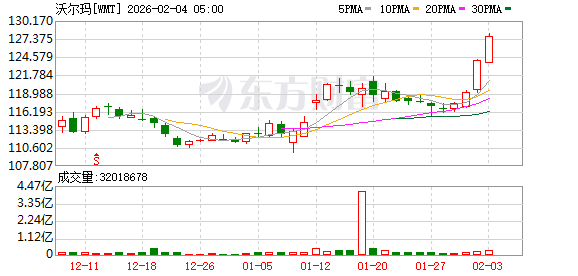
路透社数据显示,过去十年,沃尔玛股价飙升468%。报道分析,这主要归功于沃尔玛同时吸引高收入 和低收入消费者的战略。在美国,每4美元的杂货消费中,就有1美元流向沃尔玛。 值得一提的是,沃尔玛十分重视电商业务。过去5年间,其在线市场商品扩展至超5亿种,推出1小时送 达服务,创建与亚马逊Prime竞争的Walmart+会员计划,并打造价值40亿美元的广告业务。截至2025年 10月31日的3个月内,受在线订单和广告业务推动,其美国电商业务销售额增长28%。 更为关键的是,沃尔玛抢占先机大力投资人工智能(AI),投入数十亿美元用于供应链自动化,以提升生 鲜品质、加快配送速度,并优化库存预测和搜索功能。伦敦证券交易所估算,该公司已连续15个季度超 出美国同店销售预期。投资者对其AI布局的乐观情绪进一步推高股价。 美国谷歌公司上月说,将与沃尔玛等大型零售商合作,扩展其"双子座"AI模型的购物功能。去年10月, 开放人工智能研究中心(OpenAI)与沃尔玛宣布类似合作,称将允许ChatGPT用户通过"即时结账"功能购 买沃尔玛网站上除生鲜外的大部分商品。 新华财经北京2月4日电 美国沃尔玛公司3日成为全球首家市值突破1万 ...
最高人民法院:依法惩治针对企业和企业家的敲诈勒索、造谣抹黑等违法犯罪行为
Zheng Quan Ri Bao Wang· 2026-02-04 09:58
Group 1 - The Supreme People's Court is launching a special action to standardize law enforcement related to enterprises, starting in 2025, to protect the legal rights of businesses and entrepreneurs [1] - Courts are actively addressing issues such as local protectionism, market segmentation, and monopolistic behaviors to foster a unified and competitive market environment [1] - The courts are focusing on protecting enterprises from extortion, defamation, and other illegal activities that harm business reputation [1] Group 2 - Local courts are working to expand financing channels for small and medium-sized enterprises (SMEs), with initiatives like the "enterprise litigation information clarification mechanism" in Shanghai, which has helped over 2,000 enterprises secure nearly 3 billion yuan in financing [2] - The courts are promoting the effective execution of judicial decisions and the bankruptcy system, aiding 1,481 enterprises in recovery and facilitating the clearance of 29,000 zombie enterprises [2] Group 3 - The courts are enhancing judicial supervision over enterprise-related litigation and administrative actions, correcting 367 instances of improper administrative penalties and ensuring fair treatment of businesses [3] - There is a focus on preventing the misuse of criminal law in economic disputes, with 69 cases identified that should not be treated as criminal offenses [3] Group 4 - Courts are implementing civilized judicial practices to assist enterprises in overcoming litigation challenges, resolving 1.7762 million enterprise-related disputes through mediation and other mechanisms [4] - The use of enforcement measures is being carefully managed to minimize disruption to normal business operations, with 12.06 million enterprises affected by "active sealing and freezing" measures [4] - Credit restoration efforts have helped 266.96 million individuals regain their market standing, distinguishing between "dishonesty" and "inability" [4]
得印尼者得东南亚:中企扎堆掘金,会中文月薪近万
Di Yi Cai Jing· 2026-02-04 09:31
Core Insights - Indonesia represents a significant market opportunity, accounting for approximately 40% of Southeast Asia's market share, making it a strategic target for companies looking to expand in the region [4][14][19] Market Dynamics - Japanese brands dominated the Indonesian automotive market a decade ago with a 90% market share, which has now decreased to around 70% due to the rise of Chinese electric vehicles [1] - Indonesia is the largest single market in Southeast Asia, with a GDP and e-commerce scale representing about 40% and 50% of the region, respectively [4][14] - The internet penetration rate in Indonesia exceeds 70%, with a young population driving the digital economy [4][13] Investment Trends - Chinese direct investment in Indonesia is projected to reach $4.59 billion in 2024, marking a 46.5% year-on-year increase, positioning China as one of the top foreign investors in the country [7] - Companies like WOOK are successfully expanding from Indonesia to other Southeast Asian markets, indicating a trend of regional growth [8] Talent and Language - The demand for Chinese-speaking professionals in Indonesia has surged, with salaries for bilingual positions reaching up to 10,000 RMB per month [6][7] - The increasing number of Chinese companies in Indonesia has created a need for local talent who can bridge communication gaps [7] E-commerce Growth - TikTok has become the leading e-commerce platform in Indonesia, with its gross merchandise volume (GMV) surpassing $6 billion in the first half of the year, reflecting a growth of over 100% year-on-year [13] - The e-commerce market in Indonesia is expected to grow by over 14% by 2025, reaching approximately $71 billion [14] Strategic Insights - Companies that establish a foothold in Indonesia can leverage their success to expand into other Southeast Asian markets more easily [14][19] - The logistics and supply chain challenges in Indonesia can be navigated by focusing on key islands where the majority of the population resides [20] Consumer Behavior - There is a growing acceptance of new brands and business models in Indonesia, driven by the rapid development of e-commerce and social media [18] - The local market is witnessing a shift towards higher-quality products, providing opportunities for Chinese brands to compete effectively [18]

湖北去年为消费者挽回经济损失1.28亿元
Xin Lang Cai Jing· 2026-02-04 09:12
Core Insights - In 2025, Hubei Province received and processed 755,000 consumer complaints through the 12315 platform, recovering economic losses of 128 million yuan for consumers [1] - The average processing time for complaints decreased from 13.4 days in 2024 to 11.6 days, indicating a significant improvement in dispute resolution efficiency [1] Consumer Complaint Management - The Hubei market supervision department enhanced the multi-channel dispute resolution mechanism, resulting in a 20% average decrease in complaints in sectors such as entertainment, telecommunications, and utilities [1] - A rapid resolution mechanism for small online consumer disputes was implemented, with over 60% of disputes resolved within three days, improving consumer experience [1] - The department established a "three-linkage" mechanism involving people's mediation, administrative mediation, and judicial mediation, appointing 201 public welfare lawyers and experts as social mediators [1] Market Safety and Consumer Environment - Hubei's market supervision department focused on the safety regulation of food, pharmaceuticals, key industrial products, and special equipment to create a safe consumption environment [1] - The province launched a three-year action plan to optimize the consumer environment, targeting retail, catering, accommodation, and tourist areas, dynamically cultivating 23,000 safe consumption units and creating 180 safe consumption gathering areas [1] - A total of 10,000 business entities committed to a "seven-day no-reason return and exchange" policy [1]
【特稿】拥抱AI 沃尔玛市值突破1万亿美元
Xin Hua She· 2026-02-04 08:55
值得一提的是,沃尔玛十分重视电商业务。过去5年间,其在线市场商品扩展至超5亿种,推出1小时送 达服务,创建与亚马逊Prime竞争的Walmart+会员计划,并打造价值40亿美元的广告业务。截至2025年 10月31日的3个月内,受在线订单和广告业务推动,其美国电商业务销售额增长28%。 更为关键的是,沃尔玛抢占先机大力投资人工智能(AI),投入数十亿美元用于供应链自动化,以提升生 鲜品质、加快配送速度,并优化库存预测和搜索功能。伦敦证券交易所估算,该公司已连续15个季度超 出美国同店销售预期。投资者对其AI布局的乐观情绪进一步推高股价。 美国谷歌公司上月说,将与沃尔玛等大型零售商合作,扩展其"双子座"AI模型的购物功能。去年10月, 开放人工智能研究中心(OpenAI)与沃尔玛宣布类似合作,称将允许ChatGPT用户通过"即时结账"功能购 买沃尔玛网站上除生鲜外的大部分商品。 去年年底,沃尔玛决定将股票从纽约证券交易所转至科技股占比较高的纳斯达克,以强化其向数字化企 业转型的定位。沃尔玛新任首席执行官约翰·弗纳一直是公司AI投资的坚定支持者。(完)(新华社专 特稿) 拥抱AI 沃尔玛市值突破1万亿美元 卜晓明 ...
上市公司CEO入职两个月失联?此前网传被警方带走,大润发母公司回应
Sou Hu Cai Jing· 2026-02-04 08:15
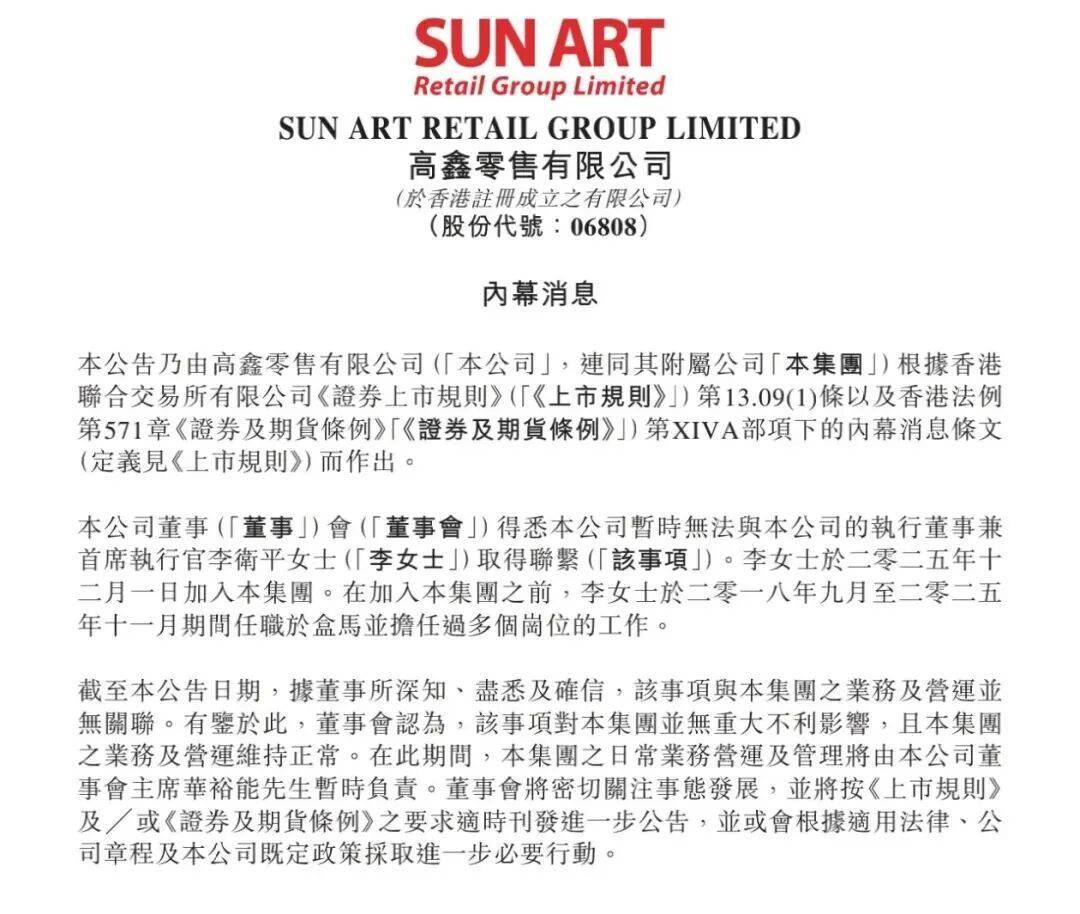
实际上,此前就有消息称,李卫平被警方带走协助调查,上周五开始已未出现在公司。不过,昨日,高鑫零售方面向媒体回应表示:"假的, 在报警了",并称李卫平正在上班。 不过,仅仅一天过后,高鑫零售的回应就被自己的公告"光速打脸"了。 2月4日早间,大润发母公司高鑫零售在港交所发布公告称,公司暂时与CEO李卫平无法取得联系。这也意味着这位刚刚入职仅两个月的上市公 司CEO"失联"了。 根据公告披露的简历,李卫平,47岁,是一位在零售行业积累了逾20年经验的老将,在成为高鑫零售CEO之前,于2018年9月至2025年11月, 一直任职于盒马,曾任盒马华北北京大区总经理、盒马鲜生业态首席执行官及盒马首席商品官,离任前任职于盒马总裁办。 而在更早之前的2007年6月至2018年8月,李卫平一直任职于乐天超市有限公司,曾担任其法定代表人及乐天华北区总经理。 来源:凤凰新闻、智通财经 李卫平 ...

零售巨头确认:女CEO失联,上任仅2个月,年薪336万元
Sou Hu Cai Jing· 2026-02-04 08:15
Group 1 - The company board believes that the recent matter is unrelated to the group's business and operations, and thus does not have a significant adverse impact on the group [2] - The daily business operations and management will be temporarily overseen by the chairman, Hua Yuning [2] Group 2 - Li Weiping has been appointed as the CEO of the company, succeeding Shen Hui, who resigned due to family reasons [4] - Li Weiping has a fixed annual salary of 3.36 million yuan and will receive annual management bonuses [4] - He has 26 years of experience in the retail industry and previously served as the Chief Merchandising Officer at Hema [4] Group 3 - The company operates under the brands "RT-Mart," "RT-Mart Super," and "M Membership Store," managing hypermarkets, medium-sized supermarkets, and membership stores [6] - As of September 30, 2025, the company has 462 hypermarkets, 32 medium-sized supermarkets, and 7 membership stores across 205 cities in 29 provinces and regions, with a total building area of approximately 13.4 million square meters [6]