
服务器

Search documents
联想集团(00992.HK)季报点评:3Q25业绩超预期 AIPC加速渗透
Ge Long Hui· 2025-11-23 05:02
Core Insights - The company reported a revenue growth of 14.6% year-on-year, reaching $20.45 billion, exceeding Bloomberg's expectations by 1.7% [1] - The adjusted net profit margin increased to 2.5%, surpassing Bloomberg's forecast by 0.3% [1] Financial Performance - Revenue from the IDG segment was $15.11 billion, exceeding Bloomberg's expectations by 3.7%, with a year-on-year growth of 11.8% [1] - The ISG segment generated $4.09 billion in revenue, which was below Bloomberg's expectations by 3.9%, but still showed a year-on-year increase of 23.7% [1] - The SSG segment achieved a record revenue of $2.56 billion, exceeding Bloomberg's expectations by 3.2%, with a year-on-year growth of 18.1% [1] Profitability Metrics - The gross margin was reported at 15.4%, slightly lower than Bloomberg's expectation by 0.06 percentage points [1] - The operating profit margin for the IDG segment was 7.3%, in line with expectations, while the SSG segment reported an operating profit margin of 22.3%, exceeding expectations by 3.1 percentage points [1] Future Outlook - The company anticipates adjusted net profit growth of 16.9%, 9.9%, and 13.3% for FY25/26 to FY27/28, translating to $1.68 billion, $1.85 billion, and $2.10 billion respectively [1] - The stock price is projected to have a PE ratio of 9.2X, 8.4X, and 7.4X for FY25/26 to FY27/28 [1]

全球AI争霸背后的电力较量:能源焦虑与联想液冷的爆发式增长
Zhi Tong Cai Jing· 2025-11-21 05:47
Group 1: AI and Energy Demand - The AI competition has shifted from chip supply to power supply, with significant implications for data center investments, projected to reach $3 trillion globally [1] - AI's energy consumption is rapidly increasing, with the energy demand for AI inference workloads expected to reach petawatt-hours by 2026, potentially overwhelming power grids [2][3] - The cost of electricity for data centers is substantial, with a 1 GW data center potentially incurring annual electricity costs of $700 million to $876 million [3] Group 2: Energy Strategies of Tech Giants - Tech companies are increasingly viewing energy as a survival necessity, with energy efficiency improvements translating to significant cost savings [4] - Major tech firms are adopting aggressive strategies, such as building their own power plants to ensure energy supply for their data centers [5][6] - The "Stargate" project, involving OpenAI, SoftBank, and Oracle, aims to invest $500 billion in constructing multiple giant data centers globally [6] Group 3: China's Energy Strategy - China is leveraging its clean energy advantages and policy guidance to meet AI computing power demands, with a massive $1.2 trillion power project expected to fulfill 75% of the national AI computing needs [7] Group 4: Cooling Technologies - AI data centers face a cooling crisis, with cooling energy consumption accounting for approximately 40% of total power demand [9] - Liquid cooling technology is becoming essential for AI data centers, with its ability to handle higher heat densities compared to traditional air cooling methods [11] - The global data center cooling market is projected to grow from $18.78 billion in 2025 to $42.48 billion by 2032, with a CAGR of 12.4% [11] Group 5: Lenovo's Position in Liquid Cooling - Lenovo has established itself as a key player in the liquid cooling market, with a 154% year-on-year revenue growth in its liquid cooling technology [13] - The company’s liquid cooling solutions have demonstrated significant energy efficiency, achieving a PUE value below 1.1 [13] - Lenovo's liquid cooling systems have been deployed in over 80,000 units globally, showcasing its competitive edge and market recognition [14] Group 6: Future Outlook - The global AI boom is transforming energy infrastructure into a high-growth asset class, with liquid cooling technology becoming a critical solution for energy efficiency [15] - Companies like Lenovo are positioned to benefit from the increasing demand for efficient cooling solutions in the AI sector [15]
联想集团(00992):发挥供应链优势应对存储周期影响
HTSC· 2025-11-21 02:11
Investment Rating - The report maintains a "Buy" rating for the company, Lenovo, with a target price adjusted to HKD 14.00 from the previous HKD 16.00, reflecting a 12.5% decrease [5][7]. Core Insights - Lenovo reported a revenue of USD 20.45 billion for 2QFY26, representing a year-over-year increase of 14.6%, surpassing Bloomberg's consensus estimate by 1.7%. The Non-HKFRS net profit attributable to shareholders was USD 512 million, up 25.2% year-over-year, exceeding the company's prior guidance by approximately 19% [1][5]. - The company benefits from a strong position in the global PC market, holding the largest market share and demonstrating robust supply chain management capabilities, which enhances its resilience against industry cycles [1][2]. - The AI-related business has become a core growth driver, with its revenue contribution reaching 30% and a year-over-year increase of 13 percentage points [1][5]. Summary by Sections IDG (Intelligent Devices Group) - IDG's revenue increased by 11.8% year-over-year, with an operating profit margin of 60%. The global PC market share rose by 1.8 percentage points to 25.6%, marking a record high [2]. - Driven by mixed AI demand, PC revenue grew by 17% year-over-year, with AI PC penetration increasing by 16 percentage points to 33% of total shipments [2]. ISG (Infrastructure Solutions Group) - ISG's revenue grew by 23.7% year-over-year, primarily due to strong demand for cloud infrastructure and enterprise solutions. The AI server business recorded high double-digit revenue growth [3]. - The Neptune liquid cooling technology saw a revenue increase of 154% year-over-year, reinforcing the company's leadership in energy-efficient AI infrastructure [3]. SSG (Solutions and Services Group) - SSG achieved an 18.3% year-over-year revenue growth, maintaining double-digit growth for 18 consecutive quarters, with an operating profit margin exceeding 22% [4]. - The project and solution services, along with operational services, accounted for 60% of SSG's total revenue, indicating a stable growth trajectory [4]. Financial Projections - The report projects a slight decrease in Non-HKFRS net profit estimates for FY26, FY27, and FY28 by 1.8%, 1.7%, and 1.7% respectively, with expected profits of USD 1.66 billion, USD 1.85 billion, and USD 2.08 billion [5][10]. - The expected Non-HKFRS EPS for FY26, FY27, and FY28 is projected to be USD 0.12, USD 0.14, and USD 0.15 respectively, reflecting growth rates of 15.5%, 11.4%, and 12.4% [5][10].
今晚9:30,美国重要数据发布;英伟达涨超5%,第三季度净利润319亿美元;“新债王”冈拉克:黄金是真正的避难所【美股盘前】
Mei Ri Jing Ji Xin Wen· 2025-11-20 11:38
Market Overview - Major U.S. stock index futures are up, with Dow futures rising by 0.44%, S&P 500 futures increasing by 1.06%, and Nasdaq futures gaining 1.41% [1] Technology Sector - Star tech stocks are experiencing pre-market gains, with Tesla and Google up over 2%, while Meta, Amazon, and Microsoft are up by 1% [2] - Nvidia's stock has risen by 5.42%, reporting a record revenue of $57 billion for Q3 of fiscal year 2026, exceeding analyst expectations by over 3%. Revenue growth accelerated to 62% year-over-year, with net profit increasing by 65% to approximately $31.9 billion [3] - AMD shares are up by 5.19% following the announcement of a joint venture with Saudi AI company Humain to develop AI infrastructure in Saudi Arabia, aiming for a capacity of up to 1 GW by 2030 [3] Hardware Developments - Supermicro has launched a new air-cooled AI server featuring AMD Instinct MI355X GPU, leading to a stock increase of 5.87% [5] Nuclear Energy Sector - U.S. nuclear stocks are seeing pre-market gains, with Oklo up over 5% and Nano Nuclear up over 6% [4] Cryptocurrency Market - Kraken, a major cryptocurrency exchange, has reportedly submitted a confidential IPO application to the SEC, with plans to go public in the first quarter of next year [4] Semiconductor Industry - UBS has raised Micron Technology's price target from $245 to $275, maintaining a buy rating due to ongoing memory supply constraints expected to last until the end of 2026. Micron's revenue has grown by 48.85% over the past twelve months, with the stock up by 2.97% [4]






应对存储芯片涨价潮!联想杨元庆:已签署协议锁定长期供应
第一财经· 2025-11-20 05:44
Core Viewpoint - The article discusses Lenovo's strategies and outlook in response to challenges in the tech industry, particularly regarding AI and component shortages, emphasizing that while there may be short-term pressures, the overall direction of AI development is positive and not a bubble [3][6]. Group 1: AI and Market Dynamics - Lenovo's chairman, Yang Yuanqing, believes that the current AI development phase is not a bubble, as it is entering a stage of widespread application and infrastructure investment, similar to the internet boom [3][6]. - The demand for components such as memory and solid-state drives is experiencing significant growth, with price increases expected to persist throughout 2026 [3][6]. Group 2: Supply Chain Management - Lenovo is one of the largest buyers of components in the industry, maintaining close relationships with suppliers and securing optimal contracts to ensure supply stability for the upcoming year [4][5]. - The company is cautious about user demand growth exceeding forecasts, which could impact pricing strategies [6]. Group 3: Financial Performance - For the second fiscal quarter ending September 30, 2025, Lenovo reported a revenue increase of 15% year-on-year to 146.4 billion RMB, achieving a historical high for the quarter, with adjusted net profit rising 25% to 3.66 billion RMB [6][7]. - AI-related business revenue now accounts for 30% of total revenue, up 13 percentage points year-on-year, driven by AI devices, servers, and solutions [6][7]. Group 4: Business Segments - The IDG smart device segment generated 108.1 billion RMB, a 12% increase year-on-year, with AI terminal devices making up 36% of IDG's revenue, a nearly 17 percentage point increase [7]. - The ISG infrastructure solutions segment saw revenue of approximately 29.3 billion RMB, a 24% year-on-year increase, with AI server revenue experiencing high double-digit growth [7]. - Lenovo plans to launch a personal super-intelligent device globally in January, integrating various wearable and environmental sensing devices for enhanced user interaction [7].
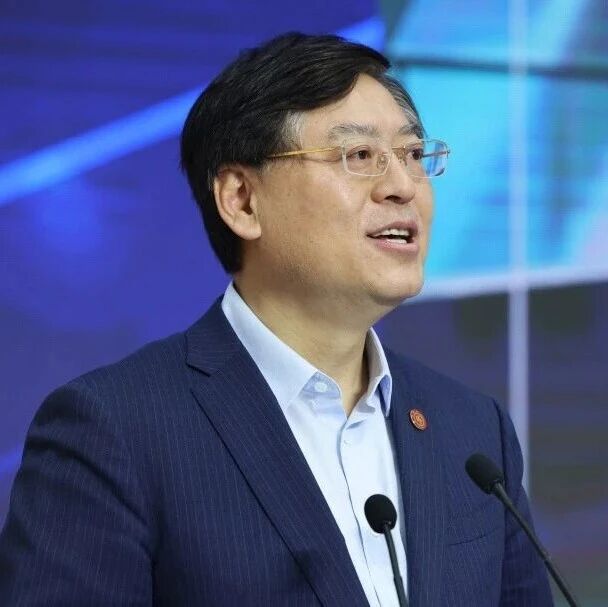
刚被机构“看空”,千亿巨头公布中期业绩:全部两位数增长
2 1 Shi Ji Jing Ji Bao Dao· 2025-11-20 05:26
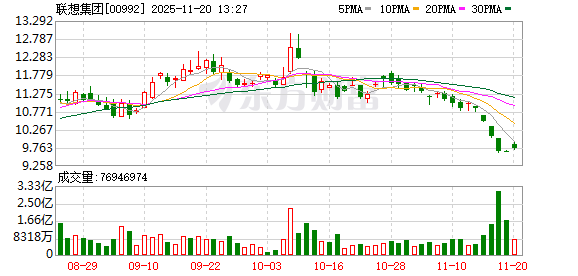
Core Insights - Lenovo Group reported a 15% year-on-year revenue growth to 146.4 billion RMB for the second fiscal quarter of 2025/26, achieving a historical high for the quarter [2] - Adjusted net profit increased by 25% year-on-year, reaching 3.66 billion RMB [2] - The company experienced double-digit revenue growth across all business groups and regional markets [2] Business Segment Performance - The Intelligent Devices Group (IDG) generated revenue of 108.1 billion RMB, a 12% year-on-year increase, with personal computer market share exceeding 25% for the first time [2] - The Infrastructure Solutions Group (ISG) reported revenue of approximately 29.3 billion RMB, up 24% year-on-year, with significant growth in AI infrastructure revenue [2] - The Solutions and Services Group (SSG) achieved nearly 20% year-on-year revenue growth, marking the 18th consecutive quarter of double-digit growth [2] AI Business Growth - AI-related business revenue now accounts for 30% of total revenue, a 13 percentage point increase year-on-year [3] - Lenovo's AI PCs hold a 31.1% share in the Windows AI PC market, maintaining the global lead [3] - AI terminal device revenue has risen to 36% of IDG's overall revenue, a 17 percentage point increase year-on-year [3] Future Innovations - Lenovo plans to launch a personal super-intelligent agent at the Innovation Technology Conference in January 2026, aimed at enhancing user experience through perception collaboration and habit learning [3] Market Outlook and Analyst Ratings - Nomura Orient International Securities downgraded Lenovo's rating to neutral and reduced the target price to 11 HKD, citing uncertainties in costs and demand [3] - Estimated storage costs for servers, PCs, and smartphones are expected to rise significantly in the fourth quarter of 2025, with potential further increases in the first quarter of 2026 [4] - Despite challenges, Nomura maintains a relatively optimistic view on Lenovo's performance in the commercial market, which may outperform the overall PC market [4] Stock Performance - As of the latest trading session, Lenovo's stock price was 9.73 HKD per share, reflecting a 1.04% increase, with a total market capitalization of 120.7 billion HKD [4]
“我们的征程是星辰大海” 豫企出海记
He Nan Ri Bao· 2025-11-17 23:27
Core Viewpoint - The article highlights the active international expansion of Chinese companies, particularly from Henan province, showcasing their efforts in embracing globalization and enhancing their global presence through various strategies and innovations [7][11][18]. Group 1: Company Expansion Stories - Thinking of international markets, companies like SiNian Foods have successfully entered overseas markets, with their products now available in 149 Sam's Club locations across 15 states in the U.S. by 2025 [8][9]. - The beverage brand Mixue has opened over 53,000 stores globally, with more than 4,700 located overseas, significantly impacting the global beverage market [9]. - Weihu Group has expanded its international footprint, exporting products to over 170 countries and regions, with a focus on internationalization, digitalization, and green development [9][10]. Group 2: Economic Trends and Data - In the first ten months of the year, Henan province exported machinery and electrical products worth 317.23 billion yuan, a 28.6% increase, accounting for 65% of the province's total exports [11]. - The export of "new three types" products reached 23.35 billion yuan, with electric vehicle exports alone growing by 254.4% [11]. - The number of companies in Henan with import and export achievements increased by 3,600 from 2020, with a target of adding over 1,000 more in the current year [17]. Group 3: Strategic Developments - Companies are increasingly focusing on supply chain management to support their overseas operations, as seen with Mixue establishing localized warehousing and distribution networks in four countries [12]. - The shift from merely exporting products to exporting entire ecosystems, such as the complete set of equipment for tunnel construction, marks a significant evolution in export strategies [12]. - The emphasis on strategic planning, brand empowerment, and compliance reflects the growing strength and scale of Henan enterprises in the global market [18].


AI算力与模型应用月报:计算机专题报告:超节点渐成共识,产业链成长动能明确-20251117
Guohai Securities· 2025-11-17 11:35
Investment Rating - The report maintains a "Recommended" rating for the computer industry [1] Core Insights - The report highlights the increasing consensus on supernodes as a foundational infrastructure for AI, driven by significant capital expenditures from major cloud service providers (CSPs) and advancements in GPU/ASIC technologies [5][8] - OpenAI has secured substantial power agreements totaling over $1 trillion, indicating a robust demand for AI computing power [5][14] - The report emphasizes the growth potential in various segments including servers, liquid cooling, power supply, and storage, with clear growth momentum identified [7][8] Summary by Sections Demand Side - CSPs are raising their capital expenditure forecasts, with Google increasing its 2025 capex to $91-93 billion, Meta to $70-72 billion, and Amazon to $125 billion, primarily for AI infrastructure [5][29] - OpenAI has signed significant power agreements with NVIDIA, AMD, and Broadcom, totaling 26GW and over $1.1 trillion in value [5][15] - Sovereign AI investments are projected to reach $1 trillion over the next five years, with major projects in the US, EU, and Saudi Arabia [5][25] Supply Side - The report notes the continuous iteration of chips, with supernodes becoming a consensus in AI infrastructure, as evidenced by new product launches from various manufacturers [34][5] - NVIDIA's upcoming GPU architectures are expected to enhance computational capabilities significantly, with the Blackwell Ultra and Rubin architectures set to launch in the coming years [36][39] - Major companies like AMD and Huawei are also advancing their AI chip offerings, with AMD's Helios solution and Huawei's Atlas series expected to drive further innovation [41][44] Growth Segments - The server market is experiencing substantial growth, with companies like Hon Hai and Wistron achieving significant increases in AI server shipments [7] - Liquid cooling technology is becoming essential in AI data centers, with companies reporting high double-digit revenue growth [7] - The storage chip industry is entering a period of severe shortage, driving up DRAM prices and increasing demand from CSPs [7] Multi-modal and Application Ecosystem - The report outlines the rapid evolution of AI models, with major updates from OpenAI and Alibaba, and a significant increase in token usage across platforms [7][8] - OpenAI's new applications and models are enhancing its ecosystem, with a notable increase in daily token usage [7][8]



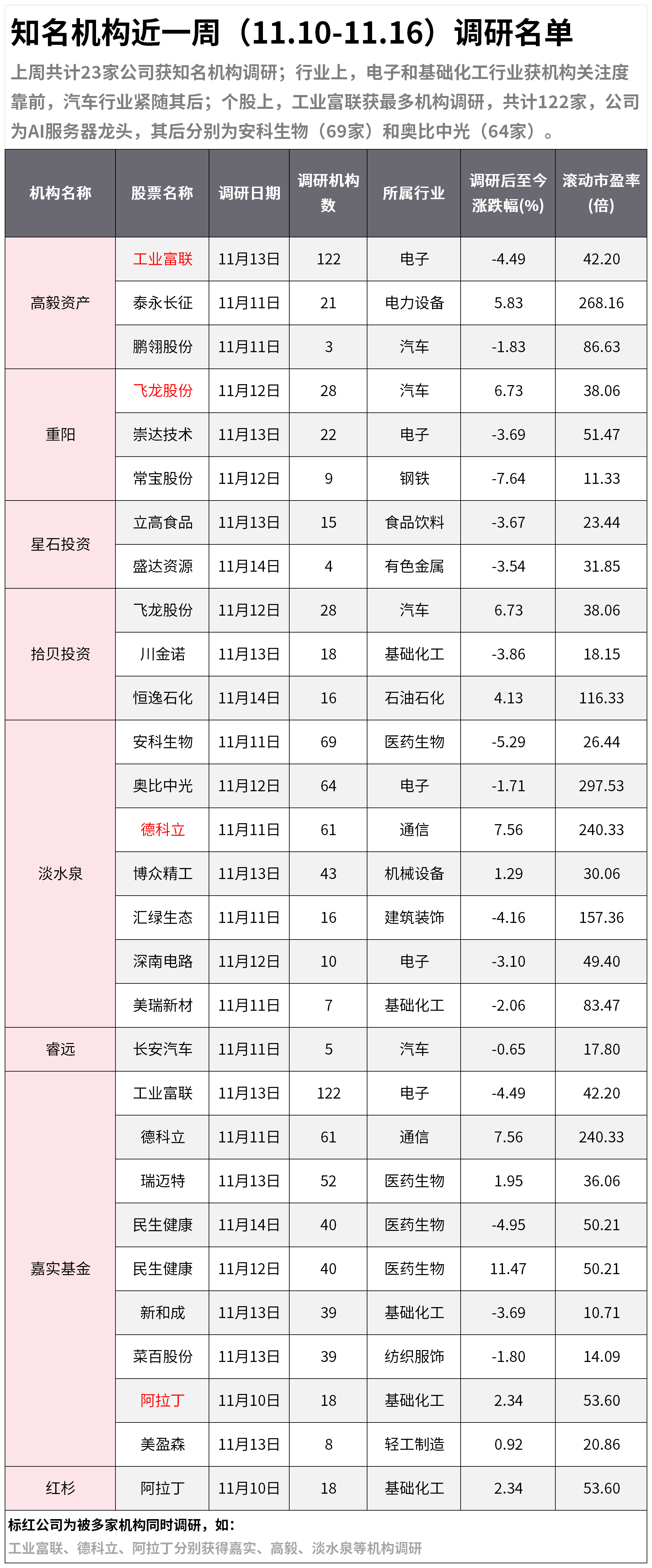
知名机构近一周(11.10-11.6)调研名单:机构扎堆这只AI服务器龙头
Xuan Gu Bao· 2025-11-17 08:45
Group 1 - A total of 23 companies were investigated by well-known institutions in the past week, with the technology sector leading the way, followed by the automotive industry [1] - Industrial Fulian was the most investigated stock, receiving 122 inquiries, indicating strong interest from investors [1][3] - Other notable companies included Anke Bio (69 inquiries), Feilong Co. (28 inquiries), and Chang'an Automobile (5 inquiries), reflecting varied interest across different sectors [2][3] Group 2 - High Yi Asset and Star Stone Investment were among the institutions conducting the most investigations, with High Yi Asset focusing on Industrial Fulian [1][2] - The investigation dates ranged from November 10 to November 14, highlighting a concentrated period of interest in these companies [1][2] - The data suggests a growing trend in institutional interest in specific sectors, particularly technology and automotive, which may present investment opportunities [1][2]
中科曙光(603019):IT基础设施领军,所处服务器、存储赛道保持高景气
Haitong Securities International· 2025-11-14 08:36
Investment Rating - The report maintains an "Outperform" rating for the company [2][53]. Core Insights - The company is a leader in IT infrastructure, focusing on high-performance servers and actively promoting a domestic ecosystem [5][54]. - The merger with Hygon is expected to provide significant growth opportunities, with projected EPS of RMB 1.71, 2.16, and 2.62 for 2025-2027 [5][12]. - The global server market is anticipated to reach USD 366 billion in 2025, with a year-on-year growth of 44.6%, indicating strong demand for servers [55][26]. Financial Summary - The total revenue is projected to be RMB 14,353 million in 2023, with a forecasted growth to RMB 20,522 million by 2027, reflecting a compound annual growth rate (CAGR) of 15.8% [4]. - Net profit attributable to the parent company is expected to grow from RMB 1,836 million in 2023 to RMB 3,830 million in 2027, with a CAGR of 21.3% [4]. - The company's earnings per share (EPS) is projected to increase from RMB 1.25 in 2023 to RMB 2.62 in 2027 [4]. Market Position and Growth - The company has a strong presence in high-end computing, storage, liquid cooling, security, and data centers, with significant market share [54][16]. - The Chinese semiconductor memory market is expected to grow from RMB 394.3 billion in 2023 to RMB 458 billion in 2025, indicating a stable growth trajectory [56][37]. - The company is actively developing independent software and hardware to reduce reliance on external supply chains, enhancing product performance and stability [55][34]. Product and Service Development - The company offers a comprehensive range of storage products, including ParaStor distributed storage and FlashNexus centralized flash storage, which are expected to benefit from the growing market [56][44]. - Recent innovations include AI workstations and liquid cooling storage solutions, which enhance performance and energy efficiency [22][44].
