
石油石化

Search documents
节后资金无需过虑
GOLDEN SUN SECURITIES· 2026-02-24 01:30
Group 1: Macro Insights - The overall sentiment around the Spring Festival is mixed, with positive aspects outweighing the negative; the macro environment remains favorable for the market [3] - Key observations include a decline in new home sales and a drop in movie ticket sales during the holiday, while travel and tourism showed strong activity [3] - The economic performance is still under observation, with credit data showing mixed results and social financing needing further assessment [3] Group 2: Fixed Income Market - The bond market is expected to continue its upward trend post-Spring Festival, supported by a stable demand for bonds from banks and other institutional investors [12][15] - The liquidity environment is anticipated to remain loose, with the central bank likely to smooth out market shocks through rollovers of maturing repos [13][14] - The overall bond market is expected to stabilize due to low financing demand and a favorable trading structure [15][16] Group 3: Transportation Sector - High dividend highway companies are becoming attractive for investment, with dividend yields rising to 4-6% [17] - The growth potential in the transportation sector is driven by infrastructure expansion and investment opportunities in mature operational assets [17] - The revision of the "Highway Management Regulations" is expected to enhance long-term returns for the industry [17] Group 4: Food and Beverage Sector - Baoli Food has transitioned from single product offerings to a comprehensive empowerment model, focusing on compound seasonings and light cooking solutions [19] - The company has shown steady revenue growth, with a projected CAGR of 14.09% from 2022 to 2024, and a net profit of 1.92 billion yuan in Q1-Q3 2025 [19][20] - Investment recommendations include focusing on high-dividend and growth-oriented companies within the food and beverage sector, particularly those with strong B-end customer relationships [32][20] Group 5: Coal Industry - Global energy prices are experiencing divergence, with crude oil prices rising significantly due to geopolitical tensions and supply concerns [29][30] - The increase in oil prices is driven by factors such as military actions in the Middle East and a reduction in U.S. oil inventories [30] - Investment suggestions include focusing on high-performing coal companies and those in niche markets [30]
地缘反复原油获得溢价,聚酯链关注节后pxn价差是否走强 | 投研报告
Sou Hu Cai Jing· 2026-02-24 01:16
回顾:春节前最后一周,申万一级行业指数表现中,石油石化指数表现一般,较上周上涨-0.82%。而中 信三级行业指数表现来看,工程服务在石油石化中表现最佳,涨幅1.51%。 原油:原油涨。美原油库存下降,汽油库存下降 聚酯:涤纶长丝价格涨。江浙织机涤纶长丝库存天数不同品种涨跌不一,织机开工率跌 以下为研究报告摘要: 投资要点 焦点:假期美伊局势不明朗,原油获得地缘溢价。PX、PTA供需今年边际好转预期。依据wind和隆众 资讯,PX(中国主港)-石脑油(日本)的价差经过调整后开始稳定在300美元/吨附近,价差节后可能 再度走强。 烯烃:样本PE现货价格跌,聚烯烃石化库存上涨 来源:中国能源网 标的: 中邮证券近日发布石化行业周报:PX、PTA供需今年边际好转预期。依据wind和隆众资讯,PX(中国 主港)-石脑油(日本)的价差经过调整后开始稳定在300美元/吨附近,价差节后可能再度走强。春节 前最后一周,申万一级行业指数表现中,石油石化指数表现一般,较上周上涨-0.82%。而中信三级行业 指数表现来看,工程服务在石油石化中表现最佳,涨幅1.51%。 炼化:若需求好转,优供给、淘汰落后产能有所进展,则利好中游炼化。 ...
地缘反复原油获得溢价,聚酯链关注节后pxn价差是否走强
Zhong Guo Neng Yuan Wang· 2026-02-24 01:05
中邮证券近日发布石化行业周报:PX、PTA供需今年边际好转预期。依据wind和隆众资讯,PX(中国主 港)-石脑油(日本)的价差经过调整后开始稳定在300美元/吨附近,价差节后可能再度走强。春节前最后 一周,申万一级行业指数表现中,石油石化指数表现一般,较上周上涨-0.82%。而中信三级行业指数表 现来看,工程服务在石油石化中表现最佳,涨幅1.51%。 回顾:春节前最后一周,申万一级行业指数表现中,石油石化指数表现一般,较上周上涨-0.82%。而中 信三级行业指数表现来看,工程服务在石油石化中表现最佳,涨幅1.51%。 原油:原油涨。美原油库存下降,汽油库存下降 聚酯:涤纶长丝价格涨。江浙织机涤纶长丝库存天数不同品种涨跌不一,织机开工率跌 烯烃:样本PE现货价格跌,聚烯烃石化库存上涨 以下为研究报告摘要: 投资要点 焦点:假期美伊局势不明朗,原油获得地缘溢价。PX、PTA供需今年边际好转预期。依据wind和隆众 资讯,PX(中国主港)-石脑油(日本)的价差经过调整后开始稳定在300美元/吨附近,价差节后可能再度走 强。 标的: 上游:地缘若未来再次给出原油溢价,则利好上游标的。 炼化:若需求好转,优供给、淘汰 ...
石化行业周报地缘反复原油获得溢价,聚酯链关注节后pxn价差是否走强
China Post Securities· 2026-02-24 00:35
证券研究报告 石化行业周报:地缘反复原油获得溢价,聚酯 链关注节后pxn价差是否走强 行业投资评级:强大于市|维持 中邮证券研究所石化团队 分析师:张津圣 1 1 发布时间:2026-02-23 投资要点 请参阅附注免责声明 2 ◼ 焦点:假期美伊局势不明朗,原油获得地缘溢价。PX、PTA供需今年边际好转预期。依据wind和隆众 资讯,PX(中国主港)-石脑油(日本)的价差经过调整后开始稳定在300美元/吨附近,价差节后可能 再度走强。 ◼ 回顾:春节前最后一周,申万一级行业指数表现中,石油石化指数表现一般,较上周上涨-0.82%。而中 信三级行业指数表现来看,工程服务在石油石化中表现最佳,涨幅1.51%。 ◼ 原油:原油涨。美原油库存下降,汽油库存下降 ◼ 聚酯:涤纶长丝价格涨。江浙织机涤纶长丝库存天数不同品种涨跌不一,织机开工率跌 ◼ 烯烃:样本PE现货价格跌,聚烯烃石化库存上涨 ◼ 标的: ➢ 上游:地缘若未来再次给出原油溢价,则利好上游标的。 ➢ 炼化:若需求好转,优供给、淘汰落后产能有所进展,则利好中游炼化。 ➢ 长丝:关注PTA反内卷进展和PX利润修复,若顺利则利好涤纶长丝。 ◼ 风险提示:油价剧 ...
积极因素提振A股开市信心 两大主线配置价值获看好
Zhong Guo Zheng Quan Bao· 2026-02-23 20:18
Group 1 - The A-share market is expected to continue its spring rally in 2026, driven by policy guidance and industry trends, with a focus on technology and resource sectors [1][3] - The market sentiment is currently strong, with limited adjustment pressure, and the potential for a rebound in market indices post-Spring Festival [2][3] - The AI sector is highlighted as a key investment opportunity, with expectations for significant advancements and commercialization in 2026 [3][4] Group 2 - Resource sectors, including chemicals and precious metals, are gaining attention from institutions, particularly due to rising international prices for gold and oil [4][5] - The geopolitical situation may provide a short-term boost to oil prices, while precious metals are seen as a safe haven for investors [5][6] - The upcoming peak season for industrial production and construction in March and April is expected to validate price increases and influence market trends [6]
马年收红包!关注黑马集中营!
Sou Hu Cai Jing· 2026-02-23 14:01
Group 1 - The article highlights four major signals that are expected to support the market as it opens for the Year of the Horse, including continuous policy support, strong consumer recovery, clear industry trends, and favorable external market conditions [4][6][9] - Policy measures are focused on equipment upgrades, consumer goods exchange programs, and significant support for new infrastructure, digital economy, and renewable energy sectors, which are expected to boost economic recovery [4] - Consumer spending has shown remarkable resilience, with record box office revenues during the Spring Festival, a doubling in travel bookings, and a nearly 500% increase in duty-free shopping in Hainan, alongside over 20% growth in dining and accommodation transactions [4] Group 2 - The article notes that the global market has been performing well, with significant gains in indices such as the Hang Seng Index and the Nikkei 225, which rose over 4%, creating a positive environment for the A-share market [6][7] - Commodity markets have also seen increases, with LME copper up 4%, London silver up 3%, and Brent crude oil rising 2.3%, providing support for cyclical sectors [7] Group 3 - The investment strategy for the Year of the Horse emphasizes a cautious approach, focusing on structural opportunities rather than broad market gains, with a prediction of a stable opening and active sector performance [9][10] - Four main investment themes are identified: the AI industry chain, semiconductors and advanced manufacturing, consumer recovery sectors, and cyclical resources, with AI being the strongest focus due to its recent performance [10][11][12] - The article advises against high-risk strategies, recommending a focus on core stocks within the identified themes and careful monitoring of key indicators such as trading volume and foreign capital inflows [13][14]


中信建投:节后A股有望开启新一轮上行
Jin Rong Jie· 2026-02-23 13:48
Core Viewpoint - The report from CITIC Securities indicates that global stock markets showed strong performance during the Spring Festival, with no significant risk events, and current market sentiment remains high, suggesting that A-shares are likely to enter a new upward phase post-holiday [1] Industry Allocation - The industry allocation continues to focus on a dual mainline strategy of "Technology + Resource Products" [1] - The technology mainline centers on AI, humanoid robots (core stocks), new energy, and innovative pharmaceuticals [1] - The resource products mainline focuses on precious metals (core stocks), oil and petrochemicals, and basic chemicals (core stocks) [1] Key Sectors to Watch - Key sectors to pay attention to include: - Semiconductors - AI (optical communication, liquid cooling, electronic fabrics, high-end copper foil, etc.) - Machinery - Non-ferrous metals - Oil and petrochemicals - Basic chemicals - Power equipment (energy storage, ultra-high voltage, photovoltaics, solid-state batteries, etc.) - Innovative pharmaceuticals [1]

港股市场速览:能源与材料估值拉升,盈利预测平稳前滚
Guoxin Securities· 2026-02-23 10:45
证券研究报告 | 2026年02月22日 2026年02月21日 港股市场速览 优于大市 能源与材料估值拉升,盈利预测平稳前滚 股价表现:行业分化较大,科技显著回撤 本周,恒生指数-0.6%,恒生综指-0.7%。风格方面,中盘(恒生中型股+0.6%) >小盘(恒生小型股+0.3%)>大盘(恒生大型股-1.0%)。 主要概念指数走势分化。上涨的主要有恒生生物科技(+1.5%);下跌的主 要有恒生互联网(-2.8%)。 国信海外选股策略表现分化。上涨的主要有 ROE 策略进攻型(+1.0%);下 跌的主要有 ROE 策略防御型(-0.5%)。 18 个行业上涨,12 个行业下跌。上涨的主要有:石油石化(+5.4%)、有色 金属(+2.8%)、综合(+1.9%)、建筑(+1.9%)、医药(+1.6%);下跌的 主要有:商贸零售(-3.7%)、电子(-2.4%)、传媒(-2.2%)、国防军工 (-2.1%)、计算机(-2.1%)。 估值水平:整体水平下降,能源与材料提升 本周,恒生指数估值(动态预期 12 个月正数市盈率,后同)-0.9%至 11.4x; 恒生综指估值-0.7%至 11.5x。 国信海外选股策略估值普 ...
中国银河策略:地缘风险叠加关税风险,港股节后行情怎么看?
Jin Rong Jie· 2026-02-23 07:57
Market Performance - During the week from February 16 to February 20, the Hong Kong stock market experienced fluctuations with the Hang Seng Index declining by 0.58% to 26,413.25 points, the Hang Seng Tech Index falling by 2.78% to 511.50 points, and the Hang Seng China Enterprises Index decreasing by 0.81% to 8,959.56 points [1][6][30] - Among the primary sectors, 8 sectors saw gains while 3 sectors experienced losses. The energy, materials, and industrial sectors had the highest increases, rising by 3.65%, 2.27%, and 1.03% respectively. Conversely, the consumer discretionary, consumer staples, and communication services sectors faced the largest declines, dropping by 1.86%, 1.50%, and 0.13% respectively [1][7][30] Market Liquidity - Due to the Spring Festival holiday, the Hong Kong stock market only operated for half a day on February 16, with a trading volume of HKD 850.56 billion. On February 20, the trading volume was HKD 1,654.61 billion, which is lower than the previous week's average daily trading volume of HKD 2,406.43 billion. The short-selling amount was HKD 237.27 billion, accounting for 14.43%, significantly higher than the previous week's average of 12.56% [2][13][15] Valuation and Risk Premium - As of February 20, 2026, the PE and PB ratios of the Hang Seng Index were 12.09 times and 1.23 times, respectively, placing them at the 79% and 55% percentiles since 2010. The Hang Seng Tech Index had PE and PB ratios of 21.51 times and 2.83 times, respectively, at the 18% and 49% percentiles since 2010 [3][17][22] - The risk premium of the Hang Seng Index was calculated at 4.19%, which is at the 5% percentile since 2010, while the risk premium based on the 10-year Chinese government bond yield was 6.48%, at the 42% percentile since 2010 [3][19][21] Investment Outlook - The geopolitical risks in the Middle East are rising, which may lead to increased volatility in energy and precious metals sectors. The U.S. is exerting pressure on Iran, with potential military actions being considered [4][9][30] - The consumer sector is currently valued relatively low, and with increasing consumer promotion policies, there is potential for growth in this sector [4][30] - The technology sector remains a long-term investment focus, with reduced valuation pressure following recent corrections, and is expected to rebound due to accelerated AI model updates and applications [4][30]

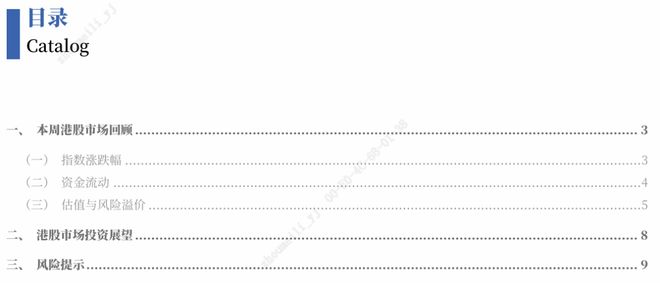
地缘风险叠加关税风险,港股节后行情怎么看?
Zhong Guo Yin He Zheng Quan· 2026-02-23 05:45
Investment Rating - The report does not explicitly state an investment rating for the industry [1]. Core Insights - Geopolitical risks and tariff risks are impacting the Hong Kong stock market, with a focus on how these factors will influence market performance post-holiday [1]. - The report highlights that the U.S. GDP growth rate for Q4 2025 was 1.4%, significantly below the expected 2.5%, indicating a slowdown in the U.S. economy [2][44]. - The report suggests that the recent increase in U.S. tariffs from 10% to 15% on global goods may lead to heightened investor risk aversion, benefiting sectors like precious metals and energy [2][46]. - The consumption sector is currently at a relatively low valuation, with potential for growth as consumer policies increase [2][46]. - The technology sector remains a long-term investment focus, with reduced valuation pressure and potential for rebound due to advancements in AI [2][46]. Market Review - During the week of February 16 to February 20, 2026, the Hong Kong stock market saw declines, with the Hang Seng Index down 0.58% to 26,413.25 points, the Hang Seng Tech Index down 2.78% to 511.50 points, and the Hang Seng China Enterprises Index down 0.81% to 8,959.56 points [4][6]. - Among the primary sectors, 8 sectors increased while 3 sectors decreased, with energy, materials, and industrial sectors showing the highest gains [6][14]. - The trading volume was affected by the Spring Festival, with a total turnover of HKD 850.56 billion on February 16 and HKD 1,654.61 billion on February 20, lower than the previous week's average [14][18]. Valuation and Risk Premium - As of February 20, 2026, the PE and PB ratios for the Hang Seng Index were 12.09 and 1.23, respectively, placing them at the 79% and 55% percentiles since 2010 [22][29]. - The risk premium for the Hang Seng Index was calculated at 4.19%, indicating a low-risk environment compared to historical data [29][31]. - The report notes that the dividend yields for the energy and communication services sectors are above 5%, suggesting stable income opportunities for investors [36][41]. Investment Outlook - The report recommends focusing on sectors that may benefit from geopolitical tensions and tariff adjustments, particularly precious metals and energy [46]. - The consumption sector is expected to gain momentum as consumer policies are implemented, while the technology sector is anticipated to rebound due to advancements in AI [46].