
软饮料

Search documents
研报掘金|中金:上调农夫山泉目标价至61港元 预期去年下半年收入增长提速
Jin Rong Jie· 2026-01-15 03:28
Group 1 - The core viewpoint of the report is that Nongfu Spring is expected to achieve a 20% year-on-year revenue growth and a 25.8% year-on-year net profit growth for the previous year, with better-than-expected profit growth in the second half of the year [1] - In the second half of the year, revenue is projected to grow by 24.7% year-on-year, while net profit is expected to increase by 30% year-on-year, indicating strong performance [1] - The company is likely to continue focusing on tea and water categories this year, with the "Oriental Leaf" brand expected to maintain double-digit growth through consumer engagement strategies [1] Group 2 - The packaging water business is showing a clear upward trend in market share, with consistent growth anticipated [1] - Juice and functional beverages are also expected to show ongoing positive performance, contributing to overall revenue growth [1] - The company launched iced tea products in the first half of last year, which received positive feedback and is expected to contribute to revenue increments [1] Group 3 - Due to the accelerated revenue growth in the second half of last year, the profit forecasts for Nongfu Spring for 2025 and 2026 have been raised by 2.5% and 2.8% to 15.3 billion and 17.3 billion yuan respectively, with a new profit estimate of 19.2 billion yuan for 2027 [1] - The target price has been increased by 13% to 61 HKD, maintaining an "outperforming the industry" rating [1]

国盛证券-2026食饮行业年度策略:消费者大时代
Sou Hu Cai Jing· 2026-01-15 03:22
Core Insights - The food and beverage industry is expected to see multi-dimensional improvements in 2026, following a year of stabilization in 2025, characterized by price pressures and structural differentiation [1][2]. Group 1: Industry Overview - The food and beverage sector (CITIC) experienced a cumulative decline of 4% in 2025, underperforming the CSI 300 by 20% [1][16]. - The liquor sector faced significant pressure, with an annual decline of 7%, while segments like health products, frozen foods, and beverages saw increases of 18%, 15%, and 12% respectively [1][16]. - The overall retail sales in China showed moderate growth, with a year-on-year increase of 4.0% from January to November 2025, and service consumption growth outpacing goods consumption [1][27]. Group 2: Liquor Industry Insights - The liquor industry is currently at a triple bottom, with supply clearing continuing into 2025, and leading companies focusing on stabilizing prices and sales [2][6]. - Demand has begun to recover, with improved sales expected during the Spring Festival, and strong demand for mid-range priced liquor brands [2][61]. - The product strategy includes a shift towards lower alcohol content and targeting younger consumers, with a focus on collaborative channel development [2][6]. Group 3: Beer and Beverage Sector - The beer sector is anticipated to benefit from a recovery in dining, with cost advantages expected to maintain stable gross margins in 2026 [2][6]. - The soft drink market is steadily expanding, with segments like functional beverages and bottled water showing strong performance, driven by leading brands leveraging their market position [2][6]. Group 4: Food Sector Developments - The food sector is focusing on recovery and growth, with a rebound in demand for restaurant supply chains and leading companies expected to show profit elasticity [3][6]. - The snack segment is being driven by retail transformation, with health-oriented products and new opportunities emerging [3][6]. - The dairy sector is nearing a turning point, with expectations for supply-demand improvements in the second half of 2026 [3][6]. Group 5: Consumer Trends - High-end consumption is showing signs of recovery, with luxury retail sales improving and experiential consumption rebounding [1][35]. - The trend towards health-conscious consumption is becoming more pronounced, with a shift towards lower sugar and simpler ingredient formulations across various food categories [3][45].





东鹏饮料通过港交所聆讯 华泰国际、摩根士丹利、瑞银为联席保荐人
Zheng Quan Shi Bao Wang· 2026-01-15 00:43
Core Viewpoint - Dongpeng Beverage is undergoing a listing hearing on the Hong Kong Stock Exchange, with Huatai International, Morgan Stanley, and UBS serving as joint sponsors [1] Company Summary - Dongpeng Beverage is the leading functional beverage company in China, with revenue growth ranking it among the top 20 listed soft drink companies globally [1] - The company has maintained its position as the number one player in the Chinese functional beverage market for four consecutive years since 2021, with market share increasing from 15.0% in 2021 to 26.3% in 2024 [1] - By retail revenue, Dongpeng Beverage is projected to be the second-largest functional beverage company in China in 2024, with a market share of 23% [1] - The company has established a comprehensive sales network covering over 4.3 million terminal sales points, achieving nearly 100% coverage of prefecture-level cities in China by September 30, 2025 [1] Industry Summary - The Chinese functional beverage market is the fastest-growing segment within the soft drink industry, with a compound annual growth rate (CAGR) of 8.3% from 2019 to 2024 [1] - The market size is expected to reach RMB 281 billion by 2029 based on retail revenue [1]

8点1氪:携程回应因涉嫌垄断行为被立案调查;茶颜悦色没喝就“消失”半杯,内部人士回应;老干妈回应“味道变了”
36氪· 2026-01-15 00:27
Group 1 - Ctrip is under investigation for alleged monopoly behavior by the State Administration for Market Regulation, but the company assures that all business operations are normal and it will cooperate with the investigation [3] - Ctrip aims to work with industry partners to build a sustainable market environment while continuing to provide quality services to users and partners [3] - The investigation is based on the Anti-Monopoly Law of the People's Republic of China, following preliminary checks by the market regulator [3] Group 2 - Coca-Cola has abandoned its plan to sell Costa Coffee due to unsatisfactory bids from private equity buyers, marking another setback for the company during its ownership of the struggling UK coffee chain [4] - In 2025, China's automotive industry is projected to achieve record production and sales, with production reaching 34.53 million vehicles and sales at 34.40 million, representing year-on-year growth of 10.4% and 9.4% respectively [8] - The new energy vehicle segment is expected to see over 16 million units sold, with domestic new car sales accounting for over 50% of the market [8] Group 3 - JD Logistics plans to offer a cash option to Debon shareholders worth approximately 3.797 billion yuan, as part of a proposal to withdraw Debon's shares from the Shanghai Stock Exchange [6] - Audi delivered approximately 1.62 million vehicles globally in 2025, a decrease of 2.9% compared to the previous year [9] - Citic Securities reported a net profit of 30.051 billion yuan for 2025, marking a year-on-year increase of 38.46% [26]
8点1氪丨携程回应因涉嫌垄断行为被立案调查;茶颜悦色没喝就“消失”半杯,内部人士回应;老干妈回应“味道变了”
3 6 Ke· 2026-01-15 00:06
Group 1 - Coca-Cola has abandoned the plan to sell Costa Coffee due to the private equity buyer's offer not meeting expectations, marking another setback for the company during its ownership of the struggling UK coffee chain [5] - In 2025, China's automotive industry is projected to produce and sell 34.53 million and 34.40 million vehicles respectively, representing year-on-year growth of 10.4% and 9.4%, maintaining its position as the world's largest automotive market for 17 consecutive years [6] - Ctrip has received a notification from the State Administration for Market Regulation regarding an investigation into alleged monopolistic behavior, and the company will cooperate fully with the regulatory authorities [1] Group 2 - JD Logistics plans to offer a cash option to Debon shareholders worth approximately RMB 3.797 billion as part of a proposal to withdraw Debon's shares from the Shanghai Stock Exchange [4] - Audi's global vehicle deliveries in 2025 are expected to be around 1.623 million units, a decrease of 2.9% compared to the previous year [8] - Baoneng Group's chairman has filed a complaint against local authorities regarding alleged illegal actions in a case involving Qoros Auto, claiming that the assets involved are significantly undervalued [9] Group 3 - Tesla has implemented new rules for its supercharging stations, including a more user-friendly fee structure for overstaying and an extended grace period for drivers [10] - Amazon plans to appeal a reduced antitrust fine in Italy, arguing that the accusations of market dominance are unfounded [10] - The U.S. government announced a 25% tariff on certain imported semiconductors and related products, effective from January 15 [18]


东鹏饮料(集团)股份有限公司关于刊发H股发行聆讯后资料集的公告
Shang Hai Zheng Quan Bao· 2026-01-14 18:19
Core Viewpoint - Dongpeng Beverage Group Co., Ltd. is in the process of applying for the issuance of H-shares and listing on the Hong Kong Stock Exchange, with the necessary documentation and updates submitted to relevant authorities [1][2][3]. Group 1: H-Share Issuance Process - The company submitted its application for H-share issuance to the Hong Kong Stock Exchange on April 3, 2025, and published the application materials on the same day [2]. - On October 9, 2025, the company updated its issuance application and financial data as required by the Hong Kong Stock Exchange [2]. - The China Securities Regulatory Commission issued a notice confirming the company's overseas issuance and listing on November 27, 2025 [2]. Group 2: Listing Hearing and Information Disclosure - The Hong Kong Stock Exchange Listing Committee held a hearing on December 4, 2025, to review the company's application for H-share issuance [3]. - The company published a post-hearing information package on the Hong Kong Stock Exchange website to provide information to the public and qualified investors [3]. - The company will not publish the post-hearing information package on domestic exchanges but provides links for domestic investors to access it [3]. Group 3: Board Meeting and Resolutions - The company's board of directors held its 19th meeting on January 14, 2026, with all 10 directors present [7]. - The board approved the global offering of H-shares, including public and international offerings, and authorized the necessary arrangements for the issuance and listing [8]. - The resolution received unanimous support from the board members, with no votes against or abstentions [9].
东鹏饮料通过港交所IPO聆讯
Xin Lang Cai Jing· 2026-01-14 10:48
Core Viewpoint - Dongpeng Beverage is the leading functional beverage company in China, with the fastest revenue growth among the top 20 listed soft drink companies globally [1] Group 1: Market Position - Dongpeng Beverage has ranked first in the Chinese functional beverage market by sales for four consecutive years since 2021, with market share increasing from 15.0% in 2021 to 26.3% in 2024 [1] - By retail value, Dongpeng Beverage is projected to be the second-largest functional beverage company in 2024, holding a market share of 23.0% [1] Group 2: Financial Performance - The company recorded revenues of 8.5 billion yuan, 11.26 billion yuan, 15.83 billion yuan, and 16.837 billion yuan for the years 2022, 2023, 2024, and the nine months ending September 30, 2025, respectively, with a compound annual growth rate of 36.5% [1] - As of December 31 for the years 2022, 2023, and 2024, and September 30, 2025, Dongpeng Beverage reported net assets of 5.064 billion yuan, 6.323 billion yuan, 7.691 billion yuan, and 8.801 billion yuan, respectively [1]
中金:2025年线下渠道表现整体承压 零食、饮料健康化趋势显著
Zhi Tong Cai Jing· 2026-01-14 07:41
Core Insights - The overall sales performance of offline channels in the food and beverage sector is under pressure for the period of January to December 2025, with notable differentiation in the soft drink industry across various segments [1] - Functional beverages and ready-to-drink juices are maintaining high single-digit growth, while the snack food category shows strong growth in konjac products and healthy snacks [1] Beverage Sector - Beer sales are under pressure with a year-on-year decline of 6.7% in sales for January to December 2025, although average prices continue to rise [2] - Ready-to-drink cocktails have seen a cumulative year-on-year sales decline of 9.9%, while the market share of the brand Rio remains stable [2] - The soft drink industry shows varied performance across segments, with functional beverages experiencing a year-on-year sales increase of 9.3% and ready-to-drink juices seeing an average price increase of 7.8% [2] Dairy Products - The demand for dairy products continues to face pressure, although there is a quarter-on-quarter improvement in Q4 2025 [2] - Leading dairy companies are performing relatively well in the low-temperature yogurt segment, which is positively impacting overall yogurt performance compared to the broader dairy market [2] Condiments and Snacks - Basic condiments prioritize price, with leading brands continuing to capture market share [3] - The performance of spicy snack foods shows significant differentiation, with konjac products and certain specialty items providing crucial support [3] - Healthy snacks are experiencing notable growth, while the nut and dried fruit category is under pressure due to the timing of the Spring Festival affecting December sales [3] - Sweet snacks are generally underperforming, with widespread year-on-year declines [3] Frozen Foods - Hot pot ingredients are showing a trend of volume growth with stable prices, while competition remains fierce in the frozen dumpling and tangyuan markets [3] - By December 2025, the frozen food sector enters a peak stocking phase, with hot pot ingredients, frozen prepared foods, and frozen snacks achieving year-on-year growth, while frozen dumplings and tangyuan continue to face pressure [3] Recommendations - Recommended stocks in the A-share market include Anjuke Food, Yanjinpuzi, New Dairy, Ximai Food, Yanjing Beer, Dongpeng Beverage, Yili Group, Qianhe Flavor, and Haitian Flavor [4] - Recommended stocks in the H-share market include Weilong, Gu Ming, Master Kong, Uni-President China, Nongfu Spring, China Resources Beer, Mengniu Dairy, and Qingdao Beer [4]



东鹏饮料预计2025年净利最高增38%至46亿,赴港IPO关键期敲定新董秘
Sou Hu Cai Jing· 2026-01-14 02:10
Core Viewpoint - Dongpeng Beverage is expected to achieve a net profit attributable to shareholders of the parent company between 4.34 billion and 4.59 billion yuan for the year 2025, representing a year-on-year increase of 30.46% to 37.97% [1][3]. Group 1: Financial Performance - The projected net profit for 2025 is between 4.34 billion and 4.59 billion yuan, with a growth rate of 30.46% to 37.97% compared to the previous year [1]. - The company continues to focus on "sales-driven management" and is advancing its national strategy [3]. Group 2: Strategic Initiatives - Dongpeng Beverage is enhancing channel management and operational capabilities to boost product visibility and drive sales at the terminal level [3]. - The company is solidifying its two main product categories, Dongpeng Special Drink and Dongpeng Hydration, while actively exploring multi-category development to cultivate new growth points [3]. Group 3: Corporate Governance - Dongpeng Beverage is in the process of preparing for an IPO on the Hong Kong Stock Exchange [3]. - The company appointed Zhan Honghui as the secretary of the board, with his term starting from the date of the board's approval [3].
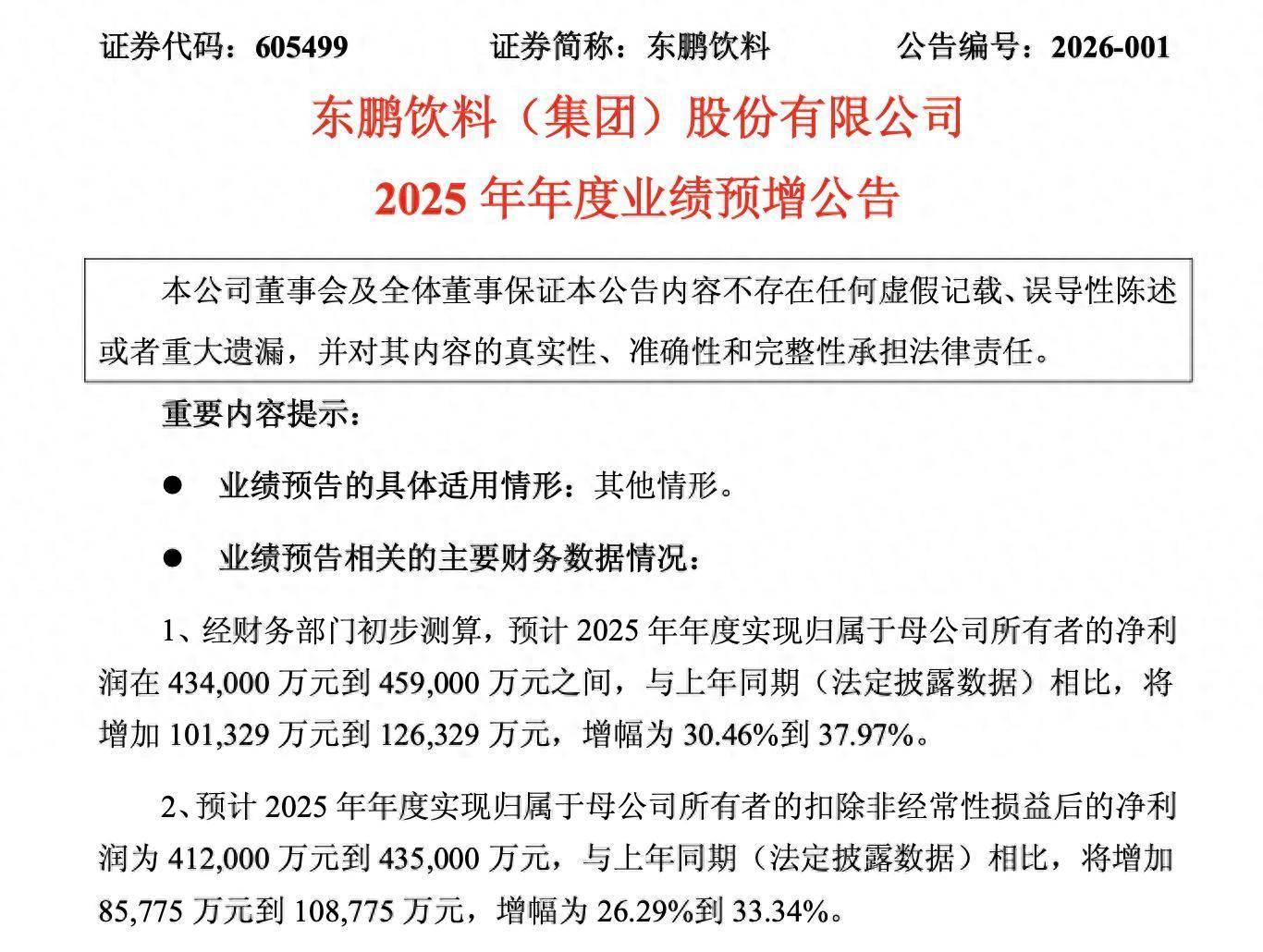
东鹏饮料(集团)股份有限公司2025年年度业绩预增公告
Shang Hai Zheng Quan Bao· 2026-01-13 19:13
Core Viewpoint - Dongpeng Beverage Group Co., Ltd. anticipates a significant increase in its 2025 annual performance, projecting net profit growth of 30.46% to 37.97% compared to the previous year [3][4]. Financial Performance Forecast - The company expects net profit attributable to shareholders to be between 434 million and 459 million yuan, an increase of 101.33 million to 126.33 million yuan from the previous year [3][4]. - The projected net profit after deducting non-recurring gains and losses is estimated to be between 412 million and 435 million yuan, reflecting an increase of 85.78 million to 108.78 million yuan, representing a growth of 26.29% to 33.34% [3][4]. Revenue Expectations - For the fiscal year 2025, the company anticipates operating revenue to be between 2,076 million and 2,112 million yuan, which is an increase of 492.12 million to 528.12 million yuan compared to the previous year's revenue of 1,583.885 million yuan, indicating a growth rate of 31.07% to 33.34% [8]. Business Strategy and Growth Drivers - The company continues to focus on a sales-driven operational strategy, enhancing its national expansion efforts through refined channel management and improved channel operation capabilities [7]. - Dongpeng Beverage is committed to strengthening its core product lines while exploring multi-category development to foster new growth points, thereby driving revenue and profit growth [7].