
钢铁业

Search documents
加拿大通知中国:加税25%!中方转手将订单给了澳大利亚,卡尼想搞事?美突然对加拿大出手
Sou Hu Cai Jing· 2025-08-06 14:44
Core Viewpoint - The Canadian government's decision to impose a 25% additional tax on steel products containing melted and cast iron from China has led to a swift and severe retaliation from China, highlighting strategic miscalculations by the Canadian Prime Minister [1][3][5]. Group 1: Trade Dynamics - Canada announced a 25% additional tax on steel imports from countries outside the U.S., particularly targeting China, which has raised international concerns [1][3]. - In response, China quickly established a trade agreement with Australia for canola seed, with the first trial shipment reaching 250,000 tons, undermining Canadian farmers [1][5]. - The Australian Prime Minister's visit to Beijing coincided with Canada's tax announcement, allowing Australia to capitalize on the situation and reclaim market share previously held by Canada [3][5]. Group 2: Strategic Miscalculations - The Canadian government misjudged China's economic influence, as China is the world's largest importer of canola seeds, with an annual import volume exceeding 4 million tons [5]. - Canada’s approach to trade disputes has been criticized as lacking diplomatic wisdom, contrasting sharply with Australia's pragmatic stance that prioritizes economic interests [5][7]. - The reliance of 75% of Canadian exports on the U.S. market has left Canada with limited maneuverability in foreign policy, making it vulnerable to external pressures [5][7]. Group 3: Economic Implications - The trade conflict has exposed structural weaknesses in the Canadian economy, particularly its dependence on the U.S. market and the inability to effectively engage with China [5][7]. - Canada's attempt to shift domestic discontent onto China has backfired, resulting in a loss of both steel industry support and agricultural orders [7]. - The situation illustrates that Canada lacks the strength of the U.S. and the market appeal of China, leading to a precarious position in international trade [7].

港股收评:恒指微涨0.03%,“反内卷”相关板块强势,内银股走低
Ge Long Hui· 2025-08-06 08:29
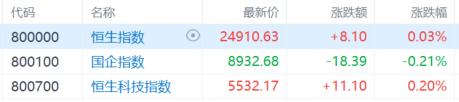
Market Overview - The Hong Kong stock market showed mixed results with the Hang Seng Index up 0.03%, the Hang Seng Tech Index up 0.2%, and the National Enterprises Index down 0.21, indicating a narrow range of fluctuations throughout the day [1][2]. Sector Performance - Large tech stocks had mixed performances, with Tencent rising 1.7%, while Meituan fell 1.46%. The paper industry saw significant gains, with both Chenming Paper and Nine Dragons Paper rising 10.75%, reaching new highs [2][4][6]. - Coal stocks experienced substantial increases, with Honghai High-tech Resources up over 18% and China Qinfa up over 9% [7][8]. - Steel stocks also performed well, with Aowei Holdings rising over 14% and other steel companies following suit [9][10]. - Gold stocks were active, with Shandong Gold and China Gold International both rising over 3% [11][12]. - New consumption concept stocks rebounded, with Pop Mart and Shangmei shares rising over 7% [13]. Individual Stock Movements - Times Angel saw a significant increase of 18.29% after announcing a profit increase, with expected net profits for the first half of the year between $13.4 million and $14.8 million, marking a year-on-year increase of approximately 5.38 to 6.05 times [16][17]. - Southbound funds recorded a net inflow of 9.485 billion HKD, indicating strong investor interest [19]. Future Outlook - According to Zhongtai International, the Hong Kong market is expected to continue a gradual upward trend supported by domestic policy, improving corporate earnings, and positive capital flows. The Hang Seng Index is anticipated to find support around 24,500 points [21].
港股午评:恒指涨0.18%,“反内卷”相关板块强势,创新药高开低走
Ge Long Hui· 2025-08-06 04:09
Core Viewpoint - The Hong Kong stock market showed a mixed performance with the Hang Seng Index slightly rising by 0.18%, briefly surpassing the 25,000-point mark, while the Hang Seng China Enterprises Index fell by 0.03% and the Hang Seng Tech Index increased by 0.03% [1] Group 1: Technology Sector - Major technology stocks exhibited varied performance, with Alibaba rising by 2% and Tencent increasing by 1.79%, while Meituan and Baidu fell over 1% [1] - The upcoming Apple iPhone 17 series launch on September 9 has positively influenced Apple-related stocks, which mostly strengthened [1] Group 2: Commodity and Industrial Sectors - The "anti-involution" related sectors saw significant gains, with a price increase trend contributing to the rise of paper stocks, exemplified by Nine Dragons Paper surging over 11% [1] - Steel and coal stocks also performed well, with Maanshan Iron & Steel reaching a new high and China Shenhua hitting an all-time high price [1] Group 3: Other Sectors - The restaurant sector faced notable declines, with Yum China dropping over 4% post-earnings, and other restaurant stocks like Jiumaojiu and Haidilao also declining [1] - Innovative drug concept stocks experienced a volatile trading pattern, while brain-computer interface stocks, gaming stocks, domestic bank stocks, and semiconductor stocks all saw declines [1]
海外经济跟踪周报:关税和非农冲击,海外市场变盘-20250803
Tianfeng Securities· 2025-08-03 14:17
Market Performance - U.S. stock indices collectively fell over 2% this week, with the S&P 500, Dow Jones, and Nasdaq down 2.36%, 2.92%, and 2.17% respectively[11] - The German DAX, London FTSE 100, Nikkei 225, and Korea Composite Index also experienced declines of 3.27%, 0.57%, 1.58%, and 2.40% respectively[11] Economic Data - Non-farm payroll data was significantly below expectations, with a downward revision of 258,000 jobs in the previous two months, leading to increased concerns about economic momentum[5] - The unemployment rate remained at 4.2%, consistent with expectations, primarily influenced by immigration effects[5] Federal Reserve Insights - The FOMC meeting maintained interest rates, with a cautious stance on potential rate cuts in September, dropping the probability of a cut below 40% initially[29] - Following the disappointing non-farm data, market expectations for a 25 basis point cut in September surged to 80.3%, with predictions for three rate cuts in total this year[29] Currency and Bond Market - The U.S. dollar index rose by 1.04% over the week, while the euro and Chinese yuan fell by 1.32% and 0.11% respectively[11] - U.S. Treasury yields saw significant declines, with the 2-year yield down 22 basis points and the 10-year yield down 17 basis points by August 1[12] Commodity Market - Gold prices increased by 0.93% amid rising inflation concerns due to tariffs, while copper prices plummeted by 23.88% following a 50% tariff announcement on certain copper products[13] - WTI crude oil prices rose by 3.37% during the week[13] Trade and Tariff Developments - President Trump announced new tariffs ranging from 10% to 41% on various imports, with a 40% transit tax on transshipped goods, effective August 7[34] - Tariff concerns have heightened market volatility and investor caution, impacting overall market sentiment[11]
海外经济跟踪周报20250803:关税和非农冲击,海外市场变盘-20250803
Tianfeng Securities· 2025-08-03 10:46
1. Report Industry Investment Rating No relevant content provided. 2. Core Viewpoints of the Report - Overseas equity markets generally declined this week due to tariff concerns and economic data. Economic data showed potential slowdown risks, and the "disappointing" non - farm data on Friday intensified market concerns about economic momentum. Tariff policies also made investors cautious. The three major US stock indexes all fell by more than 2%. [1][10] - The market's expectation of the Fed's interest rate cuts fluctuated greatly this week. After the FOMC meeting, the probability of a September rate cut dropped below 40% due to Powell's slightly hawkish stance, but soared above 80% after the "disappointing" non - farm data and the resignation of the hawkish Fed member Kugler. [2] - The US second - quarter GDP initial value showed an overall growth rate exceeding expectations, but the potential momentum weakened. Consumption was stable, while investment slowed down. [44] 3. Summary According to the Directory 3.1 Overseas Market One - Week Review - **Equity**: Overseas equities generally closed down. This was mainly affected by tariffs and economic data. The three major US stock indexes (S&P 500, Dow Jones, and Nasdaq) fell by 2.36%, 2.92%, and 2.17% respectively. Other major overseas indexes also declined to varying degrees. [10] - **Foreign Exchange**: The US dollar first rose and then fell, with a slight weekly gain. The US dollar index rose by 1.04%. The euro and the RMB against the US dollar fell by 1.32% and 0.11% respectively, while the yen against the US dollar rose by 0.19%. [10] - **Interest Rates**: US Treasury yields declined significantly. The 2Y US Treasury yield dropped 22bp, and the 10Y US Treasury yield dropped 17bp. [11] - **Commodities**: Gold and crude oil rose, while New York copper prices tumbled. COMEX gold rose 0.93%, COMEX copper dropped 23.88%, and WTI crude oil rose 3.37%. [11] 3.2 Overseas Policies and Important News 3.2.1 Overseas Central Bank Dynamics - The FOMC meeting this week maintained the interest rate unchanged, which was in line with market expectations. It was the fifth consecutive time of keeping the rate unchanged since the December rate cut last year. The meeting statement was slightly dovish, while Fed Chairman Powell's stance was moderately hawkish. [26] - The market's expectation of the Fed's September rate cut first dropped and then soared. After the FOMC meeting, the probability of a September rate cut dropped below 40%, but after the "disappointing" non - farm data and Kugler's resignation, it rose above 80%. As of August 1, the market expected a 25bp rate cut in September with a probability of 80.3%, and three consecutive 25bp rate cuts in September, October, and December. [2][27] - The Bank of Japan's interest rate meeting this week also maintained the interest rate unchanged, in line with market expectations, but it raised the inflation forecast, causing the yen to rise against the US dollar. [27] 3.2.2 Trump Policy Tracking - **Trade Negotiations**: Sino - US economic and trade talks continued to postpone the 24% part of the US's reciprocal tariffs and China's counter - measures for 90 days. Trump signed an executive order to set the "new reciprocal tariff" rates ranging from 10% to 41%, and a 40% transit tax on transit goods. He also adjusted tariff policies for Canada, Mexico, and Brazil. [3][31] - **Personnel Changes**: Trump demanded the dismissal of the Bureau of Labor Statistics director and the Fed member Kugler announced her resignation on August 8. These two personnel changes on Friday increased traders' bets on a September rate cut by the Fed. [3][31] - Trump's net satisfaction rate increased. As of August 1, his net satisfaction rate was - 5.1%, compared with - 7.0% a week ago. [32] 3.3 Overseas Economic Fundamental High - Frequency Tracking 3.3.1 Overall Prosperity - The bet on a US economic recession in 2025 on the Polymarket website dropped to 16% from 17% a week ago. The US weekly economic activity index rose slightly, while Germany's continued to decline. [4][37] - The US second - quarter GDP initial value showed an overall growth rate exceeding expectations, but the potential momentum weakened. After excluding the impact of net exports and inventory, the growth rate was lower than the previous value. [44] 3.3.2 Employment - The number of unemployment benefit recipients continued to decline, but the non - farm data was "disappointing". The number of initial jobless claims continued to be lower than expected, but the non - farm data on Friday was far below expectations, with the previous two months' data revised down by 258,000 jobs. The unemployment rate was 4.2%, in line with expectations. [4][52] 3.3.3 Demand - US airport security checks and railway transportation were better than the same period last year. The Redbook commercial retail sales growth rate declined for three consecutive weeks. The real estate market remained sluggish. [54] 3.3.4 Production - The US production side remained prosperous, with crude steel production and refinery utilization rates continuing to be higher than the same period last year. [60] 3.3.5 Shipping - International freight rates declined. The Baltic Dry Index, Panamax Freight Index, and Cape - size Freight Index all dropped, and the container freight rates from Chinese ports also continued to fall. [63][64] 3.3.6 Price - US retail gasoline prices were stable. The inflation expectations in the US declined this week, with the 1 - year inflation swap rate dropping by 0.04 percentage points and the 2 - year inflation swap rate dropping by 0.06 percentage points. [65][68] 3.3.7 Financial Conditions - The US financial pressure declined this week, with the OFR US financial stress index dropping and the credit spread narrowing. [70] 3.4 Next Week's Overseas Important Event Reminders - Key events next week include the Bank of England's interest rate meeting (the market expects a 25bp rate cut), the US July ISM services PMI, and the US June factory orders monthly rate. Attention should also be paid to the implementation of Trump's "new reciprocal tariffs" on August 7. [74]
“对等关税”2.0来袭:最高税率41%,谈判进展缓慢
Guo Ji Jin Rong Bao· 2025-08-02 09:07
Core Points - The U.S. government has announced new "reciprocal tariffs" that will take effect on August 7, following President Trump's executive order signed on July 31 [1][2] - The new tariff rates reflect a more protectionist and isolationist trade policy, with significant implications for global trade dynamics [1][11] - The average tariff rate is expected to rise from 13.3% to 15.2% [6] Tariff Rates Summary - The maximum tariff rate is set at 41%, with a general rate of 10% for countries with a trade surplus with the U.S. [2] - Countries with a trade deficit will face a minimum tariff rate of 15%, affecting approximately 40 countries [2][3] - Specific countries have been assigned varying tariff rates, with Cambodia's rate dropping from 49% to 19%, while Switzerland's rate increased from 31% to 39% [4][3] Impact on Trade Partners - Canada will see its tariff rate increase from 25% to 35%, which has been met with disappointment from Canadian officials [5][4] - The U.S. has implemented a 40% additional penalty on goods deemed to be transshipped from high-tariff countries to low-tariff countries [3][4] - The new tariffs are expected to significantly impact industries such as textiles and automotive in affected countries [4][5] Negotiation and Agreements - The U.S. has only reached a limited number of trade agreements, with only 7 out of over 200 proposed agreements finalized [7][9] - Recent agreements with countries like Japan and South Korea have resulted in reduced tariff rates, but many details remain under negotiation [8][9] - The ongoing negotiations with China have resulted in a temporary extension of tariff suspensions, indicating a complex and evolving trade landscape [10][13] Legal and Economic Implications - Trump's tariff policies are facing legal challenges, with questions raised about the extent of presidential power in modifying tariff rates without congressional approval [11][12] - Economists warn that the new tariffs could have long-term negative effects on the global economy, particularly for Asian economies [13]
首席点评:PMI回落,非制造业保持扩张
Shen Yin Wan Guo Qi Huo· 2025-08-01 03:29
Report Industry Investment Rating No relevant content provided. Core Viewpoints of the Report - China's official manufacturing PMI in July 2025 fell to 49.3, and the new orders index dropped to 49.4, while the non - manufacturing sector remained in expansion. The market demand for manufacturing has slowed down [1]. - In the long - term, A - shares have high investment value. Among them, CSI 500 and CSI 1000 are more supported by science and innovation policies and may bring higher returns, while SSE 50 and SSE 300 have more defensive value in the current macro - environment [2][9][10]. - Domestic glass and soda ash are in the process of inventory digestion. The market focus has returned to supply and demand, and the speed of upstream inventory digestion should be concerned in the future [3][15]. - Gold and silver may continue to fluctuate. The long - term drivers of gold still provide support, but the upward movement is hesitant due to high prices. Attention should be paid to the performance of the US non - farm payrolls [4][17]. Summary by Directory 1. Main News on the Day International News - The number of initial jobless claims in the US last week increased by 1,000 to 218,000, lower than the market expectation of 224,000. The number of continuing jobless claims in the previous week remained unchanged at 1.946 million [5]. Domestic News - In June 2025, China's exports of goods and services in the balance of payments were $329.2 billion, imports were $259.1 billion, and the surplus was $70.1 billion [6]. Industry News - In the first half of the year, the newly installed capacity of renewable energy in China was 268 million kilowatts, a year - on - year increase of 99.3%, accounting for about 91.5% of the newly installed capacity. The installed capacity of new energy storage reached 94.91 million kilowatts/222 million kilowatt - hours, an increase of about 29% compared with the end of 2024 [7]. 2. Daily Returns of Overseas Markets - The S&P 500 fell 0.37%, the European STOXX 50 dropped 1.11%, the FTSE China A50 futures declined 1.69%, the US dollar index rose 0.08%, ICE Brent crude oil fell 1.25%, London gold spot rose 0.45%, London silver dropped 1.16%, LME metals declined to varying degrees, and most agricultural products in CBOT showed small fluctuations [8]. 3. Morning Comments on Main Varieties Financial - **Stock Index**: The US three major indexes fell, and the stock index had a significant correction in the previous trading day. The banking sector with high interest and low volatility has performed well since 2025. In the long - term, A - shares have high investment value [2][9][10]. - **Treasury Bonds**: Treasury bonds continued to rise, and the yield of the 10 - year active treasury bond fell to 1.70%. In the short - term, when the equity and commodity markets are weak, the price of treasury bond futures may continue to stabilize [11]. Energy and Chemicals - **Crude Oil**: The sc night session fell 0.71%. Trump's tariff policies have added uncertainty to global oil demand. The US crude oil production in May reached a record high of 13.49 million barrels per day. Attention should be paid to OPEC's production increase [12]. - **Methanol**: The methanol night session fell 0.08%. The average operating load of domestic coal (methanol) to olefin plants decreased slightly, and the coastal methanol inventory increased. Methanol is expected to be slightly bullish in the short - term [13]. - **Polyolefins**: Polyolefin futures mainly declined. The market is mainly driven by supply and demand, and attention should be paid to the autumn stocking market after supply and demand digestion [14]. - **Glass and Soda Ash**: Glass and soda ash futures continued to correct. Both are in the process of inventory digestion, and attention should be paid to the speed of upstream inventory digestion [3][15]. - **Rubber**: The price of raw rubber is supported by supply - side factors, but the demand - side support is weak. The inventory in Qingdao is increasing, and the short - term trend is expected to continue to correct [16]. Metals - **Precious Metals**: Gold rebounded after a decline, and silver continued to correct. The Fed's internal views are divided, and the market is speculating on the possibility of a rate cut in September. Gold and silver may continue to fluctuate [4][17]. - **Copper**: The copper price at night session closed lower. The copper price may fluctuate within a range due to the combination of long and short factors. Attention should be paid to the progress of US tariffs and other factors [18]. - **Zinc**: The zinc price at night session closed higher. The zinc price may fluctuate widely in the short - term, and attention should be paid to the progress of US tariffs and other factors [19]. - **Lithium Carbonate**: Lithium carbonate rose significantly due to the mining qualification issue in Jiangxi. The inventory continued to increase, and the fundamentals are still under pressure. The short - term core contradiction lies in the warehouse receipt inventory [20][21]. Black Metals - **Iron Ore**: The demand for iron ore is supported, but the medium - term supply - demand imbalance pressure is large. The iron ore price is expected to be volatile and slightly bullish in the future [22]. - **Steel**: The decline of rebar is greater than that of hot - rolled coil. The supply - demand contradiction in the steel market is not significant for the time being, and the steel price is expected to be volatile and slightly bullish in the future [23]. - **Coking Coal and Coke**: After the Politburo meeting, the short - term market sentiment has declined. After the correction, it is expected to maintain a range - bound and slightly bullish trend [24]. Agricultural Products - **Soybean and Rapeseed Meal**: The soybean and rapeseed meal futures were weakly volatile at night. The good growth of US soybeans has put pressure on the price, but the import cost will support the domestic soybean meal price [25]. - **Oils and Fats**: The oils and fats futures closed slightly lower at night. The expected inventory build - up of Malaysian palm oil in July has dragged down the palm oil price, and the oils and fats are expected to be weakly volatile in the short - term [26][27]. Shipping Index - **Container Shipping to Europe**: The EC was weakly volatile, and the 10 - contract closed at 1425.1 points, down 4.66%. The market will continue to game the off - season freight rate, and attention should be paid to the degree and slope of the freight rate correction [28].
国外1. 花旗:寻求进入中国A股的量化基金需求在不断增长。2. 德银:欧洲央行宽松周期已结束,下一步行动是加息。国内1. 中金:美国钢铁价格短期或维持高位,长期中枢或上移。2. 国泰海通:育儿补贴规模或达年均千亿,提振乳品等行业需求。3. 中信建投:REITs板块间分化持续,调整后有望迎来更佳配置机会。4. 中信证券:育儿补贴方案公布,母婴连锁受益明确。5. 华泰证券:WAIC上海新政推动Robotaxi加速。6. 民生固收:短期内利率上行空间有限,收益曲线受长端利率影响有所提高偏中性。7. 中信证券:继续
news flash· 2025-07-30 08:12
Group 1 - Citigroup reports increasing demand for quantitative funds seeking to enter China's A-shares market [2] - Deutsche Bank indicates that the European Central Bank's easing cycle has ended, with the next action being interest rate hikes [2] Group 2 - CICC suggests that U.S. steel prices may remain high in the short term, with a potential upward shift in the long-term average [3] - Guotai Junan estimates that the scale of childcare subsidies could reach an annual average of 100 billion, boosting demand in the dairy industry and others [3] - CITIC Securities highlights that the newly announced childcare subsidy plan will clearly benefit maternal and infant retail chains [3] - Huatai Securities notes that the new policies from WAIC in Shanghai will accelerate the development of Robotaxi [3] - Minsheng Fixed Income states that the short-term space for interest rate increases is limited, with the yield curve being influenced by long-term rates [3] - CITIC Securities continues to focus on issuers likely to obtain the first batch of stablecoin licenses and platforms that are deterministically involved in the creation of stablecoin usage scenarios [3]

连板股追踪丨A股今日共55只个股涨停 西藏旅游收获8连板
Di Yi Cai Jing· 2025-07-30 07:39
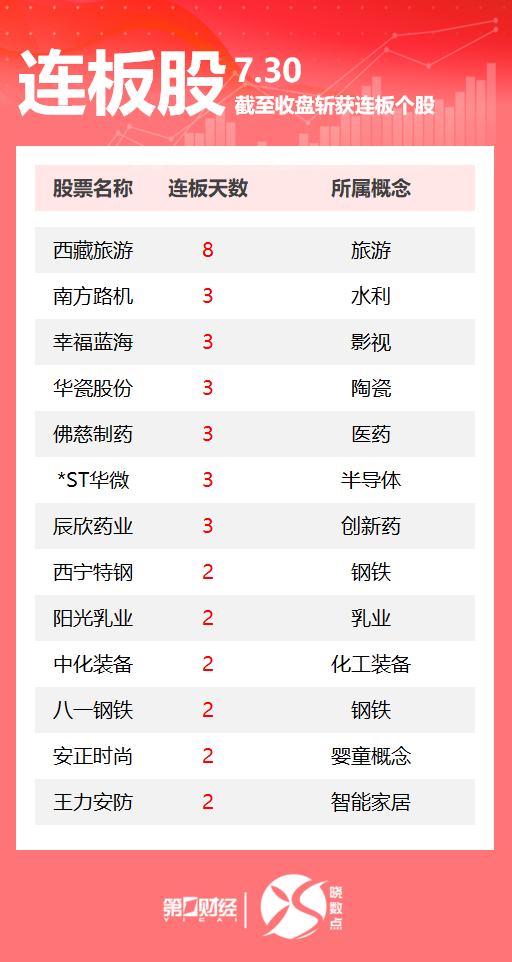
Group 1 - The A-share market saw a total of 55 stocks hitting the daily limit up on July 30, indicating strong market activity [1] - The tourism sector led with Xizang Tourism achieving an impressive 8 consecutive limit-up days, showcasing significant investor interest [1] - Happiness Blue Sea, a film industry stock, recorded 3 consecutive limit-up days, reflecting positive market sentiment towards the entertainment sector [1] Group 2 - Steel stocks such as Xining Special Steel and Bayi Steel both achieved 2 consecutive limit-up days, indicating a favorable trend in the steel industry [1] - Other notable stocks with 3 consecutive limit-up days include Southern Road Machinery (water conservancy), Huaci Co. (ceramics), and Foci Pharmaceutical (pharmaceuticals), highlighting diverse sectors performing well [1] - The overall performance of these stocks suggests a bullish trend in various industries, with a particular emphasis on tourism and entertainment [1]


以金融“五篇大文章”为抓手 推进高质量发展
Jin Rong Shi Bao· 2025-07-30 02:35
Core Viewpoint - The People's Bank of China and Tianjin government have issued a comprehensive set of policies aimed at enhancing financial support for high-quality development in Tianjin, with 34 key measures outlined to promote economic growth and innovation in the region [1]. Financial Support for Technology and Innovation - The first commercial paper backed by intellectual property assets in China was issued, raising 166 million yuan for eight technology companies in Tianjin, showcasing the city's commitment to enhancing its technology finance ecosystem [2]. - The balance of technology loans in Tianjin reached 885.04 billion yuan by May 2025, reflecting a year-on-year growth of 9.9% [3]. Green Finance Initiatives - The Tianjin branch of the People's Bank of China has developed national standards for green finance, including the first green commercial factoring standard and a green leasing project evaluation guideline [4]. - By June 2025, the balance of green loans in Tianjin was 825.7 billion yuan, an increase of 15.9% from the beginning of the year [4]. Inclusive Financial Services - The Tianjin government has implemented ten measures to support private enterprises, focusing on alleviating financing difficulties for small and micro businesses, as well as enhancing financial services for rural revitalization and elderly care [5][6]. - As of May 2025, loans for the elderly care industry reached 3.697 billion yuan, with significant growth in loans for small and micro enterprises and agricultural sectors [6]. Digital Financial Services Enhancement - The Tianjin financial sector has made strides in digital transformation, with over 3 financial technology innovation projects and 3100 digital business transactions amounting to 2.8 billion USD by June 2025 [7]. High-Level Financial Openness - The Tianjin branch of the People's Bank of China has facilitated cross-border RMB transactions for 2970 enterprises, with the FT account business scale exceeding 1.29 trillion yuan by June 2025 [8]. - The city has also expanded the coverage of foreign exchange facilitation policies, with 19 banks and 396 enterprises participating, processing a cumulative business volume of over 53.5 billion USD [8]. Industry-Specific Financial Solutions - The Tianjin financial sector has introduced innovative financing models for key industries, including the "津采e贷" and international factoring services, to support local enterprises [9]. - By June 2025, the manufacturing sector received 4.471 billion yuan in priority funding, demonstrating the focus on supporting industrial chains [9]. Economic Performance - In the first half of 2025, Tianjin's GDP grew by 5.3%, with a social financing scale increase of 305.8 billion yuan, indicating robust financial support for the real economy [10].