
装备制造业

Search documents
税务总局:4月企业销售收入增4.3% 出口企业发力“转内销”
Bei Ke Cai Jing· 2025-05-15 00:46
Core Insights - The National Taxation Administration of China is monitoring national enterprise sales revenue using value-added tax invoice data, reflecting the macroeconomic situation [1] Group 1: Sales Revenue Growth - In April, the sales revenue growth rate of national enterprises accelerated, with a year-on-year increase of 4.3%, continuing the steady growth trend since the fourth quarter of last year [2] - Domestic sales revenue of enterprises engaged in exports to the U.S. increased by 4.7% year-on-year, with the proportion of domestic sales in total sales rising by 2 percentage points compared to the first quarter [4] Group 2: Sector Performance - Among 31 manufacturing categories, 21 industries saw an increase in the proportion of domestic sales for enterprises exporting to the U.S. compared to the same period last year, with notable increases in the leather and footwear industry (10 percentage points) and in computer communication equipment, black metals, furniture, and food industries (over 5 percentage points) [4] - The sales revenue of industrial enterprises showed significant growth in April, with a year-on-year growth rate of 3.7%, and manufacturing sales revenue increased by 4.4%, driven by policies such as "two new" [4] Group 3: Regional Performance - Economic provinces like Zhejiang, Guangdong, and Beijing experienced strong growth in sales revenue in April, with year-on-year increases of 7.3%, 6.6%, and 5.4% respectively, significantly outpacing the national average [4] - The growth in these regions is particularly driven by innovative industries such as artificial intelligence, leading to accelerated development in equipment manufacturing and high-tech industries [4]
解读∣4月CPI环比由降转涨,部分工业领域出现积极信号
Guang Zhou Ri Bao· 2025-05-11 13:10
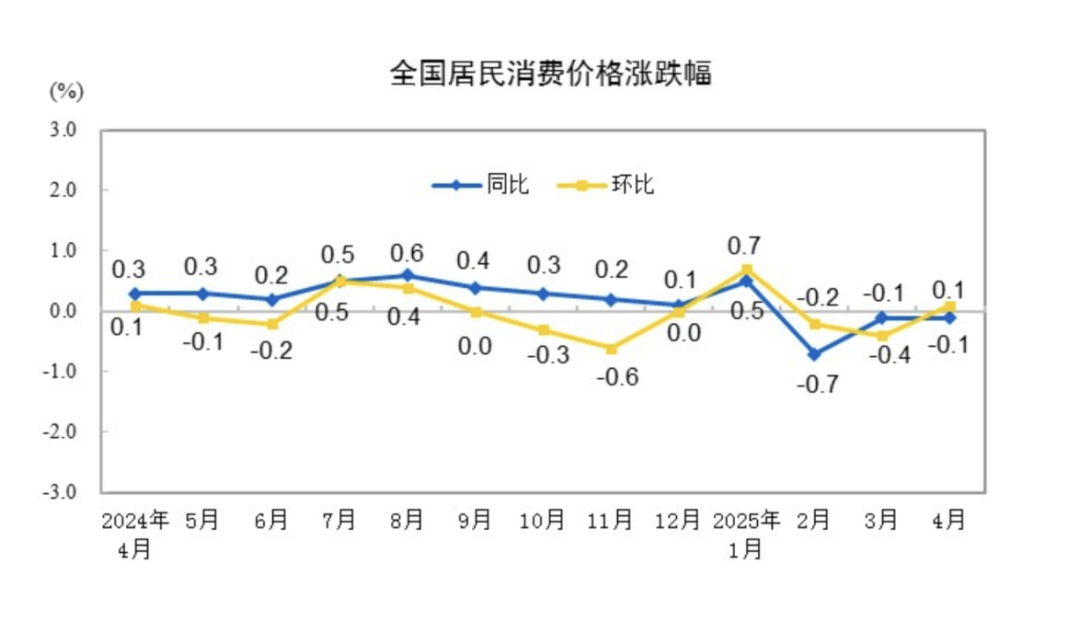
Group 1: CPI Trends - In April, the Consumer Price Index (CPI) shifted from a decrease of 0.4% in March to an increase of 0.1% month-on-month, while year-on-year it decreased by 0.1% [1] - The core CPI increased by 0.2% month-on-month and 0.5% year-on-year, indicating resilience despite the overall CPI decline [1][4] - Food prices rose by 0.2% month-on-month, contributing to the CPI increase, alongside significant rises in travel service prices, such as a 13.5% increase in airfare [4] Group 2: PPI Trends - The Producer Price Index (PPI) decreased by 0.4% month-on-month and year-on-year, with the decline attributed to both international and domestic factors, including seasonal drops in energy prices [5] - Some industrial sectors are showing positive signals, with demand in high-tech industries increasing and leading to price recoveries in certain areas, such as home appliances and new energy vehicles [7] Group 3: Policy Implications - Analysts expect that the government's macroeconomic policies aimed at boosting consumption will support demand and potentially lead to structural positive changes in the PPI [8] - There is an emphasis on the need for the government to expedite the implementation of existing policies, particularly in technology, consumption, and foreign trade, to stimulate domestic demand and support core CPI trends [4]

稳、新、增!三大“关键词”透视江苏13市“一季报”
Yang Zi Wan Bao Wang· 2025-05-08 15:17
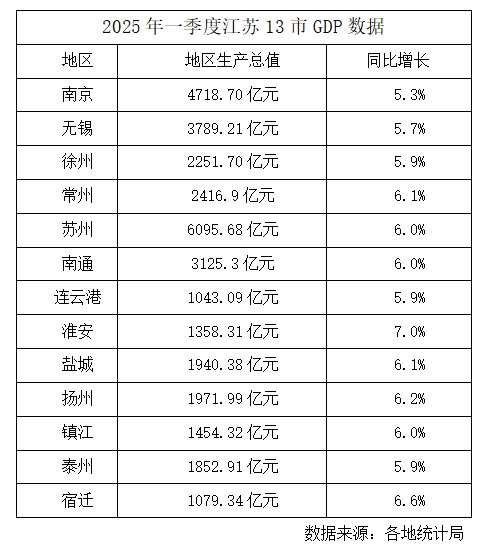
Core Insights - Jiangsu's 13 cities reported a stable economic performance in Q1, with keywords like "steady" and "good start" frequently mentioned, indicating a solid foundation for the year ahead [1][2] - The total GDP of all 13 cities exceeded 1000 billion yuan, with Suzhou leading at 609.57 billion yuan, followed by Nanjing at 471.87 billion yuan [2][3] - The industrial sector played a crucial role in Suzhou's growth, with a significant increase in industrial output and contributions from key industries such as electronics and machinery [2][4] Economic Performance - Suzhou's GDP reached 6095.68 billion yuan, up from 5549.0 billion yuan last year, showcasing a robust economic momentum [2] - Nanjing's GDP was 4718.70 billion yuan, maintaining its position above the 4000 billion yuan mark [2] - Other cities like Wuxi and Nantong surpassed 3000 billion yuan, while Changzhou and Xuzhou exceeded 2000 billion yuan [2] Growth Rates - Huai'an led the growth rates with a 7.0% increase, followed by Suqian at 6.6% and Changzhou at 6.1% [3] - Huai'an's consistent high growth is attributed to strong industrial performance and effective project implementation [4] Industrial Development - Huai'an's industrial output saw a 19.6% increase in fixed asset investment, with 292 new projects signed, indicating a strong focus on attracting investment [4] - Jiangsu's cities are focusing on new industries and technologies, with Yangzhou emphasizing low-carbon and digital sectors, achieving significant growth in manufacturing [5][6] Green Development - Yancheng is exploring green development through zero-carbon industrial parks, achieving significant growth in renewable energy sectors [7] - The city has become a leader in offshore wind power and solar energy production, contributing to its industrial growth [7] Consumer Market Dynamics - Jiangsu's "old-for-new" policies have stimulated consumer spending across various sectors, with Nanjing reporting a 7.5% increase in retail sales [8][9] - The automotive sector has seen significant growth due to incentives, with Suzhou and Wuxi implementing attractive trade-in programs [9][10] - Lianyungang's home renovation subsidy program has also driven consumer demand, resulting in notable retail sales growth [10]
强底气添动能 税收数据折射经济向新向好
Zhong Guo Zheng Quan Bao· 2025-05-06 20:27
Core Viewpoint - The report highlights the positive momentum in China's key engineering projects and overall economic performance in the first quarter of 2025, driven by increased investment and innovation in various sectors [1][2][3]. Investment and Project Development - In the first quarter, the number of engineering projects reported for work injury insurance reached 39,000, a year-on-year increase of 9.4%, with a total project cost of 1.9 trillion yuan, up 4.8% year-on-year [1]. - March saw a significant acceleration in project construction, with 18,000 projects reported, accounting for 46.5% of the quarterly total, and a total cost of 800 billion yuan, representing 43.9% of the quarterly total [3]. Innovation and High-Technology Growth - High-tech industry sales revenue grew by 13.4% year-on-year in the first quarter, with digital product manufacturing and digital technology application sectors seeing increases of 12% and 11.6%, respectively [1]. - The report emphasizes the role of tax incentives in supporting technological innovation and the development of new productive forces [2]. Consumer Market Dynamics - The health consumption sector experienced significant growth, with sales revenue from elderly care services increasing by 65.5% and nursing institution services by 23.9% year-on-year [3]. - The "May Day" holiday period saw a 15.2% year-on-year increase in sales revenue across consumer-related industries, driven by policies promoting the replacement of old consumer goods [3]. Manufacturing Sector Performance - Manufacturing sales revenue rose by 4.8% year-on-year, accounting for 29.1% of total national sales, with equipment manufacturing growing by 9.7% [4]. - High-tech manufacturing and equipment manufacturing sales increased by 12.1% and 9.7%, respectively, indicating a shift towards high-end and digital transformation in the manufacturing sector [4][5]. Tax Policy and Support Measures - The tax authorities are committed to implementing tax and fee support policies to enhance service levels and promote high-quality economic development [4][5]. - The report indicates that the tax department will continue to optimize tax payment services and respond to the needs of manufacturing enterprises, facilitating their transition to high-end, intelligent, and green development [5].
这一次,辽宁先支棱
3 6 Ke· 2025-05-05 22:25
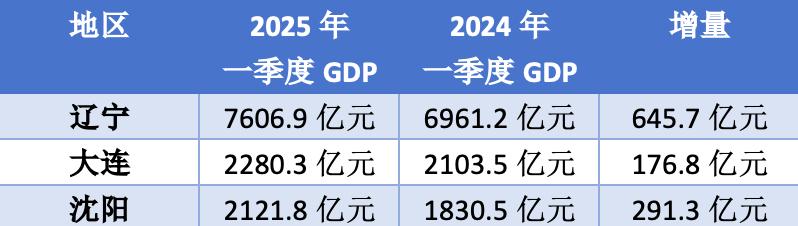
Economic Overview - In Q1 2025, Liaoning's GDP reached 760.69 billion yuan, showing a year-on-year growth of 5.2% and rising from 18th to 16th in national rankings [1][3] - The province's economic growth is driven by industrial and consumer sectors, with the secondary industry increasing by 5.4% and high-tech manufacturing growing by 10.9% [2][3] Investment and Consumption - Fixed asset investment in Liaoning grew by 7.8%, retail sales of consumer goods increased by 6.7%, and exports rose by 10.5%, all surpassing national averages [3] - Manufacturing investment rose by 13.2%, accounting for 26.7% of total investment, with significant growth in aerospace and electronic equipment manufacturing [4] - Consumer spending was boosted by policies aimed at stimulating consumption, with notable increases in retail sales of new energy vehicles (22.5%) and smart wearable devices (13.1%) [4] Trade Performance - Liaoning's exports reached a record 95.11 billion yuan in Q1, growing by 10.5%, supported by a strong performance from private enterprises [5][6] - The province's trade with Belt and Road countries amounted to 102.65 billion yuan, marking a 5.9% increase, with significant growth in exports to ASEAN and Saudi Arabia [7] City Contributions - Shenyang and Dalian are key economic drivers, with Dalian's GDP at 228.03 billion yuan (6.2% growth) and Shenyang's at 212.18 billion yuan (4.6% growth) [8][11] - Dalian's industrial output increased by 10.9%, with strong growth in equipment manufacturing and high-tech sectors [9] - Shenyang's growth was bolstered by a significant increase in the cultural and tourism sectors, with revenues from cultural and entertainment industries rising by 19% [12][13]
21个省份一季度增速跑赢或达到全国水平——地区经济实现平稳开局
Jing Ji Ri Bao· 2025-05-05 22:07
Economic Overview - As of April 25, all 31 provinces have released their Q1 reports, with 21 provinces achieving growth rates that either surpassed or matched the national level [1] - The GDP of the top ten provinces reached 19.5 trillion yuan, accounting for over 60% of the national economy [2] Provincial Performance - Guangdong and Jiangsu both exceeded 3.3 trillion yuan in GDP, with Guangdong at 33,525.51 billion yuan and Jiangsu at 33,088.6 billion yuan, narrowing the gap [2] - Tibet led the growth rate at 7.9%, while Hubei achieved a 6.3% growth, marking its highest rate in nearly 12 quarters [3] Industrial Growth - All provinces reported positive growth in industrial output, with several provinces like Zhejiang, Fujian, Jiangsu, and Shandong exceeding 8% growth [4] - New energy industries showed significant growth, with Guangdong's advanced manufacturing and high-tech manufacturing increasing by 5.9% and 5.3% respectively [4] Consumption and Investment - The government has emphasized boosting consumption and investment efficiency, with policies aimed at expanding domestic demand [5] - Major projects have shown a clear impact, with significant investment growth in provinces like Henan and Yunnan [6] Future Outlook - Provinces are focusing on high-quality development and addressing current economic challenges through targeted policies [7] - The emphasis is on stabilizing demand and optimizing supply, with a focus on innovation and improving public services [8]
固定收益点评报告:关税冲击下企业收缩业务
Huaxin Securities· 2025-05-03 09:10
Report Summary 1. Investment Rating The document does not mention the industry investment rating. 2. Core View In April, the economic expansion pace slowed down, but business production and operation activities remained in an expansion state. The manufacturing industry was affected by tariff shocks, with enterprises actively reducing inventory due to risk aversion. The non - manufacturing industry was supported by front - loaded fiscal policies in the construction sector. In the bond market, the one - year Treasury yield has room to decline, and after the ten - year Treasury yield approaches the previous low, value - type equity assets may show better allocation value [1][2][6]. 3. Summary by Directory Manufacturing - **Supply and demand**: In April, the production index dropped 2.8 to 49.8, and the new order index dropped 2.6 to 49.2. The new export order dropped 4.3 to 44.7, while domestic demand relatively recovered. Industries such as food and medicine had both supply and demand indices above 53.0, while industries like textile and clothing and metal products saw significant declines in both indices, falling below the critical point [2]. - **Price and profit**: Affected by insufficient market demand and the continuous decline of some commodity prices, the main raw material purchase price index and the ex - factory price index were 47.0 and 44.8 respectively, down 2.8 and 3.1 from the previous month [2]. - **Inventory and production expansion**: Uncertainty led enterprises to actively reduce inventory. In April, the purchase volume dropped 5.5 to 46.3, imports dropped 4.1 to 43.3, raw material inventory and finished product inventory decreased by 0.2 and 0.7 respectively. The production and operation activity expectation dropped 1.7 to 52.1, falling for three consecutive months, and the employment index dropped 0.3 to 47.9 [2]. - **Enterprise size impact**: The PMI of large, medium, and small enterprises was 49.2, 48.8, and 48.7 respectively, down 2.0, 1.1, and 0.9 from the previous month, all below the critical point [3]. - **Industry segment impact**: The PMI of high - tech manufacturing dropped 0.8 to 51.5, equipment manufacturing dropped 2.4 to 49.6, consumer goods industry dropped 0.6 to 49.4, and basic raw material industry dropped 1.6 to 47.7 [3]. Non - manufacturing - **Overall situation**: In April, the non - manufacturing PMI was 50.4, down 0.4 month - on - month. The construction industry PMI dropped 1.5 to 51.9, and the service industry PMI dropped 0.2 to 50.1. Industries such as air transportation, telecommunications, and the Internet were in a high - prosperity range, while industries like water transportation and capital market services were below the critical point [4][5]. - **Demand side**: The non - manufacturing external demand deteriorated significantly. The new order index was 44.9, down 1.7 month - on - month, and the new export order dropped 7.6 to 42.2. The new order index of the construction industry was 39.6, down 3.9 month - on - month, and that of the service industry was 45.9, down 1.2 month - on - month [5]. 4. Investment Advice Given the tariff shocks causing enterprises to shrink their businesses and the significant decline in the prosperity of the equipment manufacturing industry, and considering the central government's stable policy stance, in the bond market, the one - year Treasury yield has room to decline. After the ten - year Treasury yield approaches the previous low (1.6%), value - type equity assets are expected to gradually show better allocation value [6].
4月PMI点评:外贸冲击的衍生影响开始显现
Orient Securities· 2025-05-03 05:07
| 消费增长的量价拆解——月度宏观经济回 | 2025-04-28 | | --- | --- | | 顾与展望 | | | 积极迎战外部风险——4 月政治局会议解 | 2025-04-26 | | 读 | | 外贸冲击的衍生影响开始显现——4 月 PMI 点评 研究结论 事件:4 月 30 日统计局公布最新 PMI,其中制造业 PMI 录得 49.0%,较上月下降 1.5 个百分点;非制造业 PMI 录得 50.4%,保持在荣枯线以上。 风险提示 宏观经济 | 动态跟踪 报告发布日期 2025 年 05 月 03 日 | 陈至奕 | 021-63325888*6044 | | --- | --- | | | chenzhiyi@orientsec.com.cn | | | 执业证书编号:S0860519090001 香港证监会牌照:BUK982 | | 孙金霞 | 021-63325888*7590 | | | sunjinxia@orientsec.com.cn | | | 执业证书编号:S0860515070001 | | 曹靖楠 | 021-63325888*3046 | | | caojingnan ...
制造业PMI有所回落,非制造业PMI继续扩张—— 我国经济总体产出持续扩张
Jing Ji Ri Bao· 2025-05-02 22:08
Core Viewpoint - The manufacturing Purchasing Managers' Index (PMI) in April dropped to 49%, indicating a contraction, while the non-manufacturing business activity index and the composite PMI output index remained in the expansion zone at 50.4% and 50.2% respectively, reflecting a stable economic foundation despite external uncertainties [1][5]. Manufacturing Sector - The manufacturing PMI decreased by 1.5 percentage points in April, attributed to external environmental changes and seasonal factors, as March is typically a peak season for manufacturing [1][2]. - The new orders index for manufacturing was significantly higher than the new export orders index, indicating stable domestic demand despite a decline in export orders [2]. - High-tech manufacturing sectors continued to expand, showing resilience in production activities [5]. Non-Manufacturing Sector - The non-manufacturing PMI stood at 50.4%, down 0.4 percentage points from the previous month, but still indicating stable expansion [3]. - The construction sector showed robust activity, particularly in infrastructure, with the civil engineering business activity index rising over 5 percentage points to above 60% [3]. - Consumer sectors, including travel and leisure, experienced increased activity, with indices for air transport and entertainment rising above 55% and 51% respectively [3]. Economic Outlook - The composite PMI output index was at 50.2%, down 1.2 percentage points, but still above the critical point, indicating overall production expansion [5]. - Experts suggest that despite short-term disruptions from global uncertainties, the economic foundation remains solid, supported by a large domestic market and effective policy measures [2][4]. - The business activity expectation index for non-manufacturing remained high at over 56%, reflecting optimism among enterprises regarding future market conditions [4][6].
陕西西咸新区2025年一季度经济数据亮眼
Sou Hu Cai Jing· 2025-05-01 12:41
Economic Performance - In the first quarter, the Xi'an Xixian New Area achieved a GDP of 22.752 billion yuan, with a year-on-year growth of 7.2% [1] - Industrial investment increased by 24.2% year-on-year, while private investment grew by 13.9%, indicating a continuous optimization of the investment structure [1] Market Dynamics - As of the first quarter, the total number of market entities in the Xixian New Area reached 851,000, accounting for 27.11% of the city's total, maintaining the top position for several years [2] - New registrations of market entities amounted to 34,000, representing 42% of the city's total, with a year-on-year growth of 4.64% [2] Investment and Project Development - A total of 120 projects were launched in the first quarter, with over 85% of the investment coming from industrial projects [1] - The area attracted 65 projects with a total investment of 35.737 billion yuan, reflecting an improvement in project quality and continuous optimization of the industrial structure [2] Key Projects and Future Outlook - In the first quarter, 36 provincial key projects completed investments of 3.616 billion yuan, with a 100% commencement rate for new projects [3] - The second quarter is expected to see the release of production capacity from major projects and the deepening of innovation-driven platforms, contributing to sustained positive development [3]