机器人

Search documents
对话特斯拉陶琳:FSD入华稳步推进,今年将加大AI软硬件和能源领域
Xin Lang Cai Jing· 2026-02-09 10:49
Core Insights - Tesla plans to exceed $20 billion in capital expenditures (CapEx) in 2026, focusing on AI computing power, robotics factories, Cybercab production, energy storage and manufacturing, charging networks, and battery factories, with increased investment in AI hardware and software in the Chinese market [1][22][30] Group 1: Strategic Shift - Tesla is undergoing a significant transformation, evolving from an electric vehicle company to a technology enterprise centered on AI, robotics, and energy [3][24] - The company aims to shift market perception from focusing on vehicle delivery numbers to evaluating technological potential [6][27] Group 2: AI and Robotics Investment - The 2026 CapEx budget will prioritize AI computing investments, robotics factories, Cybercab production, energy storage, and global charging network expansion [10][31] - A local training center has been established in China for the localization of Tesla's smart driving technology [11][32] Group 3: Delivery and Production Insights - In 2025, Tesla's global delivery volume exceeded 1.636 million units, reflecting an 8% year-over-year decline, attributed to production line transitions rather than reduced demand [6][27] - The Shanghai Gigafactory delivered over 850,000 new vehicles despite production line changes for the Model Y [6][27] Group 4: Full Self-Driving (FSD) Development - Tesla's FSD is progressing rapidly, with global mileage surpassing 7.5 billion miles (approximately 12 billion kilometers) [13][34] - The company is confident that its FSD model, trained in North America, can adapt to China's complex road conditions with minor adjustments [5][26] Group 5: Energy Sector Growth - Tesla's energy sector is expected to become a new growth area, particularly with the establishment of a Megapack production facility in Shanghai, which has already secured over 1 GWh of orders [11][32] - The company is focused on enhancing energy storage systems as a critical component for grid stability and energy quality improvement [11][32] Group 6: Robotics and Supply Chain - Tesla plans to achieve mass production of humanoid robots by the end of 2026, with significant improvements in dexterity compared to previous models [15][36] - The robotics supply chain is still in the early development stage, with many components needing to be self-developed by Tesla [17][37] Group 7: Internal Efficiency and AI Utilization - Tesla utilizes its proprietary AI tools across various internal operations, enhancing efficiency and reducing the need for a large workforce [21][41] - The company has conducted 58 over-the-air (OTA) updates in the past four years, adding 105 significant practical features to its vehicles [18][38]



特斯拉的机器人革命也救不了它了?
美股研究社· 2026-02-09 10:46
Core Viewpoint - Analysts express concerns about Tesla's valuation and the impact of Elon Musk's decisions on the company, despite recognizing its operational strengths and the potential of the electric vehicle market [1][3]. Group 1: Stock Performance - Since December 2024, Tesla's stock has shown virtually no growth, while the S&P 500 has increased by 16.6% during the same period [3]. - Tesla's stock has declined by 6% since January 2024, significantly underperforming the S&P 500, which only fell by 0.9% [3]. Group 2: Autonomous Driving and Robotaxi Ambitions - Analysts believe Tesla's promises regarding its Robotaxi ambitions are largely unrealistic, as the company lags behind industry leaders like Waymo [3][5]. - Tesla's autonomous driving technology remains at Level 2, while competitors have advanced to Level 4, indicating a significant technological gap [6]. Group 3: Robotics Business - Tesla's shift towards robotics, particularly the Optimus project, is viewed skeptically by analysts, who question its ability to generate substantial revenue to justify the current valuation [8][9]. - Despite the potential market for humanoid robots, analysts estimate that even with optimistic projections, the revenue generated from this segment will not be sufficient to support Tesla's high market valuation of $1.62 trillion [9]. Group 4: Future Revenue Streams - Analysts project that the subscription revenue from Tesla's Full Self-Driving (FSD) service will not significantly impact the company's valuation, even with an increase in subscribers [11]. - The anticipated revenue from the robotics and FSD segments is deemed insufficient to support Tesla's current market valuation, making it one of the highest-risk investments among companies with market caps over $100 billion [12].
看好太空算力带动太空光伏需求,关注SpaceX合并xAI
INDUSTRIAL SECURITIES· 2026-02-09 10:45
Investment Rating - The industry investment rating is "Recommended (Maintain)" [1] Core Insights - The report highlights the potential growth in the space photovoltaic sector driven by SpaceX's acquisition of xAI, which is expected to create significant demand for solar energy in space [9][18] - The AIDC (Artificial Intelligence Data Center) sector is experiencing a surge in capital expenditure from major cloud companies, indicating strong growth opportunities for related electrical equipment manufacturers [9][13] - The solid-state battery industry is advancing towards commercialization, with significant policy support and technological developments expected to enhance profitability and valuation in the lithium battery sector [17][18] - The energy storage sector is set to benefit from the newly implemented capacity pricing policy, which is anticipated to drive rapid growth in demand for energy storage solutions [19] - The wind power sector is witnessing significant overseas expansion, with Chinese companies successfully securing projects and increasing exports, particularly in the offshore wind segment [20][22] Summary by Sections AIDC Electrical Equipment - Continuous high growth in capital expenditure is observed, with major companies like Alphabet and Amazon significantly increasing their 2026 capital expenditure forecasts [9][13] - The demand for high-density power solutions is expected to rise, providing historical growth opportunities for domestic AIDC manufacturers [10][13] Robotics - The launch of the full-size humanoid robot "Bolt" and advancements in AI-driven robotics are expected to create new investment opportunities in the robotics sector [14] - Companies like Xiaomi and Huawei are positioned to leverage their existing technology in the robotics field, presenting potential investment avenues [14] Solid-State Batteries - The solid-state battery industry is moving towards mass production, with key technological breakthroughs and supportive policies expected to accelerate the commercialization process [17][18] - Companies with strong technological capabilities and production capacity in solid-state battery materials and equipment are likely to benefit [17] Photovoltaics and Energy Storage - The integration of space computing capabilities is projected to open new growth avenues for the photovoltaic industry, with significant investments planned by SpaceX and Tesla [18] - The newly established capacity pricing policy for energy storage is expected to enhance investment confidence and drive rapid growth in the sector [19] Wind Power - Chinese companies are making significant strides in overseas markets, particularly in offshore wind projects, with a notable increase in exports expected [20][22] - The wind power sector is anticipated to enter a new growth cycle, supported by favorable policies and technological advancements [20][22] Grid Investment - The State Grid's investment is set to increase significantly, marking the beginning of a new phase of high-quality development in China's grid infrastructure [21][22] - The demand for smart grid solutions is expected to rise, driven by the need for enhanced energy management and integration of renewable sources [21][22]





富可敌市!中国最能赚钱的三个区,托举出摩尔线程、宇树们
创业邦· 2026-02-09 10:37
揭秘三大万亿市辖区创投密码!三地国资差异化打法,藏在这份"陪跑指南"里。 作者丨 巴里 编辑丨 吴岩 图源丨摄图网 2025 年,中国三大万亿 GDP 市辖区的 "成绩单" 正式敲定,内卷程度直接拉满 —— 上海浦东新区以 18769 亿元坐稳头把交椅,北京海淀区 13691 亿 元紧随其后,深圳南山区 10102 亿元稳居第三。 更亮眼的是人均 GDP :南山 7.79 万美元(约合 54 万元人民币)、海淀 6.15 万美元 (约合 43 万元人民币) 、浦东 4.55 万美元(约合 32 万元人民 币),南山甚至直接超越港澳, 185 平方公里的弹丸之地,每平方公里能造 54 万元 GDP ,堪称 "中国最能赚钱的地方"。与二者不同,南山区是目前唯 一一个由地级市下辖区实现万亿 GDP 的城区。 这三个辖区能一路领跑,靠的不是传统产业的堆砌,而是科创的硬实力。 百度、字节、华为、大疆这些科技巨头扎堆扎根, AI 、芯片、机器人等新兴赛道的初创公司更是遍地开花。 而在这些科创企业从 "小作坊" 长成 "上市公司" 的路上,有一个隐形推手不可或缺 —— 地方国资。 海淀、浦东、南山的国资平台近年来一 直 活 ...
马斯克「吹爆」中国AI:美国将不战而败?
创业邦· 2026-02-09 10:37
Core Viewpoint - Elon Musk expresses admiration for China's manufacturing capabilities and energy infrastructure, suggesting that without significant innovation, the U.S. may fall behind in AI and robotics, particularly in the context of a potential SpaceX IPO and the establishment of a space-based computing center [5][27]. Group 1: AI and Energy Infrastructure - Musk believes that the efficiency of solar energy generation in space could be five times greater than on Earth, which could address power shortages faced by U.S. data centers [7][13]. - He highlights that the U.S. is experiencing power shortages due to outdated infrastructure, while China's energy supply is more stable and efficient, making it a competitive advantage in AI development [7][11]. - Musk warns that without breakthrough innovations, China could surpass the U.S. in AI and robotics, as both countries are the primary players in this field [8][13]. Group 2: Robotics and Manufacturing - Musk identifies robots with full autonomy as crucial for the U.S. to regain its competitive edge in productivity against China, which is advancing in smart factory deployments [15][17]. - Data from the International Federation of Robotics indicates that by 2024, China will account for over 50% of global industrial robot installations, with significant growth projected for 2025 [17][18]. - In the humanoid robot sector, Chinese companies are leading, with significant market shares and production capabilities compared to Tesla's Optimus, which is still in testing phases [18][20]. Group 3: Space Computing Center Challenges - Musk's vision for a space-based computing center faces numerous challenges, including heat dissipation and maintenance logistics in space, which could complicate the feasibility of such a project [23][25]. - The ambitious timeline set by Musk for resolving these issues within 30 months raises skepticism about the practicality of the plan [25]. - The competition between the U.S. and China in technology is evolving beyond just chips to encompass energy, manufacturing, aerospace, and AI, indicating a broader strategic rivalry [27].

深圳已开通310条低空物流航线
Xin Hua Wang· 2026-02-09 10:32
Core Insights - Shenzhen's low-altitude economy is experiencing robust growth, with plans to add 82 new low-altitude logistics routes by 2025, bringing the total to 310 routes [1] - The city has established over 1,200 various low-altitude takeoff and landing facilities, highlighting its commitment to developing this sector [1] - The low-altitude economy reflects Shenzhen's broader strategy for high-quality development in strategic emerging industries, which are projected to contribute 1.67 trillion yuan to the city's GDP by 2025, increasing their share to 43.0% [1] Industry Development - Shenzhen has implemented initiatives focusing on "Artificial Intelligence+" and "Robotics+", resulting in the release of nearly 300 "City+AI" application scenarios across five batches [1] - The city is home to over 2,600 AI enterprises and more than 1,000 core robotics companies, indicating a strong presence in these emerging sectors [1] R&D Investment - Shenzhen's total R&D investment has increased from 151.08 billion yuan in 2020 to 245.31 billion yuan in 2024, reflecting an annual growth rate of 12.9% [1] - The R&D intensity reached 6.67%, with corporate R&D accounting for over 93% of the total societal R&D investment, underscoring the significant role of businesses in driving innovation [1]
兆丰股份:产业投资+全生态布局,打造机器人未来之星-20260209
Huaan Securities· 2026-02-09 10:30
Investment Rating - The investment rating for the company is "Buy" [1][8] Core Insights - The company, Zhao Feng Co., is a leading manufacturer of automotive wheel hub bearings, with a dual-driven strategy focusing on both aftermarket and OEM markets. It has established a strong presence in the high-end market in Europe and the US since its inception in 1997 and has diversified into the robotics sector through a unique model of "industrial investment + core component manufacturing + downstream applications" [4][6][12]. Company Overview - Zhao Feng Co. has a clear development trajectory, transitioning from a focus on automotive wheel hub bearings to diversifying into robotics and other new sectors. The company has established a dual-driven strategy since 2018, emphasizing both aftermarket and OEM business, and has made significant progress in the domestic market [15][16][20]. - The company's main business is automotive wheel hub bearings, which accounted for approximately 92% of revenue in 2024. It has developed over 5,500 types of wheel hub bearings, covering a wide range of vehicles from micro to heavy-duty and including traditional and new energy vehicles [22][23][59]. Financial Performance - The company is expected to achieve a net profit attributable to shareholders of 378 million yuan in 2025, 410 million yuan in 2026, and 530 million yuan in 2027, with corresponding P/E ratios of 20.8, 19.2, and 14.8 respectively [8][10]. - In the first half of 2025, the company reported a revenue of 5.11 billion yuan, a year-on-year increase of 5.17%, and a net profit of 3.03 billion yuan, reflecting a significant recovery [34]. Industry Insights - The automotive wheel hub bearing market is expected to grow significantly, driven by increasing vehicle production and the rising demand for high-performance components in electric and intelligent vehicles. The global market size for wheel hub bearings is projected to reach 759.4 billion yuan in 2024, with China's market expected to grow to 227.6 billion yuan [46][49]. - The company is well-positioned in the high-margin segment of the wheel hub bearing market, benefiting from its focus on high-end products and advanced manufacturing capabilities, which include automation and smart manufacturing [50][54]. Strategic Investments - Zhao Feng Co. has made strategic investments in leading robotics companies, establishing deep collaborations to enhance its position in the robotics supply chain. The company aims to create a closed-loop ecosystem around core components, assemblies, and applications in the robotics sector [63][68]. - The partnership with Leju Intelligent and other robotics firms aims to leverage manufacturing strengths and cutting-edge technology to develop key robotic components, enhancing the company's competitive edge in the rapidly growing robotics market [69][70].

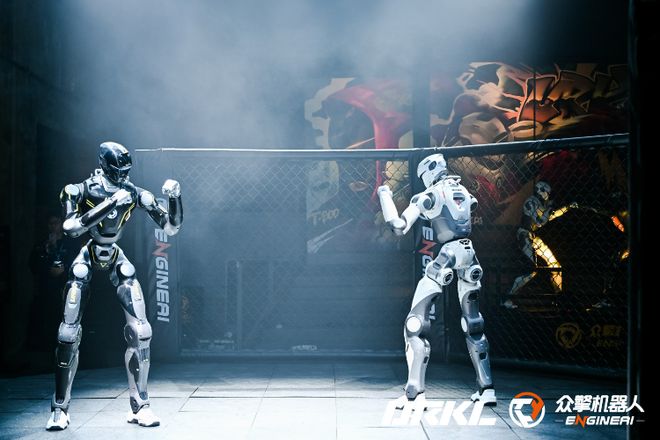
拟奖励千万纯金腰带!全球首个人形机器人格斗赛在深圳开幕
Nan Fang Du Shi Bao· 2026-02-09 10:29
Group 1 - The first global humanoid robot free fighting league (URKL) was launched in Shenzhen, initiated by Shenzhen Zhongqing Robot Technology Co., Ltd. [2] - The league aims to award the champion team with a pure gold belt valued at 10 million yuan, promoting innovation and talent discovery in the field of embodied intelligence [2] - URKL has established competition rules to ensure professionalism and safety, including a BO3 format and mechanisms for KO and TKO [2] Group 2 - URKL is defined as a comprehensive ecosystem platform integrating technology collaboration, resource integration, talent incubation, and capital linkage, serving as a test for core robot components and motion control algorithms [3] - The fighting competition is seen as a bridge connecting laboratory research with market applications, enhancing robots' capabilities in dynamic environments [3] - Current humanoid robots face challenges in performing tasks despite stable locomotion, and combat testing can improve hardware robustness and algorithm stability for real-world applications [3] Group 3 - The evolution of humanoid robot competitions, from marathons to free fighting leagues, reflects the industry's shift towards dynamic events that meet market expectations [4] - High-dynamic competitions like URKL may set new standards for evaluating the technological capabilities of robot companies, facilitating advancements in operational environments [4]

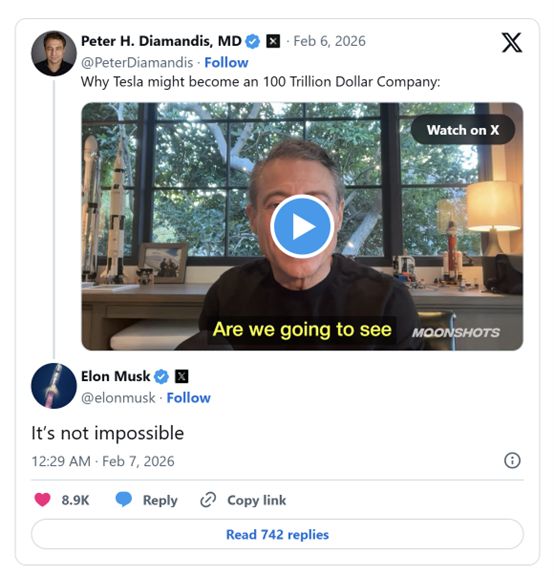
特斯拉市值有望达到100万亿美元,马斯克称“这并非不可能”
Jin Rong Jie· 2026-02-09 10:16
随着特斯拉涉足人工智能和机器人领域,投资者对其发展前景普遍看好,甚至有激进的特斯拉投资者认 为,特斯拉市值有望达到100万亿美元。如果达成,特斯拉市值将达到目前全球排名前十公司的市值之 和的近四倍。100万亿美元市值的预测来自马斯克的铁杆粉丝、方舟投资(ARK Invest)掌门人凯茜•伍 德(Cathie Wood),她日前在一场公开对话中表示,考虑到特斯拉横跨多个行业的长远野心,该车企 有望实现100万亿美元的市值。 不过,2025年,特斯拉的业绩并不算好。根据特斯拉发布的财报,2025年总营收为948.27亿美元,同比 下滑3%,首次出现营收下滑的情况。归属于普通股股东的净利润为37.94亿美元,同比下降46%。其 中,汽车业务收入为 695.26亿美元,同比下降10%,毛利率为17.8%。销量方面,2025年特斯拉共交付 163.6万辆,同比下滑8.6%。特斯拉在财报中强调,2025年是公司战略转型的关键一年,其业务正从"以 硬件为中心"转向"以物理AI为核心"的长期路径。 在社交平台X上,马斯克在相关讨论的帖子下回复称"这并非不可能"。不过有网友指出,特斯拉当前市 值为1.5万亿美元,若要达成100 ...
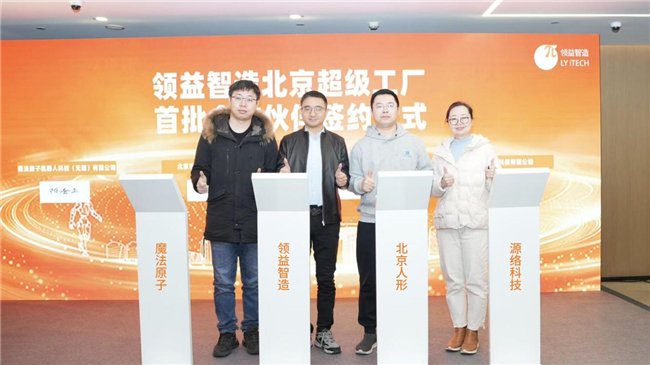
领益智造北京具身智能超级工厂规划产能50万台套,已获首批意向客户
Xin Lang Cai Jing· 2026-02-09 10:09
Core Insights - The launch of the Beijing embodied intelligence super factory marks a significant step in the company's strategy to become a top global player in embodied intelligence hardware manufacturing, with a planned annual capacity of 500,000 units by 2030 [1][11] - The factory is a key component of the company's "three-in-one" strategy, focusing on core components, comprehensive hardware manufacturing services, and the development of application scenarios for robots [3][14] Strategic Implementation - The company announced its "All in Embodied Intelligence" strategy in June 2025, leveraging nearly 20 years of experience in precision manufacturing to transition into the robotics sector [3][14] - The Beijing super factory is part of a global network of four embodied intelligence manufacturing bases, which includes locations in Chengdu, Dongguan, and India, aimed at enhancing production capacity and efficiency [3][14] Manufacturing Capabilities - The Beijing super factory will provide a one-stop manufacturing service, covering precision structural components, core modules, and complete machine assembly and testing [4][14] - The factory aims to achieve a production capacity of 10,000 units in 2026, expanding to 20,000 units in 2027, and reaching the target of 500,000 units by 2030 [4][14] Business Breakthroughs - The company has integrated resources from nine subsidiaries to form a robust operational team of over 2,000 personnel and a core R&D team of more than 100, ensuring scalability [6][16] - By December 2025, the company had completed over 5,000 units of humanoid robot hardware and assembly services, demonstrating its capability for large-scale service delivery [6][16] Hardware Manufacturing - The company has consolidated various manufacturing processes, including CNC, die-casting, 3D printing, and MIM, to create a comprehensive hardware manufacturing service system [7][17] - The company offers customizable solutions for both hardware and software, allowing for tailored products that meet diverse client needs [6][16] Application Scenarios - The company has gained industry recognition by winning multiple awards at the 2025 World Robot Conference and showcasing a multi-robot system at CES, which enhances collaborative capabilities in various automation tasks [18] - The company has trained various robot models for complex tasks across agriculture, culture, and commerce, further expanding its application scenarios [18] Future Outlook - The super factory is seen as a catalyst for building an open and collaborative industrial ecosystem, with the company emphasizing the importance of talent and industry chain in the Yizhuang area [19][20] - The company has established long-term partnerships with numerous leading firms, enhancing its delivery capabilities and standardizing production lines [9][20]