
外汇

Search documents
美元指数DXY短线走低约10点,现报98.80。欧元兑美元EUR/USD日内跌幅达0.50%,现报1.1661。
Jin Rong Jie· 2026-01-05 13:20
Core Viewpoint - The US Dollar Index (DXY) has experienced a short-term decline of approximately 10 points, currently standing at 98.80, while the EUR/USD pair has seen a daily drop of 0.50%, now at 1.1661 [1] Group 1 - The US Dollar Index (DXY) is currently reported at 98.80 after a decline of about 10 points [1] - The EUR/USD exchange rate has decreased by 0.50% during the day, now at 1.1661 [1]
CWG Markets外汇:监管明朗推动加密布局
Xin Lang Cai Jing· 2026-01-05 10:27
Group 1 - The shift in attitude of traditional professional service institutions towards crypto assets is a significant indicator in the context of the accelerating digitalization of the global financial system [1][3] - PwC's decision to expand its related business reflects a concentration of institutional funds and professional resources towards the compliant and institutionalized digital asset sector [1][3] - The advancement of stablecoin legislation and regulatory rules provides clearer risk boundaries and use cases for crypto assets, impacting not only the crypto industry but also traditional sectors like forex, payment clearing, and cross-border capital flows [1][3] Group 2 - The collective entry of the "Big Four" firms into crypto-related services indicates that digital assets are being integrated into the global mainstream financial services framework [2][4] - This trend is expected to lower the barriers for institutional participation and enhance overall market transparency, creating conditions for more traditional financial players to enter the sector [2][4] - Over the long term, as regulatory frameworks mature and professional service capabilities improve, digital assets are likely to form closer linkages with forex, interest rates, and commodity markets, potentially generating new market opportunities in cross-border settlement, asset allocation, and risk management [2][4]


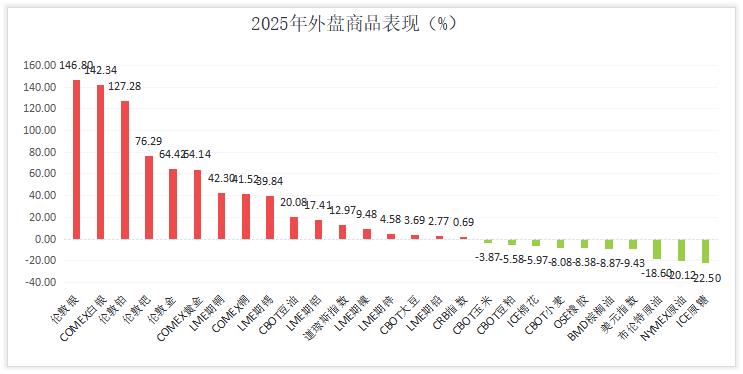
2025年外盘商品:美元创八年最大年跌幅,贵金属成为最大赢家,有色金属全面开花
Wen Hua Cai Jing· 2026-01-05 02:48
Group 1: Stock Market Performance - In 2025, the three major U.S. stock indices achieved double-digit gains, marking the third consecutive year of increases, driven by tariff uncertainties and excitement around AI stocks [3][4] - The S&P 500 index rose by 16.39%, the Nasdaq by 20.36%, and the Dow Jones by 12.97% [4] Group 2: Currency Trends - The U.S. dollar index fell by over 9% in 2025, marking the largest annual decline since 2017, influenced by interest rate cuts and trade policy uncertainties under President Trump [5] - The euro appreciated by over 13% against the dollar during the same period [5] Group 3: Federal Reserve Actions - The Federal Reserve agreed to cut interest rates after extensive discussions on economic risks, with expectations of only one more rate cut in the following year [6][7] Group 4: Precious Metals Performance - Gold experienced its largest annual increase in 46 years, rising approximately 64%, while silver surged by about 147%, marking its strongest annual performance ever [8] - Platinum and palladium also saw significant gains, with platinum increasing over 122% and palladium rising more than 75% [8] Group 5: Commodity Market Trends - LME copper prices rose by 42%, achieving the largest annual increase in 16 years, driven by supply concerns and a weaker dollar [9] - CBOT soybeans recorded their first annual gain in three years, increasing nearly 4% due to China's return to the U.S. market [10] - Oil prices fell nearly 20%, marking the largest annual decline since 2020, influenced by oversupply expectations and geopolitical tensions [11] Group 6: Agricultural Commodities - ICE cotton futures fell by 6% for the fourth consecutive year due to ample global supply and trade uncertainties [12] - ICE raw sugar prices dropped by 22% in 2025, primarily due to increased production leading to a global supply surplus [13]
经济回暖信号闪现 瑞郎多头发起逆袭?
Jin Tou Wang· 2026-01-04 03:21
Core Viewpoint - The USD/CHF exchange rate has shown a slight decline, reflecting a weakening of the dollar's temporary advantage and a structural strength in the Swiss franc, with a cumulative drop of over 12% for the year [1] Group 1: Economic Indicators - Switzerland's leading indicator unexpectedly rose to 103.4 in December, up from 101.7, marking the highest level in over a year, indicating strong performance in manufacturing and construction [1] - Despite the improvement in supply-side indicators, there are signs of weakening demand-side metrics, suggesting a balanced interpretation of the Swiss economy [1] Group 2: Market Dynamics - The price behavior of USD/CHF has been consistent since year-end, with a phase of stabilization around 0.7860 before returning above 0.79 [2] - The current position at 0.7930 is within the consolidation range following a prior rebound, with 0.7950 likely to attract technical traders' attention [2] Group 3: Technical Analysis - The MACD on the daily chart remains below the zero line, indicating a weakening downward trend, while the RSI around 44 suggests the market is not in an extreme oversold condition [2] - The significant decline of the USD/CHF over the past year has led to a reallocation of market weight between the "dollar cycle" and "safe-haven premium" [2] Group 4: Risk and Preference - In times of rising market concerns, the safe-haven attributes of the Swiss franc may enhance its strength, while risk appetite recovery may not immediately diminish the franc's strength due to inertia in interest rate expectations and capital allocation [2] - The oscillation around 0.79 reflects the simultaneous presence of two opposing forces: short-term resilience in USD data providing support, and long-term easing expectations suppressing upward movement [2]
美元2026年开局疲软!多重风险因素恐令颓势加剧
智通财经网· 2026-01-02 09:05
Group 1 - The dollar is experiencing a weak start to 2026 after a decline against most currencies last year, with concerns over the U.S. fiscal deficit, global trade wars, and the independence of the Federal Reserve impacting its performance [1][3] - The euro and pound have shown significant gains, with the euro rising 13.5% and the pound increasing 7.7% in 2025, marking their largest annual increases since 2017 [1] - The dollar index, which measures the dollar against six major currencies, fell by 9.4% in 2025, the largest annual decline in eight years [3] Group 2 - The Japanese yen remains an exception, trading at 156.85 against the dollar, with a less than 1% increase in 2025, and hovering near a 10-month low [4] - Concerns over the independence of central banks are expected to persist into 2026, with upcoming changes in the Federal Reserve leadership potentially influencing interest rate predictions [4][5] - The Australian and New Zealand dollars have started the new year positively, with the Australian dollar rising 0.35% after a nearly 8% increase in 2025, and the New Zealand dollar slightly increasing after ending a three-year decline [5][6]
加元震荡整理油价成核心博弈点
Jin Tou Wang· 2025-12-31 02:33
Core Viewpoint - The USD/CAD exchange rate is experiencing narrow fluctuations, influenced by international oil prices, divergent monetary policies, and geopolitical risks [1] Group 1: Currency Fluctuations - The USD/CAD exchange rate closed at 1.3696, with a slight increase of 0.09%, and reached a peak of 1.3700 during the day [1] - The Canadian dollar, as a commodity currency, is highly correlated with oil prices, which have stabilized around $57.80 per barrel [1] - Geopolitical risks, including conflicts in Venezuela and Ukraine, are providing support for the Canadian dollar [1] Group 2: Oil Prices and Economic Indicators - WTI crude oil prices rose by 1.6% the previous day, but there are concerns about OPEC+ increasing production, which could lead to a decline in oil prices and weaken support for the Canadian dollar [1] - The Canadian economy shows positive indicators with a November CPI of 2.2%, an addition of 53,000 jobs, and a GDP growth of 2.6% in Q3, supporting the Canadian dollar [1] Group 3: Monetary Policy Divergence - The Federal Reserve has cumulatively cut interest rates by 75 basis points in 2025, with expectations for continued easing in 2026, which diminishes the dollar's interest rate advantage [1] - The Canadian central bank has maintained a benchmark interest rate of 2.25%, with a cautious neutral tone, and there are market expectations for a potential rate cut in Q1 2026 [1] Group 4: Technical Analysis - The exchange rate is in a high-level consolidation phase, trading within the range of 1.3620 to 1.3800, with the 50-day moving average providing medium-term support [2] - Key support levels are identified at 1.3650 to 1.3620, with potential declines to 1.3550 to 1.3580 if these levels are breached [2] - Resistance levels are noted at 1.3720 and 1.3800, with analysts suggesting that the exchange rate may continue to oscillate within this range [2]
贵金属早报-20251230
Yong An Qi Huo· 2025-12-30 01:47
Group 1: Price Performance - Latest prices of London Gold, London Silver, London Platinum, London Palladium, WTI Crude Oil, and LME Copper are 4337.05, 74.64, 2208.00, 1837.00, 58.08, and 12553.00 respectively, with changes of 0.00, 0.00, 0.00, 0.00, 1.34, and 420.00 [1] - Latest values of the US Dollar Index, Euro to US Dollar, British Pound to US Dollar, US Dollar to Japanese Yen, and US 10 - year TIPS are 98.00, 1.18, 1.35, 156.03, and 1.91 respectively, with changes of - 0.04, 0.00, 0.00, - 0.53, and 0.00 [1] Group 2: Trading Data - Latest COMEX silver inventory is 13969.43, with a change of - 18.67;上期所白银库存 is 796.74, with a change of - 22.69; gold ETF持仓 is 1071.99, with a change of 0.86; silver ETF持仓 is 16305.96, with a change of - 84.60;上金所白银库存 is 714.41, with a change of 0.00;上金所黄金递延费支付方向 is 1;上金所白银递延费支付方向 is 2 [1] Group 3: Data Source - The data in the above charts are from Bloomberg, Yong'an Yuandian Information, and Wind [4]
人民币汇率“破7”之后,是单边升值,还是长期转向?
Sou Hu Cai Jing· 2025-12-29 12:29
2025年12月25日,离岸人民币对美元汇率一举升破"7.0"关口,为2024年9月以来首次。截至当日,在岸人民币最高触及7.0061,创15个月新高。这一波升值 行情不仅让投资者振奋,更引发市场对人民币未来走势的激烈讨论。 直接导火索: 美联储降息预期升温:12月美联储宣布降息后,美元指数跌破100,市场对2026年继续降息的预期增强,非美货币普遍走强。 年末"结汇潮"效应:外贸企业年底集中将美元收入兑换为人民币,推升人民币需求。 中国经济韧性显现:贸易顺差扩大、外资流入增加,市场对人民币信心增强。 一、破"7"的深层逻辑:三大核心驱动 1. 美联储政策转向:美元走弱的"外因" 降息周期开启:美联储2025年累计降息75个基点,美元指数全年下跌近10%,创2017年以来最大跌幅。 市场预期分化:尽管降息预期推动美元走弱,但专家提醒"不应放大降息效应"。美国经济仍具韧性,若通胀反弹或经济加速,美联储可能暂停降息。 历史规律警示:2017年美元指数下跌9.9%后,2018年反弹回升。当前市场对美元利空因素已部分定价,未来走势需更高门槛的利空支撑。 2. 国内经济基本面:人民币的"内力"支撑 贸易顺差创新高:20 ...
【UNforex财经事件】涨幅透支触发获利了结 黄金在假期后阶段性回落整固
Sou Hu Cai Jing· 2025-12-29 09:54
Group 1 - The overall trading pace in the market remains restrained due to the year-end holiday effects, but liquidity has improved compared to previous periods [1] - Gold and silver prices have experienced a pullback after reaching historical highs, indicating a phase of profit-taking and market consolidation [1] - The U.S. dollar index is maintaining a low range, showing limited volatility in major non-U.S. currencies, which has not provided clear direction for precious metals [1] Group 2 - Despite short-term pressure, gold has seen a cumulative increase of nearly 70% in 2025, marking its best annual performance since the late 1970s [2] - Trump's comments regarding the next Federal Reserve chair maintaining a low interest rate stance have reignited discussions about policy independence and future monetary paths, reinforcing the long-term value of traditional safe-haven assets like gold [2] - The Bank of Japan's recent monetary policy meeting highlighted concerns over inflation risks, although market expectations for actual policy changes remain cautious [2] Group 3 - Technically, gold prices are holding above the 100-day exponential moving average, with the Bollinger Bands indicating an ongoing upward structure [3] - Key resistance for gold is noted at $4550, with potential upward movement towards the psychological level of $4600 if trading volume supports it; initial support is at $4430 [3] - The current pullback in gold prices is viewed as a structural consolidation rather than a reversal of fundamental logic, with market focus shifting to Federal Reserve policy signals and global risk sentiment [3]
美元假日淡市中持稳 年内累计跌幅近10%
Xin Lang Cai Jing· 2025-12-29 07:33
在假期交易清淡、缺乏新催化剂的背景下,美元对一篮子货币汇率持稳。本周经济日程表事件稀少,多 地市场因新年休市。随着月末和年末临近,美元仓位可能出现调整。美元指数持平于98.025点。伦交所 数据显示,年内迄今该指数已下跌近10%,特朗普政府的贸易政策与美联储降息周期共同导致美元走 弱。 责任编辑:王许宁 在假期交易清淡、缺乏新催化剂的背景下,美元对一篮子货币汇率持稳。本周经济日程表事件稀少,多 地市场因新年休市。随着月末和年末临近,美元仓位可能出现调整。美元指数持平于98.025点。伦交所 数据显示,年内迄今该指数已下跌近10%,特朗普政府的贸易政策与美联储降息周期共同导致美元走 弱。 责任编辑:王许宁 ...