
美元兑加元汇率

Search documents
美加胶着1.3600关口 静待加央行决议破局
Jin Tou Wang· 2026-01-27 02:31
Group 1 - The core focus of the market is on the Bank of Canada's interest rate decision, with expectations that the policy rate will remain unchanged at 2.25%. The key factor is not the rate adjustment itself, but the guidance in the decision statement [1] - If the central bank reiterates that the current interest rate level is appropriate and that inflation targets still require time to validate, a dovish signal will further delay rate hike expectations, weakening the CAD's interest rate advantage and pushing USD/CAD towards the 1.3600 range [1] - Conversely, if the statement highlights concerns over global demand slowdown and escalating trade frictions, it may suppress market expectations for a rapid appreciation of the CAD, thus limiting the downward space for the exchange rate [1] Group 2 - The CAD's performance is closely tied to oil prices, with WTI crude stabilizing around $61.10, providing temporary support for the CAD [2] - The current supply-side tightening and regional supply disruptions are likely to push oil price volatility higher, benefiting Canada as an energy-exporting nation by improving trade conditions and boosting corporate profits and fiscal revenues [2] - Technically, USD/CAD remains in a delicate balance, with the downtrend from the previous high of 1.3927 unbroken. The price has returned below 1.3700 and is testing lower levels, indicating persistent selling pressure above [2]
ETO Markets:油价跌美元降息推迟 美元兑加元回升至1.3870
Sou Hu Cai Jing· 2026-01-20 05:27
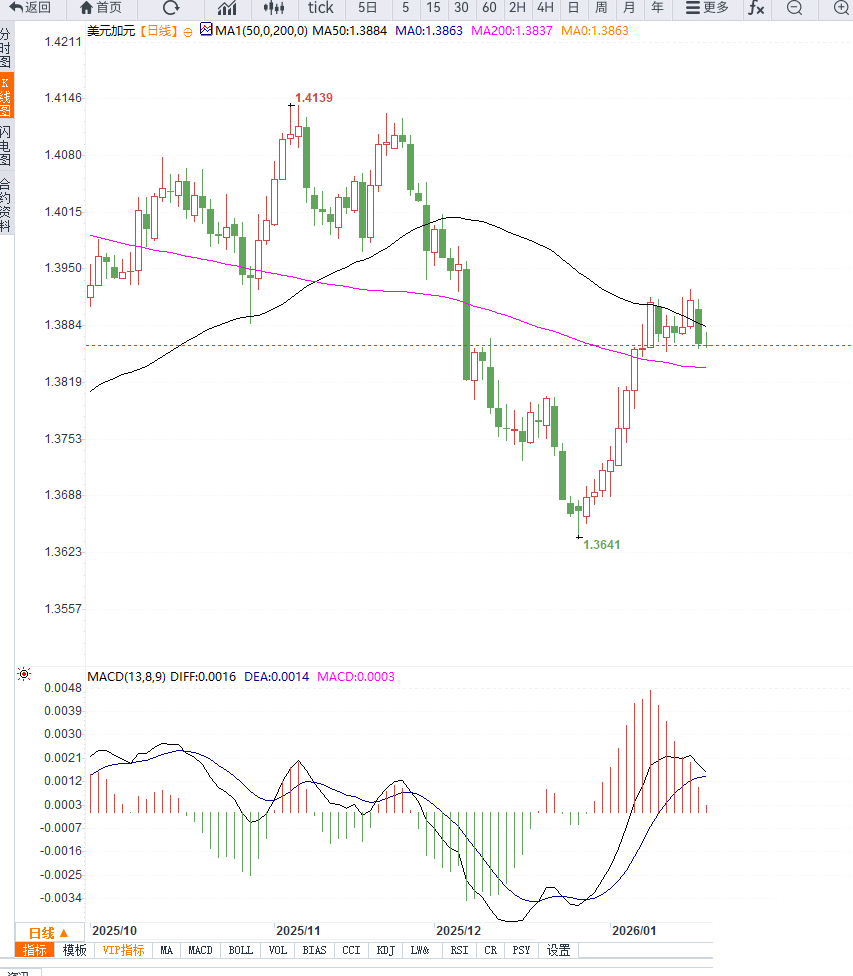
Group 1 - The core viewpoint of the articles indicates that the USD/CAD exchange rate is experiencing a slight rebound, driven primarily by the correlation with international oil prices and ongoing trade concerns between the US and Europe [1][2]. - The recent adjustments in the Federal Reserve's interest rate expectations suggest that US rates will remain elevated for a longer period, which supports the USD's relative strength while limiting the potential for a significant pullback against the CAD [2]. - The technical analysis of the USD/CAD exchange rate shows a generally strong upward trend, with key support levels above 1.3800 and significant resistance around 1.3900-1.3920, indicating a range-bound market influenced by oil price fluctuations and US monetary policy expectations [3]. Group 2 - The market sentiment remains cautious due to uncertainties surrounding trade dynamics and energy demand, which could impact the CAD's performance against the USD [2]. - The interplay between oil price movements and US monetary policy is crucial for the USD/CAD exchange rate, with macroeconomic risks still present, suggesting a likely continuation of the range-bound trading between 1.38 and 1.39 [3]. - Future developments in oil prices and US economic data will be critical in shaping the market's outlook on the Federal Reserve's interest rate decisions and the overall USD/CAD exchange rate trajectory [3].

Vatee万腾外汇:油价波动美元降息推迟影响,美元兑加元温和上扬
Sou Hu Cai Jing· 2026-01-20 05:21
Core Viewpoint - The USD/CAD exchange rate is experiencing a mild upward trend, influenced by fluctuations in oil prices and adjustments in market expectations regarding major economies' policies [1][3]. Group 1: Currency Dynamics - The Canadian dollar (CAD), as a commodity currency, is closely linked to international oil prices, with Canada being the largest exporter of crude oil to the U.S. [3]. - Recent fluctuations in West Texas Intermediate (WTI) crude oil prices, which recently fell to around $59.30 per barrel after two days of gains, have indirectly weakened the CAD, providing support for the USD against the CAD [3][4]. - The upward potential of the USD/CAD pair is constrained by uncertainties in U.S.-European trade relations, with new tariff plans and countermeasures being developed [3][4]. Group 2: Economic Indicators - The USD is supported by stable domestic labor market data, which has delayed market expectations for a Federal Reserve interest rate cut [4]. - Several Federal Reserve officials have indicated that the urgency for further monetary policy easing is limited until there is clear evidence of inflation moving towards the 2% target [4][5]. - Adjustments in institutional forecasts have pushed back the anticipated timing for the first rate cut, providing a fundamental support for the USD [4]. Group 3: Technical Analysis - The 1.3870 level is identified as a key short-term resistance point for the USD/CAD exchange rate [3]. - If oil prices continue to decline or U.S. economic data remains strong, the exchange rate may test higher resistance levels; conversely, if trade tensions ease or oil demand expectations improve, the CAD may gain rebound momentum [3][4]. Group 4: Future Outlook - The USD/CAD exchange rate is likely to continue being influenced by oil market volatility, changes in monetary policy expectations from major economies, and developments in the international trade environment [5]. - Market participants are closely monitoring upcoming economic data and policy movements, which may provide further guidance for exchange rate trends [5].

加元高位震荡修正 油价与央行政策分歧主导博弈
Jin Tou Wang· 2026-01-20 02:46
Group 1 - The USD/CAD exchange rate is experiencing a high-level consolidation, with the price reported at 1.3872, showing little change from the previous day's close of 1.3868, indicating a balance between the support from oil prices for CAD and data support for USD [1] - The recent rebound in oil prices, driven by geopolitical risks in the Baltic region and increased attacks on Russian oil tankers by Ukraine, has provided strong support for the CAD, which is closely tied to international oil price fluctuations [1] - The Canadian economy, as a major oil exporter, benefits from rising oil prices, which improve export revenues and trade surplus expectations, thereby strengthening the valuation logic for CAD [1] Group 2 - There is a significant divergence in the policy outlook of the Bank of Canada, with major banks holding varied views on interest rate direction; some expect a 50 basis point hike to 2.75% by year-end due to inflation pressures, while others predict a rate cut below 2% to stimulate the economy [2] - The resilience of the USD is attributed to strong economic data from the U.S. and delayed expectations for Fed rate cuts, with initial jobless claims dropping to 198,000 and retail sales rebounding, reinforcing the logic for maintaining restrictive policies [2] - The technical analysis indicates that the USD/CAD is in a high-level consolidation phase, with key resistance at 1.3925-1.3930 and support at 1.3850-1.3860, driven by oil price fluctuations and central bank policy expectations [3]
政策分化叠加油价波动 加元震荡拉锯
Jin Tou Wang· 2026-01-06 01:57
Group 1 - The USD/CAD exchange rate is currently in a volatile range, driven by the divergence in monetary policies between the Federal Reserve and the Bank of Canada, along with fluctuations in international oil prices and the structural trends of the US dollar index [1][2] - The Federal Reserve has initiated a monetary easing cycle, with a cumulative rate cut of 75 basis points expected by 2025, while the Bank of Canada is maintaining its benchmark rate at 2.25% after four rate cuts in 2025, indicating a cautious policy stance [1][2] - The Canadian dollar's performance is closely linked to oil prices, which have recently declined due to OPEC+ production plans and weakening demand expectations, thereby reducing the attractiveness of the CAD [2] Group 2 - The USD index has seen a cumulative decline of over 9% in 2025, with predictions of a further 10% depreciation by the end of the year, which indirectly affects the USD/CAD exchange rate [2] - The technical analysis indicates that the USD/CAD exchange rate is currently stable within a range, with no clear trend signals, and short-term indicators suggest a lack of momentum for significant breakthroughs [2] - Looking ahead, the USD/CAD exchange rate is expected to maintain its volatile range, with key resistance at 1.38 and support at 1.3750, while monitoring the monetary policy statements from the Federal Reserve and the Bank of Canada, as well as economic data from both countries [3]
TMGM外汇平台:美元/加元于1.37附近窄幅整理 年末市场交投清淡
Sou Hu Cai Jing· 2025-12-31 08:42
Group 1 - The USD/CAD exchange rate is fluctuating around the key level of 1.3700, currently reported at 1.3706, with a slight increase of 0.05% [1] - The USD index has risen slightly, reaching a one-week high of 98.3429, with a gain of 0.09% [3] - The Federal Reserve's December meeting minutes indicate a completed 25 basis point rate cut, lowering the federal funds rate target range to 3.50% to 3.75%, with a majority of officials supporting further rate cuts if inflation decreases as expected [3] Group 2 - The Canadian dollar is relatively stable, with market expectations that the Bank of Canada will not adjust interest rates in the short term, maintaining the current benchmark rate at 2.25% [3] - The Bank of Canada's recent meeting minutes reflect uncertainty regarding future rate adjustments due to U.S. trade policy and economic data fluctuations, leading to a decision to maintain current rates to stabilize inflation [3] - The technical analysis shows that the USD/CAD is in a high-level consolidation pattern, with the price oscillating around the 1.37 mark, indicating a balance of buying and selling forces [4] Group 3 - The current movement of the USD/CAD is influenced more by year-end market liquidity decline and position adjustments rather than significant changes in fundamentals [6] - The Federal Reserve retains the space for further rate cuts but is cautious in its approach, while the Bank of Canada maintains a wait-and-see attitude, resulting in limited divergence in monetary policies between the two countries [6] - The USD/CAD is likely to continue its oscillation within the range of 1.3650 to 1.3750 until macroeconomic data and central bank policy signals become clearer in the new year [6]

加元震荡整理油价成核心博弈点
Jin Tou Wang· 2025-12-31 02:33
Core Viewpoint - The USD/CAD exchange rate is experiencing narrow fluctuations, influenced by international oil prices, divergent monetary policies, and geopolitical risks [1] Group 1: Currency Fluctuations - The USD/CAD exchange rate closed at 1.3696, with a slight increase of 0.09%, and reached a peak of 1.3700 during the day [1] - The Canadian dollar, as a commodity currency, is highly correlated with oil prices, which have stabilized around $57.80 per barrel [1] - Geopolitical risks, including conflicts in Venezuela and Ukraine, are providing support for the Canadian dollar [1] Group 2: Oil Prices and Economic Indicators - WTI crude oil prices rose by 1.6% the previous day, but there are concerns about OPEC+ increasing production, which could lead to a decline in oil prices and weaken support for the Canadian dollar [1] - The Canadian economy shows positive indicators with a November CPI of 2.2%, an addition of 53,000 jobs, and a GDP growth of 2.6% in Q3, supporting the Canadian dollar [1] Group 3: Monetary Policy Divergence - The Federal Reserve has cumulatively cut interest rates by 75 basis points in 2025, with expectations for continued easing in 2026, which diminishes the dollar's interest rate advantage [1] - The Canadian central bank has maintained a benchmark interest rate of 2.25%, with a cautious neutral tone, and there are market expectations for a potential rate cut in Q1 2026 [1] Group 4: Technical Analysis - The exchange rate is in a high-level consolidation phase, trading within the range of 1.3620 to 1.3800, with the 50-day moving average providing medium-term support [2] - Key support levels are identified at 1.3650 to 1.3620, with potential declines to 1.3550 to 1.3580 if these levels are breached [2] - Resistance levels are noted at 1.3720 and 1.3800, with analysts suggesting that the exchange rate may continue to oscillate within this range [2]
震荡回升!加元站稳1.3670 降息分歧油价成关键博弈点
Jin Tou Wang· 2025-12-25 02:40
Core Viewpoint - The USD/CAD exchange rate is experiencing a rebound, currently at 1.3670, influenced by central bank policy divergences and economic data fluctuations [1][2]. Group 1: Exchange Rate Dynamics - The USD/CAD exchange rate has shown resilience, stabilizing above 1.3670 after a high of 1.3944 in September, reflecting strong market dynamics despite fluctuations in oil prices and policy expectations [1]. - The Bank of Canada maintained its benchmark interest rate at 2.25% on December 10, indicating a resilient economy despite challenges from U.S. tariffs, with future policy adjustments dependent on inflation and economic data [1][2]. Group 2: Inflation and Economic Indicators - Canada's Consumer Price Index (CPI) rose by 2.4% year-on-year in September, up from 1.9% in August, driven by narrowing gasoline price declines and rising food prices, with core CPI at 2.6% [2]. - The Canadian economy is characterized by a mix of resilience and pressure, with a strong GDP growth of 2.6% in Q3, but expected weakness in Q4 due to declining net exports and uncertainties from U.S. tariff policies [2]. Group 3: Commodity Influence and Market Sentiment - The structural weakening of the U.S. dollar index, which has fallen over 9% this year, is countered by the weakening commodity attributes of the Canadian dollar, limiting the upward movement of USD/CAD [3]. - Technical analysis indicates a clear short-term oscillation pattern for USD/CAD, with key support levels at 1.3321 and 1.3265, and resistance levels at 1.3383 and 1.3480, with potential volatility due to holiday liquidity constraints and economic data releases [3].
政策原油支撑加元小幅攀升
Jin Tou Wang· 2025-12-10 02:41
Core Viewpoint - The USD/CAD exchange rate is experiencing a slight upward trend, influenced by the monetary policies of the Bank of Canada and the Federal Reserve, with market expectations leaning towards a potential interest rate cut by the Fed [1][2][3][4] Group 1: Exchange Rate Movements - On December 10, the USD/CAD exchange rate recorded 1.3853, showing a minor increase from the previous day, with a rise of 0.0506% [1] - The exchange rate opened at 1.3852, reaching a high of 1.3854 and a low of 1.3841 during the day [1] - The short-term outlook indicates a stable upward trend for the USD/CAD, with key resistance at the 1.3875 level [2][3] Group 2: Monetary Policy Impact - The Bank of Canada is expected to maintain its policy rate at 2.25%, as officials have indicated that the current rate is "basically in a reasonable range" [1] - Market expectations show an 88% probability that the Federal Reserve will cut rates by 25 basis points in its December meeting, alongside a proposed monthly purchase of $45 billion in Treasury securities [1][3] - The divergence in monetary policies between the U.S. and Canada is a key driver of the USD/CAD fluctuations [1][4] Group 3: Economic Indicators - International oil prices have been low, limiting the appreciation potential of the Canadian dollar, with Brent crude futures recently falling below $70 per barrel [2] - Despite a better-than-expected economic growth rate in Canada for Q3, the growth was primarily driven by reduced imports and increased military spending, highlighting potential risks in consumer spending [2] - The future trajectory of the Canadian dollar will depend on the recovery of the economy and the stabilization of international oil prices [4]
原油撑腰政策托底“加强美弱”逻辑
Jin Tou Wang· 2025-11-26 02:51
Group 1 - The core exchange rate of USD/CAD is influenced by oil prices, central bank policy divergence, and economic fundamentals between the US and Canada [1][2] - Recent geopolitical tensions and OPEC+ production cuts have led to a 12.3% increase in WTI crude oil prices, supporting the Canadian dollar and expanding Canada's trade surplus to 2.8 billion CAD in October [1] - The Federal Reserve has an 82.9% probability of rate cuts in December, while the Bank of Canada is expected to maintain its rate at 4.75% until Q1 2026, creating a significant interest rate differential that supports the Canadian dollar [1][2] Group 2 - Economic data shows a stable Canadian economy with an unemployment rate of 5.7% and core inflation at 3.2%, contrasting with weaker US economic indicators, leading to a notable decline in USD/CAD [2] - The depreciation of the Canadian dollar benefits energy companies, while its appreciation requires firms to optimize pricing strategies to hedge risks [2] - The relationship between USD/CAD and energy indices is negatively correlated, enhancing the asset allocation value of the Canadian dollar [2] Group 3 - Technical analysis indicates that USD/CAD is at a critical trend reversal point, with strong support at the lower channel and 60-day moving average [3] - The MACD indicator remains in a bearish state, suggesting that downward momentum has not fully dissipated, while the KDJ indicator indicates potential short-term rebound demand [3] - Key resistance levels are identified, and failure to break through these levels could reinforce the downward trend, while breaking below previous lows may initiate a new downtrend [3] Group 4 - The convergence of technical bearish signals and the fundamental "weak US, stable Canada" narrative clarifies the current USD/CAD trend logic, providing decision-making guidance for market participants [4]