建筑

Search documents
宏观专题报告:开年经济“新变化”?
Shenwan Hongyuan Securities· 2026-02-12 09:13
Group 1: Production Trends - In January, the manufacturing PMI dropped to 49.3%, a decrease of 0.8 percentage points, indicating a contraction in manufacturing activity[3] - The average PMI over the past two months shows a recovery trend, rising 0.5 percentage points to 49.7% compared to November 2025[15] - The operating rate of blast furnaces in the metallurgical chain increased by 2.2 percentage points year-on-year to 1% during the weeks leading up to the Spring Festival[21] Group 2: Demand Insights - Export activity is expected to remain strong due to a delayed Spring Festival, with foreign trade cargo volume increasing by 13.9% year-on-year in the weeks leading up to the festival[5] - Retail sales are projected to see a slight rebound of around 1.9% in January-February 2026, supported by extended holiday periods and local consumption stimulus policies[40] - The demand for consumer goods has been impacted by previous "trade-in" policies, leading to a low performance in retail sales for household appliances and vehicles[43] Group 3: Price Dynamics - The Producer Price Index (PPI) is expected to show weak recovery, with January PPI rising to -1.4% year-on-year, indicating limited upward pressure from upstream prices[57] - The Consumer Price Index (CPI) is anticipated to exhibit a "V-shaped" trend due to the timing of the Spring Festival, with food prices providing moderate support[7] - The overall inflationary pressure remains subdued, with core CPI expected to stay low due to weak demand and reduced government subsidies[7] Group 4: Investment Outlook - Investment is expected to improve moderately in early 2026, supported by government debt financing and new policy measures aimed at infrastructure projects[49] - The net financing of government bonds in January showed positive performance, indicating a supportive environment for infrastructure investment[49] - The operating rates for asphalt and grinding processes maintained resilience, reflecting stable investment activity in the construction sector[49]
2026年一季度中国经济观察报告-毕马威
Sou Hu Cai Jing· 2026-02-12 06:22
Economic Overview - In 2025, China's economy reached a total of 140 trillion yuan, with a real GDP growth of 5.0%, achieving the target set at the beginning of the year. The GDP growth rate for the fourth quarter was 4.5%, down 0.3 percentage points from the third quarter, with external demand being the main support while consumption and investment remained weak [1][15][30] - The economic landscape showed four distinct divergences: supply-demand, internal-external demand, new-old momentum, and macro data versus micro perception. Traditional industries faced demand losses and slow capacity clearance, leading to supply-demand mismatches that affected prices and corporate profits [1][31] Investment Trends - Fixed asset investment in 2025 saw a historic decline of 3.8%, marking the first annual negative growth since records began. In the fourth quarter, investment dropped by 12.8%, significantly worse than the 6.2% decline in the third quarter. Real estate, infrastructure, and manufacturing investments all saw substantial declines [19][50] - The government is expected to implement policies to stabilize and support investment, with a focus on "investing in people" and encouraging private investment. The manufacturing sector is anticipated to see marginal improvements due to the "14th Five-Year Plan" emphasizing technological innovation and industrial upgrades [2][51][60] Consumption Insights - The total retail sales of consumer goods in 2025 grew by 3.7%, with a notable decline of 1.8% in the fourth quarter, marking the first quarterly negative growth since 2023. However, service consumption and self-indulgent consumption showed resilience, with service consumption growth reaching 5.5% [18][37] - The consumption market is expected to continue its shift towards new and quality-driven consumption, with policies aimed at promoting green, intelligent, and elderly-friendly consumption [2][18] Export Performance - Exports in 2025 increased by 5.5%, with a trade surplus of nearly 1.2 trillion USD, a historical high. High-end manufacturing emerged as the core driver of exports, supported by strong demand from ASEAN, Africa, India, and other regions [21][30] - The government aims to address trade imbalances and enhance the quality of exports while navigating the challenges posed by global trade protectionism [21][30] Fiscal Policy - Public fiscal revenue in 2025 decreased by 1.7%, falling short of the initial budget growth target of 0.1%. Public expenditure growth was only 1.0%, the lowest completion rate on record at 96.8% of the budget [22][65] - The government plans to increase fiscal support for infrastructure and social welfare, with a focus on stabilizing investment and consumption in 2026 [22][65] Monetary Policy - In 2025, monetary policy was characterized by moderate easing, with a total of 50 basis points in reserve requirement ratio cuts and 10 basis points in interest rate cuts. The focus for 2026 will be on stabilizing expectations and promoting transformation [23][60] - The central bank is expected to maintain a flexible and effective monetary policy, with potential further cuts in interest rates and reserve requirements to support economic recovery [23][60]


美国2026年1月非农数据:教育医疗支撑美国就业市场保持强劲
Donghai Securities· 2026-02-12 05:34
Employment Data - In January 2026, the U.S. added 130,000 non-farm jobs, significantly exceeding the forecast of 70,000 jobs, with the previous month's figure revised down to 48,000 from 50,000[2] - The unemployment rate fell to 4.3%, better than the expected 4.4% and down from the previous 4.4%[2] - Private sector employment increased by 172,000 jobs, with the production sector adding 36,000 jobs and the service sector contributing 136,000 jobs[2] Wage Growth and Inflation Concerns - Average hourly earnings in the private sector rose by 0.4% month-over-month, up from 0.1% in the previous month, raising concerns about inflation driven by wage growth[2] - The significant increase in wages, particularly in cyclical industries like transportation and finance, is attributed to labor shortages caused by adverse weather conditions[2] Sector-Specific Insights - The construction sector saw a rebound with 33,000 new jobs, primarily due to preemptive hiring, although wage growth in this sector slowed from 0.4% to 0.2%[2] - The healthcare and education sectors added 137,000 jobs, largely influenced by the extension of the Affordable Care Act, while financial activities and leisure sectors faced declines[2] Government Employment Trends - Government employment decreased by 42,000 jobs, with federal jobs down by 34,000 and state jobs down by 18,000, likely due to a temporary government shutdown affecting payroll reporting[2] Market Reactions and Economic Outlook - Following the employment data release, markets expect the Federal Reserve to delay interest rate cuts until July, indicating a tightening labor market[2] - The U.S. economy is projected to continue its recovery, but inflation risks remain, particularly due to wage pressures in the labor market[3]
财经早报:超六成私募倾向于满仓过节 锂价“第三次超级周期”要来了?丨2026年2月12日
Xin Lang Zheng Quan· 2026-02-12 00:15
Group 1 - The Chinese government is advancing artificial intelligence (AI) technology innovation and application across various industries, highlighting its potential to transform production and lifestyle [2][3] - The government aims to establish a comprehensive AI ecosystem, focusing on algorithm innovation, high-quality data supply, and commercial applications to enhance AI's market presence [3] - The initiative includes promoting international cooperation and developing a robust governance framework for AI applications to ensure safety and compliance [3] Group 2 - The State Council of China has set a goal to establish a unified national electricity market by 2030, with market-based transactions accounting for approximately 70% of total electricity consumption [4] - The implementation plan includes 19 key tasks aimed at breaking down market barriers and encouraging participation from various stakeholders, including private enterprises [4] - This initiative is expected to enhance the efficiency of the energy sector and stabilize energy costs, thereby improving the global competitiveness of Chinese companies [4] Group 3 - The private equity sector shows optimism for the market, with over 62% of surveyed firms preferring to hold significant positions during the upcoming holiday, indicating confidence in structural opportunities despite market volatility [11] - The ETF market has seen a significant outflow of funds, with a 38.11% decrease in trading volume, while the total number of ETF shares increased by 1.68% [13] - The consumer sector in Hong Kong is experiencing a resurgence in IPO activity, with over 10 companies filing for H-shares in early 2026, indicating a growing interest in the market [14] Group 4 - The U.S. labor market showed unexpected growth in January, which may influence the Federal Reserve's interest rate decisions, suggesting a potential pause in rate hikes [15] - The technology sector is facing challenges, particularly in software stocks, as concerns about AI's impact on job functions and valuations continue to rise [6] - The cryptocurrency market experienced significant sell-offs, with Bitcoin dropping below $66,000, reflecting broader market volatility [6] Group 5 - Tianji Co. is under investigation by the China Securities Regulatory Commission for information disclosure violations, which may impact its operations [16] - The company has recently corrected financial reporting errors and is undergoing scrutiny for its governance practices [16] - The divorce settlement involving a major shareholder of a public company highlights the financial implications of personal matters on corporate governance [17] Group 6 - Wenta Technology announced that its control over Anshi Semiconductor remains limited due to ongoing investigations, affecting its operational strategy [19] - The company is facing challenges in its governance structure as it navigates legal and regulatory hurdles [19] - The semiconductor industry is under scrutiny, with companies like Wenta needing to adapt to changing regulatory environments [19]

中国建筑国际(03311.HK):2月11日南向资金减持17.6万股
Sou Hu Cai Jing· 2026-02-11 19:26
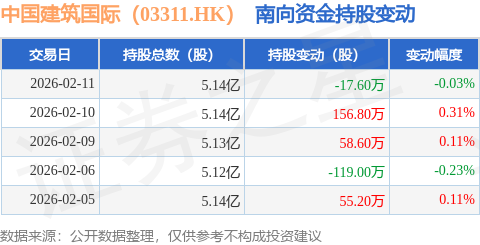
Group 1 - The core point of the news is that southbound funds have reduced their holdings in China State Construction International (03311.HK) by 176,000 shares on February 11, 2026, while there have been fluctuations in holdings over the past trading days [1] - Over the last five trading days, southbound funds have increased their holdings for three days, resulting in a net increase of 1.34 million shares [1] - In the last twenty trading days, there have been eleven days of reductions in holdings by southbound funds, totaling a net decrease of 6.4823 million shares [1] Group 2 - As of now, southbound funds hold 514 million shares of China State Construction International, which accounts for 9.73% of the company's total issued ordinary shares [1] - The company primarily engages in construction business, infrastructure project investment, toll road operations, project supervision services, and facade engineering, among other activities [2] - Additionally, the company is involved in the renovation of industrial buildings, providing project supervision services, selling construction materials, and leasing machinery and investment properties [2]


重磅数据,远超预期!美联储降息预期“正在起变化”!
Sou Hu Cai Jing· 2026-02-11 15:57
Group 1 - The U.S. labor market showed stronger-than-expected growth in January, with non-farm payrolls increasing by 130,000, significantly surpassing the Dow Jones estimate of 55,000 [2][3] - The unemployment rate decreased slightly to 4.3%, below the market expectation of 4.4%, indicating an overall improvement in the employment situation [3][4] - The healthcare sector was the primary driver of job growth, adding 82,000 positions, while the social assistance sector contributed 42,000 jobs [3][4] Group 2 - The report indicated a downward revision of initial employment data by 898,000 for the year prior, aligning with Wall Street expectations [4] - Analysts noted that the strong job growth in January may stabilize the labor market, despite ongoing weaknesses, providing a more encouraging outlook for the year ahead [4] - Following the employment data release, expectations for a Federal Reserve interest rate cut were pushed back from June to July, with the probability of a rate cut in March dropping from 19.6% to 6% [5][6]
US economy added 130K jobs in January, delayed report shows
Fox Business· 2026-02-11 14:06
Job Growth Overview - The U.S. economy added 130,000 jobs in January, surpassing economists' expectations of 70,000 jobs [2] - The unemployment rate decreased to 4.3%, slightly better than the anticipated 4.4% [2] Revisions to Previous Reports - Revisions indicated that November's job gains were adjusted down by 15,000 from 56,000 to 41,000, and December's gains were revised down by 2,000 from 50,000 to 48,000, totaling 17,000 fewer jobs than previously reported for November and December [3] Sector Performance - Private payrolls increased by 172,000 jobs in January, significantly exceeding the LSEG estimate of 70,000 [4] - The manufacturing sector added 5,000 jobs, contrary to expectations of a loss of 5,000 jobs [6] - The healthcare sector saw a substantial increase of 82,000 jobs, with notable gains in ambulatory healthcare services (+50,000), hospitals (+18,000), and nursing and residential care facilities (+13,000), surpassing its monthly average of 33,000 jobs added in 2025 [6] - Construction firms added 33,000 jobs, primarily in nonresidential specialty trade contractors (+25,000), after a flat performance in 2025 [7] - The financial sector experienced a decline of 22,000 jobs, with a total loss of 49,000 jobs since its peak in May 2025, including a loss of 11,000 jobs in insurance carriers and related activities [7] Government Employment Changes - Government payrolls decreased by 42,000 jobs in January, with federal job cuts accounting for 34,000 and state job cuts for 18,000, partially offset by a gain of 10,000 jobs in local governments [5] - The federal workforce has decreased by 327,000 jobs since its peak in October 2024, representing a decline of 10.9% [5]

中国武夷(000797.SZ)拟组建联合体共同参加菲律宾建筑改造升级项目投标
智通财经网· 2026-02-11 11:06
Core Viewpoint - China Wuyi (000797.SZ) plans to participate in the bidding for the renovation and upgrading project of public school buildings in Manila, Philippines, indicating a strategic move to expand its international presence in the construction sector [1] Group 1: Project Details - The bidding project involves the renovation, reinforcement, and upgrading of public school buildings [1] - The company will form a consortium with Fujian JianKe Engineering Technology Co., Ltd. to meet the bidding requirements [1] Group 2: Company Position - The company's own performance requirements do not meet the conditions specified in the bidding documents, necessitating the formation of a joint venture [1]

中建五局建筑节能科技有限公司与华润电力控股有限公司新设合营企业案
Zhong Guo Zhi Liang Xin Wen Wang· 2026-02-11 08:54
Group 1 - The announcement date for public disclosure is set from February 11, 2026, to February 20, 2026 [3]


美股科技巨头利润“霸权”告终?盈利增长正向全行业扩散
Hua Er Jie Jian Wen· 2026-02-11 06:49
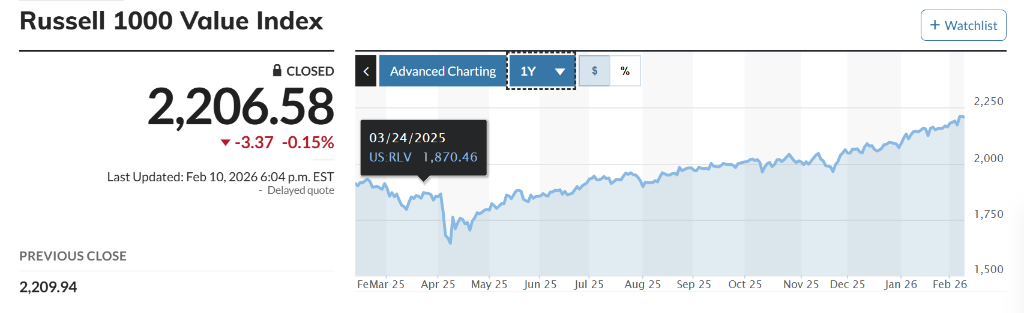
Core Insights - The dominance of a few tech giants in profits is fundamentally changing as the earnings season progresses, with the Russell 1000 Value Index outperforming growth indices since mid-December 2022 [1] - The number of sectors in the S&P 500 showing positive growth has increased from 6 to 8, with nearly half of the companies reporting double-digit growth rates, and a median growth rate close to 10%, marking a four-year high [1] Group 1: Earnings Growth and Market Dynamics - The overall earnings growth rate for the S&P 500 has risen to 14.5%, a four-year high, indicating a broadening of growth beyond just large tech stocks [3] - Market analysts suggest a style rotation is occurring, driven by cyclical factors rather than a decline in tech giants, signaling an end to the previously rare concentration of profits [3] - The current economic phase is characterized as a "robust broad expansion," which typically benefits widespread corporate profits, as confirmed by the earnings reports of S&P 500 constituents [4] Group 2: Sector Rotation and Valuation Shifts - There has been a significant rotation towards "AI-immune" sectors such as utilities, food, mining, construction, and telecommunications, reflecting a reevaluation of capital-intensive and traditional industry valuations [4] - The weakening dollar has notably impacted corporate earnings, with export-oriented S&P 500 companies experiencing higher earnings and revenue growth compared to those focused on domestic business [5] - Nvidia Corp. plays a crucial role in the earnings growth of S&P 500 companies with significant international exposure; excluding Nvidia, the blended earnings growth rate would drop from 17.7% to 12.0% [5]