通讯器材

Search documents
上半年GDP同比增长5.3% 国家统计局:消费是增长主动力
Zhong Guo Jing Ying Bao· 2025-07-15 09:28
Core Viewpoint - The overall economic performance in the first half of the year is stable and improving, with a GDP growth of 5.3% year-on-year, indicating strong resilience and pressure resistance of the Chinese economy [2][3]. Economic Performance - The GDP for the first half of the year reached 66,053.6 billion yuan, with a year-on-year growth of 5.3% [2]. - The contribution rate of domestic demand to GDP growth was 68.8%, with final consumption expenditure contributing 52% [4]. - The first quarter GDP growth was 5.4%, while the second quarter saw a slight decrease to 5.2% [2]. Sector Analysis - The primary industry added value was 31,172 billion yuan, growing by 3.7%; the secondary industry reached 239,050 billion yuan, with a growth of 5.3%; and the tertiary industry added 390,314 billion yuan, growing by 5.5% [2]. - Retail sales of consumer goods totaled 24.55 trillion yuan, with a year-on-year growth of 5%, and the second quarter growth accelerated to 5.4% [4]. Consumer Trends - Service consumption accounted for an increasing share, with service retail sales growing by 5.3% and goods retail sales by 5.1% [4]. - Upgrading consumption trends were noted, with sports goods retail sales increasing by 22.2% and jewelry retail sales by 11.3% [4]. - New consumption models and trends, such as "self-indulgent consumption" and personalized consumption, are emerging [4]. Future Outlook - The positive consumption trend is expected to continue into the second half of the year, supported by ongoing consumption policies and subsidies [5]. - The expansion of visa-free policies is boosting domestic consumption, with significant increases in foreign visitors during holidays [5].

专访郭磊:促消费红利释放,做实内需应对潜在风险
21世纪经济报道· 2025-06-26 23:23
Core Viewpoint - The article discusses the recent economic data from January to May, highlighting strong consumer performance while industrial output and exports show signs of slowing down. The chief economist of GF Securities, Guo Lei, provides insights into the driving factors behind consumer growth and the expected trends for exports and industrial performance in the second half of the year [1][2]. Consumer Performance - In May, the total retail sales of consumer goods increased by 6.4% year-on-year, marking the highest monthly growth rate this year, outperforming exports and investments [1]. - The improvement in consumer spending is attributed to several factors, including enhanced economic growth momentum and improved household income expectations, with actual GDP growth rebounding from 4.6% in Q3 of last year to 5.4% in Q1 of this year [5]. - The reduction in mortgage pressure due to lower interest rates has improved household cash flow, leading to a more significant recovery in urban consumption [5]. - The government has allocated 300 billion yuan for long-term special bonds to support consumption, with over 160 billion yuan already disbursed, indicating a solid foundation for consumer demand [6]. Industrial Performance - In May, the industrial added value grew by 5.8% year-on-year, reflecting resilience despite a slowdown [8]. - The slowdown in industrial output is linked to reduced export demand and a decline in the construction sector, which has led to a decrease in production schedules and inventory levels [8]. - High-tech manufacturing and equipment manufacturing sectors continue to grow at rates above the overall industrial average, supported by ongoing policy incentives for innovation and efficiency [9]. Export Trends - Although the export growth rate has slowed compared to previous months, it remains resilient, with significant growth in exports to the EU (12.0%) and Africa (33.3%) in May [13]. - The diversification of export markets has helped maintain overall export performance, with the share of exports to ASEAN rising to 18.5% [13]. - High-end manufacturing products, such as automobiles and integrated circuits, continue to see strong export growth, contributing to the resilience of China's export sector [13]. Future Outlook - The second half of the year is expected to see a slowdown in the export-manufacturing sector, with potential countermeasures including promoting counter-cyclical construction and enhancing domestic consumption to offset external uncertainties [11]. - The overall GDP growth rate is projected to remain around 5%, with a focus on optimizing nominal growth and addressing supply-demand imbalances [17]. - Policies aimed at reducing "involution" in industries, such as the automotive sector, are anticipated to intensify, focusing on mergers, capacity optimization, and price stabilization [17].

野村陆挺: 多方式提振消费 培育长期动能
Zhong Guo Zheng Quan Bao· 2025-06-26 20:30
Core Viewpoint - The "trade-in" policy has significantly boosted China's retail sector in the first half of the year, with May retail data showing unexpected growth, particularly in home appliances [1][2]. Group 1: Retail Sector Performance - In May, China's total retail sales reached 4.13 trillion yuan, a year-on-year increase of 6.4%, marking the fastest monthly growth rate in 2024 [2]. - Retail sales of home appliances grew by over 50% year-on-year in May, indicating strong consumer demand driven by the trade-in policy [1][2]. - The trade-in policy has been identified as a key driver of consumption growth, with specific categories like home appliances, communication equipment, and furniture showing significant increases of 53.0%, 33.0%, and 25.6% respectively [2]. Group 2: Economic Outlook and Policy Recommendations - The economic outlook for the next few months remains positive, supported by the release of prior export orders and the ongoing impact of the trade-in policy on consumption [6]. - Recommendations for stimulating consumption growth include enhancing wealth and income through policies aimed at stabilizing the real estate and stock markets, as well as reforming social security and welfare systems [2][6]. - The need to create new consumption scenarios is emphasized, with examples like the Jiangsu province's city football league driving local economic activity in tourism, dining, and accommodation [3]. Group 3: Manufacturing and Innovation - China's manufacturing sector has shown significant advantages, with over 30% global market share and rapid advancements in key areas such as shipbuilding and artificial intelligence [4]. - The domestic innovative pharmaceutical industry is experiencing growth due to supportive policies and increased R&D investment, indicating a robust environment for technological advancement [4]. Group 4: International Market Competitiveness - Chinese companies that have survived intense domestic competition are demonstrating strong capabilities in international markets, reflecting their competitive strength [5].
国家发展改革委:存量政策加快落地见效 新的储备政策陆续出台实施
Shang Hai Zheng Quan Bao· 2025-06-26 18:47
Economic Stability Measures - The National Development and Reform Commission (NDRC) announced multiple economic stability measures, including the implementation of equipment update loan interest subsidies and the promotion of mass sports events [1][2] - In May, the industrial added value for large-scale enterprises increased by 5.8% year-on-year, while the service production index grew by 6.2%, indicating stable growth in the industrial and service sectors [1] - Retail sales of consumer goods in May rose by 6.4% year-on-year, marking the highest growth rate in 2024, with fixed asset investment showing steady growth, particularly in the manufacturing sector, which saw an 8.5% increase [1] "Two New" Policy Impact - The "Two New" policy has played a crucial role in stabilizing investment, expanding consumption, and improving livelihoods, with sales of related products exceeding 1.4 trillion yuan this year [2] - The NDRC plans to enhance the management of equipment update projects and accelerate project construction while implementing a structured plan for the distribution of funds for consumer goods replacement [2] Sports and Cultural Tourism Development - There is a growing enthusiasm for diverse and mass sports events, reflecting significant potential in the sports and cultural tourism industries [2][3] - The NDRC aims to expand public fitness facilities and support the development of outdoor sports, targeting the establishment of around 100 high-quality outdoor sports destinations by 2030 [3] - The integration of sports events with cultural heritage, tourism, and dining is being promoted to enhance the attractiveness and overall value of these events [3]
“国补”资金有新进展,以旧换新下一步重点→
第一财经· 2025-06-26 16:09
2025.06. 26 本文字数:2261,阅读时长大约4分钟 作者 | 第一财经 祝嫣然 备受市场关注的"国补"资金,有了新进展。 国家发改委政策研究室副主任李超26日在发布会上表示,将在7月下达今年第三批消费品以旧换新资 金。 李超表示,将更加注重"时序性"和"均衡性"的原则,分领域制定落实到每月、每周的"国补"资金使用 计划,保障消费品以旧换新政策全年有序实施。 面对外部环境的不确定性增加,下半年稳增长政策仍需加力,消费品以旧换新等扩内需政策措施有望 继续优化升级。李超强调,当前外部环境的复杂性、严峻性、不确定性有所增加,全球经贸稳定增长 面临挑战,这些都会影响经济平稳运行。随着存量政策加快落地见效,新的储备政策陆续出台实施, 我们有信心、有能力把外部冲击的不确定性和不利影响降到最低,推动经济持续健康发展。 确保"两新"全年有序实施 今年以来,各地持续加力扩围"两新"政策,有力推动消费潜力加速释放。 从最新经济数据来看,5月份社会消费品零售总额同比增长6.4%,增速是2024年以来最高水平,消 费成为拉动经济增长的重要引擎。其中,消费品以旧换新政策发挥了重要作用。 李超介绍,消费品以旧换新方面,超长期特 ...
图说中国宏观专题:5月结构分化
2025-06-26 15:51
Summary of Key Points from the Conference Call Industry Overview - The macroeconomic data for May 2025 in China shows structural differentiation, with consumption outperforming expectations while investment and exports weaken, leading to a steady slowdown in industrial production [2][11] - The automotive industry remains resilient due to improved consumer spending, despite a decline in retail sales growth [4][6] Core Insights and Arguments Industrial Production - In May 2025, the industrial added value growth rate was 5.8%, a slight decline from the previous month, influenced by a slowdown in exports [3] - Labor-intensive manufacturing saw a decrease in growth rate by 0.2 percentage points to 6.9% [3] - Traditional infrastructure and real estate-related sectors, such as black metals and non-metallic mineral products, experienced weakened production [3] Consumption Data - Retail sales of consumer goods grew by 6.4% year-on-year in May, exceeding market expectations and marking a new high for the year [5] - Categories such as home appliances and communication equipment showed significant growth, reflecting the release of policy dividends [5] - The automotive retail growth rate was only 1.1%, indicating a price contraction despite a sales growth of 11.13% [6] Fixed Asset Investment - Fixed asset investment growth continued to decline to 3.7%, with manufacturing, infrastructure, and real estate investments all weakening [7] - Real estate investment saw a cumulative year-on-year decline of 11.1%, significantly dragging down overall investment performance [7] Real Estate Market - The real estate market showed slight recovery on the supply side, but demand remained weak, with both sales area and sales revenue declining year-on-year [8] - The price index for second-hand residential properties continued to show negative growth, although the rate of decline has narrowed [8] Price Levels and Inflation Risks - The Consumer Price Index (CPI) remained flat, while the Producer Price Index (PPI) continued to decline, indicating a widening gap between the two [9] - The PPI for production materials saw an expanded decline, raising concerns about deflation risks and the impact of price levels on corporate profitability [9] Other Important Insights - The financial data indicates that while social financing growth remains resilient, credit expansion has not significantly started [12] - Government fiscal data shows a decline in both revenue and expenditure growth, with a notable increase in the fiscal deficit scale, reaching a six-year high [14][15] - The government’s reliance on non-tax revenue has decreased, with non-tax revenue turning negative for the first time since 2024 [14] - The employment market showed marginal improvement, with the urban unemployment rate slightly decreasing to 5.0% [9] Conclusion - The macroeconomic landscape in May 2025 reflects a complex interplay of strong consumer demand against a backdrop of weakening investment and export performance, with significant implications for future economic policy and investment strategies [17]
“国补”资金有新进展,以旧换新下一步重点在哪里
Di Yi Cai Jing· 2025-06-26 12:47
Core Viewpoint - The Chinese government is intensifying policies to boost domestic consumption, particularly through the "old-for-new" program for consumer goods, in response to increasing external uncertainties and economic challenges [2][5]. Group 1: Policy Implementation - The National Development and Reform Commission (NDRC) plans to issue the third batch of "old-for-new" funds in July, emphasizing a more timely and balanced approach to fund allocation [2][4]. - The total support for the "old-for-new" program includes 300 billion yuan from special long-term bonds, with 162 billion yuan already distributed in the first two batches [3][4]. - The program has significantly contributed to the retail sector, with a reported 6.4% year-on-year growth in social retail sales in May, marking the highest growth rate in 2024 [3]. Group 2: Economic Impact - The "old-for-new" policy has led to a surge in sales of related products, exceeding 1.4 trillion yuan this year, with notable growth in the county-level markets [3][7]. - From May 1 to June 21, county-level home appliance sales increased by 47%, and "old-for-new" sales rose by 54%, indicating a new peak in sales [3]. - The focus on upgrading consumption patterns is evident, with sales of high-end appliances increasing by 73% in the first five months of the year [3][7]. Group 3: Future Outlook - The government aims to further enhance the effectiveness of the "old-for-new" policy by expanding the categories of supported products and improving the quality of goods [7][8]. - There is a strong emphasis on collaboration between fiscal, monetary, and industrial policies to ensure timely fund allocation and stimulate consumer spending [8]. - The focus will also be on supporting low-income groups and promoting service-oriented consumption, particularly in sectors like education and healthcare [7][8].
国家发改委:第三批消费品以旧换新资金将于7月下达
券商中国· 2025-06-26 07:10
Group 1 - The core viewpoint of the article emphasizes the implementation of the "Two New" policies by the National Development and Reform Commission to boost consumption and investment through the old-for-new consumption policy and equipment updates [1] - The third batch of funds for the old-for-new consumption policy will be allocated in July, with a focus on ensuring a balanced and timely distribution of funds across different sectors [1] - The total support for equipment updates through special long-term bonds amounts to 200 billion yuan, with the first batch of approximately 173 billion yuan already allocated to around 7,500 projects across 16 sectors [1] Group 2 - The total support for the old-for-new consumption policy is set at 300 billion yuan, with 162 billion yuan already distributed in the first two batches [1] - The sales of related products under the old-for-new policy have exceeded 1.4 trillion yuan this year, indicating a rapid growth in sales of appliances, furniture, and communication equipment [1] - The policies are designed to stabilize investment, expand consumption, promote transformation, and improve people's livelihoods, showcasing their effectiveness in the current economic environment [1]
国家发改委:抓紧推出加力实施设备更新贷款贴息政策 进一步降低经营主体设备更新融资成本
news flash· 2025-06-26 02:49
Core Viewpoint - The National Development and Reform Commission (NDRC) emphasizes the importance of the "Two New" policies in stabilizing investment, expanding consumption, promoting transformation, and benefiting people's livelihoods, with a notable increase in sales of home appliances, furniture, and communication equipment [1] Group 1 - The NDRC reported that sales of products related to the trade-in program have exceeded 1.4 trillion yuan this year [1] - The NDRC plans to enhance the management of equipment update projects and accelerate project construction while strengthening fund supervision [1] - A new policy for equipment update loan interest subsidies will be introduced to further reduce financing costs for businesses [1]
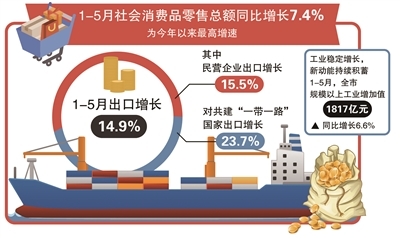
杭州1-5月经济韧性生长
Hang Zhou Ri Bao· 2025-06-25 02:46
Economic Overview - Hangzhou's economy shows strong resilience and vitality amid complex international conditions and transformation pressures, with consumption policies driving demand recovery and robust industrial support [2] - The city's social retail sales grew by 7.4% year-on-year in the first five months, marking the highest growth rate this year, outperforming the provincial average of 7.2% [2] Consumption Recovery - The recovery in consumption is closely linked to national efforts to boost consumer spending, with 162 billion yuan allocated for consumption incentives in the first two batches and an additional 138 billion yuan planned for the third and fourth quarters [3] - Hangzhou has implemented various consumption promotion activities, including a food festival and expanding the "old-for-new" policy, which is expected to enhance consumer willingness and capability [3] Foreign Trade Performance - Hangzhou's exports reached 251.7 billion yuan in the first five months, growing by 14.9%, with private enterprises contributing significantly to this growth [4] - Exports to countries involved in the Belt and Road Initiative increased by 23.7%, indicating the effectiveness of diversified foreign trade strategies [4] Investment Trends - Fixed asset investment in Hangzhou saw a slight increase of 0.2%, with industrial investment growing by 8.5%, reflecting strong confidence among technology-intensive enterprises [5] Industrial Growth - The industrial sector in Hangzhou demonstrated stable recovery, with a 6.6% year-on-year increase in industrial added value, amounting to 181.7 billion yuan [6] - Strategic emerging industries outperformed the overall industrial growth, with a remarkable 8.7% increase in added value, particularly in integrated circuits and industrial robots, which saw production growth of 24.2% and 131.1%, respectively [7] Service Sector Recovery - The service sector also showed steady recovery, with a 7.5% increase in revenue for the first four months, particularly in digital economy and high-tech services, which grew by 11.7% and 10.2%, respectively [8]