啤酒

Search documents
近3亿元并购!蜜雪冰城准备卖啤酒了
Shen Zhen Shang Bao· 2025-10-11 10:03
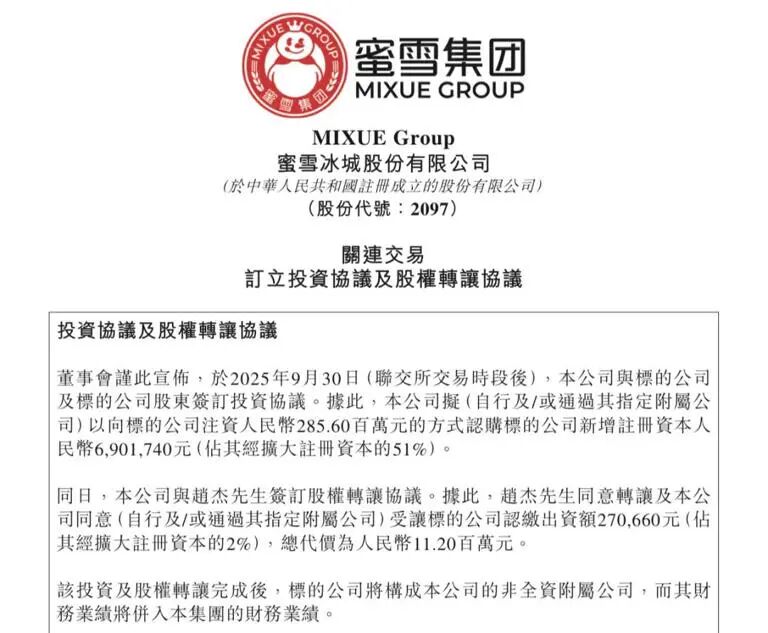
Group 1 - Mijiu Group announced plans to acquire 53% of the fresh beer brand "Fulu Family" for 297 million yuan, making it a subsidiary of the listed company [1] - The actual controller of Fulu Family, Tian Haixia, is the wife of Mijiu Ice City's CEO, Zhang Hongfu, raising concerns about the high transaction price and valuation metrics [1][2] - The acquisition involves a two-step process: an initial capital increase of 286 million yuan for 51% ownership, followed by a purchase of 2% from a natural person shareholder for 11.2 million yuan [1] Group 2 - Fulu Family was established in 2018 and launched its "Fresh Beer Fulu Family" brand in 2021, with plans to expand to approximately 1,200 stores across 28 provinces by August 2025 [1] - The company reported a loss of 1.53 million yuan in 2023, with a projected profit of 1.07 million yuan in 2024, and its net assets were approximately 19.52 million yuan [1] - The transaction values Fulu Family at 560 million yuan, with a price-to-earnings ratio of about 523 times and a price-to-book ratio of approximately 29 times, significantly higher than industry averages [1] Group 3 - The independent valuation of Fulu Family was conducted using a revenue multiple method, resulting in a fair value range of 240 million to 280 million yuan, while the final payment was slightly above this range [2] - Prior to the transaction, Tian Haixia held over 80% of Fulu Family, and after the deal, her direct stake decreased to 29.43%, maintaining her position as the second-largest shareholder [2] - Fulu Family's headquarters is located in the same facility as Mijiu Ice City, and they utilize the same cold chain logistics system, indicating a close operational relationship [3]
2.97亿元!蜜雪冰城,要卖啤酒了
Sou Hu Cai Jing· 2025-10-11 07:50
Core Insights - The article discusses the recent investment agreement between Mixue Group and Xianpi Fulujia, where Mixue Group will acquire a 53% stake in Xianpi Fulujia for a total of 297 million yuan, marking its expansion into the fresh beer market [1][2]. Investment Details - Mixue Group will inject 297 million yuan into Xianpi Fulujia, acquiring 51% of its expanded registered capital, along with an additional 2% from independent third-party shareholders [1]. - After the transaction, Xianpi Fulujia will become a non-wholly owned subsidiary of Mixue Group [2]. Company Background - Xianpi Fulujia was founded in 2021, focusing on providing freshly brewed beer products, including various types such as fresh beer, fruit beer, tea beer, and milk beer [3]. - As of August 2025, Xianpi Fulujia is projected to have around 1,200 stores across 28 provinces in China, making it the leading brand in the fresh beer chain store segment [7]. Market Positioning - The acquisition aligns with Mixue Group's strategy of offering "high-quality and affordable" products, expanding its product matrix to include fresh beer alongside tea and coffee [8][10]. - Xianpi Fulujia's pricing strategy is competitive, with most products priced between 5.9 yuan and 9.9 yuan, significantly lower than the industry average [10]. Strategic Advantages - The partnership allows Xianpi Fulujia to leverage Mixue Group's extensive cold chain logistics and marketing resources, enhancing product quality and supply chain efficiency [12]. - The acquisition is seen as a strategic move to tap into the underdeveloped fresh beer market, which is identified as a blue ocean opportunity with significant growth potential [13][15]. Industry Trends - The fresh beer segment is gaining traction as consumer preferences shift towards quality and experience, with the market expected to grow from 10 billion yuan in 2020 to over 100 billion yuan by 2025 [15]. - Xianpi Fulujia is recognized as a pioneer in the fresh beer category, being the first brand in China to receive national certification for "fresh beer" [15]. Consumer Engagement - Xianpi Fulujia's store locations are strategically chosen in community areas and dining hotspots, catering to the demand for convenient, on-the-go consumption [17]. - The brand's focus on product innovation and seasonal offerings aims to keep the consumer experience fresh and engaging, enhancing customer loyalty [17].


她把公司卖给蜜雪冰城
投资界· 2025-10-11 07:26
Core Viewpoint - The article discusses the strategic acquisition of a craft beer brand, "Xianpi Fulujia," by Mixue Ice City, marking its entry into the fresh beer market with an investment of nearly 300 million RMB [2][3][5]. Group 1: Acquisition Details - Mixue Group will invest 285.6 million RMB to acquire a 53% stake in Fulujia, making it the largest shareholder [5]. - The acquisition consists of two parts: a cash subscription for new registered capital and a purchase of existing shares from the original shareholders [5]. - The valuation of Fulujia was based on a market assessment, with a range between 244.7 million RMB and 276.6 million RMB as of August 31, 2025 [5]. Group 2: Background of Fulujia - Fulujia was established in 2021 and operates the "Xianpi Fulujia" brand, focusing on craft beer priced between 6 to 10 RMB per 500ml cup [5]. - As of August 31, 2025, Fulujia plans to have around 1,200 stores across 28 provinces in China, primarily through a franchise model [5]. - In 2023, Fulujia reported a net loss of 1.53 million RMB but is projected to turn a profit of 1.07 million RMB in 2024 [6]. Group 3: Strategic Implications - This investment is seen as a significant move for Mixue to expand into the fresh beer category, leveraging Fulujia's existing market presence [7]. - The acquisition aligns with Mixue's broader strategy of diversifying its product offerings beyond tea and coffee into the beer segment [12]. Group 4: Market Trends - The craft beer market in China is expected to grow significantly, with projections indicating a market size of 130 billion RMB by 2025 and a penetration rate of 6.3% [14]. - The shift in consumer behavior, particularly among younger generations, is driving demand for diverse and flavorful craft beers, which are increasingly seen as lifestyle products [14][15]. Group 5: Competitive Landscape - Major players in the beverage industry, including traditional liquor companies, are entering the craft beer market, indicating a competitive environment [15]. - The article highlights the challenges faced by new entrants in the alcohol market, particularly in maintaining consumer engagement and loyalty compared to established beverage categories like tea [16].

倒计时1天!2025万宁热浪消费季暨青岛啤酒嘉年华等你来嗨
Sou Hu Cai Jing· 2025-10-11 05:12
Group 1 - The event "2025 Wanning Heat Wave Consumption Season and Qingdao Beer Carnival" will start on October 12 and last for 9 days, featuring six major segments: eating, exhibitions, performances, tourism, shopping, and entertainment [1][3] - The event aims to integrate culture, tourism, and trade, enhancing music and food culture to empower tourism and create new multi-dimensional consumption scenarios, thereby supporting local government in cultivating new consumption growth points [3][5] - A key highlight of the event is the innovative exploration of the "ticket root economy" model, allowing citizens and tourists to enter without purchasing tickets, while vendors offer exclusive discounts, creating a complete cycle of "consumption—performance—re-consumption" [5][7] Group 2 - The event is organized by China National Radio Culture Media (Hainan) Co., Ltd., with guidance from Wanning City Tourism and Culture Broadcasting Sports Bureau and Wanning City Commerce Bureau, and support from Qingdao Beer [7]


卖奶茶、咖啡不过瘾?雪王悄悄布局新战场
3 6 Ke· 2025-10-11 01:55
Core Insights - The article discusses the acquisition of a majority stake in the craft beer brand "Fresh Beer Fulu Family" by the "Mixue Group," revealing the strategic expansion of Mixue into the craft beer market [2][4][7]. Company Overview - Mixue Group announced the acquisition of 53% of "Fresh Beer Fulu Family" for approximately 297 million RMB, with 285.6 million RMB coming from a capital injection and 11.2 million RMB from a share transfer agreement [2]. - After the acquisition, "Fresh Beer Fulu Family" will become a subsidiary of Mixue Group and will be included in its consolidated financial statements [2]. - The brand "Fresh Beer Fulu Family" was established in 2018 and has rapidly expanded to over a thousand stores, positioning itself as a leader in the fresh beer industry [1][4]. Market Positioning - "Fresh Beer Fulu Family" employs a unique business model by selling fresh beer through convenience stores, differentiating itself from traditional beer sales [7]. - The brand's pricing strategy is competitive, with prices for fresh beer starting at 5.9 RMB for 500ml, appealing particularly to younger consumers [7][9]. - The craft beer market in China is projected to grow significantly, with expectations to reach 11 billion RMB by 2028, indicating a favorable environment for "Fresh Beer Fulu Family" [10]. Strategic Implications - The acquisition is seen as a growth strategy for Mixue Group, similar to its previous venture with "Lucky Coffee," and aims to leverage its established supply chain and operational experience [7][9]. - Analysts suggest that the franchise model of "Fresh Beer Fulu Family" can effectively utilize Mixue's mature supply chain, potentially replicating the success of "Lucky Coffee" [7]. - The craft beer segment is becoming increasingly competitive, with various brands entering the market, indicating a need for "Fresh Beer Fulu Family" to strengthen its product offerings and market presence [19].
百威亚太(01876.HK):消费环境承压 3Q25公司仍处调整阶段
Ge Long Hui· 2025-10-10 20:26
Core Viewpoint - The company is expected to experience a double-digit decline in earnings year-on-year for Q3 2025, indicating a continued adjustment phase in its operations [1] Group 1: Earnings Forecast - Q3 2025 earnings are projected to decline by double digits year-on-year due to slow recovery in the Chinese market and adjustments in business strategies [1] - The Eastern China region is anticipated to see a double-digit decline in revenue, while the Indian market continues its growth trend [1] - The Western Korean market may experience a slight revenue decline due to weak on-premise channels and pricing pressures [1] Group 2: Market Performance - The overall performance in overseas markets is better than in the domestic market, with the Korean market maintaining stability supported by pricing advantages and brand strength [2] - In the Korean market, a slight year-on-year decline in sales is expected, but performance is likely to remain better than the industry average [2] - The Indian market continues to show a robust growth trend, benefiting from the structural shift towards high-end products and non-on-premise channels [2] Group 3: Profitability and Valuation - Due to slower-than-expected recovery in the Chinese market, EBITDA forecasts for 2025 and 2026 have been reduced by 3.1% to $1.627 billion and $1.715 billion, respectively [2] - The target price is maintained at HKD 9.8, corresponding to 8.6x and 8.2x EV/EBITDA for 2025 and 2026, with the current stock price reflecting 7.1x and 6.7x EV/EBITDA multiples [2] - The current stock price presents a 21.3% upside potential compared to the target price, maintaining an outperform rating [2]

华润啤酒核心管理层人事调整
Bei Jing Shang Bao· 2025-10-10 12:58
Group 1 - The core point of the article is the announcement of new appointments at China Resources Beer Holdings Company Limited, effective from October 10, 2025 [1] - Jin Hanquan has been appointed as the Executive Director and President of China Resources Beer, bringing experience from his previous role as Senior Auditor and Audit Professional Director at China Resources Group [1] - Li Nan has been appointed as a Non-Executive Director, while Yang Hongxia has been appointed as the Chief Financial Officer of China Resources Beer [1]

华润啤酒:执行董事及总裁等高管人事变动
Di Yi Cai Jing· 2025-10-10 11:49
华润啤酒在港交所公告,自2025年10月10日起,金汉权先生获委任为公司执行董事及总裁,并成为董事 会辖下的执行委员会、财务委员会及购股权总务委员会成员。李楠先生亦于同日获委任为公司非执行董 事。此外,阳红霞女士获委任为公司首席财务官。 (本文来自第一财经) ...
华润啤酒:金汉权获委任为执行董事及总裁
Zhi Tong Cai Jing· 2025-10-10 11:18
华润啤酒(00291)发布公告,自2025年10月10日起,金汉权先生获委任为本公司执行董事及总裁,以及 董事会辖下执行委员会、财务委员会及购股权总务委员会各自的成员;李楠先生获委任为本公司非执行 董事;及阳红霞女士获委任为本公司首席财务官。 ...
收购鲜啤企业,蜜雪集团所为何求?
Sou Hu Cai Jing· 2025-10-10 11:17
Core Insights - The acquisition of the craft beer brand "Xianpi Fulu Jia" by Mixue Group for approximately 297 million RMB aims to expand its business boundaries and enhance supply chain efficiency [2][11] - This move marks Mixue Group's entry into the fresh beer market, indicating a strategic shift from its core beverage business [3][11] - The acquisition is seen as a proactive positioning in a growing market, with the potential for significant synergies between the two brands [2][10] Company Overview - Mixue Group has over 53,000 stores and has established itself as a leader in the beverage market, initially gaining traction with its ice cream products [2][3] - "Xianpi Fulu Jia," founded in July 2021, operates around 1,200 stores across 28 provinces in China, focusing on fresh craft beer through community-based sales [4][5] Market Dynamics - The fresh beer segment is experiencing growth despite a general decline in the beer industry, driven by changing consumer preferences for quality over quantity [5][11] - The acquisition aligns with the trend of consumers seeking higher-quality beer options, with 88.9% prioritizing taste in their purchasing decisions [5] Financial Considerations - The transaction includes a capital increase and equity transfer, with a pre-acquisition valuation of "Xianpi Fulu Jia" at approximately 274.4 million RMB [6][7] - The valuation process involved multiple assessments, confirming that the acquisition price falls within a reasonable range compared to industry peers [7][9] Strategic Rationale - The acquisition allows Mixue Group to leverage its existing supply chain capabilities and operational efficiencies to support "Xianpi Fulu Jia" [11][13] - The business model of "Xianpi Fulu Jia" aligns closely with Mixue's strategy of offering high-quality, affordable products, enhancing its market positioning [12][13] - The partnership is expected to accelerate the standardization and quality improvement of the fresh beer industry, potentially setting a benchmark for future developments [13]