
制造业

Search documents
决胜“十四五” 擘画“十五五”·地方资本市场高质量发展之黑龙江篇: 金融养分滋润黑土地 孕育产业振兴“龙江之花”
Zheng Quan Shi Bao· 2025-12-15 22:24
"经济是肌体,金融是血脉",这一深刻论断在"十四五"时期的黑龙江资本市场发展实践中得到生动印 证。黑龙江资本市场深度融入区域经济发展大局,精准对接国家战略需求,紧密贴合地方特色产业脉 络,在推动产业转型升级的进程中,成为不可或缺的重要驱动力。 为激活产业发展动能,黑龙江资本市场通过拓宽直接融资渠道、优化上市公司结构、并购重组等一系 列"组合拳",解决了企业发展的资金难题,优化了产业发展的生态格局,实现资本市场与区域产业发展 同频共振。 黑龙江资本市场板块结构持续优化。"含科量"的不断跃升,成为黑龙江资本市场提质增效的重要标志。 创业板、科创板上市公司数量较"十三五"时期增加了50%,市值前10名公司中,超半数为科技企业或科 技含量比较高的企业。 黑龙江资本市场融资结构呈现"再融资为主、IPO为辅"的鲜明特征,彰显了资本市场对黑龙江企业的持 续赋能。其中,首发募集资金(IPO)89.09亿元,为企业新的发展按下"启动键";再融资金额达279.64 亿元(含可转债),约为IPO规模的三倍,通过增发、可转债等工具为已上市优质企业"持续输血",支 持其规模扩张与技术改造。这一结构契合黑龙江省产业实际,既助力新兴企业落 ...
江苏南方精工股份有限公司关于召开2025年第三次临时股东会的提示性公告
Shang Hai Zheng Quan Bao· 2025-12-15 20:42
登录新浪财经APP 搜索【信披】查看更多考评等级 证券代码:002553 证券简称:南方精工 公告编号:2025-076 江苏南方精工股份有限公司 关于召开2025年第三次临时股东会的提示性 公告 本公司及董事会全体成员保证信息披露的内容真实、准确、完整,没有虚假记载、误导性陈述或重大遗 漏。 江苏南方精工股份有限公司(以下简称"公司")于2025年12月6日在详见公司指定信息披露网站巨潮资 讯网(http://www.cninfo.com.cn)、《证券时报》、《中国证券报》、《上海证券报》披露了《关于召 开2025年第三次临时股东会的通知》(公告编号:2025-074)。为保护广大投资者的利益,提请各位股 东正确行使股东会投票权,现披露关于召开 2025年第三次临时股东会的提示性公告: 2、股东会的召集人:公司董事会。 3、会议召开的合法、合规性:本次股东会的召开符合《公司法》、《证券法》、《深圳证券交易所股 票上市规则》等有关法律法规和《公司章程》的有关规定。 4、会议时间 (1)现场会议时间:2025年12月22日14:30 (2)网络投票时间:通过深圳证券交易所系统进行网络投票的具体时间为2025年 ...

史上首个国家顺差突破万亿美元,中国登顶后正重塑全球工业版图阶梯
Sou Hu Cai Jing· 2025-12-15 18:19
Core Insights - China's trade surplus has historically surpassed $1 trillion for the first time, reaching $1.08 trillion in the first 11 months of the year [1][5] - The trade surplus is primarily driven by Chinese companies aggressively expanding into overseas markets across various industries [6][7] - The current domestic consumption market is weak, prompting a reliance on export markets to sustain production [9][11] Group 1: Trade Surplus Growth - In 2023, China maintained a trade surplus of $608 billion, leading globally, with the figure approaching $992.2 billion as of 2024 [4] - The significant growth in trade surplus is attributed to the expansion of Chinese enterprises into international markets, which has become a core strategy across all sectors [6][8] - The ongoing expansion of production capacity and rising inventory levels are linked to insufficient domestic demand [10][11] Group 2: Industrial Strategy - China's industrial development strategy differs from traditional models, opting for simultaneous advancement across all industrial levels rather than a step-by-step approach [12][13] - The country has established a comprehensive industrial ecosystem, dominating various sectors from basic manufacturing to advanced technology [13][15] - Other countries face challenges entering these industries due to China's established scale, efficiency, and innovation [14][16] Group 3: Global Market Dynamics - The traditional "flying geese" model of industrial transfer is outdated, as China occupies multiple key positions in the global market [20][21] - Emerging economies struggle to replicate China's industrial success due to the complexity and scale of its manufacturing capabilities [22][45] - China's ability to adapt its production and supply chains in response to international trade barriers has been demonstrated, particularly in the face of U.S. tariffs [59][60] Group 4: Internal Challenges - The increasing trade surplus highlights a growing internal challenge regarding the sustainability of relying on foreign markets for economic stability [61][63] - The need to enhance domestic consumption is critical, as the current economic model heavily depends on exports [62][66] - Future economic strategies must balance domestic development with international trade dynamics, acknowledging the complexities of global economic relations [64][68]

日本企业信心增强 市场关注日本央行动向
Xin Lang Cai Jing· 2025-12-15 15:13
日本央行季度短观调查显示,大型制造商景气指数创四年来最佳,强化了市场对日本央行可能加息25个 基点至0.75%的预期,推动日元走强。 责任编辑:张俊 SF065 日本央行季度短观调查显示,大型制造商景气指数创四年来最佳,强化了市场对日本央行可能加息25个 基点至0.75%的预期,推动日元走强。 责任编辑:张俊 SF065 ...
【环球财经】土耳其10月工业产出同比增长2.2%
Xin Hua Cai Jing· 2025-12-15 15:12
Core Viewpoint - Turkey's industrial output showed a year-on-year growth of 2.2% in October, indicating a continued moderate growth trend [1] Industry Analysis - The mining and quarrying sector experienced the highest growth, increasing by 9.4% year-on-year [1] - Manufacturing output grew by 1.9% year-on-year [1] - The electricity, gas, steam, and air conditioning supply sector saw a year-on-year increase of 0.6% [1] Monthly Data Insights - On a month-on-month basis, the industrial production index decreased by 0.8% in October [1] - The mining and quarrying sector grew by 1.2% month-on-month [1] - Manufacturing output declined by 0.9% month-on-month [1] - The electricity, gas, and related industries experienced a month-on-month decrease of 1.2% [1] Overall Assessment - The industrial sector maintains expansion on a year-on-year basis, but the monthly data fluctuations indicate that the manufacturing sector is still facing certain pressures in the short term [1]
国信证券荀玉根:投资增速回正靠AI和股市
Xin Lang Cai Jing· 2025-12-15 14:35
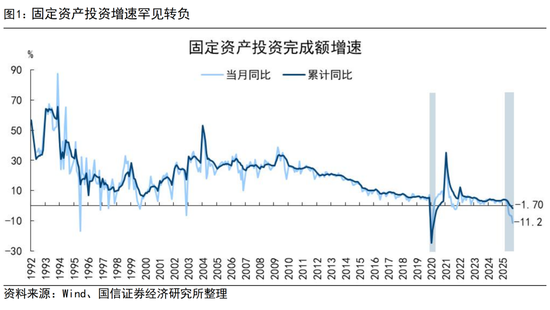
Core Conclusion - Fixed asset investment growth in China may experience its first annual negative growth since data collection began, with declines in real estate, infrastructure, and manufacturing investments [1][2][36] - To reverse the negative investment growth, reliance on the AI+ sector is essential, and the capital market must play a larger role [1][2][22] - Recommendations include accelerating the pace of technology IPOs, actively attracting long-term capital from the stock market, and increasing support for diversified financing tools like science and technology bonds [1][2][28][30][31] Investment Trends - Investment growth has been a key driver of China's economic growth, historically outpacing overall GDP growth [1][36] - The current situation marks a rare instance of negative investment growth, with a projected annual decline of -1.0% [2][36] - The decline is primarily driven by three major sectors: manufacturing, real estate, and infrastructure, which together account for over 70% of total investment [2][36] Real Estate Sector - The real estate sector has seen a significant slowdown, with cumulative investment down by -14.7% year-on-year in the first ten months of the year, and monthly growth dropping to -23.1% [6][39] - Demand-side factors include a demographic shift leading to a decrease of approximately 4.5 million eligible homebuyers compared to peak levels, and suppressed purchasing intentions due to falling housing prices [6][39] - Supply-side issues include ongoing debt risks for property companies, with approximately 524.4 billion due this year, limiting their investment capacity [6][39] Infrastructure Sector - Infrastructure investment has weakened, with a year-on-year decline of -12.1% in October [8][41] - Contributing factors include reduced funding capabilities due to a cooling land finance system and a lack of project reserves during the transition between the 14th and 15th Five-Year Plans [8][41] - Local governments are prioritizing risk prevention and debt repayment over new projects, reflecting a cautious fiscal approach [8][41] Manufacturing Sector - Manufacturing investment has shown signs of fatigue, with a year-on-year decline of -6.7% in October [10][43] - Factors include declining corporate profitability, with the median return on invested capital (ROIC) for non-financial A-share companies dropping to 2.9% from 3.7% the previous year [10][43] - The "anti-involution" policy has led to reduced capacity expansion among enterprises, while some are shifting investments abroad due to "de-globalization" trends [10][43] Historical Investment Recovery Insights - Historical data shows that previous investment recoveries were driven by demand shifts, with notable low points in 2006, 2015, and 2020 [12][45] - The 2008 recovery was fueled by a government-led stimulus plan focusing on large-scale infrastructure projects [14][47] - The 2015 recovery involved supply-side structural reforms and targeted demand stimulation through housing policy adjustments [16][51] - The 2020 recovery was characterized by a focus on new economic drivers amid the pandemic, with significant investments in high-tech sectors [18][55] Future Investment Strategies - The current investment recovery requires a focus on the AI+ sector, which presents vast opportunities and aligns with national strategic goals [22][56] - The government’s role in the economy is evolving, transitioning from direct involvement to a more supportive role that encourages private investment [26][60] - Recommendations for enhancing investment include improving the IPO process for tech companies, increasing long-term capital from the stock market, and expanding the use of science and technology bonds [28][30][31]

纽约州制造业活动意外萎缩 订单停滞
Xin Lang Cai Jing· 2025-12-15 14:22
纽约联邦储备银行周一公布的数据显示,其综合企业状况指数下降约23点,至-3.9。低于零的读数表明 收缩,而机构对经济学家调查得出的预期中值为10。 尽管出现挫折,但由于对订单和出货量的乐观情绪增强,对未来六个月的整体展望指数上升16.6点,达 到年初以来最高水平。订单展望指数攀升至2022年以来最高。 对制造业而言,这一积极前景实属利好消息。此前该行业在投入品价格上涨、需求波动及贸易政策不确 定性中举步维艰。 报告同时显示,当前原材料支付价格指数与收取价格指数均有所回落,表明通胀压力趋缓。支付价格指 数降至1月以来最低水平。工厂就业指标则小幅回升。 调查收集时间为12月2日至9日。 责任编辑:王许宁 纽约州工厂活动在连续两个月强劲增长后,12月意外出现萎缩,因订单停滞且出货量下降。 纽约州工厂活动在连续两个月强劲增长后,12月意外出现萎缩,因订单停滞且出货量下降。 纽约联邦储备银行周一公布的数据显示,其综合企业状况指数下降约23点,至-3.9。低于零的读数表明 收缩,而机构对经济学家调查得出的预期中值为10。 尽管出现挫折,但由于对订单和出货量的乐观情绪增强,对未来六个月的整体展望指数上升16.6点,达 到年 ...
破题罕见负增长,2026年投资如何“止跌回稳”
经济观察报· 2025-12-15 13:45
Core Viewpoint - The article emphasizes that the decline in fixed asset investment (FAI) growth reflects economic structural adjustments, and does not expect a rebound through aggressive policy measures. The central economic work conference's policy tone is to "support without lifting," aiming for a stabilization of investment growth without setting a specific growth bottom line [1][3]. Group 1: Current Investment Trends - From January to November, national fixed asset investment decreased by 2.6% year-on-year, while excluding real estate development, FAI grew by 0.8% [2]. - The fixed asset investment growth rate has been declining significantly over the past decade, with projections indicating a potential negative growth for the first time in twenty years by 2025 [2]. - Real estate development investment has been a major drag on FAI growth, with a sharp decline to -10% in 2022 and further expected declines of around -10% to -15.9% in subsequent years [5]. Group 2: Factors Influencing Investment Decline - The decline in FAI growth is attributed to a combination of factors, including the persistent negative growth in real estate investment and the impact of debt resolution policies that have constrained infrastructure investment funding [7]. - Manufacturing investment has also seen a significant drop, with year-to-date growth rates declining compared to the previous year, reflecting cautious investment activities due to insufficient order demand [8]. Group 3: Future Investment Outlook - Experts predict a potential rebound in investment growth in 2026, supported by policy measures and a projected FAI growth of 2.8% in the first quarter [10]. - The anticipated recovery is based on several factors, including the support from new policy financial tools, a reduction in project funding pressure, and historical trends indicating a high probability of investment growth at the beginning of the year [10]. - The central economic work conference highlights the need for significant public investment to stimulate demand and support consumption, emphasizing the importance of both social and infrastructure investments [11].

加息预期支撑日元 通胀水平高于政策目标
Jin Tou Wang· 2025-12-15 12:52
Group 1 - The core logic supporting the strengthening of the Japanese yen includes improved manufacturing confidence and inflation levels consistently above policy targets, alongside rising expectations for a Bank of Japan interest rate hike during the December 18-19 policy meeting [1][2] - The recent Tankan survey indicates a significant recovery in Japan's manufacturing sentiment, with both the manufacturing business conditions and outlook indices exceeding market expectations [1][2] - The weakening of the US dollar is attributed to delayed releases of key macroeconomic data and increasing market expectations for future Federal Reserve rate cuts, which have put significant pressure on the USD/JPY exchange rate [1][2] Group 2 - The Bank of Japan's Governor Ueda has publicly stated that the central bank is gradually approaching its inflation target, reinforcing market expectations for a rate hike in the upcoming meeting [2] - Concerns regarding Japan's public finance situation due to Prime Minister Kishida's proposed large fiscal spending plan have somewhat offset the support for the yen stemming from rate hike expectations [2] - The divergence in interest rate expectations between the US and Japan continues to provide support for yen demand as a safe haven [2] Group 3 - Technical analysis indicates that the USD/JPY exchange rate is under short-term pressure, facing strong resistance near the short-term simple moving average (SMA) [3] - If the key psychological support level is broken, the exchange rate may accelerate its decline towards monthly lows, increasing the likelihood of testing integer levels [3] - Conversely, if the USD/JPY can recover and stabilize above the short-term SMA, it may trigger a short-covering rally, with bulls targeting key resistance levels [3]
——11月经济数据点评:11月经济:从分化看转型
Shenwan Hongyuan Securities· 2025-12-15 12:43
Consumption - In November, the year-on-year growth of social retail sales was 1.3%, down 1.6 percentage points from the previous month, significantly below the expected 2.9%[1][7] - Retail sales of goods fell sharply, with categories like gold and jewelry down 29.1% to 8.5%, and home appliances down 4.8% to -19.4%[2][8] - Service retail sales showed positive performance, with a cumulative year-on-year increase of 5.4%[2][8] Investment - Fixed asset investment in November recorded a year-on-year decline of 10.1%, but this was an improvement of 2.1 percentage points from October[3][39] - Infrastructure investment improved by 2.9 percentage points to -6.7%, supported by new special bonds and policy financial tools[3][17] - Manufacturing investment rose by 4.3 percentage points to -3.6%, indicating a recovery in certain sectors[3][41] Real Estate - Real estate development investment fell by 15.9% year-on-year, with a significant drop of 6.9 percentage points to -29.9% in November[2][43] - New construction and completion rates remained in negative growth, with new starts down 27.7% and completions down 25.4%[2][43] - Despite falling prices, the sales area of commercial housing increased by 7.7 percentage points to -17.9%[2][43] Production - Industrial added value maintained a growth rate of 4.8% in November, only slightly down by 0.1 percentage points from the previous month[3][26] - The production of food and beverages saw significant recovery, with growth rates of 5.6% and -0.6% respectively[3][26] - The automotive sector experienced a notable decline, with production down 4.9 percentage points to 11.9%[3][26] Policy Implications - The economic structure is increasingly differentiated during the policy transition, with a shift from goods consumption to service consumption[4][31] - The government's focus on "new investment" areas is beginning to show positive effects, with overall investment expected to stabilize in the future[4][31] - Risks remain from external environmental changes and the pace of growth policy implementation may not meet expectations[5][50]