新消费

Search documents
鹏扬基金吴西燕:在稳健与创新之间寻找平衡
Shang Hai Zheng Quan Bao· 2025-11-30 14:10
Core Viewpoint - The investment strategy should balance policy guidance and industry fundamentals, with a focus on high-end manufacturing globalization, new consumption, and innovative pharmaceuticals as long-term growth drivers [1][5]. Group 1: Consumer Market Insights - The consumer market is expected to have strong confidence and growth momentum due to policy support, but brand promotion must align with positioning to avoid blind cross-industry ventures [2]. - Brand building plays a crucial role in boosting consumer confidence and expanding domestic demand, requiring careful maintenance and alignment with appropriate channels [2]. - The sectors of "new consumption" and "emotional consumption" are viewed positively for their growth potential as policy plans continue to be implemented [2]. Group 2: Traditional Industries - Traditional industries like kitchen appliances and automotive lighting have investment value due to improved industry structure and efficiency, despite being affected by cyclical factors [2]. - The kitchen appliance sector, while growing slowly and constrained by the real estate cycle, benefits from a favorable competitive landscape leading to high return on equity (ROE) [2]. - The automotive lighting industry is experiencing growth driven by the upgrade of new energy vehicles, with increased unit value and profit margins due to early investments in the sector [3]. Group 3: Investment Strategy - The current market preference for high-growth sectors and the pressure on blue-chip stock valuations highlight the risks associated with chasing hot themes [4]. - A solution proposed is to identify long-term growth potential through in-depth research and invest when there is a perceived safety margin in stock prices [4]. - In a market environment dominated by quantitative strategies, active management investors should focus on solid companies with sustainable performance to endure long-term [4]. Group 4: Future Outlook - Three key areas are highlighted for future investment: globalization of high-end manufacturing, emerging consumer products, and innovative pharmaceuticals [5]. - High-end manufacturing is expected to gain investment value as Chinese companies enhance their global competitiveness through a complete domestic supply chain and ongoing technological upgrades [5]. - Emerging consumer products are projected to maintain a growth advantage within the overall consumer sector, presenting investment opportunities [5]. - Despite recent adjustments, the long-term logic for innovative pharmaceuticals remains strong, supported by robust internal demand and upcoming clinical data releases from representative companies [5].
财信证券宏观策略周报(12.1-12.5):市场初步企稳,逐步布局AI科技方向-20251130
Caixin Securities· 2025-11-30 11:59
Group 1 - The report indicates that the market shows initial signs of stabilization, transitioning from a downward trend to an upward trend, supported by factors such as improved dollar liquidity and positive communications between the US and China [4][14]. - It is expected that by mid-December, as institutional funds reposition for the next year and the Federal Reserve is anticipated to lower interest rates, the A-share market will enter a new bullish phase, particularly in the AI technology sector [4][9]. - The report highlights the importance of the "full-stack AI model," which includes hardware, foundational models, and application layers, as major tech companies optimize performance and costs [4][12]. Group 2 - The report notes that the recent market adjustments were driven by multiple internal and external factors, but the overall adjustment is considered healthy and does not alter the long-term upward trend of the market [7]. - Concerns regarding the AI investment bubble are primarily focused on the return on investment, with significant investments in AI yet to yield blockbuster applications [8]. - The report emphasizes the potential for a consumption recovery driven by improved supply-demand matching, particularly in sectors like health, tourism, and entertainment, as outlined in recent government policies [11]. Group 3 - The report provides insights into the performance of various sectors, noting that the TMT sector's trading volume has recently increased, indicating renewed interest [7]. - It also discusses the impact of macroeconomic factors, such as the anticipated easing of the US-China trade tensions and the potential for improved global liquidity, which could benefit the market in 2026 [14]. - The report suggests that the AI investment direction may shift from hardware to application development, with a focus on sectors like media and computing [12].
A股低开高走,科创50涨超1%,锂矿领涨,地产股续跌,港股指数表现分化,消费强势,多只万科债临停
Hua Er Jie Jian Wen· 2025-11-28 13:40
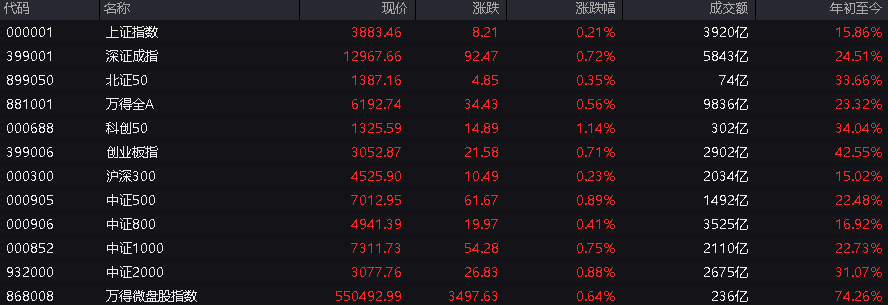
Market Performance - A-shares opened lower but rebounded, with the Shanghai Composite Index rising by 0.21% to close at 3883.46 points [1] - The Shenzhen Component Index increased by 0.72%, closing at 12967.66 points [2] - The ChiNext Index rose by 0.71%, ending at 3052.87 points [3] - The CSI 300 Index saw a modest gain of 0.23%, closing at 4525.90 points [4] - The STAR 50 Index experienced a notable increase of 1.14%, closing at 1325.59 points [5] - The CSI 500 Index rose by 0.89%, closing at 7012.95 points [6] - The CSI 1000 Index increased by 0.75%, closing at 7311.73 points [7] Sector Performance - The titanium dioxide, lithium mining, Hainan Free Trade Zone, and commercial aerospace sectors led the gains [1] - The pharmaceutical, banking, gaming, and tourism sectors experienced declines [1] - Notable stocks included Qian Zhao Guangdian, which hit the daily limit, and Hai Xin Food, which saw significant gains [1] Trading Volume - The total trading volume for the morning session reached 983.7 billion [1] - Over 3500 stocks in the Shanghai and Shenzhen markets were in the green [1] Debt Market - Vanke's bonds saw significant fluctuations, with a 20 billion yuan bond extension adding uncertainty to its future debt repayment outlook [13] - Some of Vanke's domestic bonds rebounded sharply, with "22 Vanke 02" rising by 120% and "21 Vanke 06" increasing by 107.8% [13] Analyst Insights - JPMorgan strategists indicated a higher probability of significant gains in the Chinese stock market next year compared to risks of a major downturn, upgrading A-shares to "overweight" [8]


中美西线无战事,热点主线板块
Sou Hu Cai Jing· 2025-11-27 13:05
Market Overview - A-shares and Hong Kong stocks remained stable, with the ChiNext index retreating after approaching the 60-day moving average, indicating a cautious market sentiment and reduced trading volume [1] - The overall market sentiment is positive, with more favorable news than negative, leading to a structural market where investors focus on sectors rather than indices [1] Positive Factors - Positive news includes the delay of U.S. tariffs on China until 2026 and the near certainty of a Federal Reserve rate cut in December [1] - The Federal Reserve's rate cut is expected to benefit cyclical resource stocks, suggesting opportunities for short-term positioning around this event [1] Negative Factors - Minor external issues, such as tensions with a certain country, and internal concerns like the decline in Vanke's bonds, are noted [1] - The decline in Vanke's bonds may be a deliberate market action, with the external negative factors largely priced in [1] Real Estate Market Dynamics - The real estate market is undergoing a "soft landing" approach, with gradual price reductions to prevent a significant drop in housing prices [3] - The strategy involves both soft and hard landing methods, with the former focusing on state-owned enterprises acquiring existing housing stock and the latter on the liquidation of real estate companies [3] Investment Recommendations - Investors are advised to avoid real estate and focus on sectors such as semiconductor chips, AI and internet leaders, innovative pharmaceuticals, new consumption, industrial robots, energy storage batteries, and photovoltaics [6] - The policy direction indicates a focus on creating three trillion-yuan industries and ten hundred-billion-yuan industries, with consumer electronics, home appliances, and automotive manufacturing expected to benefit [6]

安永:A股和香港市场IPO筹资额占全球1/3
Di Yi Cai Jing· 2025-11-27 11:48
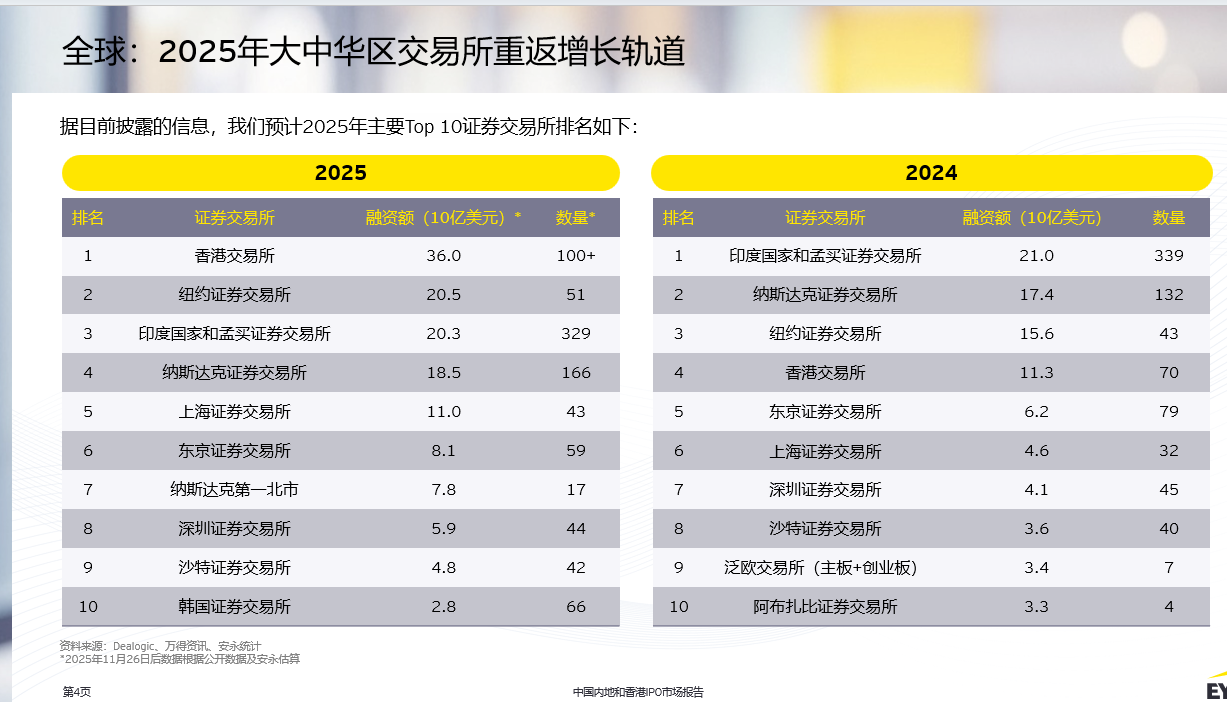
Core Insights - The report by Ernst & Young indicates a growth trend in IPO activities in mainland China and Hong Kong, with A-shares and Hong Kong accounting for 16% of global IPO numbers and 33% of global fundraising amounts in 2025 [1] Group 1: IPO Market Overview - Hong Kong Stock Exchange is projected to lead global exchanges with a fundraising amount of $36 billion in 2025, while Shanghai Stock Exchange ranks fifth with $11 billion [2] - Chinese companies occupy five positions in the global top ten IPOs, with representation across automotive, mining, energy, and advanced manufacturing sectors [2] Group 2: A-share Market Dynamics - The A-share IPO market is expected to see moderate growth in 2025, with approximately 97 companies going public and raising around 100 billion RMB [3] - The average fundraising amount per IPO in A-shares has increased to 1.031 billion RMB, reflecting a 53% year-on-year rise, driven by large IPOs [4] - The automotive sector accounts for about 30% of A-share IPOs, with significant contributions from industrial, technology, and materials sectors [4] Group 3: Hong Kong IPO Landscape - The Hong Kong IPO market is experiencing a strong recovery, with fundraising surpassing 200 billion HKD, marking the second-highest peak in five years [5] - Mainland enterprises dominate the Hong Kong IPO market, contributing 88.5% of the number of listings and 83.5% of the total fundraising [5] - New consumption and hard technology sectors are identified as the dual engines driving IPO activities in Hong Kong [5] Group 4: Future IPO Trends - The IPO issuance in 2026 is expected to transition to a "new normal," focusing on a steady pace rather than a return to rapid expansion, influenced by macroeconomic conditions and the quality of prospective listings [8] - The A-share market is anticipated to gradually restore normal issuance patterns, emphasizing quality and structural optimization, particularly in strategic emerging industries [8] - The Hong Kong IPO market is expected to maintain its momentum, with a focus on A+H listings and the return of Chinese concept stocks [8]

这一板块,逆市大涨!
中国基金报· 2025-11-27 11:34
Market Overview - The Hong Kong stock market experienced a volatile trading session, with the Hang Seng Index rising by 0.07% and the Hang Seng China Enterprises Index increasing by 0.03%, while the Hang Seng Technology Index fell by 0.36% [4][5] - Southbound capital recorded a net inflow of 1.3 billion HKD [4] New Consumption Concept Stocks - New consumption concept stocks surged despite the overall market decline, driven by favorable government policies [10] - The State Council has outlined plans to optimize the supply structure of consumer goods by 2027, aiming to cultivate three trillion-level consumption sectors and ten hundred-billion-level consumption hotspots [11] - Companies like Pop Mart, Lao Pu Gold, and Miniso saw significant stock price increases of over 6%, 4.45%, and 2.73% respectively [12] Technology Sector Performance - Major technology stocks showed mixed performance, with Xiaomi, JD.com, and Meituan rising by 2.49%, 1.22%, and 0.19%, while Alibaba, Baidu, and Tencent fell by 2.71%, 1.57%, and 1.29% respectively [8][9] - Analysts from Dongwu Securities noted that the AI industry trend is irreversible, and leading tech companies in Hong Kong are expected to benefit significantly [8] Innovative Pharmaceutical Sector - The innovative pharmaceutical sector showed signs of recovery, with stocks like Lai Kai Pharmaceutical and Sanleaf Bio rising by 16.07% and 10.08% respectively [14][15] - The industry is entering a new development phase, with Chinese pharmaceutical companies gaining global competitiveness in advanced technology fields [14] Non-ferrous Metals Sector - The non-ferrous metals sector remained active, with stocks like China Silver Group and Jihai Resources increasing by 3.08% and 3.03% respectively, driven by rising expectations of a Federal Reserve interest rate cut [16][17] IPO Performance - The online market operator Quantitative派 saw its stock price surge by 88.78% on its first day of trading, raising approximately 131 million HKD through its IPO [20]

恒指涨0.07% 内房股普遍下挫
Mei Ri Jing Ji Xin Wen· 2025-11-27 08:29
Group 1 - The Hang Seng Index experienced a slight increase, closing up by 0.07%, while the Hang Seng Tech Index fell by 0.36% [1] - Real estate stocks generally declined, with Vanke Enterprises dropping nearly 8%, reaching a historical low [1] - Technology stocks mostly retreated, with Alibaba Health decreasing by over 5% and Alibaba falling by nearly 3% [1] Group 2 - The new consumption sector showed resilience, with Youran Dairy surging by 12% and Pop Mart rising by nearly 7% [1]




国盛证券:战略性、战术性看好A股资产 尤其是AI、新质生产力、自主可控、出海主线
智通财经网· 2025-11-27 05:38
Core Viewpoint - The report from Guosheng Securities suggests a strategic and tactical bullish outlook on A-share assets, driven by the anticipated rise of new economic drivers and forces in China during the "14th Five-Year Plan" period, particularly in advanced manufacturing and technology [2][3] Group 1: Investment Strategy - The report emphasizes the importance of investing in China, highlighting that each era has its core assets that reflect the macroeconomic environment, with the upcoming period expected to attract global resources and create a bull market in equities [2] - The focus is on four main investment themes: "All in AI, new productive forces, self-control, and going global" [1][2] Group 2: Asset Allocation - A-shares are viewed positively, with a focus on a "dumbbell strategy" where investments are concentrated at both ends: technology growth and dividend stocks, while rotating through mid-range assets [3] - The report identifies key sectors for investment, including technology related to self-control and domestic substitution, as well as long-duration low-yield assets like dividend stocks [3] Group 3: Market Conditions - The domestic bond market is expected to experience fluctuations, with the 10-year government bond yield projected to range between 1.5% and 1.9% due to various economic factors [4] - In the U.S. market, the report anticipates volatility in U.S. stocks, with a downward trend in U.S. Treasury yields and a weakening dollar, influenced by AI narratives and fiscal policies [5][6] Group 4: Commodity Outlook - The report notes a broad presence of bullish options in commodities, with precious metals like gold and silver benefiting from trends such as "de-dollarization" and "debt monetization" [6] - Specific commodities such as copper, aluminum, and rare earths are expected to gain from energy transition and technological advancements, as well as geopolitical tensions [6]

ETF资金下半年加速净买入港股资产,港股通互联网ETF、香港证券ETF、港股通非银ETF强势吸金
Ge Long Hui· 2025-11-27 04:23
Group 1 - Southbound funds have significantly increased their net purchases of Hong Kong stocks, totaling 1.38 trillion HKD this year, marking a record high [1] - The Hang Seng Index has seen a year-to-date increase of nearly 30%, while the Hang Seng Tech Index has risen over 25% [1] - In the second half of the year, ETF funds have accelerated their net purchases of Hong Kong assets, with notable inflows into various ETFs, including over 350 million HKD into the Hong Kong Internet ETF and over 200 million HKD into the Hong Kong Securities ETF [1] Group 2 - Hong Kong stocks have unique advantages compared to A-shares, aligning well with current trends in AI, new consumption, and innovative pharmaceuticals [2] - Despite recent adjustments, the mid-term outlook for Hong Kong stocks remains bullish, supported by incremental capital inflows and the gathering of quality assets [2] - The AI-driven technology sector is expected to be the main theme in the Hong Kong market, with dividend-paying stocks benefiting from policy support and low interest rates [2] Group 3 - The "AI bubble" narrative in the US has led to mispricing of Chinese assets, particularly in the tech sector, where the valuation of Hong Kong tech stocks is about half that of the Nasdaq [3] - The adjustment in Hong Kong stocks has been significant, suggesting that the rebound potential may exceed that of A-shares [3] - A "barbell strategy" is recommended, focusing on high-dividend and turnaround assets to navigate market uncertainties while maintaining a long-term growth perspective [3]
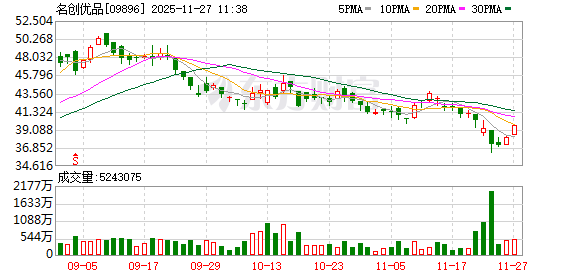
港股新消费概念股走高 名创优品涨3.83%
Mei Ri Jing Ji Xin Wen· 2025-11-27 03:37
Core Viewpoint - The new consumption concept stocks in the Hong Kong market are experiencing a general rise, indicating positive market sentiment towards this sector [2] Group 1: Stock Performance - Pop Mart (09992.HK) increased by 7.82%, reaching HKD 220.6 [2] - Aosheng Holdings (02145.HK) rose by 4.55%, trading at HKD 88.45 [2] - Blucoco (00325.HK) saw a gain of 4.43%, priced at HKD 75.4 [2] - Miniso (09896.HK) climbed by 3.83%, with a share price of HKD 39.6 [2] - Mao Geping (01318.HK) increased by 3.25%, now at HKD 92.05 [2]