食品饮料

Search documents
雀巢中国连发两份奶粉自愿回收公告,婴儿营养业务合并后首遇挑战
Cai Jing Wang· 2026-01-07 12:45
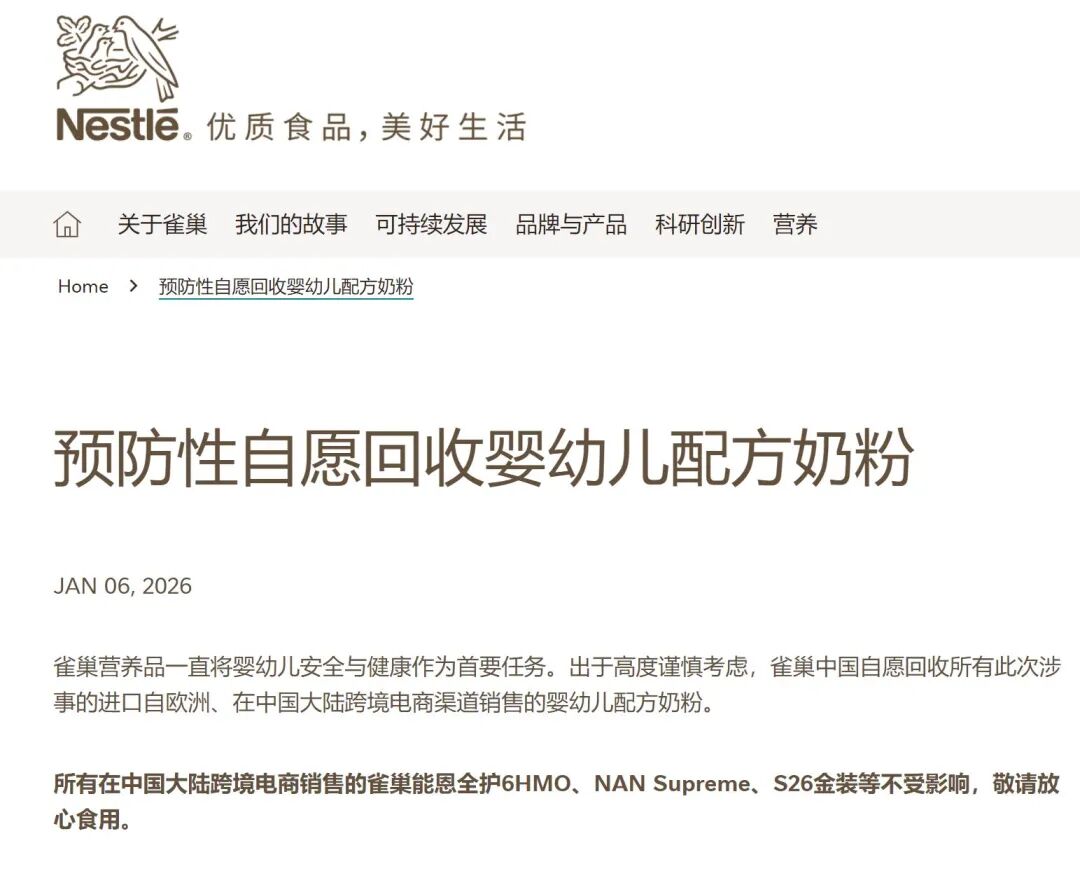
另据雀巢官网近期发布的婴配粉产品咨询问答录,公司正与相关国家的相关部门保持联系,确保采取必 要措施。雀巢向家长和照顾者保证,正在采取适当措施,帮助确保家庭及其婴儿的健康与福祉。同时, 公司也在努力尽量减少潜在的供应中断。 其进一步介绍,Cereulide会引起食源性疾病,由某些菌株--蜡样芽孢杆菌(Bacilus cereus)产生。油品中 存在相关物质非常罕见,雀巢正与油品供应商合作,进行全面的原因分析。 刚刚迎来在华业务合并的惠氏营养品业务和雀巢婴儿营养品业务,于2026年开年遭遇内部冲击。由于供 应商提供的油脂原料存在质量问题,在全球多地销售的相关批次婴幼儿配方奶粉将召回,而中国大陆市 场亦位列其中。 近日,雀巢发布针对部分批次婴幼儿配方奶粉产品的召回通知。称公司对用于生产可能受影响的婴幼儿 配方奶粉产品的所有花生四烯酸油及相关油脂混合物进行了检测,发现供应商提供的这种油脂原料存在 质量问题,相关批次婴幼儿配方奶粉中可能存在蜡样芽孢杆菌,这种细菌可能引起食源性疾病。 根据雀巢中国官网公布的两份自愿回收婴幼儿配方奶粉公告。其中一份提到,所有在中国大陆市场注册 并销售的雀巢特殊医学用途婴儿配方食品、超启能恩 ...

固收+市场全景解析
Mai Gao Zheng Quan· 2026-01-07 12:33
- The report focuses on the "Fixed Income+" (固收+) product, which aims to achieve absolute returns higher than pure fixed-income products, with risk-return characteristics between bond and equity products. The specific scope includes mixed bond funds with average convertible bond positions not exceeding 80% over the past eight quarters and equity positions (stocks + 0.5×convertible bonds) not exceeding 40% on average, with a maximum equity position of 60%[18] - The classification of "Fixed Income+" funds is based on long-term equity risk exposure, dividing them into three categories: conservative, balanced, and aggressive. The classification thresholds are set at 15% and 25% for average equity positions over the past eight quarters[21][20] - The report highlights the growth in "Fixed Income+" fund scale, with a total increase of 7700.41 billion yuan (63.50%) from the end of 2024 to Q3 2025. Among the categories, conservative funds grew by 3695.98 billion yuan, balanced funds by 2101.94 billion yuan, and aggressive funds nearly doubled with an increase of 1902.49 billion yuan[18][21] - The performance of "Fixed Income+" funds from 2020 to 2025 demonstrates strong stability and cross-cycle return capabilities. Even aggressive funds show significantly lower drawdowns compared to equity and convertible bond products. The products exhibit strong return elasticity during equity market uptrends and resilience during downturns[31][35] - The leverage ratio of "Fixed Income+" funds has been declining, from 1.24 at the end of 2023 to 1.10 by Q3 2025. Conservative funds generally maintain higher leverage, while aggressive funds rely more on equity asset elasticity for returns[57][60] - The duration of "Fixed Income+" funds has increased from 1.92 years in 2024 to 3.04 years by Q3 2025, reflecting a strategy to extend duration for bond yield enhancement amid declining bond yields[61][63]
1月7日深证国企ESG(970055)指数跌0.32%,成份股云铝股份(000807)领跌
Sou Hu Cai Jing· 2026-01-07 10:46
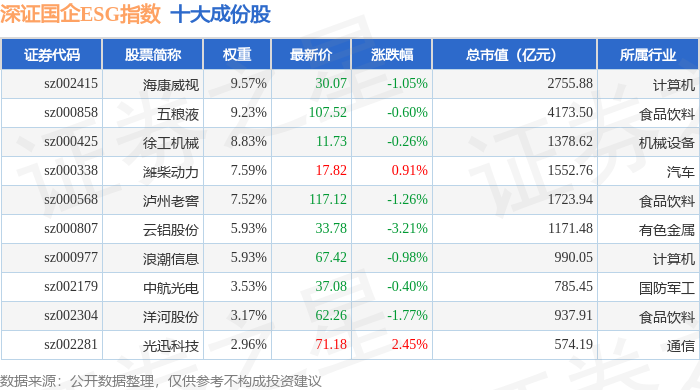
Core Viewpoint - The Shenzhen State-owned Enterprise ESG Index (970055) closed at 1436.92 points, down 0.32%, with a trading volume of 43.67 billion yuan and a turnover rate of 1.69% [1] Group 1: Index Performance - On the day, 19 constituent stocks rose, with Zhongtung High-tech leading with a 7.67% increase, while 29 stocks fell, with Yun Aluminum leading the decline at 3.21% [1] - The index's constituent stocks experienced a net outflow of 222 million yuan from institutional investors and a net outflow of 127 million yuan from retail investors, while retail investors saw a net inflow of 348 million yuan [1] Group 2: Top Constituents - The top ten constituents of the Shenzhen State-owned Enterprise ESG Index are as follows: - Hikvision (sz002415) with a weight of 9.57%, latest price at 30.07, and a decrease of 1.05% [1] - Wuliangye (sz000858) with a weight of 9.23%, latest price at 107.52, and a decrease of 0.60% [1] - Xugong Machinery (sz000425) with a weight of 8.83%, latest price at 11.73, and a decrease of 0.26% [1] - Weichai Power (sz000338) with a weight of 7.59%, latest price at 17.82, and an increase of 0.91% [1] - Luzhou Laojiao (sz000568) with a weight of 7.52%, latest price at 117.12, and a decrease of 1.26% [1] - Yun Aluminum (sz000807) with a weight of 5.93%, latest price at 33.78, and a decrease of 3.21% [1] - Inspur Information (sz000977) with a weight of 5.93%, latest price at 67.42, and a decrease of 0.98% [1] - AVIC Optoelectronics (sz002179) with a weight of 3.53%, latest price at 37.08, and a decrease of 0.40% [1] - Yanghe Distillery (sz002304) with a weight of 3.17%, latest price at 62.26, and a decrease of 1.77% [1] - Guangxun Technology (sz002281) with a weight of 2.96%, latest price at 71.18, and an increase of 2.45% [1]






上市公司回购、增持、分红月度跟踪(2025年12月):AH股回购金额大幅增长,关注新发布分红承诺公司-20260107
Shenwan Hongyuan Securities· 2026-01-07 08:40
Group 1 - The report highlights a significant increase in stock buybacks and dividend commitments among listed companies, with A-share buyback amounts rising by 97% and buyback proposals increasing by 50% in December 2025 compared to November 2025 [5][10]. - In December 2025, the total amount of buyback transactions in A-shares reached approximately 232.6 billion, with 88 transactions recorded, marking a substantial increase from the previous month [10][11]. - The report identifies the top three companies with the largest proposed buyback amounts: China Metallurgical Group, ZTE Corporation, and Zhongju Hi-Tech, with proposed amounts of 10-20 billion, 10-12 billion, and 3-6 billion respectively [10][11]. Group 2 - The report notes that the total amount of buyback and increase loans applied for in December 2025 was approximately 1604.5 billion, with 788 transactions recorded, indicating a structural preference for buybacks over increases [8][9]. - The A-share market saw a 58% increase in actual buybacks by controlling shareholders in December 2025, with a total of 38.9 billion in buybacks, although the number of new buyback proposals dropped significantly by 82% [17]. - The report also provides insights into the Hong Kong stock market, where buyback amounts reached approximately 219.3 billion HKD in December 2025, a rise of 87% from the previous month, driven by stock price corrections [23][24]. Group 3 - The report emphasizes the importance of dividend commitments as a key component of shareholder returns, tracking new dividend commitments from listed companies, with notable companies listed for December 2025 [30][31]. - The report suggests a focus on companies with significant buyback and increase announcements, providing a list of companies for investor reference based on their fundamentals and current valuations [27][28].



月度策略:继续关注科技成长及高股息“哑铃”策略-20260107
Zhongyuan Securities· 2026-01-07 08:38
Macro Environment - The central economic work conference held on December 10-11 emphasized counter-cyclical and cross-cyclical adjustments, indicating a stable macro policy for 2026, focusing on structure and efficiency [10] - The manufacturing PMI for December was 50.1%, up 0.9 percentage points from the previous month, indicating an acceleration in manufacturing activities [12] - The non-manufacturing business activity index rose to 50.2%, returning to the expansion zone [12] Market and Industry Performance - In December, the bond market faced pressure, with the ten-year main contract down 0.05% and the thirty-year bond down 2.66% [50] - The equity market favored growth styles, with the advanced manufacturing sector rising by 5.97% and technology (TMT) by 4.55% [51] - The top five performing industries in December were defense and military (17.22%), non-ferrous metals (13.68%), and telecommunications (12.06%) [59] Monthly Allocation Recommendations - For January 2026, the report suggests focusing on technology sectors (such as electrical equipment and semiconductors), resource products, and high-dividend sectors due to ongoing policy support and a favorable liquidity environment [70]
“爷爷的农场”谋求IPO,能否成下一个国民辅食品牌?
Jin Tou Wang· 2026-01-07 08:32
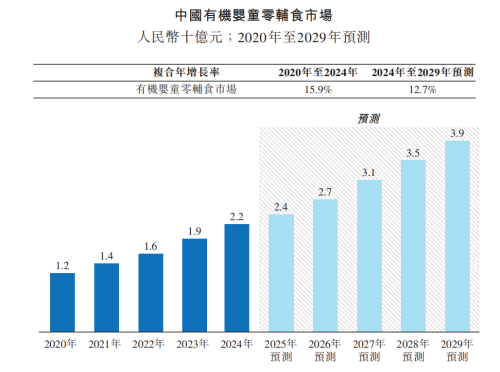
Core Insights - The company "Grandpa's Farm" has officially submitted its listing application, capitalizing on the growing organic food market driven by health-conscious consumers and scientific feeding concepts [1][4] - The organic baby food segment is experiencing significant growth, with a projected market size increase from 1.2 billion RMB in 2020 to 2.2 billion RMB by 2024, reflecting a compound annual growth rate (CAGR) of 15.9% [4][5] - The company holds a leading position in the organic baby food sector, with a market share of approximately 23.2% and the highest growth rate among the top five competitors from 2022 to 2024 [5][9] Market Trends - The penetration rate of infant complementary food in China is expected to rise from 36.8% in 2020 to 43.3% in 2024, with further growth anticipated to 52.2% by 2029 [4] - The organic seasoning market is projected to grow from 7 billion RMB in 2024 to 19.8 billion RMB by 2029, with a CAGR of 23.2% [6] Competitive Landscape - The Chinese organic baby food market is still in its early stages, with only 5.6% market share compared to more mature markets in Europe and Australia, which have shares of approximately 30% and 40-50%, respectively [5] - The top five players in the organic baby food segment are expected to hold a combined market share of 79.1% by 2024, indicating a trend towards market concentration [5] Financial Performance - The company has demonstrated strong financial growth, with revenue increasing from 622.39 million RMB in 2023 to 875.35 million RMB in 2024, representing a growth of 40.6% [9][10] - The gross profit margin has remained high, with rates of 55.5%, 58.8%, and 57.3% for the years 2023, 2024, and 2025, respectively [9][10] Product Strategy - The company has developed a diversified product system centered around organic products, with a total of 269 SKUs, including 195 for infant complementary food and 74 for family food [7][12] - The family food segment is rapidly growing, with revenue expected to increase from 42.92 million RMB in 2023 to 105.03 million RMB in 2024, marking a growth of 144.72% [11][12] Future Outlook - The upcoming IPO is expected to provide new momentum for the company's growth, supporting capacity expansion, research and development, and upgrades to the family food business [13] - The company is well-positioned to leverage its strengths in the organic baby food market and its successful expansion into family food, creating a dual growth engine for future performance [11][13]
站在“十五五”新起点,广元谋划经济发展新目标 锚定1+3+3 奋力攀向2000亿
Si Chuan Ri Bao· 2026-01-07 08:05
Core Viewpoint - The city of Guangyuan aims to achieve an economic total of 200 billion yuan by the end of the 14th Five-Year Plan, driven by the development of the aluminum industry and the establishment of a comprehensive industrial chain [3][4]. Group 1: Economic Growth and Industrial Development - Guangyuan's industrial added value increased by 13.7% year-on-year from January to November 2025, marking 17 consecutive months of double-digit growth [4]. - The "1+3+3" industrial advantage model has led to a 10.4% year-on-year increase in output value for key industries [4]. - The aluminum-based new materials industry is projected to exceed 50 billion yuan in output value by the end of 2025, with over 100 related enterprises established in Guangyuan [6]. Group 2: Project Attraction and Service Efficiency - Guangyuan has demonstrated a rapid project initiation process, with a notable example of a project starting within 36 days from signing [7]. - The city has implemented a comprehensive service model for enterprises, including dedicated service teams and policy support to address challenges faced by businesses [7]. - In 2025, Guangyuan welcomed 23 new enterprises and added 28 provincial-level specialized and innovative enterprises [8]. Group 3: Strategic Planning and Future Outlook - Guangyuan's strategic plan includes the establishment of a national green aluminum processing base and an innovation base for the aluminum industry in the Sichuan-Chongqing region by 2030 [9]. - The city plans to implement five major projects to enhance aluminum production capacity, upgrade the industrial chain, and accelerate green innovation [9]. - Future industrial development will focus on integrating traditional industries with emerging sectors such as low-altitude economy, new energy, and artificial intelligence [10].
数百万经销商,正在被二代“毁灭”?
Sou Hu Cai Jing· 2026-01-07 07:43
Core Insights - A "succession wave" is occurring among China's first-generation private entrepreneurs as they reach retirement age, particularly impacting the food and beverage industry where nearly 40% of distributors are involved [1] - The transition for the second generation of distributors is fraught with challenges, as they inherit not just businesses but also the expectations and operational styles of their predecessors [1][3] Group 1: Industry Context - The average age of China's first-generation private entrepreneurs has surpassed 55 years, indicating a significant demographic shift in the business landscape [1] - The food and beverage sector is a focal point of this transition, with a substantial number of distributors facing the need to adapt to modern market demands [1][3] Group 2: Challenges Faced by Second-Generation Distributors - Many second-generation distributors struggle with the legacy of their parents' business models, which were built on personal relationships and traditional sales methods [3][4] - The shift in consumer behavior towards e-commerce and personalized shopping experiences necessitates a fundamental change in the role of distributors from mere "transporters" to "service providers" [3][4] Group 3: Resistance to Change - The second generation often encounters resistance from their parents and older employees when attempting to implement modern management practices and digital solutions [4][5] - A significant portion of the challenges faced by second-generation distributors stems from ideological differences with their predecessors regarding business operations [5][6] Group 4: Innovative Approaches - Some second-generation distributors are successfully integrating traditional insights with modern technology, such as using customer relationship management (CRM) systems to enhance operational efficiency [6] - There are emerging trends where second-generation leaders are creating their own brands or innovative products, indicating a shift from merely being agents to becoming brand creators [6][7] Group 5: Perceptions of Succession - There is a prevalent skepticism regarding the ability of second-generation leaders to maintain or grow their inherited businesses, with statistics indicating a high failure rate in family business transitions [7][9] - However, not all performance declines post-succession indicate failure; some decisions made by the second generation may prioritize long-term stability over short-term revenue [9][11] Group 6: Future Outlook - The success of the second generation in maintaining their businesses hinges on the readiness of the organization for systemic changes and the support from their predecessors [11] - The current transition period presents both challenges and opportunities, as the second generation can leverage their parents' experiences while utilizing modern tools and strategies to navigate the market [11]
雀巢在欧洲多国召回部分批次奶粉,中国市场少数产品或受影响
Nan Fang Du Shi Bao· 2026-01-07 07:07
Core Viewpoint - Nestlé has initiated a voluntary recall of certain batches of infant formula in multiple European countries and China due to quality issues identified in a supplier's raw material, which may contain a bacterial toxin that can cause digestive problems [1][2]. Group 1: Recall Details - The recall affects specific batches of infant formula sold in the UK, Germany, France, and Ireland, with Nestlé confirming that the issue stems from a supplier's ingredient potentially containing cereulide toxin [1][2]. - In China, Nestlé announced the recall of 30 batches of products, including brands like 力多精, 能恩, and 惠氏, all with expiration dates extending to 2027 [2][5]. - The affected products in China include various stages of infant formula, with specific batch numbers listed for consumer reference [5][6]. Group 2: Safety Measures - Nestlé has stated that, despite the low levels of the detected toxin, the recall is a precautionary measure, and no illnesses related to the affected products have been reported to date [2][3]. - The company emphasizes that all other products and batches not included in the recall are safe for consumption, reinforcing their commitment to product quality and safety management [2][3].
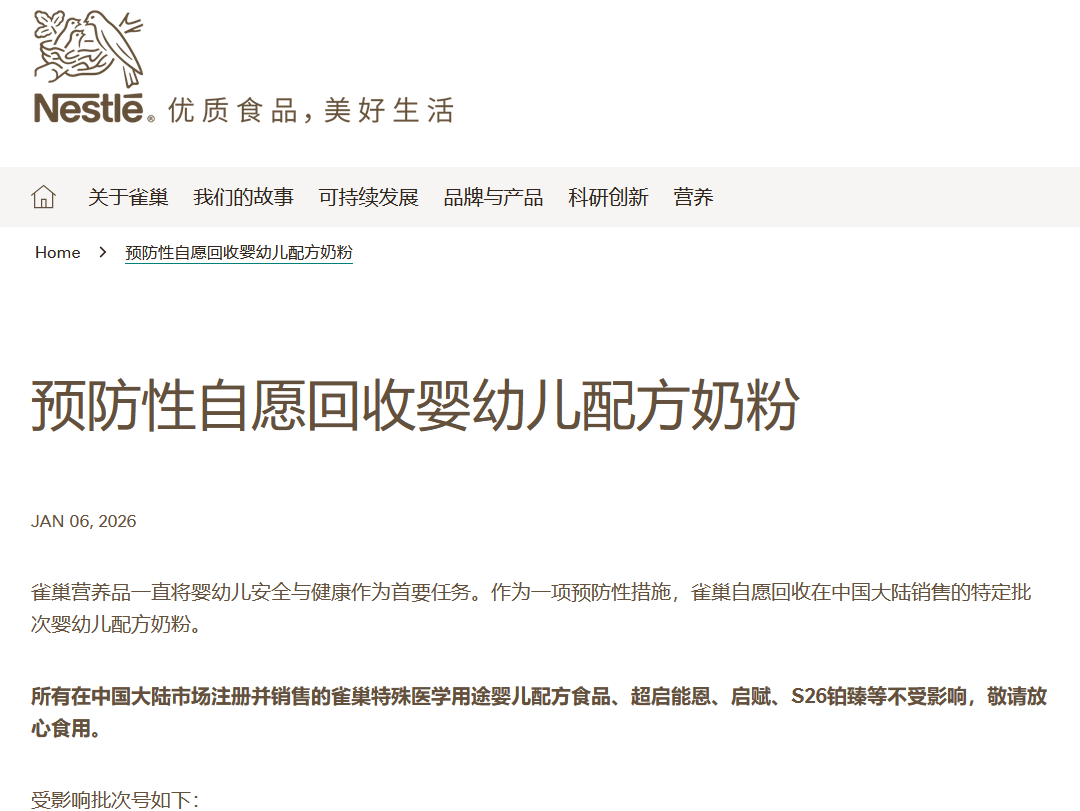
因原料质量问题,雀巢在欧洲多国召回数批次婴儿奶粉,公司:中国市场特定批次亦启动预防性回收
Mei Ri Jing Ji Xin Wen· 2026-01-07 07:02
Group 1 - Nestlé has recalled several batches of infant formula in multiple European countries, including Germany, Austria, Denmark, Sweden, and France, due to quality issues linked to a specific ingredient sourced from a large supplier, which may contain bacterial substances from Bacillus cereus, leading to gastrointestinal discomfort such as diarrhea and vomiting [1] - On January 6, Nestlé China announced a voluntary recall of specific batches of infant formula sold in mainland China, affecting products like Litojing, Platinum Enfamil, Shuyin Enfamil, and multiple batches of Wyeth products. The recall also includes all imported infant formula from Europe sold through cross-border e-commerce channels in China [1] - Nestlé China emphasized that all other products outside the recall scope, as well as other batches of similar products, are safe for consumption. Products registered and sold in mainland China, such as special medical purpose infant formula and others like Super Enfamil and S26 Platinum, are not affected [3] Group 2 - As of January 7, Nestlé China stated that it is taking the situation seriously, noting that only a few products in the Chinese market may be affected. As a precautionary measure, specific batches of infant formula have been recalled, and no reports of adverse effects related to the products have been received so far. The company prioritizes product quality and consumer health [3]