
有色金属

Search documents
铜:情绪悲观,价格弱势
Guo Tai Jun An Qi Huo· 2026-02-03 02:38
Report Summary 1. Report Industry Investment Rating - Not provided in the report 2. Report's Core View - The copper market is currently experiencing pessimistic sentiment and weak prices, with a trend strength of 0, indicating a neutral outlook [1][3] 3. Summary by Relevant Catalog 3.1 Fundamental Data Tracking - **Futures Prices**: The closing price of the Shanghai Copper main contract was 98,580, down 4.92% during the day, and 100,820 at night, up 2.27%. The LME Copper 3M electronic disk closed at 12,900, down 1.30% [1] - **Trading Volume and Open Interest**: The trading volume of the Shanghai Copper index was 865,268, a decrease of 611,602 from the previous day, and the open interest was 604,349, a decrease of 53,190. The trading volume of the LME Copper 3M electronic disk was 49,201, a decrease of 2,097, and the open interest was 327,000, a decrease of 5,073 [1] - **Futures Inventory**: The Shanghai Copper futures inventory was 158,527, an increase of 1,676 from the previous day, and the LME Copper inventory was 174,675, a decrease of 300. The LME Copper注销仓单 ratio was 21.68%, a decrease of 2.21% [1] - **Price Spreads**: Various price spreads, including LME copper spreads, warehouse warrant premiums, bill premiums, and spot - futures spreads, showed different degrees of change compared to the previous day [1] 3.2 Macro and Industry News - **Macro News**: The US January ISM manufacturing index rose to 52.6, the highest since 2022, indicating a substantial expansion of the US manufacturing industry. The US January employment report will not be released on time due to a partial government shutdown [1] - **Industry News**: Zambia's copper production in 2025 was about 890,346 tons, an increase of 8% compared to 2024. Chile's Antofagasta's 2025 copper production was lower than its production guidance, Glencore's 2025 copper production decreased by 11%, and Southern Copper expects its copper production to decline in the next two years. Chile's copper production in December 2025 decreased by 4.7% year - on - year to 540,221 tons. Canada's Capstone Copper has resumed operations at its Mantoverde copper - gold mine in northern Chile despite a union strike [1][3]
新广东四小龙诞生!四个镇街GDP超千亿
3 6 Ke· 2026-02-03 02:37
Core Insights - Guangdong province has witnessed the emergence of its first trillion-yuan town, Guicheng, which is projected to surpass a GDP of 100 billion yuan by 2025, marking a significant milestone for the region [2][3] - Guicheng joins the ranks of three other trillion-yuan towns in Guangdong, namely Shishan, Beijiao, and Chang'an, collectively referred to as the "Four Little Dragons of Guangdong," showcasing the region's robust economic development [3][10] - The growth of these trillion-yuan towns reflects Guangdong's successful strategy of regional economic coordination and the flourishing of county and town economies over the past 30 years [3][4] Economic Performance - Shishan was the first to exceed the trillion-yuan mark in 2017, with a GDP of 137 billion yuan in 2023 and a significant industrial output of 468.95 billion yuan [5] - Beijiao followed in 2022, achieving a GDP of over 100 billion yuan, driven by major enterprises like Midea and Country Garden, and has developed a comprehensive white goods industry chain [6] - Chang'an reached a GDP of 105.07 billion yuan in 2024, supported by major players like OPPO and vivo, establishing a seamless supply chain in the electronics sector [7] - Guicheng, unlike the others, is a highly developed urban area with a thriving CBD, contributing significantly to the overall economic landscape of Foshan [8][9] Regional Development Strategy - Guangdong's approach to developing trillion-yuan towns is characterized by empowering local economies and fostering a "chain evolution" model, which has become a crucial driver for balanced regional development [10] - The "Hundred Counties, Thousand Towns, and Ten Thousand Villages High-Quality Development Project" initiated by the Guangdong provincial government aims to enhance regional coordination and economic growth [10] - The concentration of trillion-yuan towns in Guangdong, which accounts for three out of six known nationwide, underscores the province's leadership in this economic segment [10][11]
股商波动剧烈,全球资源品大周期?丨周度量化观察
申万宏源证券上海北京西路营业部· 2026-02-03 02:15
Core Viewpoint - The article discusses the recent volatility in the stock market, particularly in resource-related sectors, and highlights the ongoing global resource cycle, with a focus on investment opportunities and market dynamics [1]. Equity Market Summary - A-shares experienced a decline in prices but an increase in trading volume, with average daily trading exceeding 3 trillion yuan. Resource sectors such as oil, coal, non-ferrous metals, and agriculture led the market, indicating a broad revaluation of physical assets [1]. - The CSI Value Index rose by 1.01%, while the CSI Growth Index fell by 0.59%. The Hang Seng Index outperformed A-shares with a 2.38% increase [1]. - The market is expected to exhibit a "slow bull" characteristic until the Spring Festival, with rapid thematic rotations. Long-term investment strategies focusing on resource competition and technological self-reliance are recommended [4]. Bond Market Summary - The bond market remained stable, with the central bank supporting liquidity. Short-term bonds showed little volatility, while long-term bonds were relatively weaker. The low interest rate environment is expected to persist, but increased market speculation and volatility are anticipated [5]. Commodity Market Summary - Gold prices experienced significant fluctuations, reaching historical highs before a technical correction. The volatility was driven by geopolitical risks and a strengthening dollar due to potential hawkish signals from the Federal Reserve [6]. - The South China Commodity Index rose by 2.60%, with notable increases in precious metals and energy sectors, while non-ferrous metals and black commodities saw declines [35]. Overseas Market Summary - The US stock market showed overall gains, with large-cap stocks outperforming small-cap stocks. The Federal Reserve maintained interest rates, aligning with market expectations, while the dollar weakened significantly due to political statements [2]. - The AI industry trend remains strong, with a focus on productivity and revenue growth, while traditional cycles are being monitored for recovery [7].


国泰君安期货商品研究晨报-20260203
Guo Tai Jun An Qi Huo· 2026-02-03 02:12
2026年02月03日 国泰君安期货商品研究晨报 观点与策略 | 黄金:释放风险 | 3 | | --- | --- | | 白银:高位回落 | 3 | | 铜:情绪悲观,价格弱势 | 5 | | 锌:区间震荡 | 7 | | 铅:LME库存减少,限制价格下跌 | 9 | | 锡:回落整理 | 10 | | 铝:等待市场修复 | 11 | | 氧化铝:小幅反弹 | 11 | | 铸造铝合金:跟随电解铝 | 11 | | 铂:在震荡中小幅修复 | 13 | | 钯:韧性偏强但仍然低位震荡 | 13 | | 镍:宏观情绪主导边际,基本面与投机盘博弈 | 15 | | 不锈钢:二月检修减产频出,镍铁预期托底下方 | 15 | | 碳酸锂:下游陆续采购,盘面下方空间较有限 | 17 | | 工业硅:硅厂减产落地,下方空间不深 | 19 | | 多晶硅:关注现货成交情况 | 19 | | 铁矿石:窄幅震荡 | 21 | | 螺纹钢:市场情绪共振,偏弱震荡 | 22 | | 热轧卷板:市场情绪共振,偏弱震荡 | 22 | | 硅铁:成本预期松动,弱势震荡 | 24 | | 锰硅:商品情绪共振,弱势震荡 | 24 | | ...
广期所碳酸锂主力合约大涨6%,重新站上15万元关口
Jin Rong Jie· 2026-02-03 02:08
Core Viewpoint - The main contract for lithium carbonate on the Shanghai Futures Exchange surged by 6%, surpassing the 150,000 yuan per ton mark, closing at 150,100 yuan per ton [1] Group 1 - The significant increase in the price of lithium carbonate indicates strong market demand and potential bullish sentiment in the lithium sector [1] - The price movement reflects ongoing trends in the electric vehicle and battery manufacturing industries, which are heavily reliant on lithium carbonate [1]
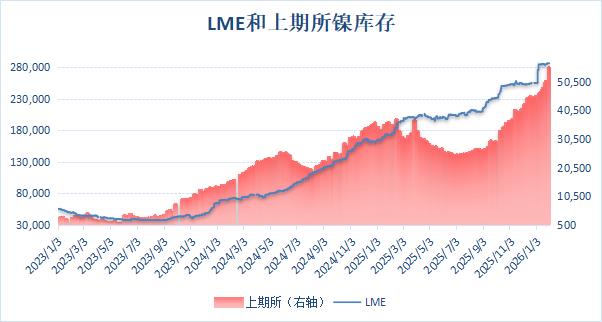
沪镍库存增近一成 刷新近八年最高位
Wen Hua Cai Jing· 2026-02-03 02:07
Core Insights - The London Metal Exchange (LME) reported that nickel inventories initially increased and then decreased, reaching a seven-year high on January 29, with the latest inventory level at 285,528 tons [1] - The Shanghai Futures Exchange (SHFE) indicated that nickel inventories continued to accumulate, marking five consecutive weeks of increases, with a weekly rise of 9.06% to 55,396 tons, reaching an eight-year high [1] Inventory Trends - As of February 2, 2026, LME nickel inventory stood at 285,528 tons, while SHFE inventory was at 55,396 tons as of January 30, 2026 [5] - The LME inventory peaked at 286,470 tons on January 29, 2026, before declining, while SHFE inventory has shown a consistent upward trend since January 23, 2026, when it was 50,794 tons [5] - The increase in SHFE inventory over the past five weeks indicates a significant upward trend, with the latest data reflecting a 9.06% increase from the previous week [1][5]
流动性风险下的商品市场
2026-02-03 02:05
Summary of Conference Call on Commodity Market Dynamics Industry Overview - The conference call discusses the recent dynamics in the commodity market, particularly focusing on the significant price declines observed since January 30, 2026, with silver futures being the primary commodity affected [1][2]. Key Points and Arguments Commodity Price Movements - A notable price drop in commodities has been observed, with silver futures leading the decline, followed by tin, platinum, palladium, nickel, copper, aluminum, and eventually impacting crude oil and lithium carbonate [3][4]. - The price of domestic silver futures remains 30% higher than the London Metal Exchange (LME) spot price, indicating a significant premium [5]. Market Dynamics and Liquidity Risks - The liquidity risk in the market is primarily concentrated in silver, with over 90,000 short positions unable to be cleared, triggering margin calls and subsequent sell-offs [4][6]. - The gold market is relatively stable, with a fair pricing mechanism, and is less affected by liquidity risks compared to silver [6]. Future Market Outlook - Historical patterns suggest that severe commodity price fluctuations often follow similar transmission chains, necessitating close monitoring of domestic and international price premiums [7]. - There is potential for recovery in certain commodities that may have been oversold, particularly in the non-ferrous metals sector, with aluminum identified as a key focus [8][9]. Investment Opportunities - The call highlights three main investment themes for 2026: non-ferrous metals (with a focus on aluminum), renewable energy materials, and critical raw materials in high-tech industries [8]. - The basic and fine chemical sectors are also recommended for investment, as they may experience a rebound due to inventory replenishment and capacity restructuring after a prolonged period of destocking [10]. Gold as an Investment - Gold continues to be viewed as a valuable investment, with central banks maintaining a trend of purchasing gold, which is expected to persist despite recent market volatility [11]. Monitoring Silver Futures - Silver futures are considered a critical indicator for assessing market sentiment and liquidity. A recovery in silver futures could signal a stabilization in the broader commodity market [12]. Additional Important Insights - The A-share market's volatility is largely driven by emotional transmission rather than fundamental deterioration, with significant correlations observed with U.S. stock market movements [13][14]. - The current market fluctuations are primarily liquidity-driven, with expectations of stabilization in the precious metals matrix in the near term [15]. - Several sectors are highlighted for potential investment, including commercial aerospace, AI applications, and semiconductor equipment, which are expected to attract attention in the upcoming market cycles [16][17]. Investment Strategy Recommendations - Investors are advised to manage their positions and timing carefully, focusing on growth sectors while being adaptable to rapid market rotations, especially around the Chinese New Year [18].
沃什接棒联储会改变周期逻辑吗
2026-02-03 02:05
沃什接棒联储会改变周期逻辑吗?20260202 摘要 Kevin Warsh 被提名为美联储主席后,市场普遍认为他是"缩表派", 可能推动美联储缩减资产负债表,给各类资产带来不确定性,投资者需 关注其具体实施细节。 Warsh 曾批评美联储的数据依赖路径,并多次强调通胀风险,市场认为 他可能更偏鹰派,更加关注通胀问题,投资者需警惕其政策对通胀的潜 在影响。 Warsh 与特朗普总统关系密切,可能减少美联储与白宫之间的摩擦,但 也可能导致政策冲突,如 Warsh 倾向于缩表与特朗普希望低利率刺激经 济的目标相悖。 当前金融系统面临流动性风险和波动性增加的挑战,美联储新主席人选 的不确定性加剧了市场波动,投资者应重新评估风险并调整投资策略。 全球主要经济体面临高通胀、货币贬值和财政不可持续性的债务管理挑 战,各国央行倾向于容忍较高通胀以降低实际债务负担,可能导致金融 抑制。 Q&A Kevin Warsh 被提名为下一届美联储主席后,市场对其政策方向有哪些解读? 市场对 Kevin Warsh 的政策方向有多方面的解读。首先,Warsh 曾公开表示 对 2008 年后的大规模量化宽松(QE)非常不满,并因此辞去上 ...
大摩闭门会:邢自强、Laura Wang:风云变幻的26年市场
2026-02-03 02:05
大摩闭门会:邢自强、Laura Wang:风云变幻的 26 年市场 260202 发言人 00:00 黄金这个行业分析的张雷,以及今天也在线的我们的经济学家蔡志鹏。我们在一月初参加的摩根斯 standing 的人民币基金的一场讨论的年会上也提出过,2026 年的宏观和市场必定毕竟会是波涛汹涌 的一年。我想上周就经历了这过山车一般的变化。 发言人 00:24 发言人 04:11 调整的越剧烈,比如说贵金属市场基本上是一个史诗级的震荡。黄金价格在 48 小时之内从接近 5600 块钱美元跌到了 4690 块钱美元,跌幅累计高达 16%。而且黄金在这段时间的波动率飙升到 44 以上, 这仅仅在 2020 年的三月全球疫情期间出现过更高的水平,创下了一个历史纪录。在这个过程中美元也 反弹了,美元指数大幅反弹了单日的 0.8%。 发言人 03:13 那么美元对日元就呈现出像去年 4 月份,美国提出关税战的解放日之后的这种过山车式的行情。在短短 一两周之内,从跌破了 150 美元,日元汇率反弹到 154 的上方。这些背后都反映了似乎它对边际流动 性预期敏感性,贵金属是最敏感的。 发言人 03:36 其次汇率市场在最后到一 ...
2月2日有色金属、电子、通信等行业融资净卖出额居前
Sou Hu Cai Jing· 2026-02-03 02:00
Summary of Key Points Core Viewpoint - As of February 2, the market's latest financing balance is 26,926.79 billion yuan, showing a decrease of 6.01 billion yuan compared to the previous trading day. Industry Financing Changes - 15 out of 31 industries reported an increase in financing balance, with the basic chemical industry seeing the largest increase of 0.69 billion yuan. Other notable increases were in the construction decoration, automotive, and building materials industries, which rose by 0.56 billion yuan, 0.25 billion yuan, and 0.17 billion yuan respectively [1][2] - Conversely, 16 industries experienced a decrease in financing balance, with the non-ferrous metals, electronics, and communications sectors showing the most significant declines of 3.27 billion yuan, 2.32 billion yuan, and 1.97 billion yuan respectively [1][2] Percentage Changes in Financing Balance - The construction decoration industry had the highest percentage increase in financing balance at 1.31%, followed by building materials, coal, and light manufacturing industries with increases of 1.18%, 0.96%, and 0.87% respectively [1] - The non-ferrous metals, petroleum and petrochemicals, and communications industries had the largest percentage decreases in financing balance, with declines of 2.09%, 1.95%, and 1.45% respectively [1][2]