
能源

Search documents
今年上半年外国对格能源领域投资有所增加
Shang Wu Bu Wang Zhan· 2025-09-17 17:31
格鲁吉亚Georgiatoday网站9月10日消息报道,格国家统计局数据显示,今年上 半年外国对格能源领域直接投资1.26亿美元,同比增长34.7%。能源已成为格吸引 外国直接投资的第二大行业,仅次于金融和保险业,凸显了能源在格经济中日益增 强的作用。 报告期内,捷克是格能源领域最大投资国,规模达7570万美元,其次是荷兰— 920万美元和土耳其—310万美元。 (原标题:今年上半年外国对格能源领域投资有所增加) ...
今年第二季度外国对格直接投资同比下降12%
Shang Wu Bu Wang Zhan· 2025-09-17 17:31
格鲁吉亚BPN网站9月8日消息报道,格国家统计局数据显示,今年第二季度外 国对格直接投资5.801亿美元,同比下降12% 。 对格直接投资最多的三个国家分别是英国—2.427亿美元,土耳其—5400万美 元,捷克—3830万美元。 (原标题:今年第二季度外国对格直接投资同比下降12%) 外资主要投向格以下三个领域:金融和保险—3.272亿美元,房地—6640万美 元,能源—5440万美元(占9.4%)。 ...
海报|与省领导面对面,8位山东企业家谈如何玩转AI+
Sou Hu Cai Jing· 2025-09-17 14:18
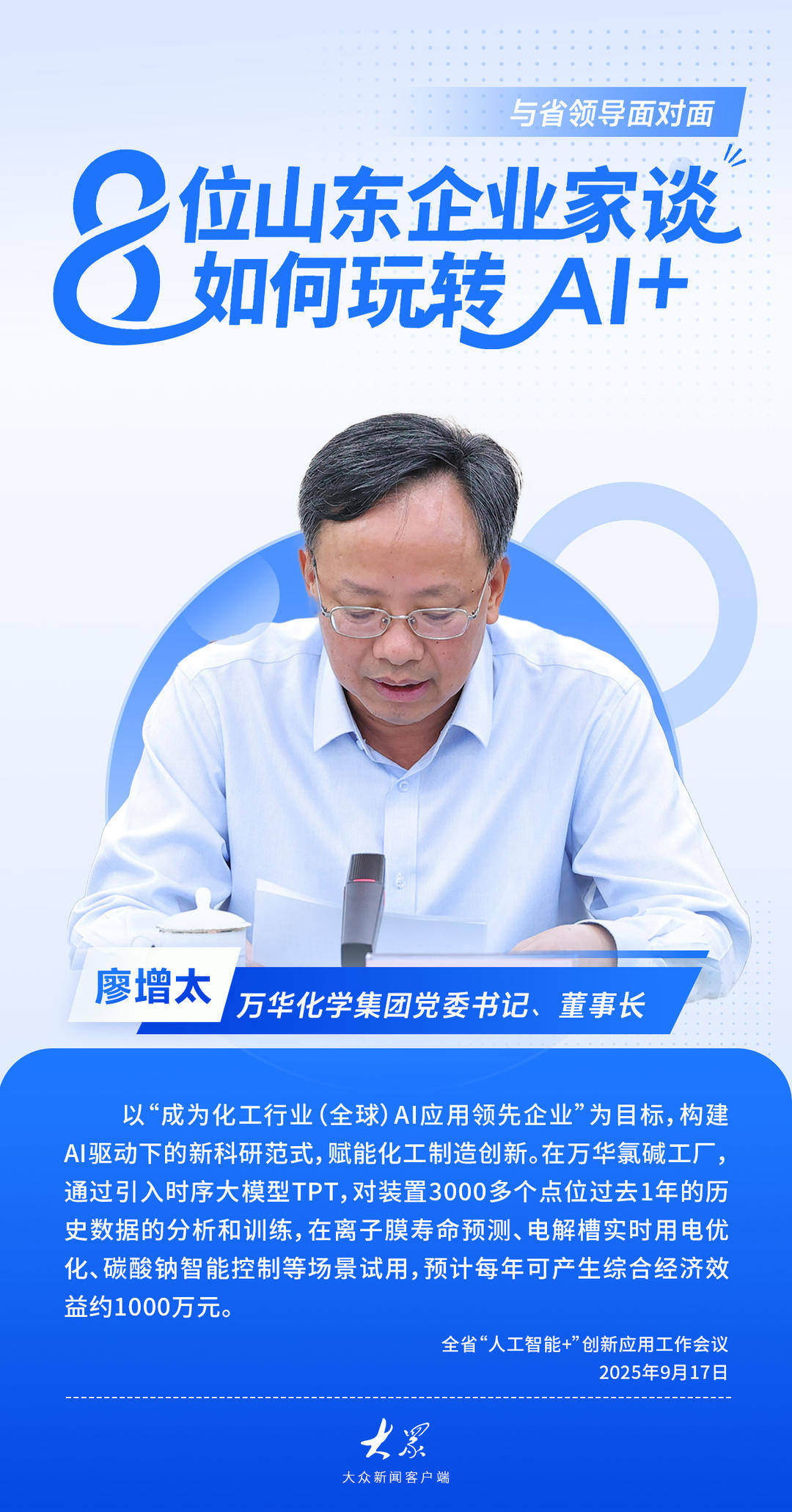
9月17日,全省"人工智能+"创新应用工作会议在济南召开。会上,8家企业作了发言,分享了将人工智能技术深度融入企业生产经营管理的经验做法。让 我们来看一下他们怎么说。 以"成为化工行业(全球)Al应用领先企业"为目标,构建 AI驱动下的新科研范式,赋能化工制造创新。在万华氯碱工厂, 通过引入时序大模型TPT,对装置3000多个点位过去1年的历 史数据的分析和训练,在离子膜寿命预测、电解槽实时用电优 化、碳酸钠智能控制等场景试用,预计每年可产生综合经济效 益约1000万元。 全省"人工智能+"创新应用工作会议 2025年9月17日 与省领导面对面 IFRT 切IP 1 北元年 FRAF 山东魏桥创业集团董事长 倾力打造行业领先的智铝大模型,深度挖掘电解槽运行 时序规律,形成了"数据+机理+经验"融合的强泛化人工智能体 系。投用后电解槽冷热转换周期从14天延长至18天,降低了冷 热转换对寿命的影响;分子比波动降低15%,提升了槽稳定性, 降低了50%现场重复性工作。 全省"人工智能+"创新应用工作会议 2025年9月17日 大众新闻客户端 乐企业 FT T 定 上一 山钢集团永锋临港有限公司党委书记、董事长 按照 ...

TA Securities:美联储若降息50bp 可能提振对利率敏感的行业股票
Ge Long Hui A P P· 2025-09-17 12:47
Core Viewpoint - TA Securities suggests that a sudden 50 basis point rate cut by the Federal Reserve could initially boost stocks in interest-sensitive sectors like real estate and utilities, but it may also heighten concerns about the severity of economic weakness compared to market expectations [1] Group 1: Impact on Sectors - A rate cut could positively impact real estate and utilities, which are sensitive to interest rates [1] - Concerns may arise regarding the Federal Reserve's perception of economic weakness, potentially shifting market sentiment from a "soft landing" to a "hard landing" scenario [1] Group 2: Market Sentiment and Reactions - The transition in sentiment could lead to a more severe market correction, particularly affecting cyclical sectors such as energy and industrials [1] - Even the technology sector may face valuation pressures unless companies demonstrate resilient earnings [1]
商品:波动率能否被美联储降息叙事激发?
对冲研投· 2025-09-17 12:06
Core Viewpoint - The article emphasizes the divergence in commodity markets, highlighting the lack of intrinsic demand momentum as a key obstacle for bullish narratives, contrasting with the robust performance of capital markets [5][6]. Group 1: Commodity Market Dynamics - The commodity market is experiencing a split, with bullish sentiment being challenged by a lack of internal demand momentum, which is crucial for sustaining price increases [5]. - In the energy sector, particularly crude oil, rising inventories have weakened bullish momentum, and despite geopolitical tensions, there is no significant bullish trend in prices [6]. - The EIA has revised down its 2025 demand growth forecast to 900,000 barrels per day, likely linked to the U.S. economic outlook, while OPEC's recent decisions to increase production reflect a persistent oversupply situation expected to last until early 2026 [6]. Group 2: Investment Opportunities - Key judgments to make include whether the market's second pricing of supply pressures and weak demand is nearing a marginal end and if the current downward volatility in commodities has reached a bottom, potentially leading to an upward shift in volatility following the Fed's interest rate decisions [7]. - The article suggests continuing to embrace the bullish logic surrounding precious metals, as the self-fulfilling nature of expectations could drive prices higher, although caution is advised regarding potential corrections following interest rate announcements [8]. - Focus on commodities with bullish trading opportunities, particularly those with supply constraints, such as coking coal and polysilicon, while also monitoring external variables affecting supply [8]. Group 3: Export and Demand Trends - The article highlights that China's export sector shows potential for exceeding expectations, with a reported export value of 17.61 trillion yuan in the first eight months of 2025, a year-on-year increase of 6.9% [9]. - The structure of exports is improving, with high-value and high-tech products seeing significant growth, such as integrated circuits and automotive exports, which are expected to support demand for basic metals [9]. - The diversification of export markets is also noted, with significant growth in trade with emerging markets, particularly ASEAN and Africa, indicating reduced reliance on single markets [9]. Group 4: Specific Commodity Insights - The article points out that global aluminum demand is expected to grow by 3% year-on-year, while production growth remains sluggish at around 1.5%, suggesting potential upward price elasticity for aluminum [10]. - The current visible inventory of aluminum is approximately 1.13 million tons, which, while slightly up from the year's low, remains significantly below levels seen in 2024, indicating a potential for price increases [10]. - The relationship between alumina and aluminum has weakened, suggesting that trading strategies focusing on long aluminum and short alumina could have further potential [10].

用好雪球三分法,把握降息后的投资机会
Sou Hu Cai Jing· 2025-09-17 11:22
Group 1 - The Federal Reserve is expected to announce a key interest rate decision in the second half of 2025, with a 95.9% probability of a 25 basis point rate cut [1] - A rate cut is anticipated to trigger a liquidity turning point in global financial markets, affecting the performance of U.S. stocks, emerging markets, and commodities [1][3] Group 2 - In the U.S. stock market, technology growth is expected to remain the main focus, while traditional cyclical sectors may perform relatively flat [3][5] - The Nasdaq 100 index, primarily composed of technology stocks, is likely to continue its upward trend post-rate cut, benefiting companies like Apple and Microsoft due to reduced financing costs [4] - Historical data indicates that U.S. stocks typically experience a "rate cut trade" lasting around three months, suggesting limited concern for immediate pullbacks [6] Group 3 - Emerging markets, particularly A-shares and Hong Kong stocks, may attract new capital as the U.S. dollar weakens post-rate cut [7] - A-shares in sectors like AI computing and semiconductors are expected to benefit from valuation expansion due to low interest rates, while Hong Kong tech stocks may recover from previous pressures [8] Group 4 - In the commodities market, gold and silver are seen as having greater opportunities compared to oil, with gold historically showing an 83% success rate in the ten trading days following rate cuts [9] - The appeal of gold is heightened by reduced opportunity costs and rising geopolitical risks, while silver benefits from both its safe-haven and industrial demand [9] Group 5 - The "雪球三分法" (Snowball Three-Part Method) is proposed as a strategy for investors to navigate the differentiated market conditions post-rate cut [11] - This method emphasizes asset, market, and timing diversification to capture opportunities across various sectors while mitigating risks associated with single markets [12] Group 6 - Asset diversification can lower volatility, as evidenced by a significant reduction in maximum drawdown when incorporating gold into traditional stock-bond portfolios during rate hikes [13] - Market diversification allows for capturing opportunities across global markets, reducing the impact of correlated movements between different asset classes [16] Group 7 - Timing diversification through regular investment can alleviate concerns about market timing, allowing investors to benefit from long-term trends without the stress of buying at peak prices [17]

深化AI与能源融合发展,2025能源绿色发展大会在深圳举行
Zheng Quan Shi Bao Wang· 2025-09-17 11:03
Core Insights - The 2025 Energy Green Development Conference was held in Shenzhen, focusing on the theme of "Energy + AI Leading Green Development" [1] - Key speakers emphasized the importance of integrating artificial intelligence with the energy sector to promote green and low-carbon transformation [1][2] - The conference announced the launch of the international journal Energy Use and the establishment of the AI Application Working Committee by the China Refrigeration Association [2][3] Group 1: Conference Highlights - The conference was inaugurated by prominent figures including Zheng Jianbang, Meng Fanli, and Wan Jinsong, who highlighted the significance of energy as a foundation for economic development [1] - Zheng Jianbang called for a global perspective and focus on Chinese practices to enhance the synergy between energy and AI, aiming to maximize their combined effectiveness [1] - Meng Fanli expressed Shenzhen's commitment to advancing high-quality development in the AI industry and its application across various sectors [1] Group 2: Industry Developments - Wan Jinsong pointed out the urgent need for reliable and green energy to support the rapid development of AI, advocating for deep integration between AI and the energy sector [2] - Shenzhen Energy and Huawei announced a collaboration to create the first AI joint innovation laboratory in the energy sector, launching a global first in renewable power forecasting based on meteorological models [2] - A demonstration project integrating solar energy storage and charging was introduced, aimed at showcasing low-carbon transformation and energy utilization in urban settings [2] Group 3: Forum Discussions - The conference featured eight parallel forums discussing topics such as national energy security, AI and energy synergy, low-carbon planning for urban energy systems, and breakthroughs in energy storage [3]

央企资产总额超90万亿元,现代新国企加速成长
2 1 Shi Ji Jing Ji Bao Dao· 2025-09-17 11:01
Core Insights - The central enterprises in China have shown significant growth during the "14th Five-Year Plan," with total assets increasing from less than 70 trillion yuan to over 90 trillion yuan, and total profits rising from 1.9 trillion yuan to 2.6 trillion yuan, achieving average annual growth rates of 7.3% and 8.3% respectively [1][2] - The focus on technological innovation has been pivotal, with R&D expenditures exceeding 1 trillion yuan for three consecutive years, and the establishment of 97 original technology sources and 23 innovation alliances [1][5] - The reform and restructuring of state-owned enterprises (SOEs) are set to conclude in 2025, with strategic mergers and the establishment of new central enterprises aimed at enhancing operational efficiency and resource allocation [1][8] Financial Performance - Central enterprises have improved their operational efficiency, with the operating income profit margin increasing from 6.2% to 6.7%, and labor productivity rising from 594,000 yuan to 817,000 yuan per employee annually [2] - Cumulatively, central enterprises have completed fixed asset investments totaling 19 trillion yuan from 2021 to 2024, with an average annual growth rate of 6.3% [2] Economic Contribution - Central enterprises play a crucial role in the economy, supplying approximately 80% of crude oil, 70% of natural gas, and 60% of electricity, thereby ensuring energy security and food supply [3] - They have contributed over 10 trillion yuan in taxes and transferred 1.2 trillion yuan in state-owned equity to social security funds during the "14th Five-Year Plan" [3] Technological Innovation - The innovation capabilities of central enterprises have significantly advanced, with R&D intensity increasing from 2.6% to 2.8%, and a focus on strategic emerging industries leading to an annual investment growth rate exceeding 20% [5][6] - The "AI+" initiative has been implemented across over 800 application scenarios, promoting the intelligent transformation of traditional industries and fostering the rapid development of general and industry-specific models [7] Structural Reforms - The restructuring of central enterprises is characterized by a focus on enhancing core functions and competitiveness, with 10 enterprises undergoing strategic mergers and 9 new central enterprises established [8][9] - The optimization of state-owned capital is evident, with over 70% of revenue from central enterprises coming from sectors critical to national security and public welfare [9]
高质量完成“十四五”规划丨“十四五”时期中央企业“AI+”专项行动效果初显
Xin Hua She· 2025-09-17 07:09
Core Insights - The "14th Five-Year Plan" period has seen the implementation of the central enterprises' "AI+" initiative, which has shown initial positive results in various key industries [2][3] - The initiative aims to transform traditional industries by integrating AI technologies, thereby enhancing productivity and reshaping the global industrial landscape [2] Group 1: AI+ Initiative Implementation - Over 800 application scenarios have been developed across 16 key industries, including energy, manufacturing, and telecommunications [2] - The establishment of three industry data communities in transportation logistics, green low-carbon, and smart energy has led to the creation of over 1,000 industry data sets [3] - Telecommunications operators have accelerated their transition to AI foundational service providers, with cumulative investments exceeding 10 billion yuan, resulting in a more than twofold increase in intelligent computing scale compared to before the "AI+" initiative [3] Group 2: Development of AI Models - Central enterprises are focusing on building autonomous, controllable, and secure foundational AI models, with models like "Jiutian," "Xingchen," and "Yuanjing" being rapidly applied in energy and manufacturing sectors [3] - The establishment of the "Renewal Community" has brought together 244 vertical industry models and nearly 160 high-quality data sets, facilitating the widespread application of AI technologies [3] Group 3: Future Directions - Central enterprises will continue to implement the recent State Council's opinions on deepening the "AI+" initiative, leveraging their strengths and development realities to achieve better outcomes in the AI field [3]
“十四五”时期中央企业“AI+”专项行动效果初显
Xin Hua She· 2025-09-17 07:00
Group 1 - The core viewpoint is that the "AI+" initiative during the 14th Five-Year Plan period has shown initial success, with over 800 application scenarios developed across 16 key industries, including energy, manufacturing, and communication [1][2] - The "AI+" initiative is described as a comprehensive paradigm shift rather than a simple technological overlay, fundamentally transforming production and lifestyle while reshaping the global industrial landscape [1] - Central enterprises are encouraged to embrace AI and effectively utilize it to enhance productivity and drive industrial upgrades [1][2] Group 2 - During the 14th Five-Year Plan, the "AI+" initiative has led to the establishment of three industry data communities in transportation logistics, green low-carbon, and smart energy, with over 1,000 industry data sets created [2] - Communication operators have accelerated their transition to AI foundational suppliers, investing over 10 billion yuan and achieving more than a twofold increase in intelligent computing scale compared to before the "AI+" initiative [2] - The initiative has also led to the establishment of the "Renewal Community," which has gathered 244 industry-specific models and nearly 160 high-quality data sets, facilitating the widespread application of AI technology [2]