
人形机器人

Search documents
揭秘涨停 | 强势“一”字板,黄金龙头股超44亿元封涨停!
Zheng Quan Shi Bao Wang· 2026-01-26 11:23
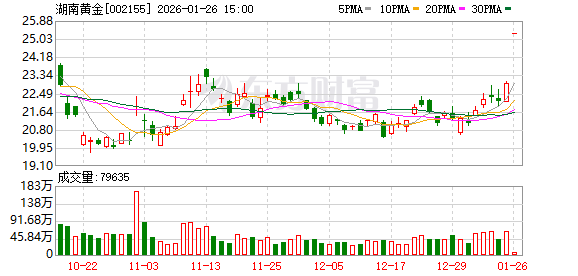
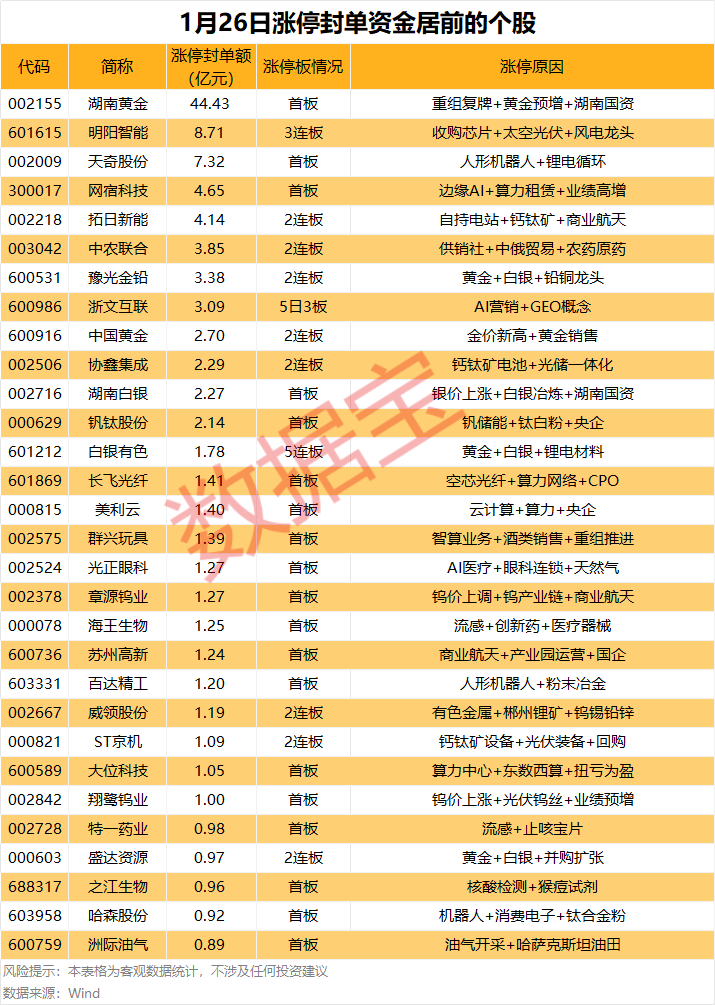
截至今日(1月26日)收盘,上证指数报收4132.61点,下跌0.09%;深证成指收于14316.64点,下跌 0.85%。创业板指下跌0.91%;科创50指数下跌1.35%。 不含未开板新股,今日可交易A股中,上涨个股有1604只,占比29.36%,下跌个股有3771只。其中,收 盘封死涨停的有77只,跌停股有42只。另外,53股封板未遂,整体封板率为59.23%。 德邦证券指出,贵金属与有色金属表现强势。具体来看,国际商品中"贵金属领涨,银价飙升,锡、 金、镍价大涨"。国内市场同样呈现"贵金属、有色、能化强势,白银领涨"的格局。 从封单力度(封单量占流通A股比例)来看,中农联合、湖南黄金、天奇股份等力度较大,分别为 14.40%、11.25%、7.92%。 | | | | 1月26日涨停封单资金居前的个股 | | | --- | --- | --- | --- | --- | | 代码 | 简称 | 涨停封单额 (亿元) | 涨停板情况 | 涨停原因 | | 002155 | 湖南黄金 | 44.43 | 首板 | 重组复牌+黄金预增+湖南国资 | | 601615 | 明阳智能 | 8.71 | 3连板 ...


强势“一”字板,黄金龙头股超44亿元封涨停!
Xin Lang Cai Jing· 2026-01-26 11:09
截至今日(1月26日)收盘,上证指数报收4132.61点,下跌0.09%;深证成指收于14316.64点,下跌 0.85%。创业板指下跌0.91%;科创50指数下跌1.35%。 德邦证券指出,贵金属与有色金属表现强势。具体来看,国际商品中"贵金属领涨,银价飙升,锡、 金、镍价大涨"。国内市场同样呈现"贵金属、有色、能化强势,白银领涨"的格局。 从封单力度(封单量占流通A股比例)来看,中农联合、湖南黄金、天奇股份等力度较大,分别为 14.40%、11.25%、7.92%。 | | | | 1月26日涨停封单资金居前的个股 | | | --- | --- | --- | --- | --- | | 代码 | 简称 | 涨停封单额 (亿元) | 涨停板情况 | 涨停原因 | | 002155 | 湖南黄金 | 44.43 | 首板 | 重组复牌+黄金预增+湖南国资 | | 601615 | 明阳智能 | 8.71 | 3连板 | 收购芯片+太空光伏+风电龙头 | | 002009 | 天奇股份 | 7.32 | 首板 | 人形机器人+锂电循环 | | 300017 | 网宿科技 | 4.65 | 首板 | 边缘AI ...
韩国今年将向融合源技术领域投资2342亿韩元
Shang Wu Bu Wang Zhan· 2026-01-26 09:57
据韩联社1月16日报道,韩国科学技术信息通信部15日宣布融合源技术开发项目实施计划,今年将投资 2342亿韩元用于融合源技术研究、高温超导、超级计算机、科技人工智能和人形机器人。融合源技术领 域将继续支持融合技术项目,对高商业化潜力项目的桥梁融合研发和全球融合研发提供给支持。高温超 导领域将启动新项目增强实用性。超级计算机领域将建设并运行第六台超级计算机,确保软件源代码安 全。科技人工智能领域将开发用于生物、材料和化学领域的人工智能模型。人形机器人领域将开发具有 人类水平行为自主性的人形机器人。 ...
智能制造行业周报:SpaceX推进星链升级与IPO进程-20260126
Shanghai Aijian Securities· 2026-01-26 09:41
Investment Rating - The mechanical equipment industry is rated as "stronger than the market" based on its performance relative to the CSI 300 index, which decreased by 0.62% during the week while the mechanical equipment sector increased by 2.57% [5][6]. Core Insights - SpaceX is advancing its Starlink system upgrades and capitalizing on its operations, planning to launch a second-generation Starlink system by 2027, which will enhance satellite performance and network capacity. The company aims to reduce the cost of launching to below $100 per pound through full reusability of its Starship [2]. - The capital market is preparing for SpaceX's IPO, expected in Q3 2026, with a valuation around $800 billion based on recent internal equity transactions. The report suggests that the valuation uplift in China's private rocket companies will follow a similar trajectory as SpaceX, transitioning from project-based products to infrastructure and technology services [2]. - In the PCB equipment sector, companies such as Chipbond (688630), Dongwei Technology (688700), and Dazhu CNC (301200) are recommended, with a focus on the increasing demand for advanced packaging and fine line technology [3]. - The humanoid robot sector is highlighted with recommendations for companies like Inovance Technology (300124) and Sanhua Intelligent Control (002050), as the production of Tesla's Optimus V3 approaches, which is expected to catalyze the market [3]. - In the controlled nuclear fusion sector, Guoji Heavy Industry (601399) is recommended, with expectations of increased procurement activity related to fusion projects, potentially exceeding previous investment forecasts [4]. Summary by Sections Mechanical Equipment Sector - The mechanical equipment sector's PE-TTM valuation increased by 2.56%, with the best-performing sub-sector being abrasives, which rose by 8.58% [5][6]. - The report indicates that the mechanical equipment industry ranks 13th out of 31 in the Shenwan industry classification [5]. Commercial Aerospace - Companies such as Yingliu Co. (603308), Srey New Materials (688102), and West Materials (002149) are recommended for investment in the commercial aerospace sector [5]. PCB Equipment - The report emphasizes the transition towards thinner substrates and finer line requirements in PCB manufacturing, with specific recommendations for companies involved in advanced packaging technologies [3]. Humanoid Robots - The report suggests focusing on core enterprises in the humanoid robot sector, particularly as Tesla ramps up production of its Optimus V3 robot, which is expected to begin sales in 2027 [3]. Controlled Nuclear Fusion - The procurement pace for fusion projects is accelerating, with significant budget allocations expected for various projects, indicating a robust growth outlook for companies in this sector [4].





A股收评:成交额3.28万亿元!三大指数集体下跌,贵金属、生物疫苗股逆市大涨
Ge Long Hui· 2026-01-26 07:11
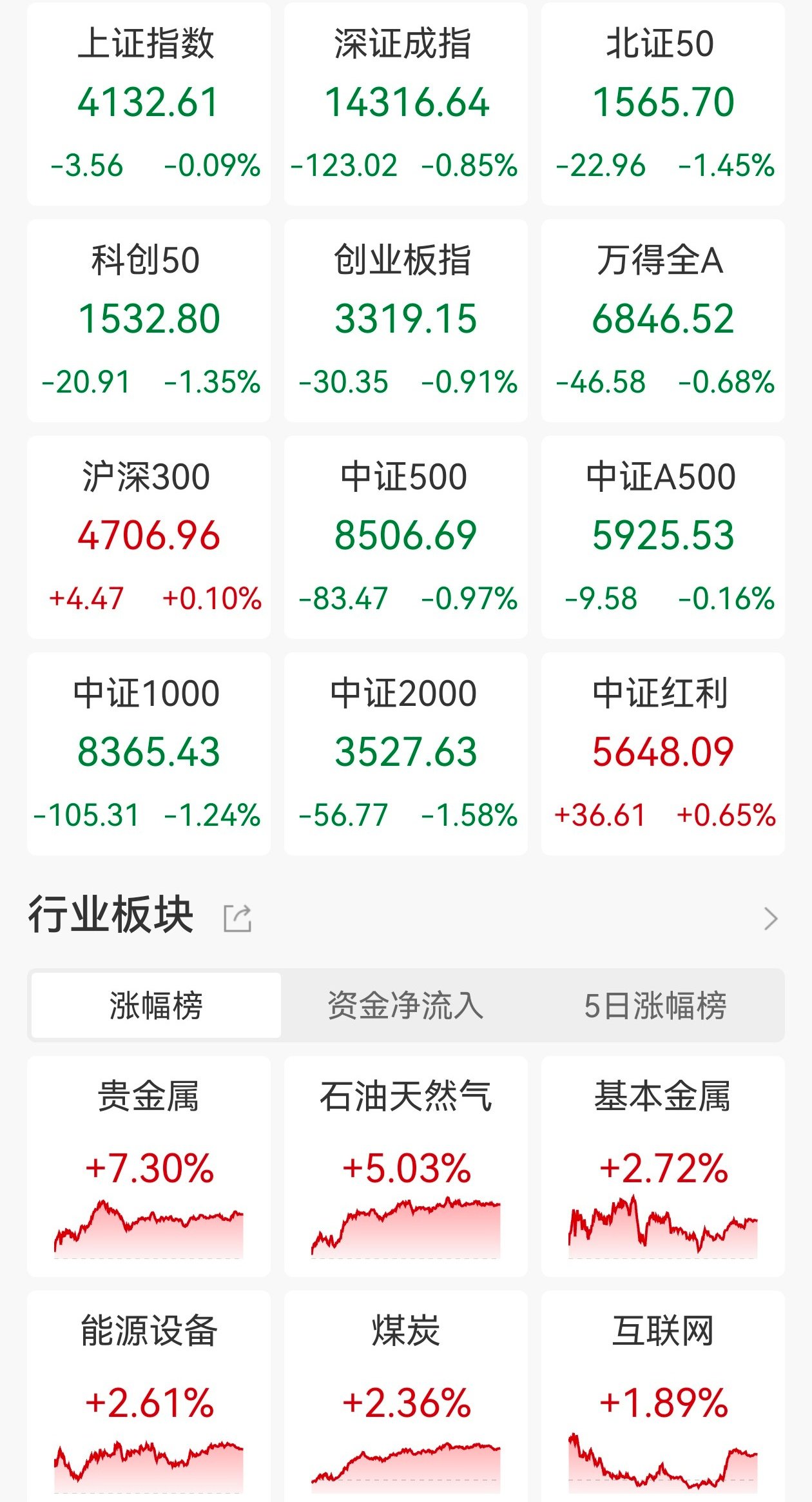
Market Overview - The three major A-share indices collectively declined, with the Shanghai Composite Index down 0.09% to 4132 points, the Shenzhen Component Index down 0.85%, and the ChiNext Index down 0.91% [1] - The total market turnover reached 3.28 trillion yuan, an increase of 162.5 billion yuan compared to the previous trading day, with over 3700 stocks declining [1] Sector Performance - Precious metals and gold concepts surged, with multiple stocks such as Xiaocheng Technology, Western Gold, and Hunan Silver hitting the daily limit [1] - The outbreak of the Nipah virus in India led to a rise in the biopharmaceutical sector, with stocks like Cap Bio also hitting the daily limit [1] - The non-ferrous metals sector saw gains, with stocks like Xingye Silver and Tin also reaching the daily limit [1] - The oil, insurance, and influenza sectors performed well, showing significant gains [1] - Conversely, the commercial aerospace and satellite internet sectors experienced a sharp decline, with stocks like China Satellite and Aerospace Development hitting the daily limit [1] - The 6G concept sector fell, with Yaguang Technology dropping over 13% [1] - The military industry sector also declined, with stocks like Chaojie Co. falling over 10% [1] - Sectors such as LiDAR, AI chips, and humanoid robots faced significant losses [1] Fund Inflow and Performance - The top sectors by net fund inflow included oil and gas (+7.30%), precious metals (+5.03%), and basic materials (+2.72%) [2] - Other sectors showing positive performance included coal (+2.61%), energy equipment (+2.36%), and the internet sector (+1.89%) [2]
住建部:今年将着力稳定房地产市场 能源局:电动汽车充电设施突破2000万个
Xin Lang Cai Jing· 2026-01-26 06:39
Group 1: Real Estate Market - The Ministry of Housing and Urban-Rural Development aims to stabilize the real estate market this year by implementing city-specific and precise policies, supporting reasonable financing needs of real estate companies, and addressing residents' housing demands [1] - Key initiatives include establishing a project company system for real estate development, promoting a main bank system for financing, and implementing a "see what you get" system for the sale of commercial housing [1] Group 2: Market Regulation - The State Administration for Market Regulation reported that in 2025, it urged mobile power production companies to recall 1.3977 million problematic power banks due to safety concerns [2] - The number of complaints regarding mobile power products has decreased by 85% compared to the peak in July 2025, indicating improved consumer satisfaction [2] Group 3: Environmental Initiatives - The Ministry of Ecology and Environment announced the first batch of 23 beautiful rural pilot areas, focusing on ecological protection and rural development [4] - By 2025, rural environmental quality is expected to improve significantly, with over 24,000 administrative villages undergoing environmental remediation [4] Group 4: Transportation Impact - The recent cold wave has led to the closure of 161 sections of national and provincial highways across 14 provinces due to snow and icy conditions [5] Group 5: Electric Vehicle Infrastructure - As of December 2025, the number of electric vehicle charging facilities in China has surpassed 20 million, supporting over 40 million new energy vehicles [6] - The growth rate of charging facilities has accelerated, with the number doubling from 10 million to 20 million in just 18 months [6] Group 6: Robotics Industry - In 2025, over 140 domestic companies have produced more than 330 humanoid robot models, marking a significant advancement in the industry [6] - The Ministry of Industry and Information Technology plans to promote technological innovation and safety in humanoid robots to support the broader development of embodied intelligence [6] Group 7: Telecommunications - China has built 4.838 million 5G base stations, with over 1.2 billion 5G users, establishing the largest and most advanced information infrastructure globally [7] - The first phase of 6G technology trials has been completed, with over 300 key technologies developed, and the second phase of trials has recently begun [7] Group 8: Consumer Market - The total retail sales of consumer goods in 2025 are projected to exceed 50 trillion yuan, with a growth rate of 3.7% [8] - The contribution of final consumption expenditure to economic growth is expected to reach 52%, highlighting its role as a key driver of economic development [8]
“星算·智联”太空算力研讨会将召开;报道称三星电子将一季度NAND价格上调100%丨盘前情报
2 1 Shi Ji Jing Ji Bao Dao· 2026-01-26 01:01
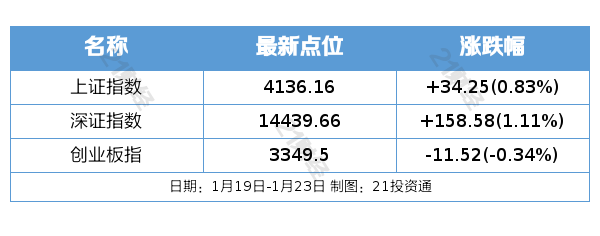
Market Performance - A-shares showed mixed performance in the past week, with the Shanghai Composite Index closing at 4136.16 points, up 0.83%, and the Shenzhen Component Index at 14439.66 points, up 1.11%. However, the ChiNext Index fell by 0.34% to 3349.50 points [1][2] - Over 77% of stocks experienced gains during the week, with 237 stocks rising over 15%, while only 14 stocks fell more than 15% [1] Sector Performance - The building materials, oil and petrochemicals, steel, and basic chemicals sectors saw increases, while the banking, telecommunications, non-bank financials, and food and beverage sectors experienced declines [1] International Market Overview - In the U.S. market, the Dow Jones Industrial Average fell by 285.30 points to 49098.71 points, a decrease of 0.58%. The S&P 500 rose slightly by 2.26 points to 6915.61 points, while the Nasdaq Composite increased by 65.22 points to 23501.244 points [3][4] - European markets showed mixed results, with the FTSE 100 down 0.07%, the CAC 40 down 0.07%, and the DAX up 0.18% [3][4] Commodity Prices - International oil prices rose, with WTI crude oil increasing by $1.71 to $61.07 per barrel, a rise of 2.88%, and Brent crude oil up by $1.82 to $65.88 per barrel, a rise of 2.84% [3][4] Industry Insights - The upcoming "Star Computing and Intelligent Connection" seminar aims to promote the integration of space information and intelligent computing, with a focus on developing a space computing infrastructure [5] - The global space economy is projected to reach $1.8 trillion by 2035, driven by the emergence of space infrastructure and applications [5] - Samsung Electronics plans to raise NAND flash memory prices by over 100% in Q1, indicating a significant supply-demand imbalance in the semiconductor market [7] - The Chinese securities market is expected to see a rise in demand for storage products due to AI-driven growth, with recommendations to focus on various segments of the storage industry [8] Investment Recommendations - Analysts suggest focusing on satellite internet and related sectors, including potential operators, communication equipment providers, and application service providers [5] - The semiconductor storage chain is viewed as having high certainty opportunities, with recommendations for companies involved in distribution, IC design, and domestic semiconductor supply chains [8]
证券日报:监管部门的一系列举措并非打压热门赛道
Xin Lang Cai Jing· 2026-01-26 00:25
MACD金叉信号形成,这些股涨势不错! 格隆汇1月26日|证券日报文章称,事实上,自2026年以来,A股市场热门概念轮动加速,商业航天、 AI应用、人形机器人等赛道轮番升温,推动部分个股走出短期暴涨行情。在此背景下,监管部门已采 取上调融资保证金比例、对涨幅过大个股启动停牌核查等调控措施为市场降温。此次针对锋龙股份的精 准监管,更是直指蹭热点、炒题材的违规交易行为。需要明确的是,监管部门的一系列举措并非打压热 门赛道,而是清晰划定"真价值"与"伪炒作"的边界:重点打击脱离公司基本面、借助题材概念实施资金 控盘、从事异常交易的投机行为,同时保护那些依托核心技术、深耕产业生态、具备长期发展潜力的优 质企业,引导市场资金从短期题材炒作向长期价值投资回归,维护资本市场的健康生态。 ...
影响市场重大事件:中科宇航完成IPO辅导;蓝箭航天朱雀三号总设计师张晓东表示,力争今年实现火箭的返回与部分再次飞行;银河航天徐鸣,太空新基建迎万亿市场
Mei Ri Jing Ji Xin Wen· 2026-01-25 22:27
每经记者|杨建 每经编辑|肖芮冬 |2026年1月26日 星期一| NO.1 中科宇航完成IPO辅导,5家运载火箭核心企业悉数入局 1月24日,商业航天龙头中科宇航已完成IPO辅导,该公司于1月16日进入辅导验收流程,其IPO辅导机 构为国泰海通证券。1月22日电,据上交所官网显示,蓝箭航天空间科技股份有限公司IPO审核状态变 更为已问询。近日,星河动力、星际荣耀、天兵科技3家商业航天企业更新了上市辅导进展,5家主营运 载火箭的核心企业已悉数入局,向"商业航天第一股"发起冲刺。 NO.2 蓝箭航天朱雀三号总设计师张晓东:力争今年实现火箭的返回与部分再次飞行 1月23日,在北京国际商业航天展览会商业航天产教融合新生态论坛上,蓝箭航天朱雀三号总设计师张 晓东表示,朱雀三号火箭未来要瞄准高频次的重复使用,第一步要固化回收技术,力争今年实现火箭的 返回,并且实现部分再次飞行;第二步是转入批产的运营,依托酒泉两个工位和无锡、嘉兴两座总装厂 房,形成年产30发,年发保底20发、力争30发的生产和发射能力,支撑我国低轨互联网星座快速组网; 第三步是开展朱雀三号甲的研制,并行启动海上平台、返场、塔架等多种回收模式探索,同步换 ...
财信证券宏观策略周报(1.26-1.30):市场上行斜率放缓,重视业绩基本面-20260125
Caixin Securities· 2026-01-25 13:32
Group 1 - The report suggests a strategic bullish outlook with tactical flexibility, emphasizing the importance of performance fundamentals in investment decisions [4][7][13] - It identifies a favorable investment window from mid-December 2025 to early March 2026, while cautioning against rapid upward trends in indices [4][7] - Key sectors to watch include commercial aerospace, satellite industries, AI applications, and sectors driven by price increases such as non-ferrous metals and chemicals [4][13] Group 2 - Economic growth is projected at 5.0% for 2025, with a focus on high-quality development and a potential GDP growth target of around 5% for 2026 [7][10] - The real estate market is still in a deep adjustment phase, with new housing sales expected to decline by 8.7% in 2025, indicating a need for careful observation of stabilization points [8][9] - Fiscal policy is expected to maintain a "only increase, not decrease" approach, with significant spending in key areas to support economic growth [10] Group 3 - The public fund industry is anticipated to solidify its high-quality development framework, with new guidelines enhancing the accountability of performance benchmarks for funds [11] - Precious metals are expected to retain investment value due to increasing global instability and ongoing central bank gold purchases, with gold prices nearing $5,000 per ounce [12][13] - The report highlights the importance of monitoring industry-specific data, such as cement price indices and industrial production growth rates, to gauge market trends [19][20]