
建材

Search documents
主动量化周报:春节特别篇:低起点,大空间,维持乐观-20260223
ZHESHANG SECURITIES· 2026-02-23 13:33
- The report does not contain specific quantitative models or factors, nor does it provide detailed construction processes, formulas, or backtesting results for any quantitative models or factors. The content primarily focuses on market analysis, investment opportunities, and thematic discussions such as AI technology and price increase logic[2][3][10][11][12][13]
淮北绿金股份股价单日下跌4.52%,技术面调整与市场情绪波动为主因
Jing Ji Guan Cha Wang· 2026-02-23 08:48
Stock Performance - On February 23, 2026, Huabei Green Gold Co., Ltd. (02450.HK) experienced a stock price fluctuation, closing down 4.52% at HKD 3.80, with a volatility of 7.04% [1] - The stock reached a high of HKD 4.01 after opening but subsequently fell to a low of HKD 3.73 [1] - The MACD histogram turned negative at -0.016, and the KDJ indicator showed a J value of 90.096, indicating a technical correction after a short-term overbought condition [1] Capital Flow - Despite a total net inflow of HKD 29,800 on that day, there was no net inflow from major funds, with retail investors dominating the trading (average price of HKD 4.00) [2] - The Hong Kong construction materials sector rose by 1.81% during the same period, but the stock's performance diverged from the sector, likely due to low liquidity (turnover rate of 0.26%) and short-term profit-taking [2] Business Developments - In November 2025, the company signed a three-year strategic agreement with Shenzhen Phoenix Co., Ltd. to explore cooperation in property management and asset operation, though specific progress has not been announced [3] - In December 2025, the controlling shareholder completed a restructuring (Huabei Hongjian Construction Engineering was renamed to Xinghuai Holdings and transferred to the State-owned Assets Supervision and Administration Commission), but this did not directly affect the listed company's operations [3] Company Fundamentals - The mid-2025 report indicated that the company generated revenue of HKD 127 million, a year-on-year increase of 14.9%, but still reported a net loss attributable to shareholders of HKD 2.8 million (a year-on-year reduction in loss of 63.7%) [4] - The current price-to-earnings ratio (TTM) is negative at -53.56, reflecting ongoing profitability pressures [4] Summary - The stock price movement is primarily attributed to technical overbought corrections and market sentiment fluctuations, with a need to monitor future business cooperation developments and performance improvement [5]
中国股市“迎接转型牛”专题系列报告三:中国股市上升的关键动力三:中国内需提振的“有力转折”
GUOTAI HAITONG SECURITIES· 2026-02-23 07:43
Group 1 - The focus of China's economic work is shifting towards domestic demand as a primary task, marking a historical turning point for expanding domestic demand [7][8] - The proportion of final consumption expenditure in GDP is expected to reach approximately 56.6% by 2024, significantly lower than the 66%-83% levels of developed economies like Japan and South Korea [7][23] - The strategic position of consumption as a "stabilizer" and "new engine" for economic growth is increasingly prominent, with service consumption becoming a core driver of consumption upgrade [7][23] Group 2 - Current domestic consumption is stabilizing at a low level, with structural recovery signals gradually emerging, supported by effective policies targeting long-standing consumption constraints [30][33] - The contribution rate of consumption to economic growth reached 52% in 2025, indicating that domestic demand is solidifying its dominant role in macroeconomic balance [33] - Service consumption is leading the recovery, with its share of total consumption rising from 41.66% to 46.15% over the past three years, indicating a strong trend towards service-oriented consumption [34] Group 3 - The real estate sector has undergone significant adjustments, entering a bottoming phase, with housing prices in first, second, and third-tier cities dropping by 22%, 30%, and 30% respectively from their peaks [7][10] - Recent policy changes are positively impacting the real estate market, with financing policies easing and urban renewal initiatives stabilizing housing price expectations [12][29] - The valuation and holding of domestic demand-related sectors are at historical lows, presenting a favorable opportunity for investment as expectations stabilize [4][38]
四中全会精神在基层·一“县”观察丨凤泉区 项目攻坚开局起势
He Nan Ri Bao· 2026-02-20 23:10
Group 1 - The core focus of Fengquan District is on high-quality development, emphasizing project implementation and industrial transformation through strategic actions and a systematic approach to enhance industrial clustering and capability [1][2] - The district has initiated the "Return of Feng Business" campaign to attract entrepreneurs back to invest, with a total of 49 signed projects amounting to 9.588 billion yuan by 2025, and 14 projects worth over 3.11 billion yuan planned for the first quarter of this year [2] - Fengquan District has adopted a full lifecycle service approach for projects, implementing innovative management measures to ensure seamless transitions from signing to production, exemplified by the rapid development of several projects [2][3] Group 2 - The district is actively promoting the "Retreat from Villages (Cities) to Parks" initiative to revitalize land resources, aiming to attract high-growth enterprises and facilitate the transformation towards high-end, intelligent, and green industries [3] - By 2025, the district plans to add 11 new enterprises under the "Retreat from Villages (Cities) to Parks" initiative, with a cumulative total of over 40, and aims to cultivate specialized small and medium-sized enterprises [3] - The recent economic work meeting outlined a roadmap for project construction, focusing on the development of new industrial zones and urban renewal to drive long-term growth and modernization in the region [3]
华泰 | 海外看中国:海外上市公司如何看中国修复
Xin Lang Cai Jing· 2026-02-20 01:40
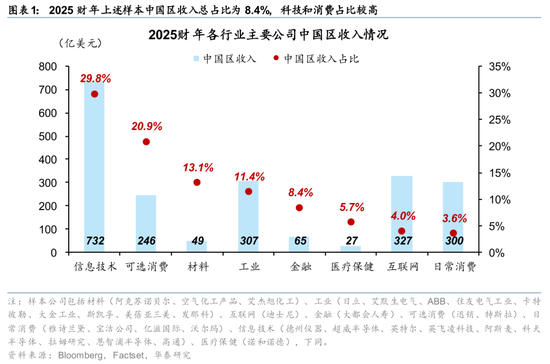
Core Insights - Domestic demand recovery is ongoing, with technological advancements and emotional consumption as structural highlights [1] - 45% of multinational companies reported improved performance in Q4 2025, while 33% expect further improvement [1][5] - The real estate sector continues to drag down growth, but there are notable structural strengths, particularly in technology and service consumption [1][5] Domestic Demand - Overall domestic demand remains weak, but there are structural highlights such as optimistic prospects for renovation in coatings and elevators [2][12] - Service and emotional consumption are experiencing high demand, with companies like Estée Lauder and Procter & Gamble reporting double-digit growth in specific product lines [2][12] - Companies are adapting to trade friction by increasing localization, with ABB reporting over 85% localization in China [2][12] Trade Friction - Localization strategies are being adopted by companies to mitigate the impact of trade tensions, with some firms shifting to local development and sales models [2][12] - Companies like SKF are facing supply chain pressures due to trade policy uncertainties, but are implementing measures to manage these risks [34] Technology - There is a slight decline in external demand for technology products, with a trend towards domestic substitution becoming evident [3][13] - Traditional companies are benefiting from increased demand driven by technological advancements, particularly in the semiconductor sector [3][13] - U.S. export restrictions and domestic competition are impacting overseas companies' revenues in China [3][13] Industry Summaries Materials and Industrial - Demand for materials and industrial products is generally weak, but there are structural demands in electronic gases due to the semiconductor industry [14][26] - The coatings sector is showing resilience due to renovation demand, while traditional electrical and elevator businesses are facing declines [14][27] Consumer Sector - The consumer sector shows significant differentiation, with companies like Uniqlo experiencing revenue declines due to increased competition [20][21] - High-end products in the beauty sector are performing well, while food and beverage sectors are facing slight declines [21][22] Financial Services - MetLife's operations in China are showing strong recovery, with a focus on optimizing distribution channels and enhancing service offerings [19][41] - The company is transitioning away from telemarketing and focusing on high-end customer segments [41] Technology Hardware - Semiconductor companies maintain a high revenue share in China, but face challenges from export controls and supply chain adjustments [23][30] - Companies like Intel and AMD are experiencing delays and increased competition from local manufacturers [30][31] Machinery - Caterpillar anticipates positive growth in the Chinese market, particularly in larger excavators, while SKF is facing challenges in the automotive sector [32][33] - Companies are adjusting their strategies to focus on local development and sales, with a shift in production towards Southeast Asia [39]

扶余:一座东北小城的转身|故乡里的中国
Jing Ji Guan Cha Wang· 2026-02-19 10:44
Core Insights - Fuyu, a city with over 2,000 years of history, is undergoing economic transformation, balancing traditional agriculture with emerging industries [3][21] - The local government has improved the business environment by streamlining administrative processes and promoting fair competition, which has attracted various enterprises [9][15] - Fuyu's industrial economy ranks among the top ten in Jilin Province for county-level cities, with key industries including construction materials, agricultural product processing, and automotive components [15] Economic Development - Fuyu's administrative history reflects the evolution of county-level economic strategies, with significant changes in its administrative status impacting local economic development [5] - The city has developed a logistics system around its transportation hubs, enhancing its economic growth potential [5][9] - The agricultural sector has seen consistent growth, with grain production increasing for nine consecutive years, and a shift towards diversified crop planting [13][14] Industrial Growth - Fuyu's industrial base includes construction materials, agricultural processing, and automotive components, with emerging clusters in compound fertilizers and glass manufacturing [15][16] - The presence of major companies in the fertilizer and construction sectors has reshaped local business practices and standards [9][15] - New energy projects, such as wind power and biomass energy, are being developed to diversify the local economy and promote sustainable practices [16] Cultural and Historical Context - The city’s historical significance, from the ancient Fuyu Kingdom to its modern status, contributes to its unique cultural identity [21] - The juxtaposition of old and new urban landscapes symbolizes the ongoing transformation of Fuyu's economy [5][21]

美国建材行业并购活跃,智能化转型与政策审查成焦点
Jing Ji Guan Cha Wang· 2026-02-18 23:47
Industry Mergers and Acquisitions - TITAN Group announced the acquisition of Keystone Cement Company for $310 million to expand its presence in the U.S. Mid-Atlantic cement market, including a cement plant and aggregate business in Pennsylvania with a clinker annual capacity of 900,000 tons and a total market capacity of approximately 5.6 million tons [1] Business and Technological Development - The integration of digital intelligence in the building materials industry is accelerating, with the CNC rate for key processes expected to reach 66.5% by 2024, and "AI + building materials" emerging as a new direction for upgrades [2] Policy and Regulation - New CFIUS review regulations in 2026 will strengthen investment controls in key technologies, infrastructure, and raw materials, with a notable decline in investment applications in the semiconductor and electronic components manufacturing sectors by 60% and in scientific research and development by 57%, indicating compliance risks for cross-border investments in the building materials sector [3] Industry Status - The building materials industry in 2026 will focus on four main areas: stabilization of traditional building material leaders, domestic companies going abroad, high-demand new materials (such as AI electronic fabrics), and corporate mergers and transformations [4] Company Structure and Governance - Building material companies are optimizing governance structures through board restructuring and asset impairment provisions, with several companies holding extraordinary shareholder meetings in January 2026 to review significant proposals, reflecting an active adjustment period in the industry [5]

山西证券、阳泰集团、中德集团向全球晋商拜年
Sou Hu Cai Jing· 2026-02-17 00:21
Group 1 - The past year has been challenging yet hopeful for the Chinese economy, with a focus on high-quality development and deepening capital market reforms [3][5] - Shanxi Securities has served over 140 billion yuan in direct financing within the province, leading in corporate bond underwriting for six consecutive years and local government bonds for four years [5] - The company has established a matrix of angel funds with a subscribed scale exceeding 1.5 billion yuan, investing in over 20 new quality projects in the province [5][6] Group 2 - Wealth management services have reached 3.09 million clients, with assets under management (AUM) exceeding 320 billion yuan, achieving both scale and structural optimization [5][6] - The company has restructured its customer service system to enhance efficiency and customer experience, winning multiple awards for financial technology development [6][7] - Shanxi Securities emphasizes its commitment to social responsibility, integrating political advantages into governance and supporting local communities through various initiatives [7][8] Group 3 - The company aims to focus on three strategic pillars: functional leadership, professional standing, and differentiated development, while enhancing capabilities and driving transformation through AI integration [8] - The commitment to serving the real economy and managing residents' wealth remains a core responsibility, with a focus on building a collaborative culture [8] - The company expresses gratitude to its stakeholders and emphasizes the importance of trust and connection in its operations [7][8]


2026年2月上旬流通领域重要生产资料市场价格变动情况
Guo Jia Tong Ji Ju· 2026-02-14 01:33
Core Viewpoint - The monitoring of market prices for 50 important production materials in China shows a mixed trend, with 28 products experiencing price increases, 20 seeing declines, and 2 remaining stable in early February 2026 compared to late January 2026 [2]. Group 1: Price Changes in Major Categories - In the black metal category, prices for rebar, wire rod, and ordinary medium plates decreased by 0.3%, 0.4%, and 0.2% respectively, while seamless steel pipes remained unchanged [4]. - In the non-ferrous metal category, electrolytic copper saw a price increase of 0.3%, while aluminum ingots and lead ingots decreased by 2.8% and 2.4% respectively [4]. - Chemical products like sulfuric acid and ethanol experienced price increases of 3.3% and 2.7%, while caustic soda and acetic acid saw declines of 2.4% and 4.4% respectively [4]. Group 2: Energy and Coal Prices - In the petroleum and natural gas sector, liquefied natural gas prices fell by 0.8%, while liquefied petroleum gas and gasoline prices increased by 0.3% and 0.9% respectively [4]. - Coal prices showed mixed results, with anthracite coal increasing by 0.7% and coking coal decreasing by 1.0% [4]. Group 3: Agricultural Products and Fertilizers - Among agricultural products, prices for rice and wheat increased by 0.1% and 0.3%, while cotton prices decreased by 0.6% [5]. - Fertilizer prices also varied, with urea increasing by 1.2% and potassium fertilizer rising by 0.5% [5]. Group 4: Monitoring Methodology - The price monitoring includes a comprehensive range of 50 products across 9 categories, covering over 300 markets and nearly 2000 businesses nationwide [7][8]. - The methodology involves various data collection techniques, including on-site price collection and electronic inquiries [8].
寒冬渐退春不远,劲草迎风气象新:建筑建材 2026 年策略报告:-20260213
Huafu Securities· 2026-02-13 13:48
Investment Highlights - The construction sector faced pressure in 2025, with the building materials sector showing signs of bottom recovery, as the building materials sector increased by 22.1%, outperforming the construction decoration sector which only rose by 6.7% [2][15][22]. Construction Sector Analysis - The construction sector is under significant fundamental pressure, with a focus on three main investment directions: overseas expansion through the "Belt and Road" initiative, resource value reassessment, and state-owned enterprise reform [3][5]. - The domestic traditional infrastructure investment growth rate is slowing, and real estate construction continues to weaken, limiting the improvement space for the sector [3][5]. - Companies with business transformation capabilities and those positioned in high-growth niche markets performed well, while engineering consulting firms faced pressure due to local government financial constraints [3][5]. Building Materials Sector Analysis - The building materials sector is experiencing structural differentiation, with some segments expected to reach a turning point, particularly consumer building materials [4][5]. - Despite weak real estate data, the marginal negative impact on the building materials sector has significantly decreased, with supply-side improvements expected to precede demand-side recovery [4][5]. - The cement industry is recovering from price bottoming, while the glass industry remains under pressure, and the fiberglass sector is seeing significant improvements due to structural demand [4][5][41][46]. Investment Recommendations - In the construction sector, focus on leading infrastructure companies benefiting from overseas projects and major engineering, such as China Communications Construction Company, China State Construction Engineering, and China Railway Construction Corporation [5]. - In the building materials sector, attention should be given to leading consumer building material companies like Sangke Tree, Oriental Yuhong, and Beixin Building Materials, as well as cyclical building material leaders like Huaxin Cement and China National Building Material [5]. Belt and Road Initiative - The "Belt and Road" initiative has created significant opportunities for the construction sector, with a notable increase in overseas orders and contracts signed in 2025, amounting to $257.98 billion, a 10.8% increase year-on-year [77][79]. - The demand for infrastructure in countries participating in the initiative is expected to grow rapidly, providing a substantial project pool for construction companies [77][79]. Resource Value Reassessment - The expectation of rising prices for non-ferrous metals is anticipated to benefit state-owned construction companies that have acquired valuable mineral resources through past projects [3][5]. State-Owned Enterprise Reform - Policies promoting the securitization of state-owned assets and mergers and acquisitions are expected to create value reassessment opportunities for state-owned construction companies with quality assets [3][5].