汽车行业

Search documents
2025年上半年土耳其对非洲出口额达100亿美元
Shang Wu Bu Wang Zhan· 2025-08-02 15:47
Group 1 - Turkey has strengthened its engagement in Africa since 2003 through various channels, including establishing diplomatic missions and signing security cooperation agreements [1] - In the first half of 2025, Turkey's exports to African countries reached approximately $10 billion, with Morocco being the largest export destination at $1.8 billion [1] - The sector distribution of Turkey's exports to Africa in the first half of 2025 shows that the chemical industry led with $1.3 billion, followed by grains, legumes, oilseeds, and derivatives at $1.2 billion [1] Group 2 - Since the introduction of the "Africa Policy" in 2023, Turkey has enhanced its participation in the continent, with bilateral trade increasing from $3 billion in 2003 to nearly $41 billion in 2022 [2] - As of mid-November 2024, Turkish companies have completed 1,977 infrastructure projects in Africa, with a total value of $91.6 billion [2]
整理:8月1日美国关税大限倒计时!全球各国谁在“妥协让步”、谁在“死磕到底”?
news flash· 2025-07-31 11:45
Summary of Key Points Agreements Reached - The UK has reduced the baseline tariff from 25% to 10%, with exemptions for automotive and aerospace products, while negotiations continue on steel, aluminum, and digital services tax [1] - Vietnam has lowered the baseline tariff from 46% to 20%, with a 40% punitive tariff on goods transshipped to the US, and has committed to zero tariffs on all US goods [1] - Indonesia has decreased tariffs from 32% to 19%, eliminating tariffs on 99% of US goods and addressing non-tariff barriers [1] - The Philippines has reduced tariffs from 20% to 19%, with commitments to open markets and zero tariffs, alongside enhanced military cooperation [1] - Japan has lowered the baseline tariff from 25% to 15%, becoming the first major economy to secure lower tariffs for the automotive sector, and has pledged $550 billion in investments in the US [1] Additional Agreements - The EU has reduced the baseline tariff from 30% to 15%, covering various products while exempting certain items, and has committed to $600 billion in investments and $750 billion in energy product purchases from the US [2] - South Korea has lowered the baseline tariff from 25% to 15%, with commitments of $350 billion in investments and $100 billion in energy purchases from the US, while maintaining original rates on semiconductors and steel [2] Agreements Not Reached - Canada faces a potential 35% tariff if no agreement is reached by August 1, with ongoing negotiations described as "intense" [3] - Mexico is at risk of a 30% tariff, with discussions between the US and Mexican presidents planned as the deadline approaches [3] - India is facing a 25% tariff starting August 1, with additional unspecified penalties, while seeking a reciprocal agreement with the US [3] - Australia currently has a 10% baseline tariff, which may rise to 15%-20%, with no recent updates on negotiations [3] - Brazil is set to face a 50% tariff starting August 6, with certain products exempted, while the Brazilian president expresses willingness for constructive dialogue [3]
金十图示:2025年07月29日(周二)新闻联播今日要点
news flash· 2025-07-29 12:53
Group 1 - The Chairman Zhao Leji's visit to Hungary from 24th to 28th aims to strengthen bilateral relations and mutual support, emphasizing China's appreciation for Hungary's adherence to the One China principle [2] - China welcomes more high-quality Hungarian agricultural products in its market and seeks policy support for Chinese investments in Hungary [2] - Hungary's Prime Minister Orban highlighted the significance of President Xi Jinping's state visit last year, marking a milestone in China-Hungary relations and emphasizing Hungary's strategic choice to develop friendly cooperation with China [2] Group 2 - In the first half of the year, China's total social logistics exceeded 171 trillion yuan, showing a year-on-year growth of 5.6%, indicating a stable growth in logistics demand [4] - The contribution of industrial goods logistics to the total social logistics growth was 85%, providing solid support for the stability of the industrial economy and the smooth operation of supply chains [4] - Emerging industries showed strong logistics demand growth, with logistics demand in equipment manufacturing and high-tech manufacturing increasing by 10.9% and 9.7% year-on-year, respectively [4] Group 3 - In the first half of the year, the "work-for-relief" program in China has absorbed 2.08 million low-income individuals for nearby employment, a 32% increase compared to the same period last year [6] - A total of 22.3 billion yuan in labor remuneration was distributed, marking a 34% increase year-on-year, with over 20,000 projects initiated under this program [6] Group 4 - The Ministry of Agriculture and Rural Affairs, along with 10 other departments, has introduced a plan with 23 specific measures to expand new consumption spaces for agricultural products, aiming to meet the evolving consumer demands [7] Group 5 - A new central enterprise automobile group, China Chang'an Automobile Group Co., Ltd., was established in Chongqing, consisting of 117 subsidiaries, focusing on green, low-carbon, and intelligent products to stimulate domestic demand [9]


关税乐观情绪降温,越南股市大跌4%,欧股反弹,美元创月内新高,欧元跌至五周低点
Hua Er Jie Jian Wen· 2025-07-29 07:52
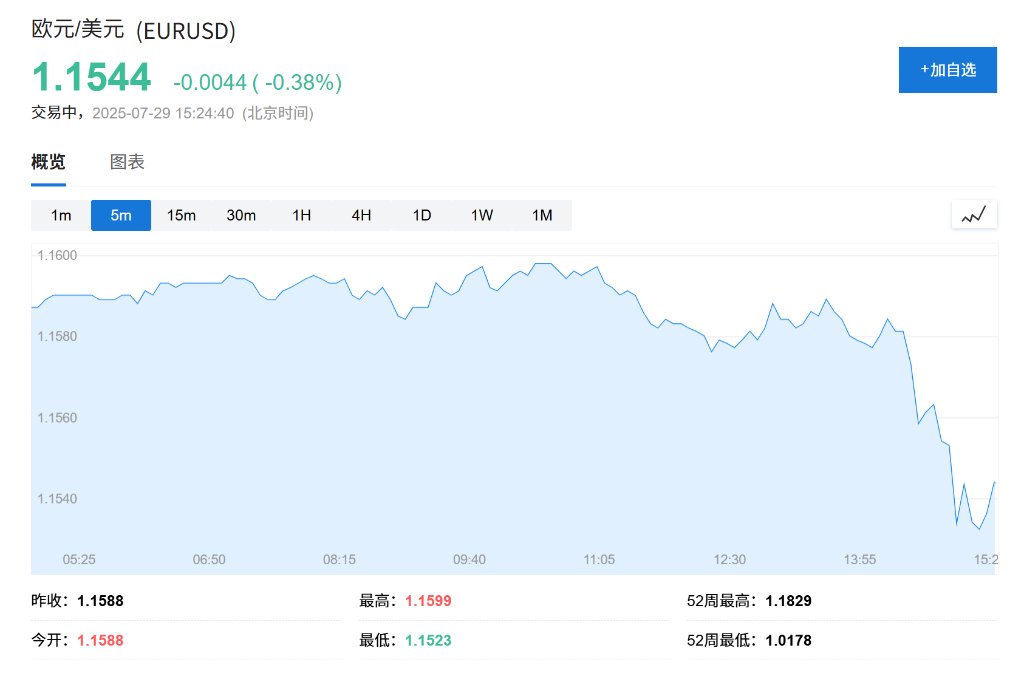
Group 1 - Asian stock markets have declined for the third consecutive day, with Vietnam's VN Index dropping 4% as optimism from recent trade agreements fades [1][5] - The MSCI Asia-Pacific Index fell by 0.8%, while the US dollar index rose by 0.3%, reaching its highest level since late June [1][5] - Investors are shifting focus to key economic indicators as the Federal Reserve is expected to maintain interest rates during its upcoming policy meeting [1][6] Group 2 - The EU-US trade agreement has sparked controversy, with critics arguing it poses risks to the European automotive industry and competitiveness [2] - The euro has depreciated by 0.3% against the dollar, reaching its lowest level in five weeks, reflecting market skepticism about the trade deal [2][5] - Market reactions to the trade agreement have become more rational, with investors prioritizing hard data to assess economic and policy outlooks [2] Group 3 - The Federal Reserve's upcoming interest rate decision is a key focus for the market, with significant economic data expected to be released this week [6] - Analysts predict that the data will indicate a rebound in economic activity for the second quarter, influencing short-term policy decisions [6] - Gold prices are projected to rise significantly, potentially reaching $4,000 per ounce by the end of next year, driven by the Fed's rate cuts and increasing global gold reserves [6]
欧美新协议“无法统一成员国间利益需求 将加大欧盟内部分歧”
Sou Hu Cai Jing· 2025-07-29 04:34
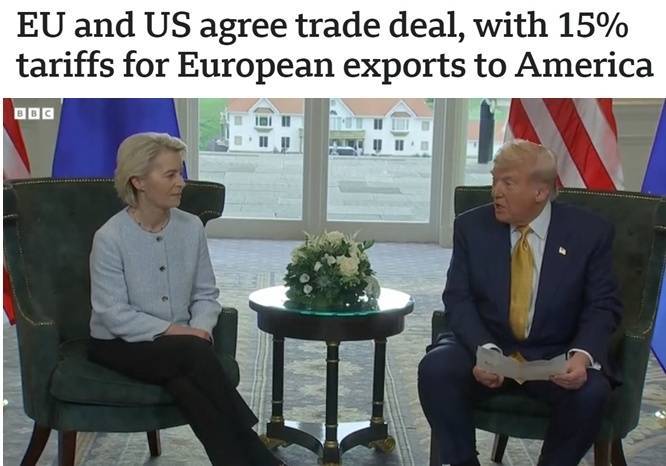
Group 1 - The core point of the news is the announcement of a new trade agreement between the US and the EU, which includes a 15% tariff on EU products entering the US and a commitment from the EU to invest an additional $600 billion and purchase $750 billion worth of US energy products [1][4][7] - The agreement has received mixed reactions from EU leaders, with German Chancellor Merz expressing that a no-deal scenario would have been more damaging for Germany, while Italian Prime Minister Meloni described the agreement as "sustainable" [4][7] - French Prime Minister François Bérou criticized the agreement as a "surrender" by the EU, highlighting concerns over the imbalance it creates, particularly for French agriculture, which faces a 15% tariff on products sold to the US while benefiting from zero tariffs on US agricultural imports [4][7] Group 2 - The internal divisions within the EU regarding the tariff agreement reflect differing interests between the political and business sectors, complicating the EU's ability to manage disputes [7][11] - The 15% tariff is expected to increase costs for EU exports to the US, potentially reducing competitiveness and impacting the development of the EU's industrial chain [7][11] - The agreement postpones negotiations on tariffs related to steel, aluminum, and chips, which are critical areas for both parties, to avoid complications that could derail the talks [11][12]
等待ROA的企稳——6月工业企业利润点评
一瑜中的· 2025-07-28 15:53
Group 1 - The core viewpoint of the article is that the profit growth rate of industrial enterprises in June has narrowed its decline, indicating a potential stabilization in the return on assets (ROA) [1][19] - In June, the profit of industrial enterprises decreased by 4.3% year-on-year, an improvement from the previous decline of 9.1% [19] - The inventory level as of June increased by 3.1% year-on-year, slightly down from 3.5% in the previous month [19] Group 2 - The overall industrial profit margin in June was 5.96%, compared to 6.33% in the same period last year [19] - The manufacturing sector showed a profit growth of 1.43% in June, a significant recovery from the previous decline of 4.05% [23] - The automotive industry experienced a remarkable profit increase of 96.8% due to promotional activities and investment returns [23] Group 3 - The ROA for industrial enterprises in June was 4.14%, down from 4.18% in the previous month, indicating a cumulative decline of 0.16% for the year [3][8] - Factors affecting ROA include a 5.1% growth in asset speed and a 1.8% decline in profit growth from January to June [3][8] - The manufacturing upstream profit margin was 4.13% in June, lower than the 4.2% recorded in the same month last year [10][11] Group 4 - The manufacturing midstream profit margin improved to 6.35% in June, compared to 6.27% in the same period last year [10][11] - The manufacturing downstream profit margin was 5.51% in June, down from 6.63% a year earlier, indicating a need for monitoring consumer behavior [11][19] - The overall revenue growth for industrial enterprises was 1.0% in June, remaining stable compared to May [10][19]

6月工业利润边际改善 回升态势需要更多政策加力支持
Jing Ji Guan Cha Wang· 2025-07-28 13:04
Core Viewpoint - The industrial profit landscape in China shows signs of marginal recovery in June, with manufacturing profits turning positive, but overall industrial profits still face challenges due to insufficient demand and cost pressures [1][2][3]. Group 1: Industrial Profit Trends - In June, profits of industrial enterprises reached 715.58 billion yuan, a year-on-year decline of 4.3%, but the decline narrowed compared to May [1]. - For the first half of the year, profits totaled 3,436.5 billion yuan, reflecting a year-on-year decrease of 1.8% [1]. - Manufacturing profits improved from a 4.1% decline in May to a 1.4% increase in June, indicating a recovery trend [1][2]. Group 2: Economic Factors Influencing Profits - The industrial production index increased by 6.8% year-on-year in June, driven by strong export performance and domestic demand during the 618 shopping festival [2]. - The Producer Price Index (PPI) fell by 3.6% year-on-year in June, continuing to exert pressure on profit margins [2]. - Profit margins for industrial enterprises averaged 5.15% in the first half of the year, showing a year-on-year decline of 0.26 percentage points [2]. Group 3: Sector-Specific Insights - The equipment manufacturing sector showed significant profit growth, with revenues increasing by 7.0% year-on-year in June and profits rising by 9.6% [4]. - The automotive industry experienced a remarkable profit increase of 96.8%, driven by promotional activities and investment returns [4]. - Mining sector profits faced a larger decline due to price weakness and falling profit margins [2][4]. Group 4: Policy and Future Outlook - Recent government policies aim to stabilize employment and support industrial growth through various measures, including capacity replacement and technological upgrades [5]. - The continuation of demand expansion policies is expected to support profit recovery for industrial enterprises [5]. - The impact of "anti-involution" policies on market competition and profit margins will be crucial for future profitability [5].

6月工业企业利润点评:等待ROA的企稳
Huachuang Securities· 2025-07-28 04:45
Group 1: Overall Industrial Profit Trends - In June, the profit growth rate of industrial enterprises decreased by 4.3% year-on-year, an improvement from the previous value of -9.1%[2] - As of June, inventory increased by 3.1% year-on-year, slightly down from 3.5% in the previous month[2] - The profit margin in June was 5.96%, compared to 6.33% in the same period last year[14] Group 2: ROA and Profitability Analysis - The Return on Assets (ROA) in June was 4.14%, down from 4.18% in the previous month, with a cumulative decline of 0.16% for the year[4] - Factors affecting ROA include a 5.1% growth in asset side and a 1.8% decline in profit growth from January to June[4] - The gross profit margin in June was 14.8%, down from 15.2% in the same month last year[14] Group 3: Industry-Specific Insights - In June, the mining industry saw a profit growth rate of -36.1%, while manufacturing grew by 1.43%[19] - The automotive sector experienced a significant profit increase of 96.8%, driven by promotional activities and investment returns[19] - The profit margin for the manufacturing upstream was 4.13%, slightly lower than the 4.2% recorded last year[10]
1.35万亿换15%关税!欧盟“割肉”让步,特朗普最大赢家
Ge Long Hui· 2025-07-28 04:28
Core Points - The US and EU have reached a significant trade agreement, marking the end of months of trade uncertainty [2][4] - The agreement includes a 15% uniform tariff, $600 billion in investments, and $750 billion in energy purchases from the US [4][6] - The deal is seen as a major win for President Trump, who claims it is the largest agreement of its kind [4][7] Trade Agreement Details - The agreement stipulates a 15% tariff on EU products entering the US, with key industries exempted [4][11] - The EU will increase investments in the US by $600 billion and purchase $750 billion worth of US energy products [4][6] - The agreement is expected to benefit the automotive industry and have significant implications for agriculture and the semiconductor sector [4][6] Reactions from EU Officials - EU Commission President von der Leyen stated that the agreement is the best possible outcome given the current circumstances [6] - There are concerns within the EU about the reliance on US liquefied natural gas and the impact of the 15% tariff on the overall EU GDP [12][14] - Some EU officials express dissatisfaction, arguing that the agreement does not align with Europe's fundamental interests and may cause long-term harm [14][15] Market Implications - The agreement alleviates fears of a transatlantic trade war, providing a sense of predictability for financial markets [17][20] - Analysts suggest that the deal is a moderate positive for the stock market, as much of the content may have already been priced in [21] - The removal of the risk of further tariff increases is seen as a significant macroeconomic relief [19][20] Future Considerations - Attention will shift to the interpretation and execution of the agreement, which may present political and technical challenges [23] - The potential for ongoing uncertainty remains, as highlighted by some analysts [22]

关税突发!美欧重大宣布:15%!欧元、欧美股指期货拉升
证券时报· 2025-07-27 23:31
Group 1: Trade Agreement Overview - The United States and the European Union have reached a new trade agreement, with the US imposing a 15% tariff on EU products entering the US, while the EU commits to increasing investments in the US by $600 billion and purchasing $750 billion worth of US energy products [1][7][12] - The agreement aims to stabilize trade relations and is expected to have significant impacts on the automotive and agricultural sectors, as well as increased focus on the semiconductor industry [7][10] Group 2: Market Reactions - Following the announcement of the trade agreement, the euro strengthened against the dollar, rising by 0.25% during trading [2] - Major US and European stock index futures showed positive movements, indicating market optimism regarding the trade deal [4] Group 3: Tariff Details - The agreed 15% tariff will apply uniformly across various goods, including automobiles and pharmaceuticals, as confirmed by EU Commission President Ursula von der Leyen [10][11] - The US Secretary of Commerce indicated that the EU will open its $20 trillion market to US standards for automobiles and industrial products [11][12] Group 4: Criticism and Concerns - European officials expressed dissatisfaction with the agreement, arguing it is unbalanced and detrimental to European interests, with concerns that it may harm local employment and industry [13][15] - Finnish Trade Minister Ville Tavio noted that despite the agreement easing tensions, the high tariff levels do not warrant celebration and may not be sustainable in the long term [16]