电动汽车

Search documents
小米二季报解读:汽车业务高毛利率弥补手机疲软,下半年关键看北京第二工厂产能爬坡
Hua Er Jie Jian Wen· 2025-08-20 00:44
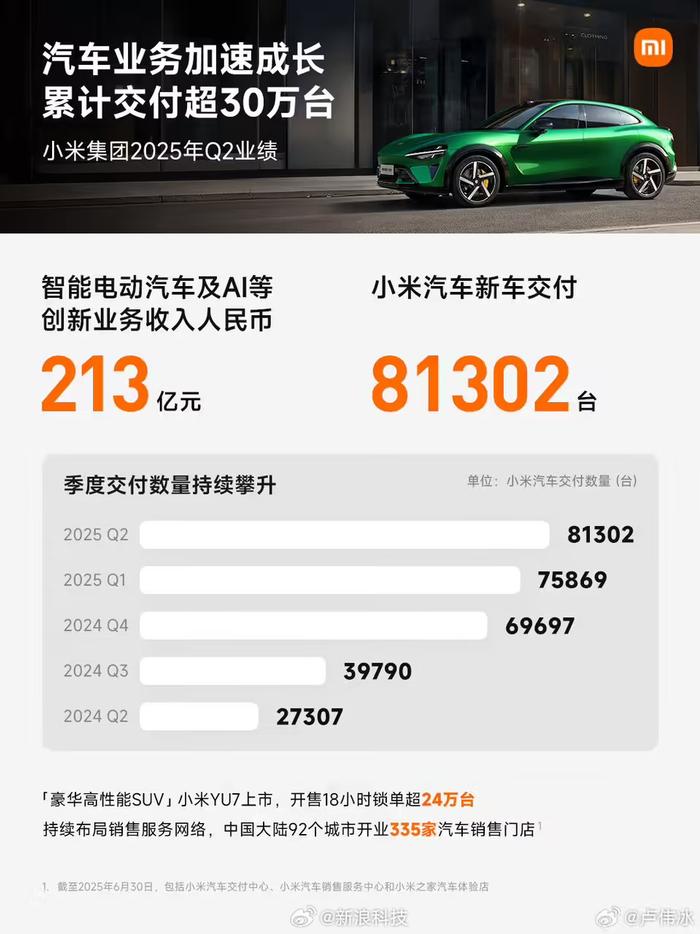
Core Viewpoint - Morgan Stanley believes that the explosive growth of Xiaomi's electric vehicle (EV) business is effectively compensating for the slowdown in its smartphone business, with the ramp-up of production capacity at the Beijing second factory in the second half of the year expected to be a catalyst for the stock price [2] Group 1: Financial Performance - Xiaomi's total revenue for Q2 reached 1159.56 billion RMB, a year-on-year increase of 30% and a quarter-on-quarter increase of 4%, exceeding Morgan Stanley's expectations by 3% [9] - The AIoT business revenue was 387 billion RMB, a significant year-on-year increase of 45%, surpassing expectations by 18% [9] - The EV business revenue was 213 billion RMB, more than doubling year-on-year and exceeding estimates by 6% [9] - Smartphone business revenue was 455 billion RMB, a year-on-year decline of 2%, falling short of expectations by 8% [9] - Internet services revenue was 91 billion RMB, a year-on-year increase of 10%, but 5% below expectations [10] Group 2: Profitability and Margins - The overall gross margin for the company reached 22.5%, an increase of 1.8 percentage points year-on-year, but a decrease of 0.3 percentage points quarter-on-quarter [6] - The EV business gross margin was 26.4%, significantly increasing by 3.3 percentage points quarter-on-quarter, indicating strong profitability prospects [6] - The AIoT business gross margin was 22.5%, up 2.8 percentage points year-on-year but down 2.7 percentage points quarter-on-quarter [6] - The smartphone business gross margin was 11.5%, reflecting a year-on-year and quarter-on-quarter decline of 0.7 and 0.9 percentage points, respectively, due to intense market competition [7] Group 3: Future Outlook - The EV business is seen as the biggest highlight for Xiaomi in the current quarter, with average selling prices increasing by 6.4% to 254,000 RMB, driven by high-end models SU7 Ultra and YU7 [8] - Morgan Stanley analysts believe that the delivery volume of EVs will be a key driver for the stock price in the second half of the year, especially following strong orders for the YU7 model [8] - UBS maintains a delivery forecast of 720,000 units for 2026, assuming full capacity operation at the second factory, which requires stable production capacity by the end of Q4 [8][11]


多地暂停汽车置换更新补贴,银行严管信用卡资金入市 | 财经日日评
吴晓波频道· 2025-08-20 00:29
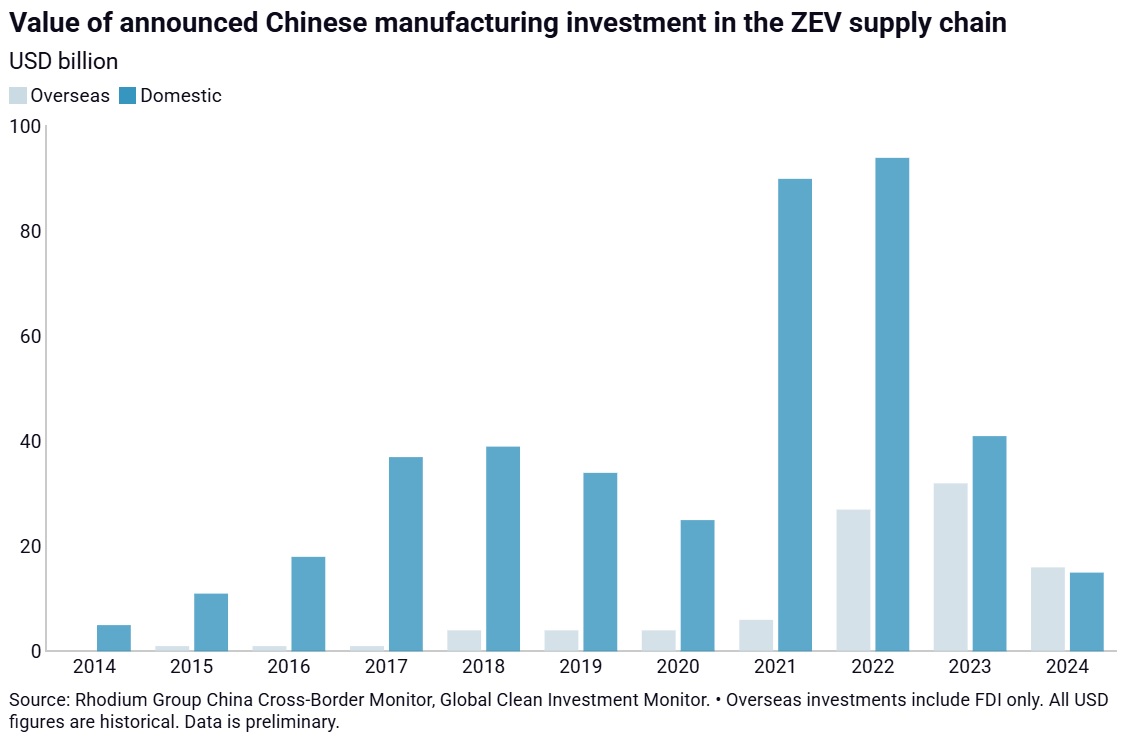
Group 1: Electric Vehicle Industry - China's electric vehicle supply chain companies invested approximately $16 billion overseas last year, slightly surpassing the $15 billion invested domestically, breaking the previous trend of 80% of investments being concentrated domestically [2] - About three-quarters of the overseas investments came from battery manufacturers, with companies like CATL prioritizing overseas expansion due to intense domestic competition [2] - BYD has established factories in Brazil and Thailand, with plans for new facilities in Turkey and Indonesia, while Chery has committed to investing $1 billion in a Turkish electric vehicle factory [2] Group 2: Automotive Subsidy Policies - Several regions, including Qinghai, Guizhou, and Inner Mongolia, have suspended vehicle replacement subsidies, with some areas also halting vehicle scrapping policies [4] - The suspension of these policies is not permanent, as many local governments are expected to resume them once additional funding is allocated [4][5] - The suspension is attributed to the exhaustion of allocated funds due to underestimated demand driven by the subsidy policies [4] Group 3: AI and Manufacturing - Shanghai's plan aims to accelerate the integration of AI in manufacturing, targeting 3,000 companies for smart applications and establishing 10 benchmark factories [6] - The initiative includes financial incentives like computing and data resource vouchers to lower the costs of smart upgrades for companies [6][7] - The plan emphasizes the need for large-scale application and data feedback to enhance the AI ecosystem in manufacturing [7] Group 4: U.S. Stock Market Performance - Approximately 60% of S&P 500 companies exceeded earnings expectations in the second quarter, with an 11% year-over-year increase in earnings per share [10] - The strong performance is attributed to better-than-expected profit margins despite tariff pressures, with technology companies leveraging AI applications for profit growth [11] - SoftBank's $2 billion investment in Intel at $23 per share reflects a long-term vision amidst Intel's operational challenges and restructuring efforts [12][13] Group 5: Credit Card Regulations - Multiple banks have issued warnings against the use of credit card funds for stock market investments, aiming to protect borrowers and maintain financial market stability [14] - The regulations are a response to past incidents where borrowed funds significantly impacted market volatility, highlighting the need for stricter oversight [15]

美股收盘:纳指跌1.4% 英特尔逆势收涨近7%
Jin Rong Jie· 2025-08-19 20:18
Group 1 - The Dow Jones Industrial Average closed slightly higher, while the S&P 500 index fell by 0.58% and the Nasdaq dropped by 1.46% [1] - Intel (INTC.O) saw a significant increase of 6.97%, while Nvidia (NVDA.O) experienced a decline of over 3% [1] - Meta Platforms (META.O) decreased by 2%, indicating a downward trend in its stock performance [1] Group 2 - The Nasdaq Golden Dragon China Index fell by 0.9%, reflecting challenges in the Chinese market [1] - NIO Inc. (NIO.N) and XPeng Inc. (XPEV.N) both rose by 4%, suggesting positive momentum for these electric vehicle companies [1]
国家税务总局:以税收公平助力反“内卷”
Zhong Guo Jing Ying Bao· 2025-08-19 16:30
Core Viewpoint - The "New Three Items" (electric vehicles, lithium batteries, photovoltaic products) have seen rapid development due to tax incentives, but there is an increasing trend of tax fraud and abuse within this sector, prompting the need for stricter regulation and compliance [1][2] Group 1: Tax Fraud and Compliance Issues - The State Taxation Administration has exposed two cases of tax fraud in the "New Three Items" sector, marking the first disclosure of such violations in this area [1] - Some businesses are using the "savings" from tax incentives to lower prices, leading to excessive competition and harming compliant enterprises, thus disrupting fair market order [1] Group 2: Policy and Market Implications - The Central Political Bureau meeting emphasized the need to advance the construction of a unified national market and optimize market competition order, advocating for legal governance of disorderly competition [1] - Experts suggest that companies in the "New Three Items" sector should focus on technological innovation and market expansion rather than exploiting tax compliance loopholes [1] - Stricter enforcement against tax fraud is seen as essential for ensuring that tax benefits reach companies genuinely focused on innovation and quality improvement, which is crucial for the long-term healthy development of the industry [1] Group 3: Industry Development and Future Directions - The "New Three Items" industry has experienced significant growth due to supportive policies, but it now faces challenges such as "involution" competition and weakened profitability, necessitating the optimization of incentive policies [2] - Adjustments to fiscal subsidy standards and tax incentives should be made based on industry development stages, technological advancements, and cost changes to promote a shift from "policy-driven" to "innovation-driven" growth [2]
小米2027年进军欧洲汽车市场,手机年出货量目标2亿台
Xin Lang Ke Ji· 2025-08-19 15:39
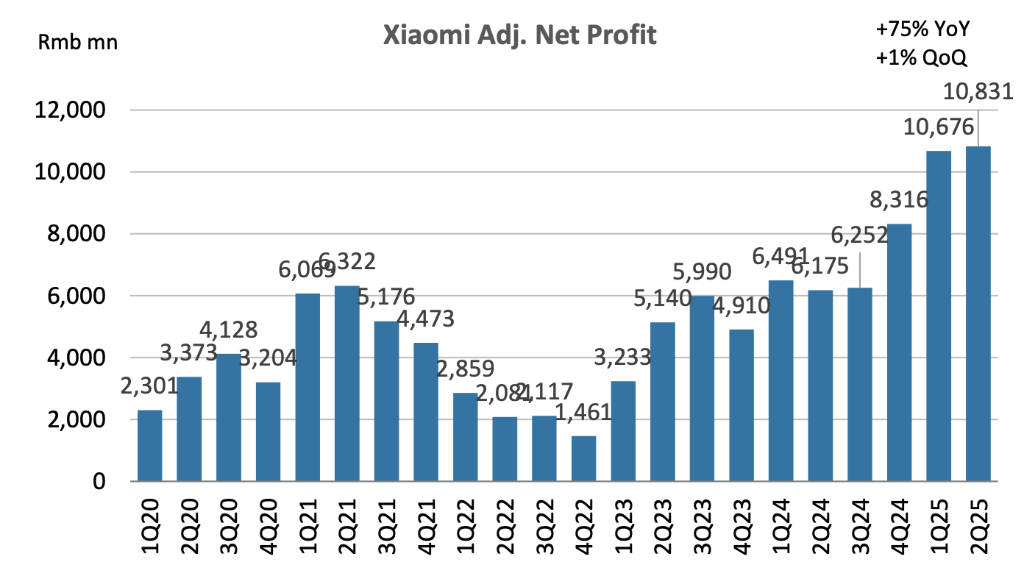
【#小米2027年进军欧洲汽车市场##小米计划手机年出货量突破2亿台#】小米集团 2025 年第二季度总收 入达 1160 亿元,同比增长 30.5%,创下历史新高;公司净利润为 119 亿元,同比增长 134.2%;经调整 净利润为 108 亿元,同比增长 75.4%。 小米在本季度交付新车 81302 辆,较去年同期增长 197.7%,进一步推动小米电动汽车业务收入同比增 长 233.9% 达到 213 亿元。 在今晚的媒体电话会议上,小米集团总裁卢伟冰表示:YU 7 系列延续了 SU7 的耀眼表现,"再次创造 了小米的爆款奇迹",公司决定在 2027 年正式进入欧洲电动汽车市场。 卢伟冰表示,小米汽车业务二季度经营亏损收窄至 3 亿元,按照当前的速度,有望在下半年单月或单季 盈利;但过去三年多投入超 300 亿元,累计亏损仍巨大,全面盈利还有很长一段路要走。 对于手机业务,卢伟冰表示小米手机坚定瞄准"2 亿俱乐部",即计划未来三到五年跻身全球年出货量 2 亿台行列。 在被问到家电反内卷问题时,卢伟冰表示,小米坚决不打价格战、不参与内卷。他还提到,2025 全年 小米集团整体收入预计增长 30% 以上,对 ...
荣鼎集团:2024年中国电动汽车供应链海外投资额首次超过国内
Xin Hua Cai Jing· 2025-08-19 14:20
Core Insights - In 2024, Chinese companies' overseas investment in the electric vehicle supply chain will surpass domestic investment for the first time, marking a historic shift in investment strategy [1] - Chinese electric vehicle supply chain investments have evolved significantly since 2014, with domestic investments peaking at an average of $92 billion in 2021 and 2022, but declining to $15 billion in 2024 [1] - The report indicates that while overseas investments have increased, they are still facing challenges such as higher costs and longer construction times compared to domestic projects [4] Investment Trends - Chinese companies have historically invested about 80% of their electric vehicle supply chain investments domestically, but this trend is changing as overseas investments grow [1] - The overseas investment in the electric vehicle supply chain is primarily focused on battery manufacturing, which accounts for 74% of total overseas investments [4] - Major battery manufacturers like CATL have led the way in overseas expansion, with significant investments in facilities abroad, such as the $2 billion battery plant in Germany [4] Production Capacity - As of 2024, Chinese companies have a total battery production capacity of approximately 4,647 GWh domestically, compared to only 707 GWh overseas [5] - The total electric vehicle production capacity in China is around 28 million units, while overseas capacity is only 4 million units, indicating a continued focus on the domestic market [5] - Despite the increasing number of Chinese automotive and parts companies expanding overseas, their share of overseas production capacity remains relatively low [5]

前瞻全球产业早报:ChatGPT移动应用已创造20亿美元收入
Qian Zhan Wang· 2025-08-19 11:59
Group 1 - China holds 60% of the global artificial intelligence patent count, establishing itself as a leader in AI innovation [2] - As of June 30, over 35,000 high-quality datasets have been created in China, providing a substantial data foundation for AI training, equivalent to 140 times the digital resources of the National Library of China [2] - The proportion of Chinese data used in domestic model training has exceeded 60%, with some models reaching 80% [2] Group 2 - The first low-altitude flight route connecting Kunshan, Jiangsu, and downtown Shanghai has officially commenced, allowing for a 20-minute aerial journey [3] - This route is notable for supporting night flights, distinguishing it from other low-altitude routes [3] Group 3 - China's first offshore booster station equipped with a meteorological radar has been installed, enhancing marine weather monitoring and the efficient operation of offshore wind farms [4] Group 4 - China successfully launched the low Earth orbit satellite internet group 09 on August 17, with the satellite entering its designated orbit [5] - Hainan Province is developing a "low-altitude + marine" tourism model, aiming to create a new "land-sea linkage" pattern through various marine tourism initiatives [5] Group 5 - The first batch of autonomous smart connected taxis in Shanghai's Lingang area has officially started operations, covering 58 locations in the main urban area [6][7] - The service operates daily from 8 AM to 8 PM, with a fare structure that includes a base fare of 16 yuan for distances under 5 kilometers and 4 yuan per kilometer thereafter [7] Group 6 - Huawei's executive Yu Chengdong stated that the HarmonyOS framework aims to help more Chinese applications expand internationally, with user numbers rapidly increasing [8] Group 7 - The ChatGPT mobile application has generated $2 billion in revenue since its launch in May 2023, significantly outperforming its competitors [12] Group 8 - Advent International has proposed a $1.3 billion acquisition of Swiss chip manufacturer U-blox, with a cash offer of 135 Swiss francs per share, representing a 53% premium over the past six months' average [18]

小米电话会:不打价格战、不参与内卷,对实现全年目标充满信心
Hua Er Jie Jian Wen· 2025-08-19 11:30
Core Insights - Xiaomi's Q2 financial report shows record high revenue and net profit driven by explosive growth in the smart electric vehicle (EV) business [1] - The company plans to officially enter the European electric vehicle market by 2027 [1] - Xiaomi's EV deliveries reached 81,300 units in Q2, a 197.7% increase from 27,300 units in the same period last year, significantly boosting EV revenue by 233.9% to 21.3 billion yuan, exceeding market expectations [1] - Xiaomi Group's overall revenue is expected to grow by over 30% in 2025, with strong confidence in achieving this target [1] - The company aims to join the "200 million club" in smartphone shipments, targeting an annual shipment of 200 million units within the next three to five years [1] - Xiaomi is committed to avoiding price wars and internal competition in the home appliance sector, focusing on long-term strategic positioning rather than short-term rankings [1]
小米集团总裁卢伟冰:拟于2027年进军欧洲电动汽车市场
Hua Er Jie Jian Wen· 2025-08-19 10:17
小米集团总裁卢伟冰:拟于2027年进军欧洲电动汽车市场。 风险提示及免责条款 市场有风险,投资需谨慎。本文不构成个人投资建议,也未考虑到个别用户特殊的投资目标、财务状况或需要。用户应考虑本文中的任何 意见、观点或结论是否符合其特定状况。据此投资,责任自负。 ...
摩根士丹利:Robotaxi迎来“iPhone时刻”,现在购买带方向盘的汽车,无异于在2006年选择“黑莓”
华尔街见闻· 2025-08-19 10:16
Core Viewpoint - The autonomous taxi technology is on the verge of a historic breakthrough, ready for commercialization due to advancements in generative AI, massive capital competition, and geopolitical factors [1][2]. Group 1: Technological Advancements - The rapid development of generative AI has led to significant improvements in autonomous driving technology, making large-scale commercialization feasible, akin to the transformative impact of the iPhone in 2007 [2]. - Major investments from tech giants like Tesla and Google Waymo, as well as traditional automakers, are accelerating the maturity of autonomous driving technology, creating intense competition [2]. Group 2: Geopolitical Factors - Governments worldwide are prioritizing the development of autonomous driving capabilities as a key area for future transportation and technological competitiveness, leading to supportive policies [3]. Group 3: Market Trends - Global electric vehicle sales continue to grow robustly, with June sales increasing by 30% year-on-year to 1.26 million units, driven primarily by the Chinese market, which saw a 43% increase [4]. - Morgan Stanley maintains an "overweight" rating on Tesla with a target price of $410, indicating a potential upside of 28% from current levels, citing Tesla's advantages in autonomous driving technology and data accumulation [4]. Group 4: Impact on Automotive Industry - The rise of autonomous taxi services may fundamentally change traditional car ownership models, with consumers likely to prefer on-demand mobility services over purchasing private vehicles, which will have profound implications for the entire automotive supply chain [8].