
农业

Search documents
纵深推进产业强省建设 云南多点发力抓投资促转型
Jing Ji Ri Bao· 2025-10-17 21:43
Core Insights - Yunnan Province is focusing on resource endowment and distinctive features to enhance its resource economy, park economy, and port economy, with industrial development shifting towards a diversified support from traditional and emerging industries [1] - The proportion of industrial investment in fixed asset investment is projected to increase from 26.7% in 2020 to 52.1% in 2024 [1] - Traditional industries like energy and non-ferrous metals remain strong, while green aluminum, silicon photovoltaic, and new energy batteries are emerging as new growth engines [1] Group 1 - The added value of key resource industries accounts for approximately 45% of the regional GDP [1] - Yunnan is transitioning towards a green and low-carbon economy, with total installed power capacity rising from 103 million kilowatts in 2020 to 167 million kilowatts, including 150 million kilowatts of green power [1] - The construction of a green power certificate service platform at the Kunming Power Trading Center is expected to maintain an annual transfer scale of over 100 million green certificates, equivalent to more than 100 billion kilowatt-hours of electricity [1] Group 2 - Yunnan is accelerating the formation of a multi-point investment landscape, with significant projects like 203,000 tons of green aluminum driving the industry chain towards deep processing [2] - The output value of green energy and non-ferrous metal industries has surpassed 400 billion yuan, while tourism remains a trillion-yuan pillar industry [2] - Since 2022, Yunnan has held major industrial project scheduling meetings for 15 consecutive quarters, resulting in the implementation of over 9,000 major industrial projects [2] Group 3 - To stimulate private investment, Yunnan is advancing investment attraction and optimizing the business environment, with the share of private investment rising from 44% in 2021 to 45.2% in the first eight months of this year [2] - The proportion of industrial private investment in total private investment has increased from 42.6% to 67.5% [2]
“文旅+”点亮乡村经济
Jing Ji Ri Bao· 2025-10-17 21:43
Core Insights - The integration of cultural tourism and agriculture in Taiyuan has led to significant economic development and improved living standards for local residents [1][2] Group 1: Cultural Tourism Development - Taiyuan has adopted a "cultural tourism integration" strategy, leveraging top-level design and precise policy support to create new development paths [1] - The establishment of the first "On Protracted War" exhibition hall in Xipu Village highlights the focus on red tourism and non-material cultural heritage [1] - The village has received over 20,000 visitors from more than 200 organizations, showcasing the success of the "on-site teaching + situational experience" educational model [1] Group 2: Agricultural and Tourism Synergy - Jinyuan District serves as a model for deep integration of agriculture and cultural tourism, creating a development loop of "industry foundation - cultural tourism empowerment - shared benefits" [2] - The "Rice Dream Light" Ferris wheel and "Rice Front Small Forest" camping site have become popular tourist attractions, significantly boosting local tourism [2] - The "Rice Field Music Festival" attracted 42,000 attendees in 2024, generating over 18 million yuan in revenue, transforming rice fields into cultural tourism consumption spaces [2]
为保障世界粮食安全贡献中国力量
Xin Hua She· 2025-10-17 15:41
Core Points - President Xi Jinping's congratulatory letter to the FAO on its 80th anniversary emphasizes China's commitment to global food security and sustainable agricultural development [1][6] - The letter highlights the FAO's significant achievements in ensuring food security and improving rural development over the past 80 years [1][3] - Xi's message calls for enhanced international cooperation to achieve the UN's 2030 Sustainable Development Goals [6] Group 1: China's Role in Global Food Security - Xi Jinping's letter underscores China's determination to contribute to global food security and its historical responsibility in this regard [1][6] - The Chinese government prioritizes food security, aiming to address the needs of over 1.4 billion people while providing assistance to countries in need [3][6] - China's agricultural advancements, particularly in hybrid rice and sustainable practices, serve as a model for developing countries [3][5] Group 2: International Cooperation and Knowledge Sharing - The FAO welcomes China's expertise and innovation, aiming to deepen practical cooperation in areas like digital agriculture and climate adaptation [2][4] - Countries like Colombia and Uzbekistan express interest in learning from China's agricultural practices to enhance their own food security and rural development [4][5] - Collaborative projects between China and various nations have led to increased agricultural productivity and job opportunities in regions like Africa and Latin America [5][6] Group 3: Future Directions and Initiatives - The establishment of the Chinese permanent mission to the FAO signals a commitment to ongoing collaboration in agricultural innovation and technology [3] - China plans to implement practical measures based on Xi's letter, focusing on sustainable practices and capacity building in agriculture [3][6] - The emphasis on a global development initiative reflects China's intention to work with the international community to achieve shared goals in food security and sustainability [6]
为保障世界粮食安全贡献中国力量——习近平主席向联合国粮食及农业组织成立80周年致贺信引发热烈反响
Xin Hua She· 2025-10-17 14:53
Core Points - President Xi Jinping's congratulatory letter emphasizes China's commitment to contributing to global food security and highlights the achievements of the Food and Agriculture Organization (FAO) over the past 80 years [1][6] - The letter calls for enhanced global cooperation in food and agricultural governance, aligning with the UN's 2030 Sustainable Development Goals [1][6] Group 1: China's Role in Global Food Security - China has pledged to continue supporting the FAO's role in international food and agriculture, showcasing its historical responsibility and determination to ensure food security [1][3] - The Chinese government prioritizes food security, aiming to solve the food needs of over 1.4 billion people while providing assistance to countries in need [3][6] Group 2: International Collaboration and Knowledge Sharing - The FAO welcomes China's expertise and innovation, aiming to deepen practical cooperation in areas such as loss reduction, digital agriculture, and climate adaptation [2][4] - Various countries, including Colombia and Uzbekistan, express interest in learning from China's agricultural advancements and technologies to enhance their own agricultural productivity and food security [4][5][6] Group 3: Practical Initiatives and Projects - China plans to implement practical measures based on Xi's letter, focusing on hybrid rice, water-saving irrigation, and pest control demonstrations, while promoting digital agriculture and green technologies [3][5] - Collaborative projects between China and other nations, such as South-South cooperation initiatives, have led to increased agricultural efficiency and job creation in various regions [5][6]
韶关市水稻技术培训班暨晚造新品种新技术现场观摩会举办
Nan Fang Nong Cun Bao· 2025-10-17 13:01
Core Viewpoint - The event focused on the promotion of new rice varieties and cultivation techniques to enhance rice production in Shaoguan City, showcasing the integration of quality seeds and effective farming practices [2][20]. Group 1: Event Overview - The rice technology training class and observation meeting was successfully held in Shaoguan City, organized by the local agricultural bureau and attended by various agricultural experts and stakeholders [2][17]. - A total of 150 participants, including agricultural technicians and grain growers, attended the event, indicating strong local engagement [5][4]. Group 2: Technical Demonstrations - Participants observed 27 new rice varieties and reasonable planting density techniques at a rice planting base in Masha Village, demonstrating the effectiveness of these innovations [6][7]. - Experts provided detailed explanations on the growth status of rice plants, emphasizing the importance of planting techniques and market prospects [8][9]. Group 3: Key Training Sessions - The afternoon training focused on two critical technologies: the advantages and operational points of machine-harvested ratoon rice, which addresses yield limitations in certain regions [11][12]. - The significance of reasonable planting density for increasing rice yield and efficiency was highlighted, providing clear directions for enhancing rice production [13][15]. Group 4: Collaborative Efforts - The event was co-hosted by multiple agricultural institutions, showcasing a collaborative approach to improving the technical capabilities of participants and promoting sustainable development in the rice industry [17][19].


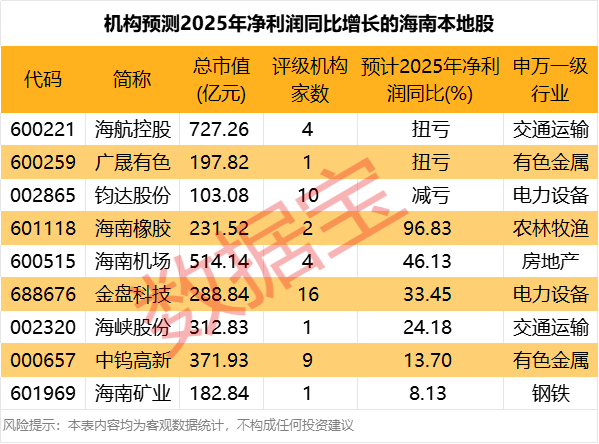
海南板块迎来政策利好 机构预测2025全年净利润预计向好的海南本地股一览
Zheng Quan Shi Bao Wang· 2025-10-17 11:29
Core Insights - The Ministry of Finance, General Administration of Customs, and State Taxation Administration jointly announced adjustments to the duty-free shopping policy for travelers in Hainan, effective from November 1 [1] - As of October 16, financing net purchases exceeding 50 million yuan were recorded for 10 local Hainan stocks, with Haixia Co., Zhongtung High-tech, and Intercontinental Oil & Gas leading the list [1] - Institutions predict that nine local Hainan stocks will see improved net profits for the full year of 2025, with Hainan Rubber, Hainan Airport, Jinpan Technology, and Haixia Co. showing the highest profit growth rates [1] Financing and Stock Performance - Ten local Hainan stocks had net financing purchases over 50 million yuan since the second half of the year, with the top three being Haixia Co. (304 million yuan), Zhongtung High-tech (294 million yuan), and Intercontinental Oil & Gas (235 million yuan) [1] - Other notable stocks with net financing purchases above 100 million yuan include Guangsheng Nonferrous, Haima Automobile, HNA Holding, and Hainan Airport [1] Profit Forecasts for 2025 - Institutions forecast significant profit growth for several Hainan stocks in 2025, with Hainan Rubber expected to increase net profit by 96.83%, followed by Hainan Airport (46.13%), Jinpan Technology (33.45%), and Haixia Co. (24.18%) [2] - HNA Holding and Guangsheng Nonferrous are expected to turn losses into profits for the full year [1][2]

安徽铜陵:废弃矿坑“蝶变”文旅“金山”
Zhong Guo Qing Nian Bao· 2025-10-17 10:55
Core Insights - The article highlights the transformation of Yongquan Town in Tongling, Anhui Province, from a mining village to a thriving tourist destination, showcasing the balance between ecological restoration and economic development [1][3][5]. Group 1: Tourism Development - During the recent National Day and Mid-Autumn Festival holiday, Yongquan Town received 202,000 visitors, generating ticket revenue of 9.9 million yuan, with an expected annual visitor count of 2 million and revenue surpassing 200 million yuan [1]. - The town has become a popular "internet celebrity" destination, featuring a cultural street with over 150 local delicacies and interactive activities that enhance visitor engagement [7]. Group 2: Ecological Restoration - The initial challenge of transforming the area involved ecological restoration, with a commitment to prioritize ecology over cost, leading to the planting of over 20,000 trees and the creation of scenic spots from former mining sites [5][6]. - The largest abandoned mine pit was transformed into "Mandarin Duck Lake," and the area was developed into a scenic spot that integrates local history and culture [5]. Group 3: Community Impact - The development has positively impacted the local community, with the establishment of over 20 pollution-free farming bases, generating more than 20 million yuan in annual agricultural orders, directly benefiting local farmers [7]. - The initiative has created job opportunities for over 600 villagers and has positively influenced more than 2,000 households, with an average annual income increase of over 50,000 yuan per household [7].

每日期货全景复盘10.17:沪金期货盘中一度突破1000元关口,表现尤为强势!
Jin Shi Shu Ju· 2025-10-17 09:53
Group 1: Market Overview - The futures market shows a bearish sentiment with 29 contracts rising and 50 contracts falling, indicating a concentration of trading activity in declining varieties [2] - The main contract for gold futures has surged past the 1000 yuan mark, marking a significant milestone with a year-to-date increase of over 370 yuan, or more than 60% [12] - The market is currently influenced by expectations of interest rate cuts and ongoing geopolitical tensions, which are driving demand for safe-haven assets like gold [23] Group 2: Key Commodity Movements - The top gainers in the futures market include gold (+3.82%), lithium carbonate (+2.55%), and silver (+2.06%), driven by supply-demand dynamics [5] - Conversely, the largest decliners include caustic soda (-4.37%) and glass (-3.69%), likely impacted by increased bearish sentiment or negative fundamental factors [6] - Significant inflows were observed in the China Securities 1000 contract (3.136 billion yuan) and gold futures (1.274 billion yuan), while notable outflows were seen in the CSI 300 contract (-749 million yuan) [8] Group 3: Production and Supply Insights - The average daily pig iron output from 247 surveyed steel mills is 2.4095 million tons, reflecting a slight decrease from the previous week [17] - Indonesia is transferring previously seized tin assets to PT Timah, which is expected to stabilize the country's tin production amid supply concerns [16] - Argentina's soybean planting area for the 2025/26 season is projected to decline by 2.8% to 17.5 million hectares, indicating potential supply constraints [15] Group 4: Future Outlook - Upcoming data releases include U.S. soybean export sales and potential interest rate cuts by the central bank, which could influence market dynamics [19][20] - The lithium carbonate market is experiencing a tightening supply situation, with production gradually increasing, supporting price stability [24][25] - The caustic soda market is under pressure due to high inventory levels and potential production cuts in the alumina sector, which may limit price recovery [26][28]

港股收评:三大指数齐跌,恒科指跌4.05%,芯片股持续走低!
Ge Long Hui· 2025-10-17 08:35
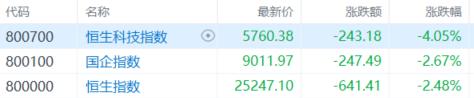
Market Overview - The Hong Kong stock market experienced a significant decline on October 17, with the Hang Seng Tech Index dropping by 4.05% to close at 5760 points, the Hang Seng Index falling by 2.48% to 25247 points, and the Hang Seng China Enterprises Index decreasing by 2.67% to 9011.97 points, marking recent adjustment lows for all three indices [1][2]. Sector Performance - Major technology stocks collectively dragged the market down, with significant declines in semiconductor and cryptocurrency-related stocks. Notably, ZTE Corporation fell nearly 13% [1][2]. - Retail and jewelry stocks showed resilience, with notable gains from Chow Tai Fook, which rose over 3%, and luxury brand Prada, which increased by over 2% [1][4]. Individual Stock Movements - Key technology stocks such as Meituan, Alibaba, Baidu, and Kuaishou all saw declines exceeding 4%, while other companies like Li Auto, Xiaomi, and NetEase dropped over 3% [2][3]. - In the retail sector, Jia Hua Department Store Holdings surged nearly 9%, while other retail stocks like Pacific Century Premium Developments and Maoye International also posted gains [4][5]. Agricultural Sector - The agricultural sector showed signs of recovery, with China Wan Tian Holdings rising over 12% and Congyu Zhino gaining over 3%. This follows the announcement of a new initiative by the Ministry of Agriculture to enhance agricultural production standards by 2025 [6][7]. Semiconductor Sector - The semiconductor sector continued to decline, with ZTE Corporation down over 13%, Horizon Robotics down over 7%, and other major players like Huahong Semiconductor and SMIC dropping over 6% [7][8]. Energy Sector - The electric equipment sector faced declines, with Harbin Electric and Goldwind Technology both dropping nearly 10%, while other companies like Xinyi Solar and GCL-Poly Energy fell over 6% [8][9]. Cryptocurrency Sector - Cryptocurrency-related stocks also experienced a downturn, with New Fire Technology Holdings and Star Chain Group both falling over 9% [10][11]. Capital Flows - Southbound funds recorded a net inflow of HKD 57.91 million, with the Shanghai-Hong Kong Stock Connect seeing a net purchase of HKD 59.4 million, while the Shenzhen-Hong Kong Stock Connect recorded a net outflow of HKD 1.49 million [12]. Future Outlook - Analysts from China Merchants Securities suggest that the Hong Kong stock market may experience a period of volatility in the short term, but could see a gradual recovery in the medium to long term, driven by improved fundamentals and valuation corrections [14].
宏观日报:能源、农业上游价格回落-20251017
Hua Tai Qi Huo· 2025-10-17 06:00
Report Summary 1. Report Industry Investment Rating There is no information about the report industry investment rating provided in the given content. 2. Core View of the Report - The upstream prices of energy and agriculture have declined recently. Specifically, international oil prices have dropped significantly, and pork prices have also fallen [1]. - The chip manufacturing industry is showing a strong trend. TSMC's Q3 financial report exceeded market expectations, boosting market optimism about the increasing demand for AI chips. TSMC is confident in the positive development of the AI market [1]. - China's foreign trade has withstood pressure and shown a stable and positive trend in the first three quarters of this year. The Ministry of Commerce will strengthen policy reserves and introduce new policies to stabilize foreign trade [1]. 3. Summary by Related Catalog Production Industry - TSMC's Q3 revenue and net profit exceeded market expectations, indicating strong demand for AI chips. The company is confident in the AI market. In terms of technology and capacity, the A16 process is expected to be mass - produced in the second half of the year, the 2 - nanometer process will be mass - produced later this quarter, and multiple phases of 2 - nanometer wafer fabs are being prepared in Taiwan. The second wafer fab in Japan has started construction [1]. Service Industry - The Ministry of Commerce will strengthen policy reserves and introduce new policies to stabilize foreign trade. It will work on releasing policy effectiveness, promoting trade, and deepening trade cooperation [1]. Upstream - Energy: International oil prices have declined significantly [1]. - Agriculture: Pork prices have fallen [1]. Midstream - Chemical: The PTA operating rate is at a medium level compared to the same period in the past three years [1]. - Energy: The coal consumption of power plants has decreased [1]. Downstream - Real estate: The sales of commercial housing in second - and third - tier cities have rebounded from a low level [1]. Key Industry Price Indicators - Many agricultural products' prices have declined, such as corn (-1.61%), eggs (-1.63%), palm oil (-1.28%), etc. on October 16 [34]. - Most non - ferrous metals' prices have decreased, including copper (-0.59%), zinc (-1.06%), nickel (-1.18%), etc. on October 16 [34]. - Energy prices have mixed trends. WTI crude oil increased by 7.53%, while Brent crude oil decreased by 6.55% on October 16 [34]. - Chemical product prices generally declined, like PTA (-3.51%), polyethylene (-1.43%), etc. on October 16 [34]. - Real estate - related indices, such as the building materials composite index (-1.49%) and the concrete price index (-0.34%), have decreased on October 16 [34].
