
钢铁

Search documents
安阳钢铁(600569.SH):2026年度第一期中期票据发行完成
Ge Long Hui A P P· 2026-01-26 12:27
本期债券由中国民生银行股份有限公司、中原银行股份有限公司为主承销商组织承销团,通过簿记建 档、集中配售的方式在全国银行间债券市场公开发行。本期债券募集资金用于补充公司及下属子公司流 动资金。 格隆汇1月26日丨安阳钢铁(600569.SH)公布,公司已于近日完成了安阳钢铁股份有限公司2026年度第一 期中期票据的发行。本期债券发行额为4亿元人民币,期限为2+1+1年,单位面值为100元人民币,发行 利率为4.00%。 ...

策略周报(20260119-20260123)-20260126
Mai Gao Zheng Quan· 2026-01-26 11:50
Market Liquidity Overview - R007 increased from 1.5137% to 1.5360%, a rise of 2.23 basis points; DR007 rose from 1.4430% to 1.4935%, an increase of 5.05 basis points. The spread between R007 and DR007 narrowed by 2.82 basis points [9] - The net outflow of funds this week was 250.36 billion yuan, with net inflow decreasing by 167.59 billion yuan compared to last week. Fund supply was -184.25 billion yuan, while fund demand was 66.12 billion yuan [13] Industry Sector Liquidity Tracking - Most sectors in the CITIC first-level industry index saw gains, with the building materials sector leading at a weekly increase of 9.18%. Other sectors like petroleum and petrochemicals, and steel also experienced slight increases. The banking and telecommunications sectors led the declines, with decreases of 2.69% and 1.68% respectively [18] Style Sector Liquidity Tracking - Most style indices increased, with cyclical and growth styles leading at 4.64% and 1.81% respectively. The financial style was the only one to decline, down by 1.50%. Growth style accounted for 58.15% of the average daily trading volume, making it the most active sector [3]
新华解码丨发展绿色生产力 零碳工厂怎么建?
Xin Hua She· 2026-01-26 11:46
新华社北京1月26日电 题:发展绿色生产力 零碳工厂怎么建? 新华社记者周圆 "指导意见优先选择脱碳需求迫切、能源消费以电力为主、脱碳难度相对较小的行业先行探索,待 条件成熟后再向碳排放量强度高、脱碳难度大的行业逐步推进。"潘小海说,因业施策、分阶段梯度培 育,充分考虑了行业发展特点、碳排放特征、脱碳技术难度及成本效益等方面的因素,有利于积极稳妥 推进工业领域实现"双碳"目标。 零碳工厂建设是一项系统工程。指导意见聚焦科学算碳、源头减碳、过程脱碳、协同降碳、智能控 碳、碳抵销和信息披露等方面,系统布局了零碳工厂的建设路径,构建起全过程全链条降碳体系。 首先要解决"怎么算得清、说得准"的问题。中国电子技术标准化研究院副院长陈大纪介绍,指导意 见明确健全碳排放核算管理体系,实现科学算碳,把核算边界、计量核算、信息报告等关键环节规范起 来,形成真实、可比、可核查的数据基础,为减排路径选择、过程管控和成效评估提供依据。 零碳工厂"怎么减"是建设成败的关键。陈大纪说,指导意见聚焦关键环节,在源头减碳、过程脱碳 作出一系列安排,如鼓励有条件的工厂建设工业绿色微电网、协同推进能效提升与工艺流程脱碳、提高 通用设备能效水平等 ...
安阳钢铁:1月26日召开董事会会议
Sou Hu Cai Jing· 2026-01-26 11:41
每经AI快讯,安阳钢铁1月26日晚间发布公告称,公司2026年第二次董事会临时会议于2026年1月26日 以通讯方式召开。会议审议了《关于公司控股子公司河南安钢南方电磁新材料科技有限责任公司向银行 申请项目贷款的议案》等文件。 每经头条(nbdtoutiao)——国际金价冲破5000美元!7年涨了280%,什么时候才见顶?专家:关键还 看美元,重点关注国际货币体系、降息和科技革命 (记者 王晓波) 免责声明:本文内容与数据仅供参考,不构成投资建议,使用前请核实。据此操作,风险自担。 每日经济新闻 ...
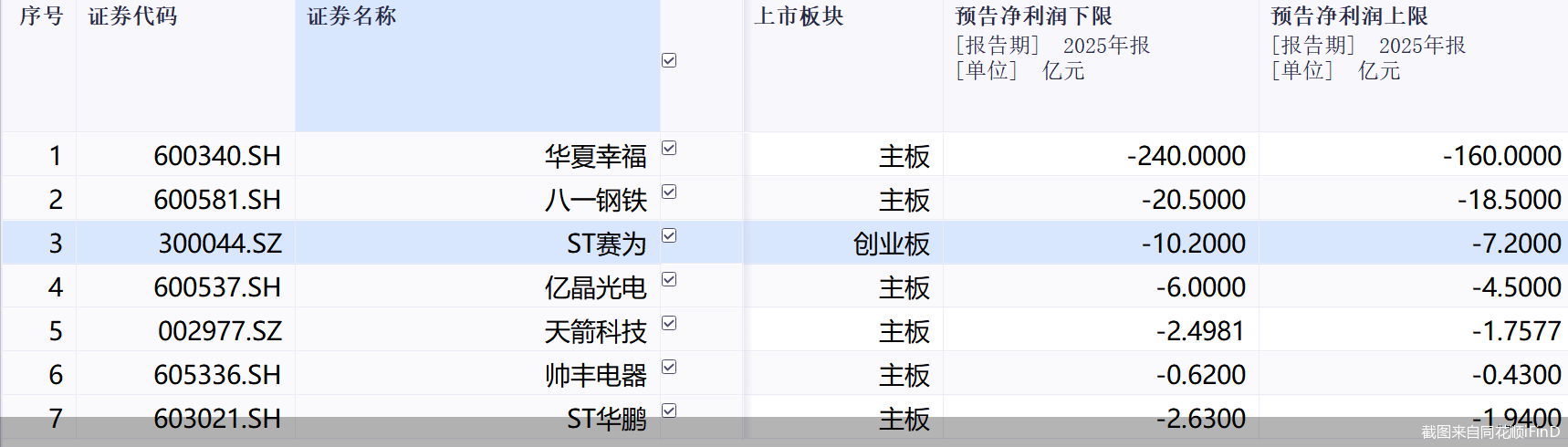
财务亮红灯!年内7股预警“*ST”!
Xin Lang Cai Jing· 2026-01-26 11:39
Core Viewpoint - The A-share market is experiencing a surge in performance forecasts, with several companies issuing "*ST" warnings, indicating potential delisting risks due to negative net assets and expected losses in 2025 [1][2][5]. Group 1: Company Announcements - Ba Yi Steel announced on January 25 that its stock may face delisting risk warnings, with an expected net asset value of -1.76 billion to -1.95 billion yuan by the end of 2025 [2][9]. - As of January 26, a total of seven companies have disclosed potential "*ST" warnings, with five of them indicating negative net assets [2][10]. Group 2: Financial Forecasts - The five companies expected to have negative net assets include Ba Yi Steel, ST Saiwei, Huaxia Happiness, Yijing Photovoltaic, and ST Huapeng, all of which are facing mandatory delisting indicators due to financial performance [3][10]. - Huaxia Happiness is projected to incur the largest loss, with an estimated net loss of 16 billion to 24 billion yuan for 2025, while Ba Yi Steel and ST Saiwei are expected to report losses of 1.85 billion to 2.05 billion yuan and 720 million to 1.02 billion yuan, respectively [5][12]. Group 3: Market Impact - Following the announcement, Ba Yi Steel's stock price fell to the limit down price of 3.24 yuan per share, resulting in a total market capitalization of 4.967 billion yuan [2][6]. - The overall market sentiment is affected as all seven companies are expected to report net losses for 2025, indicating a challenging financial environment [5][12].

2026年债券信用风险展望
Si Lu Hai Yang· 2026-01-26 11:35
Group 1: Report Industry Investment Rating - No information provided in the given content. Group 2: Core Viewpoints of the Report - In 2026, focus on provinces with large maturity scales of industrial bonds, such as Inner Mongolia, Heilongjiang, and Jilin, and avoid entities with industry downturns, weakened profitability, and financing channels, or those with non - bond debt risks [2]. - The broad private real estate developers still face challenges, and other industries have a low probability of concentrated risks, but entities with weak competitiveness, significant profit decline, cash - flow pressure, and concentrated debt maturities should be focused on [2]. - For convertible bonds, weak - quality entities with low - priced underlying stocks and high conversion premiums may face difficulties in exiting through conversion, and potential losses should be watched out for [2]. Group 3: Summary by Relevant Catalogs 1. Overall Bond Market Situation - As of January 6, 2026, the national credit bond balance was 36.18 trillion yuan, with urban investment bonds at 17.73 trillion yuan (49.00%) and industrial bonds at 18.45 trillion yuan (51.00%, down from 54.57% last year) [5]. - Beijing has the largest bond balance, followed by Jiangsu, Guangdong, Zhejiang, and Shandong. Inner Mongolia has the highest short - term bond maturity ratio at 81.09%, followed by Heilongjiang at 40.39% [5]. 2. Urban Investment Bonds - Since 2023, with a series of policies and measures, the debt pressure of urban investment platforms has been relieved, the issuance cost and credit spread of urban investment bonds have decreased, the financing cost is generally below 3%, and the debt term has been significantly extended [10]. 3. Industrial Bonds Provincial - level Analysis - Excluding urban investment bonds, Beijing has the largest industrial bond scale at over 7 trillion yuan, mainly central - enterprise bonds. Inner Mongolia has the highest short - term industrial bond maturity ratio at 82.64%, followed by Tibet, Heilongjiang, Tianjin, and Jilin [11]. - Inner Mongolia, Heilongjiang, and Jilin have a bond issuance coverage ratio of less than 1 for the next - year's maturity scale, indicating weak refinancing ability [14]. Industry - level Analysis - In 2025, default industries included 12 sectors such as automobile services and real estate development. The industrial holding and power industries have the largest bond balances, over 2 trillion yuan each [15]. - The paper - making, automobile services, medical devices, medical services, and publishing media industries have a short - term debt ratio of over 50%, with poor debt term structures [15]. - Industries with large short - term debt repayment pressures include rail transit, packaging, heating, furniture and home appliances, textiles, automobile services, and information technology [15]. 4. Real Estate Industry - In 2025, the default rate of real estate development entities remained high, with Vanke and Zhengxinglong defaulting. As of January 6, 2026, the real estate development enterprise bond balance was 11,528.76 billion yuan, mainly held by local and central state - owned enterprises [18]. - The short - term bond maturity pressure of public, Sino - foreign joint - venture, and private enterprises is over 40%. The broad private enterprises still face pressure, with an issuance amount of only 234.38 billion yuan in the past year, 76.93% of the next - year's maturity amount [20]. - In 2026, private real estate enterprises to focus on are Longfor and Yida Development [23]. 5. Loss - making Industrial Entities - Large - loss entities (losses over 10 billion yuan in 2024 and still in losses in the first three quarters of 2025) are mainly in the real estate development industry, including state - owned enterprises such as Overseas Chinese Town Group and financial street - related companies, as well as steel giant Ansteel Group [24]. - Entities with losses between 5 and 10 billion yuan involve industries such as electrical equipment, chemical, steel, and airport [26]. 6. ABS Market - From 2023 - 2025, the default rate of CSRC - regulated ABS was 1.10%, 0.77%, and 0.88% respectively. As of January 6, 2026, the ABS balance was 25,021.96 billion yuan, with a one - year maturity amount of 3,541.59 billion yuan (14.15%). The 2025 issuance amount covered the next - year's maturity amount 3.97 times, with good continuation [32]. 7. Convertible Bond Market - Since 2024, the convertible bond repayment risk has increased. As of January 6, 2026, the convertible bond balance was 5553.51 billion yuan, a 22.89% year - on - year decrease. The broad private enterprises accounted for 64.73%, with a relatively large proportion [33]. - Entities such as Anhui Honglu Steel Structure, Shenzhen Huayang International Engineering Design, and Shanghai Kehua Bio - Engineering face large convertible bond repayment pressures, but the conversion mechanism can reduce credit risks to some extent [35]. - Entities such as Dongfang Fashion Driving School, Hainan Pulili Pharmaceutical, and Jiangsu Fumiao Technology, although not facing immediate repayment pressures, have negative information such as business fluctuations, financial fraud, and equity freezes, and their dynamic changes should be continuously monitored [36].





财务亮红灯!年内7股预警将被“*ST”,2025年集体预亏
Bei Jing Shang Bao· 2026-01-26 11:18
Core Viewpoint - The A-share market is experiencing a surge in performance forecasts, while several listed companies have issued "*ST" warnings, indicating potential delisting risks due to negative net assets [1][3]. Group 1: Company Announcements - On January 25, Bayi Steel (600581) announced that its stock may be subject to delisting risk warnings due to expected negative net assets [3]. - As of January 26, a total of 7 companies have disclosed potential "*ST" warnings, with 5 of them indicating negative net assets at the end of the period [1][5]. Group 2: Financial Forecasts - Bayi Steel expects its net assets to be between -1.76 billion to -1.95 billion yuan by the end of 2025, which triggers delisting risk warnings under the Shanghai Stock Exchange rules [3]. - Other companies, including Huaxia Happiness and ST Saiwei, also forecast negative net assets, with Huaxia Happiness projecting a range of -15 billion to -10 billion yuan [5][7]. Group 3: Market Impact - Following the announcement, Bayi Steel's stock price fell to the limit down price of 3.24 yuan per share, resulting in a total market capitalization of 4.967 billion yuan [4]. - The overall market sentiment is affected, as all 7 companies are expected to report net losses for 2025, with Huaxia Happiness leading with a projected loss of 16 billion to 24 billion yuan [7]. Group 4: Company Profiles - ST Saiwei, which has previously faced delisting risks, is now again under scrutiny due to financial performance issues, with expected net assets of -870 million to -620 million yuan [5][8]. - Tianjian Technology and Shuai Feng Electric are also facing delisting risks due to financial metrics, with Tianjian expecting a total loss of 170 million to 242 million yuan for 2025 [6][7].




精益赋能!板材质检计量中心气瓶间管控升级筑牢安全发展基石
Xin Lang Cai Jing· 2026-01-26 11:16
在该作业区,气瓶间长期储存氩气等惰性气体,此类气体泄漏易造成局部缺氧,存在安全隐患。此前仅配置一氧化碳报警器的管控模式,无法监测氧气浓 度变化,缺氧隐患难以及时预警,成为安全生产的"隐形风险点"。为从根源化解隐患,该作业区秉持"安全为先、精益为本"原则,构建闭环整改体系,精 准推进管控升级。在硬件优化上,作业区深挖内部潜力开展修旧利废,对闲置损坏的氧气报警器进行专业修复调试;同步加装声光报警装置,按安全规范 安装经检定合格的氧气检测报警器,结合现场工况科学设定高低氧报警阈值,实现风险实时监测、异常即时预警。在人员赋能上,组织班组职工开展专项 培训,围绕报警识别、应急撤离、现场处置等实操要点系统讲解,全面提升作业人员应急处置能力,筑牢"人人讲安全"的思想防线。通过"双管齐下",解 决了此"隐形风险点"难题。 此次管控升级是该中心组织作业区将精益管理融入"双基"建设的生动实践。下一步,该中心将持续聚焦生产现场安全隐患与管理痛点,不断完善安全管控 体系,以精准施策、务实举措护航生产安全,为板材公司高质量发展提供坚实支撑。 (来源:本钢板材) "精益+双基"专栏 安全是企业高质量发展的"压舱石"。近期,板材质检计量中 ...


关注地方两会 | 河南将启动新一轮国资国企改革行动 加大战新产业等投资力度
Xin Lang Cai Jing· 2026-01-26 11:15
Core Viewpoint - In 2026, Henan Province aims to deepen reforms in key areas, with a focus on economic growth and structural adjustments in various sectors [2][3][14]. Economic Goals - The main expected targets for 2026 include an economic growth rate of around 5%, industrial added value growth of approximately 6.5%, fixed asset investment growth of about 5%, and retail sales growth of 5.5% [2][13]. - The province aims for a grain production of over 1.3 trillion jin, with a goal to achieve more growth compared to the previous year [2][13]. Reform Initiatives - A new round of state-owned enterprise reform will be initiated, focusing on strategic restructuring and professional integration [3][14]. - The government plans to enhance the investment in strategic emerging industries and the livelihood sector [3][14]. - There will be a comprehensive implementation of zero-based budgeting reforms and performance management mechanisms [3][14]. Employment and Social Policies - The urban unemployment rate is targeted to be around 5.5%, with over 1.1 million new urban jobs expected to be created [2][13]. - The government will implement policies to ensure the synchronization of resident income growth with economic growth [2][13]. Infrastructure and Investment Projects - Over 1,000 key provincial projects will be implemented, with an annual investment completion target of 1 trillion yuan [19]. - Major infrastructure projects include high-speed rail developments and enhancements in digital infrastructure [19][22]. Financial Strategies - The province plans to issue 132.7 billion yuan in local government special bonds to support project construction [8][18]. - There will be an increase in social financing scale by 1 trillion yuan, alongside efforts to manage local government financing platforms effectively [22]. Industry Development - The share of strategic emerging industries in industrial added value is expected to exceed 25% [8][18]. - The government will support the development of six major industrial clusters and 18 rural prosperity industrial chains [22].


2026年总量与政策年度展望:风至势起,进而有为
Guoyuan Securities· 2026-01-26 11:11
Group 1 - The core viewpoint of the report emphasizes the need for a systematic reshaping of macro governance paradigms through "three rebalances," aiming to establish a new starting point for high-quality development in 2026, which is the first year of the 14th Five-Year Plan [1] - The report identifies the main contradiction in the economy as "strong supply and weak demand," highlighting the necessity for policies to focus on expanding domestic demand while addressing structural issues [2][3] - The macroeconomic policy framework for 2026 is expected to prioritize internal demand, reform, and innovation, aiming for high-quality development while balancing external and internal factors [3] Group 2 - In 2025, the economic operation showed a steady improvement supported by proactive macro policies, with industrial production demonstrating resilience and a shift towards high-tech industries [2][12] - The report notes that the external demand has been stronger than internal demand, with exports playing a significant role in supporting economic stability [3][33] - The investment landscape remains challenging, particularly in real estate, while manufacturing investment is buoyed by equipment renewal policies [2][3] Group 3 - The economic outlook for 2026 suggests a moderate GDP growth target of around 5%, with growth driven by improvements in domestic demand and supply efficiency [4] - Price indicators are expected to show a mild upward trend, with PPI likely to recover due to improved supply-demand dynamics and global manufacturing inventory cycles [4][33] - The market dynamics are shifting from liquidity-driven growth to profit-driven growth, particularly in the midstream manufacturing sector, which is expected to see significant profit recovery [4][33]