芯片半导体

Search documents
千元股“寒王”,最新动作曝光!
Sou Hu Cai Jing· 2025-08-23 20:42
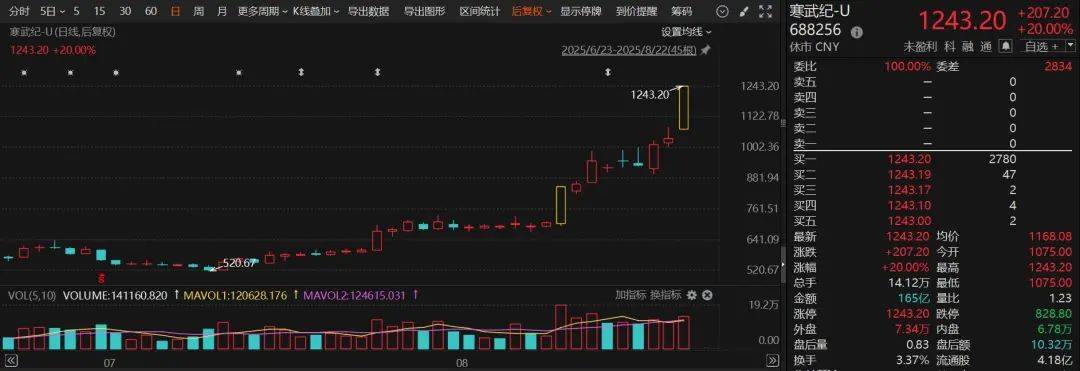
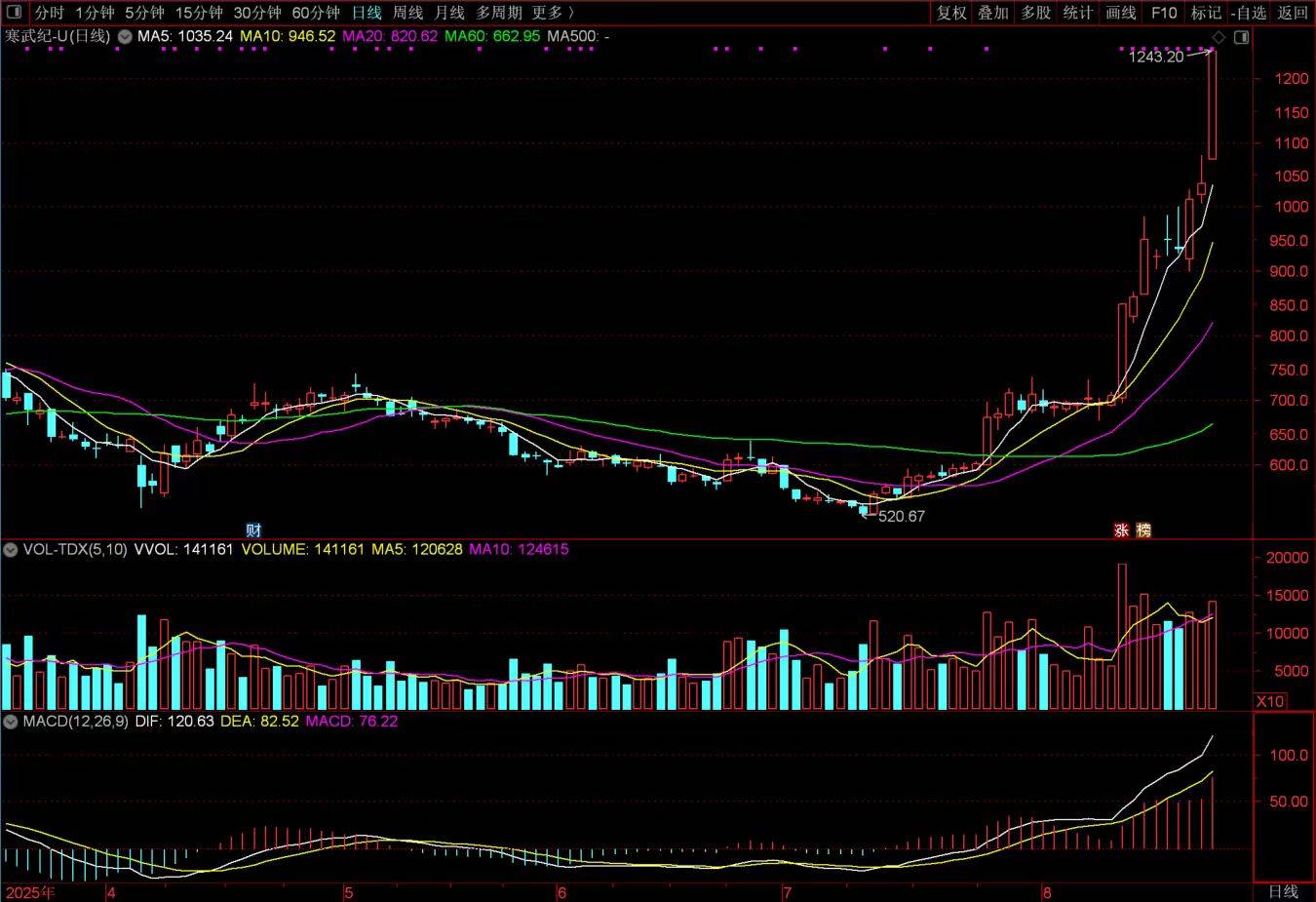
Core Viewpoint - The stock of Cambricon Technologies ("寒武纪") has surged significantly, reaching a market capitalization of over 500 billion yuan, making it the leading company in the semiconductor industry and the second stock in the market to exceed 1,000 yuan per share, following Kweichow Moutai [1][4][6]. Company Performance - Cambricon's stock price has increased over 88% this year, with a remarkable rise of more than 130% in the past month [5]. - The company reported a substantial revenue growth of 65.56% year-on-year, reaching 1.17 billion yuan in 2024, with Q1 2025 revenue soaring to 1.11 billion yuan, a year-on-year increase of over 4,200% [6]. - Net profit for Q1 2025 was 360 million yuan, reflecting a year-on-year growth of 257% [6]. Market Dynamics - The semiconductor sector is experiencing a bullish trend, with major stocks like Cambricon leading the charge, as evidenced by the Shanghai Composite Index surpassing 3,800 points [4][10]. - The demand for domestic AI chips is increasing due to the ongoing US-China tech competition, positioning Cambricon favorably in the market [7][8]. Industry Trends - The semiconductor index has risen by 25% since April 8, with the "semiconductor selection index" rebounding over 40% in the same period [9]. - The trend towards domestic innovation is expected to reshape technology valuations, with a focus on hard technology innovation since the launch of the Sci-Tech Innovation Board in 2019 [9]. - The semiconductor cycle is currently in an upward trajectory, driven by strong AI demand and a recovery in industrial applications [10].

3800 点后嘉宾解析切换与方向 8月24日《大象财经•论股》不见不散
Sou Hu Cai Jing· 2025-08-23 03:48
Market Overview - The Shanghai Composite Index has surged past the 3800-point mark, with other indices also reaching new highs, leading to a total A-share market capitalization exceeding 100 trillion [1][3] - Daily trading volume has consistently remained above 2 trillion, indicating strong market activity despite some fluctuations in high-priced stocks [1][3] Sector Performance - The banking sector has shown continuous gains, while brokerage stocks have experienced volatility with inconsistent performance [3] - The technology sector remains active, with notable performances from companies like Cambrian, which has become the second stock to reach a thousand yuan after Moutai [3] - Key areas such as semiconductor chips, storage chips, and related hardware have also seen significant activity, although some stocks are experiencing corrections after substantial gains [3] Investment Trends - There is a noticeable shift in market capital flow, with funds increasingly moving towards lower-priced stocks in banking, white liquor, beverage manufacturing, and oil processing sectors [3] - Conversely, sectors that have seen significant recent gains, such as military, automotive parts, and chemical pharmaceuticals, are experiencing capital outflows [3] Future Outlook - The market is expected to continue its upward trend, but adjustments are anticipated as part of a healthy market cycle [5] - The focus remains on whether the financial sector can sustain its momentum and if the technology sector will continue to perform strongly or face a downturn [5]

登顶第一,A股新历史时刻
3 6 Ke· 2025-08-22 11:40
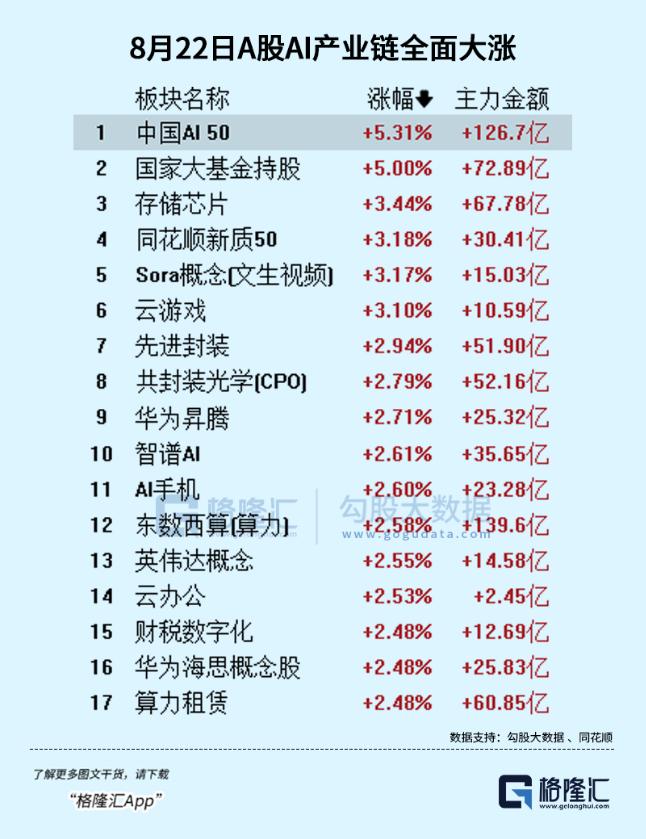
Core Insights - The A-share electronic sector has reached a market capitalization of 11.54 trillion yuan, surpassing the banking sector for the first time in history, indicating a significant shift in the growth engine of the Chinese stock market towards technology-driven companies [2][3]. Market Performance - On August 22, major A-share indices rose collectively, with the Shanghai Composite Index up 1.45% to 3825 points, marking a ten-year high. The Shenzhen Component Index increased by 2.07%, and the ChiNext Index rose by 3.36%, while the STAR 50 Index surged by 8.59% [3]. - The total trading volume in the Shanghai and Shenzhen markets reached 2.55 trillion yuan, an increase of 122.7 billion yuan from the previous trading day, reflecting heightened market sentiment [3]. Sector Highlights - The semiconductor industry, particularly the AI chip sector, experienced a significant surge, with major players like Hanwang and Haiwang hitting their daily limit up of 20%, driving numerous related stocks to also reach their limits [5]. - The CPO sector has seen remarkable growth, with companies like Xinyisheng, Zhongji Xuchuang, and Tianfu Communication experiencing cumulative increases of 233%, 126%, and 89% respectively this year [11]. Company Performance - Hanwang reported a revenue of 1.111 billion yuan for Q1 2025, a year-on-year increase of 4230.22%, and a net profit of 355 million yuan, marking a significant turnaround [18]. - Haiguang Information achieved a revenue of 5.464 billion yuan in H1 2025, a 45.21% increase year-on-year, with a net profit of 1.639 billion yuan, reflecting strong demand in the domestic high-end chip market [19]. Industry Outlook - The global AI chip market is projected to reach $92 billion by 2025, with a year-on-year growth of 29.58%. The Chinese AI chip market is expected to reach 141.2 billion yuan in 2024, accounting for approximately 28% of the global market [20]. - The urgency and importance of domestic chip production are increasing, with expectations of rapid growth in domestic computing power demand, potentially generating hundreds of billions in market opportunities [25]. Future Trends - The infrastructure for computing power centers is set to receive significant attention, with the Ministry of Industry and Information Technology indicating plans to optimize the national computing power layout [24]. - Various segments of the semiconductor supply chain, including advanced packaging and semiconductor equipment, are anticipated to attract continued investment as the domestic chip production narrative strengthens [22][23].


登顶第一!A股新历史时刻!
Ge Long Hui A P P· 2025-08-22 11:10
Group 1 - The A-share electronic sector has reached a market capitalization of 11.54 trillion yuan, surpassing the banking sector for the first time in history, indicating a shift in the growth engine of the Chinese stock market towards technology-driven companies [2] - On August 22, major A-share indices rose significantly, with the Shanghai Composite Index up 1.45% to 3825 points, marking a ten-year high, and the Shenzhen Component Index rising 2.07% [3] - The semiconductor industry chain, particularly in chips, packaging, and AI applications, experienced a comprehensive surge, with significant trading volumes and heightened market sentiment [3][4] Group 2 - The strongest performers included the China AI 50 index, which rose by 5.31%, and various segments of the semiconductor industry, with notable gains in storage chips and advanced packaging [4] - The market rally was triggered by DeepSeek's announcement of its new chip architecture, which has led to increased speculation about the acceleration of domestic computing power autonomy [5][6] - The AI chip sector has seen substantial price increases, with companies like XinYiseng and Zhongji Xuchuang experiencing remarkable stock price growth, reflecting the booming demand for AI-related technologies [7][10] Group 3 - Companies like Cambrian and Haiguang Information have reported significant revenue growth, with Cambrian's revenue reaching 1.111 billion yuan, a year-on-year increase of 4230.22%, and Haiguang's revenue at 5.464 billion yuan, up 45.21% [14][16] - The overall A-share market is increasingly focused on technology growth, with substantial market opportunities in AI computing hardware, robotics, and semiconductor sectors [17] - The global AI chip market is projected to reach $92 billion by 2025, with China's market expected to reach 141.2 billion yuan, indicating a strong growth trajectory for domestic AI chip manufacturers [17][18] Group 4 - The urgency for domestic computing power replacement is rising, with expectations of rapid growth in domestic demand for computing power, potentially generating significant market opportunities [20] - Despite the potential for long-term investment opportunities in the domestic computing power industry chain, caution is advised due to the significant short-term price increases in many related stocks [21]


登顶第一!A股新历史时刻!
格隆汇APP· 2025-08-22 10:51
Core Viewpoint - The A-share electronic sector has reached a market capitalization of 11.54 trillion yuan, surpassing the banking sector for the first time in history, indicating a significant shift in the growth engine of the Chinese stock market towards technology-driven new economy [2][3][4]. Market Performance - On August 22, major A-share indices rose collectively, with the Shanghai Composite Index up 1.45% to 3825 points, marking a ten-year high; the Shenzhen Component Index increased by 2.07%, and the ChiNext Index rose by 3.36% [7]. - The total trading volume in the Shanghai and Shenzhen markets reached 2.55 trillion yuan, an increase of 122.7 billion yuan from the previous trading day, reflecting a significant boost in market sentiment [8]. Sector Highlights - The semiconductor industry chain, particularly in chips, packaging, CPO, servers, computing power, and AI applications, experienced a comprehensive surge [9]. - On August 22, various AI-related sectors saw substantial gains, with the China AI 50 index rising by 5.31% and the National Big Fund holdings increasing by 5.00% [10]. Key Drivers - The recent surge in the market was triggered by DeepSeek's announcement regarding the release of its next-generation domestic chip design, which has heightened market speculation about the acceleration of domestic computing power autonomy [12][14]. - The AI chip sector has shown remarkable growth, with companies like Cambrian and Haiguang Information reporting significant revenue increases, validating the demand for domestic chips [28][30]. Long-term Outlook - The AI chip market is expected to expand significantly, with projections indicating that the global AI chip market could reach $92 billion by 2025, growing by 29.58% year-on-year, and China's market could reach 141.2 billion yuan, accounting for approximately 28% of the global market [31]. - The domestic AI chip brands are anticipated to capture a 40% market share this year, reflecting a robust growth trajectory [32]. Investment Opportunities - The current market environment presents numerous long-term investment opportunities across various segments of the semiconductor industry, including liquid cooling, CPO, PCB, and server sectors, which are expected to receive continued attention from investors [33][36]. - The urgency for domestic computing power replacement is expected to drive significant market growth, potentially creating a multi-hundred billion yuan market opportunity in the coming years [36].

如果寒武纪股价超越茅台,会给市场传递什么样的信息?
Sou Hu Cai Jing· 2025-08-22 09:07
Group 1 - The core point of the article is the significant rise in the stock price of chip leader Cambricon, which surged to 1242 yuan, an increase of 20%, driving the STAR 50 Index up by 8.4% and boosting various semiconductor ETFs and the AI sector [1] - The phenomenon is attributed to the acceleration of domestic chip replacement, creating high market expectations, and the influx of latecomer funds into the STAR market, which has led to a dual profit effect through major stocks like Cambricon [1] - The current market dynamics suggest that both retail and institutional investors who previously missed out are now driving the STAR board's performance, indicating a shift in investment focus towards technology [1] Group 2 - Cambricon's stock price is currently at 1242 yuan, and if it rises by 200 yuan, it will surpass Kweichow Moutai's price of 1462 yuan, raising questions about the implications of such a shift in market leadership [2] - The potential surpassing of Moutai by Cambricon signals a transformation in market sentiment, reflecting a preference for technology-driven growth over traditional consumer brands, indicating a structural economic transition [4] - The rise of Cambricon as a leading stock in this bull market suggests that technology is the primary driver, with all tech-related stocks likely to benefit from this trend, opening up new opportunities in various tech sectors [5]
史诗级,暴涨
Zhong Guo Ji Jin Bao· 2025-08-22 08:07
Market Overview - The Shanghai Composite Index reached 3800 points, marking a ten-year high, with the ChiNext Index rising over 3% and the STAR Market Index soaring more than 8% [3] - A total of 2803 stocks rose, with 79 hitting the daily limit up, while 2396 stocks declined [3][4] - The total trading volume was approximately 25,788.42 billion, with a total of 5426 stocks traded [4] Sector Performance - Financial stocks, led by brokerages, showed strong performance, with Everbright Securities and Xinda Securities hitting the daily limit up, and Zhinancai rising over 10% to a new high [5] - The semiconductor sector experienced a collective surge, with stocks like Cambrian and Zhaoyi Innovation hitting the daily limit up, and SMIC rising over 10% [7] Key Stocks - Notable performers in the financial sector included: - Everbright Securities (601788) up 10.01% at 20.78 - Xinda Securities (601059) up 6.6% at 19.72 - GF Securities (000776) up 7.27% at 22.42 [6] - In the semiconductor sector, key stocks included: - Cambrian (288526) up 20% at 1243.20 - Zhaoyi Innovation (603986) up 10% at 150.88 [8] Catalysts for Semiconductor Surge - The surge in the semiconductor sector is attributed to two main factors: 1. The update of the DeepSeek model to version V3.1, which is expected to support FP8 precision and domestic chips, indicating a boost for the domestic computing power sector [9] 2. Nvidia's halt in the production of the H20 chip, leading to increased investor confidence in Chinese AI chip manufacturers as alternative suppliers [10]



8.22黄金V转20美金 多空争夺等爆发
Sou Hu Cai Jing· 2025-08-22 07:21
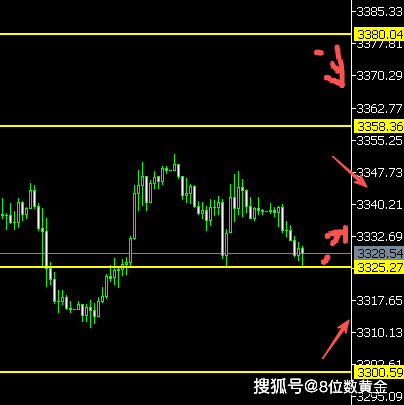
Group 1: Gold Market Analysis - The gold market experienced a U-shaped strong reversal followed by a significant drop of $30, leading to a second V-shaped reversal, indicating ongoing adjustments and a fierce battle between bulls and bears [1][4] - After a four-month consecutive rise, gold is now facing a high-level adjustment around the 3300 mark, with a potential breakout direction expected as the month-end approaches [7] - Key support levels to watch are 3325 and 3300 for potential long positions, while resistance levels at 3358 and 3380 should be monitored for short opportunities [5][7] Group 2: Economic Indicators Impacting Gold - The Federal Reserve is showing internal divisions regarding inflation pressures, maintaining its independence despite external pressures, which continues to put downward pressure on gold [7] - Recent unemployment claims data showed 235,000, lower than previous values, indicating a weakening economic situation in the U.S., which could support gold prices [8] - The upcoming speech by Fed Chairman Jerome Powell is anticipated to create market volatility, especially in light of ongoing inflation concerns and trade tensions [9] Group 3: Broader Market Trends - The A-share market has broken the 3800 mark, creating a bullish atmosphere [10] - The semiconductor sector is experiencing significant activity, driven by recent developments in U.S.-China trade relations and tariffs [11][12] - The intensifying tech war between the U.S. and China is fueling a trend towards domestic alternatives in the semiconductor industry [13]
国投期货:美联储今夜定乾坤 贵金属以震荡为主
Jin Tou Wang· 2025-08-22 06:08
Group 1: Gold Market - The Shanghai gold futures price is reported at 775.04 CNY per gram, with a decline of 0.14% [1] - The opening price for the day was 776.0 CNY per gram, with a high of 777.22 CNY and a low of 774.76 CNY [1] - Market risk appetite remains high, suggesting short-term fluctuations in gold prices, but potential interest rate cuts in September may provide support for gold prices [2] Group 2: Silver Market - Silver prices are expected to experience short-term range fluctuations, but the medium-term outlook will be driven by fundamental factors [3] Group 3: Macro Economic Developments - The U.S. Department of Justice plans to investigate Federal Reserve Governor Lisa Cook, with a senior official urging Fed Chair Powell to remove her from the board [1] - Cleveland Fed President Loretta Mester does not support interest rate cuts if the Fed is to make a policy decision imminently [1] - According to CME's FedWatch, there is a 25% probability that the Fed will maintain interest rates in September, with a 75% probability of a 25 basis point cut [1] - The Jackson Hole global central bank conference is drawing attention, with Fed Chair Powell scheduled to deliver a keynote speech, which investors are eagerly awaiting for clues on interest rate direction [1] Group 4: U.S.-EU Trade Agreement - The U.S. and EU have reached a consensus on a trade agreement framework, which includes 19 key points covering various sectors such as agricultural products, automobiles, and semiconductors [2] - The framework specifies that the U.S. will apply the most favored nation (MFN) tariff or a 15% reciprocal tariff on EU-origin goods, with certain products facing MFN tariffs starting September 1, 2025 [2] - The agreement aims to reduce the current 27.5% tariff on automobiles and parts to a maximum of 15%, alleviating pressure on the European automotive industry [2]
沪指站上3800点
华尔街见闻· 2025-08-22 05:18
Group 1 - The core viewpoint of the article highlights a significant increase in the Science and Technology Innovation 50 Index, which surged over 5%, driven by a strong performance in the semiconductor sector, particularly with stocks like Cambrian Technology rising over 15% to reach a new historical high [1] - AI hardware stocks are also showing strength, with sectors such as CPO and PCB leading the gains [1] Group 2 - The Shanghai Composite Index (000001) recorded a closing price of 3801.14, up by 30.04 points or 0.80% from the previous close of 3771.10, with a trading volume of 710.66 billion [2] - The index saw a total of 978 stocks rising while 1287 stocks declined, indicating a mixed market sentiment [2] - The highest price during the trading session was 3801.14, while the lowest was 3772.28, reflecting a trading range within the day [2]