软件

Search documents
是时候抄底了?奥本海默上调甲骨文评级:大跌之后即是买入机会
Hua Er Jie Jian Wen· 2026-02-25 14:16
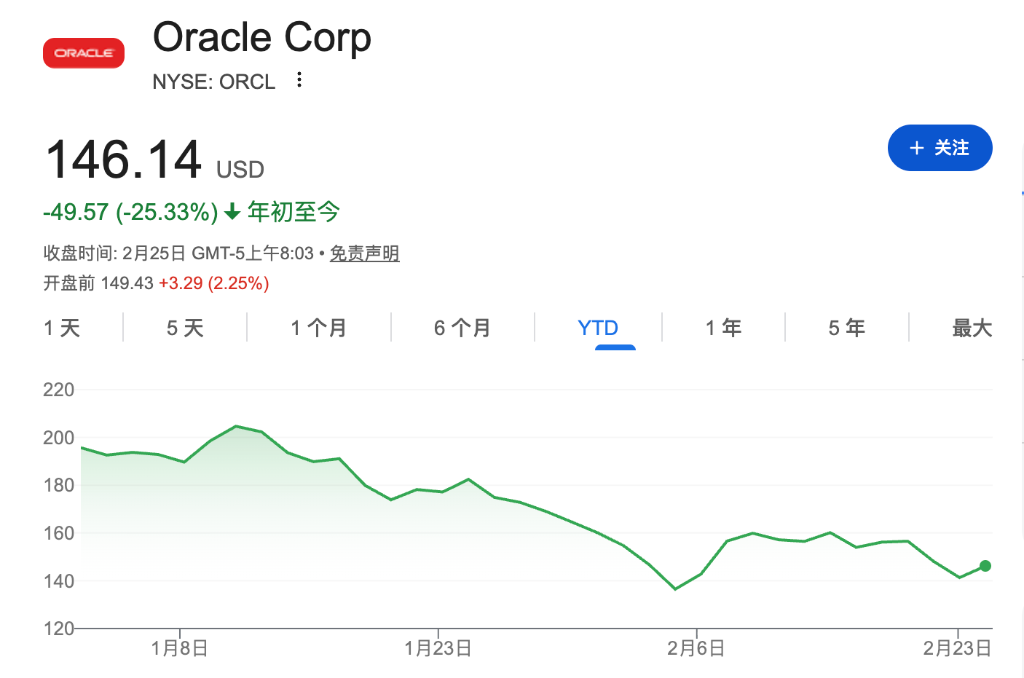
Core Viewpoint - Oracle's stock price has dropped over 25% year-to-date, presenting a buying opportunity according to Oppenheimer, which upgraded its rating from "market perform" to "outperform" with a target price of $185, indicating a potential upside of 27% [1] Group 1: Stock Performance and Valuation - Oppenheimer analyst Brian Schwartz noted that Oracle's price-to-earnings ratio has decreased by more than half since September last year, making the current risk-reward ratio highly favorable for investors [3] - The firm expects Oracle's earnings per share (EPS) to grow two to three times by fiscal year 2030, reinforcing its attractiveness as a buy [3] - Bernstein's extreme scenario stress test indicates that even if the AI business were to completely fail, Oracle's stock price downside would be limited to approximately 15% [4] Group 2: Lease Liabilities and Financial Health - Bernstein addressed concerns regarding Oracle's $248 billion lease liabilities, stating that the risk is significantly overstated. The actual annual maximum risk exposure is only $13 to $16.5 billion until fiscal year 2030 [4] - The long-term nature of these leases (15 to 19 years) allows Oracle to manage its capacity effectively, and demand for data centers is expected to remain high as long as the global market does not enter an "AI winter" [4] Group 3: Hardware and Capital Expenditure Risks - Bernstein highlighted that Oracle's exposure to hardware capital expenditure risks is limited, as the procurement cycle allows for flexibility in order cancellations without significant penalties [5] - Even if hardware has been delivered, most computing assets are highly versatile and can be repurposed for traditional SaaS and OCI businesses, mitigating risks associated with customer defaults [5] Group 4: Core Business Strength - Bernstein's analysis indicates that even without AI-related revenues, Oracle's core business (traditional databases, SaaS, and OCI) could generate total revenue of $101 billion by fiscal year 2030 [6] - After accounting for interest costs from debt incurred for AI infrastructure, Oracle's EPS is still projected to reach $9.0, suggesting a strong cash generation capability [7] Group 5: Revenue Projections - Oracle's total revenue is projected to grow from $50 billion in fiscal year 2023 to $221 billion by fiscal year 2030, with a year-over-year growth rate of 17% in the final year [8] - The revenue excluding AI is expected to reach $101 billion by fiscal year 2030, with a consistent growth trajectory [8] Group 6: Market Comparisons - Oracle's expected EPS compound annual growth rate (CAGR) is 18.2%, with a reasonable price-to-earnings ratio of 27.3x, suggesting that the current stock price is undervalued compared to peers like Microsoft and SAP [10]


Xbox遭遇危机?曝微软游戏新CEO或对其进行拆解
Sou Hu Cai Jing· 2026-02-25 14:06
Group 1 - The co-founder of Xbox expressed concerns about the potential dismantling of the Xbox brand under the new CEO, who has a background in artificial intelligence rather than gaming [1] - Despite the co-founder's pessimism, the new CEO emphasized a commitment to the Xbox hardware and gaming business, stating a focus on reinforcing investment in the console segment [1] - Many gamers remain skeptical about the strategic shift towards artificial intelligence [1] Group 2 - Rumors suggest that the upcoming Xbox console may resemble a Windows gaming PC, lacking exclusive games to appease fans [3] - The next-generation Xbox is expected to deeply integrate with Windows 11, allowing compatibility with the entire Xbox game library and enabling seamless switching to a full Windows environment [3] - The collaboration model aims to create a "Windows handheld" experience by overlaying the Xbox interface on Windows 11 while minimizing unnecessary system processes [3] Group 3 - Microsoft has invited members of the PC gaming preview program to test a new "post-game review" feature in the Xbox app for Windows 10 and 11 [5] - This feature is designed to help players quickly summarize highlights from a gaming session, including game duration, achievements unlocked, key screenshots, and video clips [5] Group 4 - The review panel is triggered when players take screenshots or unlock achievements, and it may also provide brief sign-in information and game recommendations for first-time players [7] - The Xbox app has been optimized to minimize its impact on system performance and memory usage, ensuring it does not hinder game performance [7] Group 5 - The feature allows users to maintain full control, enabling them to disable the post-game review option if they prefer not to see the pop-up or have the app running in the background [9] - The feature is still in testing, with a feedback mechanism integrated into the review panel for players to share their opinions on its usefulness and any missing features [9]


AI要毁掉白领?城堡证券戳破“末日叙事”
Jin Shi Shu Ju· 2026-02-25 14:04
Core Viewpoint - Citadel Securities' research report argues that the rapid expansion of AI is unlikely to lead to widespread unemployment, countering a recent report that caused market turmoil [1][2] Group 1: Historical Context and Current Data - Historical trends indicate that technological changes do not lead to uncontrolled exponential growth or make labor redundant [1] - Current data shows little evidence of AI causing widespread disruption in the labor market, with an increase in job postings for software engineers and a recovery in construction hiring supported by AI-related data center projects [1] Group 2: Technology Adoption and Labor Market Dynamics - Technological change typically follows an S-curve, with slow initial adoption, acceleration as costs decrease, and eventual leveling off as the market approaches saturation [2] - If the marginal cost of computing power for AI exceeds that of human labor, the replacement of humans by robots is unlikely to occur [2] - AI is more likely to complement human labor rather than replace it, similar to past technological revolutions [2] Group 3: Counterarguments to Dystopian Scenarios - Citrini Research's report suggests that the speed of job displacement will outpace job creation, but its founder emphasizes that it is a hypothetical scenario rather than a prediction [2] - In the event of significant labor displacement, government intervention through regulation and fiscal stimulus could mitigate the impact and slow the pace of replacement [2]
大摩逆势发声:AI恐慌过头,市场正为选股者砸出“黄金坑”
Zhi Tong Cai Jing· 2026-02-25 13:25
Group 1 - The core viewpoint is that the overreaction in various industries due to concerns over disruptive AI is creating opportunities for selective stock investors [1] - Investors should focus on "AI-enabled incumbents," strong growth stocks, and quality targets to capture the dual benefits of current low valuations and the wave of technology adoption [1] - The investment logic for AI adopters with high pricing power is continuously strengthening, as highlighted by the Morgan Stanley strategy team [1] Group 2 - The banking sector is expected to be a net beneficiary of AI technology, which will gradually enhance productivity and profitability [3] - Citigroup (C.US), Bank of America (BAC.US), State Street (STT.US), and Truist Financial (TFC.US) are identified as the most defensive stocks in the analysts' view [3] - In the consumer finance sector, AI is also expected to be a net beneficiary, with short-term disruptive effects offset by long-term efficiency gains [3] Group 3 - In the payments and fintech sectors, Mastercard (MA.US) and Visa (V.US) are seen as net beneficiaries of AI and agency commerce [3] - The current market situation is characterized by significant volatility, with intermittent phases where the market questions the pace of capital spending and the specific areas at risk of disruptive change [3]
从“讲故事”到“交作业”:AI狂热下谁在裸泳谁在筑墙?
2 1 Shi Ji Jing Ji Bao Dao· 2026-02-25 13:17
Group 1 - The market is experiencing increased volatility driven by alternating enthusiasm and fear surrounding AI, with a recent rebound in U.S. stocks led by technology shares, overshadowing concerns about the disruptive potential of AI [1][2] - SanDisk's stock faced a significant drop of over 8% due to short-selling by Citron Research, which cited cyclical pressures in the storage market, intensified competition from Samsung, and the exit of long-term investors as reasons for their bearish stance [1][3] - The AI hype is returning to a more rational state, with the Nasdaq index down 1.63% year-to-date, contrasting sharply with the previous three years of over 20% annual gains [1] Group 2 - The recent fluctuations in the market reflect a re-evaluation of two curves: the new demand curve driven by AI and the replacement curve for old business models, with software stocks experiencing a significant loss in market value due to premature fears of AI replacement [2] - The rebound in software stocks indicates that smart capital recognizes the previous overreaction in valuations rather than a sudden deterioration in fundamentals [2] Group 3 - SanDisk's recent decline is not representative of the current AI storage industry, as its focus on NAND flash memory is more aligned with consumer electronics, while the real demand for AI capabilities is driven by HBM and high-end DRAM [3] - The market is currently in a "dual high" phase, characterized by both high valuations and high growth, leading to increased volatility and sensitivity to minor data changes [3] Group 4 - The tech giants are transitioning from light-asset models to capital-intensive, cash flow-demanding enterprises due to the AI wave, with significant capital expenditures transforming their business models into utility-like structures [5][6] - The market's perception of tech giants is shifting, with a focus on their ability to convert computing power into sustainable revenue streams, while companies failing to optimize their GPU utilization may be treated as heavy-asset cyclical stocks [6] Group 5 - The current market faces potential risks, including tight pricing in the U.S. stock market, with the S&P 500's forward valuation around 22 times, making it sensitive to changes in interest rates, earnings, and policy [8] - The overall delinquency rate for U.S. households has risen to 4.8%, indicating pressure from credit card and student loans, while banks are becoming more cautious in lending, particularly in real estate development [8] Group 6 - The private equity sector is aggressively lending to traditional software companies and mid-sized enterprises, creating a risk of defaults if AI disrupts their business models, which could lead to significant cash flow issues [9] - The market is becoming more selective, with a focus on how companies can achieve growth rather than just the amount of growth, indicating a shift in investor sentiment towards the application of AI across various industries [10] Group 7 - The U.S. stock market is expected to continue its upward momentum, but with a "K-shaped melt-up" dynamic, where passive investment flows disproportionately benefit a few large tech companies, creating a facade of prosperity while smaller firms struggle [11] - The disparity in performance between large tech giants and smaller firms highlights the risks associated with a concentrated market, where the absence of a technological moat can lead to significant declines in stock prices for those companies facing AI disruption [11]
“全市场的希望”!美股科技股陷入2022年来最糟开局,英伟达业绩成扭转颓势关键
Hua Er Jie Jian Wen· 2026-02-25 13:17
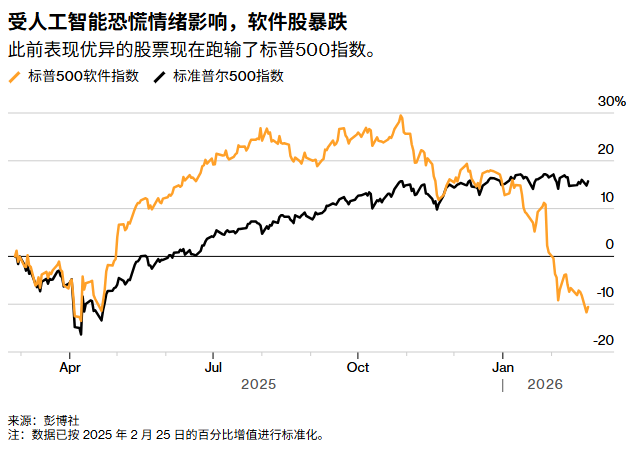
Core Viewpoint - The performance of technology stocks in the U.S. market has significantly declined at the start of 2026, with Nvidia's upcoming earnings report seen as a critical factor in potentially reversing market sentiment [1]. Group 1: Technology Sector Performance - The S&P 500 Information Technology sector has dropped 3.5% year-to-date, marking the worst start since 2022, with a clear divide between software and semiconductor/hardware stocks [1]. - Software companies are facing severe declines due to concerns over AI disruption, while semiconductor and hardware stocks have shown resilience, reflecting a revaluation of "AI beneficiaries" versus "AI impacted" companies [1][3]. Group 2: Software Sector Struggles - The software sector has experienced a historic decline, with the S&P 500 Software and Services Index down 23% year-to-date, the worst annual start on record [2]. - Notable individual stock declines include Intuit down approximately 46%, Salesforce down 30%, and Microsoft down nearly 20%, with Microsoft being the largest detractor from the S&P 500's performance this year [2]. Group 3: Semiconductor and Hardware Resilience - The semiconductor and equipment sector has increased by about 7% year-to-date, while the hardware sector has risen over 4%, contrasting sharply with the software sector's performance [3]. - Investor anxiety regarding the potential for AI disruption has led to a significant divergence in performance between semiconductor and software stocks, with funds flowing towards perceived AI beneficiaries [3]. Group 4: Impact of Technology Sector on Market - The technology sector holds a dominant position in the S&P 500, accounting for approximately 33% of the index, significantly higher than the second-largest sector, financials, at 12.4% [4]. - Despite other sectors benefiting from a rotation, the overall market's upward potential remains constrained if technology stocks continue to lag [4]. Group 5: Importance of Nvidia's Earnings Report - Nvidia's earnings report is crucial in the current context, as it may influence the overall sentiment in the technology sector and the broader market [5]. - Nvidia, along with other major companies, has been a key driver of the recent bull market, and its performance could determine the future trajectory of the tech sector [5].

强劲财报难以托举美股 AI与信贷担忧成上行阻力
Zhi Tong Cai Jing· 2026-02-25 13:06
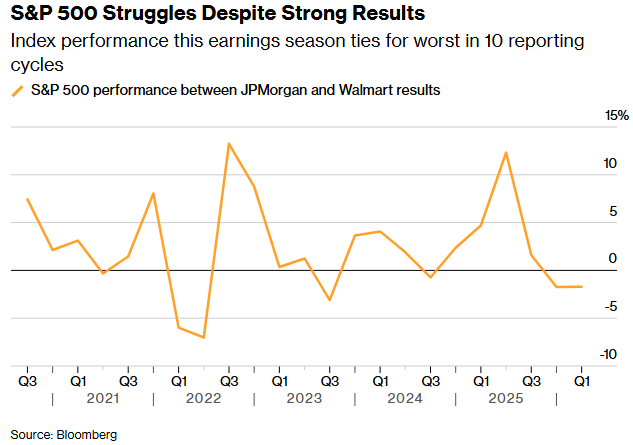
Group 1 - The core point of the article highlights that despite a strong earnings season for U.S. companies, the stock market performance has been disappointing, with the S&P 500 index declining by 1.7% during the earnings reporting period [1][4] - S&P 500 companies reported a 13% profit growth in Q4, exceeding expectations by nearly 6 percentage points, and showed optimism for the upcoming year [1] - The ratio of companies raising earnings guidance to those lowering it in the Russell 3000 index was 4:1, a level not seen since the end of a recession or after the 2018 tax reform [1] Group 2 - The market's position at the start of the earnings season, combined with uncertainties surrounding AI and geopolitical tensions, has contributed to the lackluster performance of the S&P 500 [4][5] - Concerns over AI's disruptive potential and issues in private credit markets have led to lower valuations for sectors like software and fintech, resulting in a sideways movement for the S&P 500 [5] - The uncertainty regarding tariffs, following the Supreme Court's overturning of Trump's global tariff plan, has also dampened investor sentiment [5] Group 3 - Despite the current market challenges, there remains confidence among traders that the fundamentals of U.S. companies will prevail in the long run [6] - Investors are expected to take time to understand the extent and pace of AI disruption, with a belief that the economic conditions are sound and there is room for future growth [6] - If companies meet the consensus growth expectations for 2026 and market sentiment remains stable, the S&P 500 could see an impressive performance, with potential gains of 10% to 15% this year [7]
李·罗奇:仍可从软件股中大赚一笔 许多软件股的市盈率已跌至2008年以来罕见水平
Ge Long Hui A P P· 2026-02-25 12:58
格隆汇2月25日|深度价值投资者李·罗奇(Lee Roach)指出,当市场预期一家公司会"立即死亡",而实际 上它只是"缓慢衰退"时,投资回报可能非常惊人。罗奇认为,尽管人工智能(AI)削弱了软件公司的"护 城河",但这并不意味着其终值为零。许多软件股的市盈率已跌至2008年危机以来罕见的水平。就像早 期的烟草公司、纸质名录或传统零售,这些业务虽然进入结构性衰退,但其庞大的企业客户群、长达数 年的更换周期以及持续产生的自由现金流,能让它们在未来数年内依然是"现金奶牛"。软件切换成本极 高,且大型软件公司拥有数据、客户关系、分发渠道和领域专业知识,这些是两名员工组成的AI初创 公司难以逾越的。 ...
恒指温和收涨 周期股领涨科技分化
2 1 Shi Ji Jing Ji Bao Dao· 2026-02-25 12:09
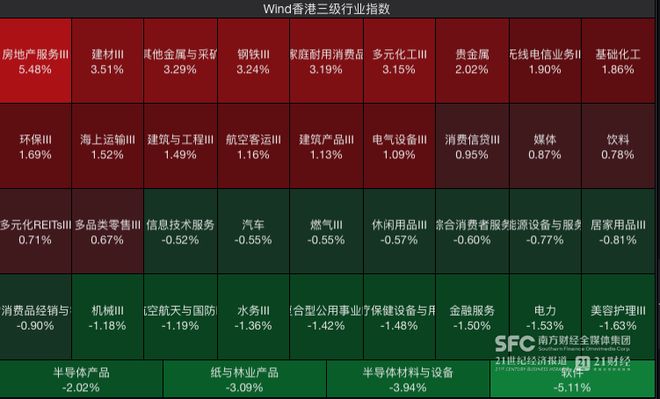
Market Overview - The Hong Kong stock market experienced a mixed performance with a structural characteristic of "strong cyclicals, weak technology" as policy support and rising commodity prices drove the market upward, while profit-taking affected the technology sector [1][2] - The Hang Seng Index rose by 0.66% to 26,765.72 points with a trading volume of 236.765 billion HKD, while the Hang Seng Tech Index slightly declined by 0.19% to 5,260.5 points with a trading volume of 51.908 billion HKD [1][2] Sector Performance - Cyclical sectors such as real estate services (+5.48%), building materials (+3.51%), and mining (+3.29%) led the gains, supported by favorable policies and rising commodity prices [2] - In contrast, technology sectors like software (-5.11%) and semiconductor materials and equipment (-3.94%) saw significant declines due to profit-taking from previously high-performing stocks [2] Individual Stocks - Notable gainers included Tianbao Energy (+69.49%) due to a projected profit increase of 84.5% year-on-year, and Semir Holdings (+60.53%) benefiting from active small-cap market sentiment [2] - Major decliners included Zhijing International Financial (-26.32%), Zhuoyue Holdings (-23.08%), and China National Pharmaceutical Group (-18.75%) [2] Trading Activity - The top three stocks by trading volume were Tencent Holdings (11.981 billion HKD), Alibaba-W (7.110 billion HKD), and HSBC Holdings (6.193 billion HKD) [2] Policy and Economic Developments - The Hong Kong budget proposed optimizing the listing system, including revising "same share, different rights" requirements and advancing T+1 settlement cycle consultations, aiming to enhance market efficiency [2] - New policies in Shanghai's real estate market, including shortening the social security period for non-local buyers and increasing public housing loan limits, stimulated the Hong Kong real estate sector [2] Future Outlook - Analysts suggest focusing on three sectors: precious metals and energy due to rising geopolitical risks, consumer sectors at relatively low valuations, and technology sectors expected to rebound as AI applications accelerate [3] - Concerns over potential VAT increases in service sectors may affect investor sentiment, but pre-meeting policy expectations could support the Hong Kong market [3] - The real estate sector showed overall gains during the Spring Festival, with a continued positive outlook for first-tier and select second-tier cities [3]





恒指温和收涨 周期股领涨科技分化丨港股复盘
2 1 Shi Ji Jing Ji Bao Dao· 2026-02-25 12:00
Core Viewpoint - The Hong Kong stock market experienced a mixed performance with a structural divergence, where cyclical sectors outperformed while technology stocks faced profit-taking pressures [1] Market Performance - The Hang Seng Index rose by 0.66% to 26,765.72 points with a trading volume of 236.765 billion HKD, while the Hang Seng Tech Index slightly declined by 0.19% to 5,260.5 points with a trading volume of 51.908 billion HKD [1] - Southbound capital recorded a net outflow of 3.569 billion HKD [1] Sector Performance - Cyclical sectors such as real estate services (+5.48%), building materials (+3.51%), and other metals and mining (+3.29%) led the gains, driven by favorable policies and rising commodity prices [1][2] - Technology sectors, including software (-5.11%) and semiconductor materials and equipment (-3.94%), showed significant declines due to profit-taking [1][2] Individual Stock Movements - Notable gainers included Tianbao Energy (+69.49%) due to a profit forecast increase of 84.5% year-on-year, and Semmy Holdings (+60.53%) benefiting from active small-cap market sentiment [2] - Major decliners included Zhijing International Finance (-26.32%), Chuangyue Holdings (-23.08%), and China National Pharmaceutical Group (-18.75%) [2] Major Transactions - The top three stocks by trading volume were Tencent Holdings (11.981 billion HKD), Alibaba-W (7.110 billion HKD), and HSBC Holdings (6.193 billion HKD) [3] - Conch Group plans to increase its stake in Conch Cement A-shares (7 to 14 billion HKD) and Conch Venture (10.61%), contributing to the rise in building materials stocks [3] Policy and Economic Factors - The Hong Kong budget proposed optimizing the listing system, including revising "same share different rights" requirements and advancing T+1 settlement cycle consultations [3] - New policies in Shanghai's real estate market aimed at stimulating demand, such as shortening social security requirements for non-local buyers and increasing public housing loan limits [3] Future Outlook - Analysts suggest focusing on three sectors: precious metals and energy due to rising geopolitical risks, consumer sectors at relatively low valuations, and technology sectors expected to rebound as AI applications accelerate [4]