汽车

Search documents
美股资产大幅缩水后的反思:本轮大崩盘的真凶不是 AI?
Sou Hu Cai Jing· 2026-02-07 12:53
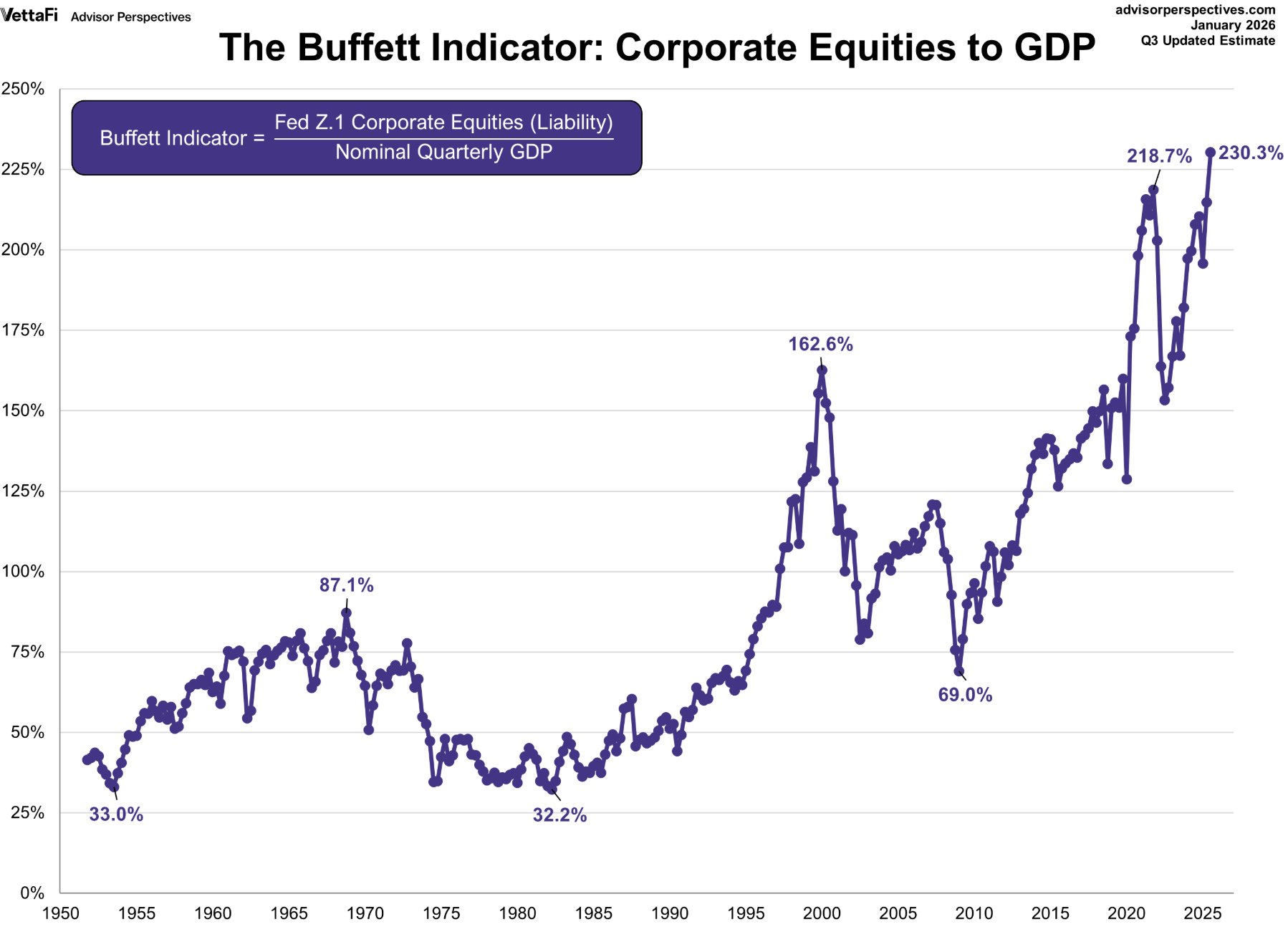
Market Overview - The recent market downturn has seen significant declines in various asset classes, including gold, silver, cryptocurrencies, and major stock indices like the US and Hong Kong markets, with some stocks like Figma and Xpeng dropping over 70% [1][2][3] Market Analysis - Analysts are attributing the market decline to several factors, including the perceived strength of Anthropic's legal AI, Google's higher-than-expected capital expenditure guidance, and the hawkish stance of incoming Federal Reserve Chair Warsh [2][4] - However, these explanations are deemed superficial, as the real drivers of the market volatility are liquidity tightening and high valuations [4][5] Valuation Metrics - The current market valuation, as indicated by the Buffett Indicator (total market capitalization to GDP ratio), stands at 230%, significantly above the 120% threshold that suggests severe overvaluation [5][6] - The S&P 500 Forward P/E ratio is at 22.0x, compared to a 30-year average of 17.1x, indicating a significant premium and suggesting that the market is in a "significantly overvalued" zone [7] Liquidity Concerns - Liquidity tightening is primarily driven by rising Japanese government bond yields, which are reducing global market liquidity due to the unwinding of yen carry trades [10][13] - The U.S. Treasury General Account (TGA) is also a critical factor, with a high balance of approximately $893.2 billion as of early February, and plans for significant debt issuance, further constraining market liquidity [14][15] Market Dynamics - The Chicago Mercantile Exchange (CME) has raised margin requirements for precious metals, which has historically led to forced deleveraging in the market, contributing to the recent volatility [17][19] - Key liquidity indicators to monitor include net liquidity, short-term funding prices (SOFR), interest rate volatility (MOVE), and credit spreads (HY OAS), as these factors will influence market stability and risk asset performance [20][21]

马斯克重磅发声:三年内部署AI成本最低的地方在太空,Optimus是“无限印钞机”
华尔街见闻· 2026-02-07 12:35
Core Insights - Elon Musk predicts that within 30 to 36 months, space will become the most cost-effective location for deploying AI due to Earth's electrical power constraints [6][30][17] - Musk envisions launching 100 gigawatts (GW) of AI computing power annually into space, aiming to exceed the total AI computing power on Earth within five years [9][50][55] - The xAI business model targets a trillion-dollar market by creating "digital humans" capable of performing various tasks, which Musk believes could generate significant revenue [11][18] - The Optimus robot is described as an "infinite money printer," with its production expected to scale significantly, enhancing the competitiveness of U.S. manufacturing [14][18] Group 1: Space AI Computing - Musk emphasizes that the efficiency of solar panels in space is five times greater than on Earth, eliminating the need for expensive battery storage systems [8][27] - He warns of an impending surplus of chips that cannot be powered due to stagnant electrical output outside of China [7][82] - The plan involves launching approximately 10,000 Starship missions annually to achieve the necessary power and computing capacity in orbit [9][52] Group 2: xAI and Digital Humans - Musk's xAI aims to emulate human tasks digitally, potentially unlocking trillions in revenue as it competes with existing tech giants [11][18] - He anticipates that by the end of the year, significant advancements in digital human simulation will be achieved [12] - The strategy relies on rapid hardware iteration and vertical integration capabilities from Tesla and SpaceX [12] Group 3: Optimus and Manufacturing - The Optimus robot is positioned as a critical factor for U.S. manufacturing competitiveness, with Musk highlighting the need for innovation to counter China's manufacturing dominance [14][15] - Musk proposes building a "TeraFab" chip factory to overcome current supply chain limitations and meet the growing demand for chips [15][69] Group 4: Energy and Supply Chain - Musk discusses the necessity of self-manufacturing energy equipment to support the ambitious AI and robotics plans [15][46] - He notes that the current supply chain for energy components is insufficient to meet the rapid expansion required for his projects [15][46] - The company aims to produce solar panels domestically, targeting an annual output of 100 GW [38][50]


【环球财经】德国工业产出连续第四年萎缩
Xin Hua She· 2026-02-07 11:13
Core Viewpoint - Germany's industrial output is projected to decline by 1.1% in 2025, marking the fourth consecutive year of decrease, primarily due to weak automotive production and other factors [1] Group 1: Industrial Output Trends - In 2025, the construction sector's output is expected to drop by 1.7%, while other industrial sectors, excluding construction and energy, will see a decline of 1.3% [1] - Key sectors such as the automotive industry and machinery manufacturing are experiencing significant output reductions, with declines of 1.7% and 2.6% respectively [1] - The industrial output has been shrinking for several years, with declines of 1.5% in 2023 and 4.5% in 2024 [1] Group 2: Economic Factors - High labor and energy costs, along with weak external demand, are constraining Germany's industrial output [1] - Despite some signs of improvement in the fourth quarter of 2025 due to domestic demand in defense and infrastructure, structural issues continue to hinder industrial development [1] - The overall economic landscape has not shown signs of a recovery that could lead to a comprehensive increase in industrial goods demand [1] Group 3: Long-term Industrial Performance - The industrial sector plays a crucial role in the German economy, and its ongoing weakness is widely regarded as a significant factor in the country's sluggish economic growth [1] - According to the Kiel Institute for the World Economy, Germany's industrial production has only seen growth in 2021 over the past seven years, with the 2025 output level still approximately 14% lower than in 2018, and the automotive sector's decline exceeding 20% [1]
长安汽车:系列点评三十五股份回购彰显发展底气,智驾与全球化驱动长期成长-20260207
Guolian Minsheng Securities· 2026-02-07 10:20
Investment Rating - The report maintains a "Recommended" rating for the company [2]. Core Insights - The company has announced a share repurchase plan, demonstrating confidence in its strategic development and intrinsic value. The repurchase will utilize self-owned funds, with a total planned amount between 1 billion and 2 billion yuan, aimed at enhancing shareholder value [7]. - The company has achieved significant technological advancements, including the first L3 level autonomous driving license and the launch of new models equipped with advanced technology, reinforcing its competitive edge in the smart electric vehicle market [7]. - The company's global expansion strategy is yielding results, with operations in 117 countries and plans to introduce new models in the European market over the next three years, supported by local production capabilities [7]. Financial Forecast Summary - Projected revenue for 2024 is 159.73 billion yuan, with a growth rate of 5.6%. By 2027, revenue is expected to reach 233.54 billion yuan, with a growth rate of 11.5% [2][8]. - The net profit attributable to shareholders is forecasted to be 7.32 billion yuan in 2024, declining to 6.31 billion yuan in 2025, before rebounding to 10.94 billion yuan by 2027, reflecting a growth rate of 34.1% [2][8]. - Earnings per share (EPS) is expected to be 0.74 yuan in 2024, decreasing to 0.64 yuan in 2025, and then increasing to 1.10 yuan by 2027 [2][8].

小米YU7 GT完成申报;汽车业生产疲软,德国工业产出连续第四年萎缩丨汽车交通日报
创业邦· 2026-02-07 10:09
Group 1 - Xiaomi YU7 GT has completed its declaration, with dimensions of 5015mm in length, 2007mm in width, and 1597mm in height, and a maximum speed of 300 km/h [2] - The German industrial output has declined for the fourth consecutive year, with a 1.1% decrease in 2025 compared to the previous year, largely due to weak automotive production [2] - The total transaction volume of used cars in China is projected to reach 20.11 million units in 2025, reflecting a year-on-year increase of 2.5% [2] Group 2 - In December 2025, the used car market transaction volume is expected to be 1.87 million units, with a month-on-month increase of 7% and a year-on-year decrease of 1.5% [2] - The transaction amount for used cars in December 2025 is estimated at 120.7 billion yuan, showing a year-on-year increase of 0.6% [2] - The penetration rate of new energy used cars in December 2025 is projected to be 12%, with a transaction volume of 169,000 units, reflecting a year-on-year growth of 36.5% [2]

“立场转变”!加拿大对华最新表态
中国能源报· 2026-02-07 09:46
加拿大工业部长梅拉妮·乔利称,加拿大政府正努力促成中加合资制造电动汽车,销往全球。 据新加坡《联合早报》网站2月7日报道,加拿大工业部长梅拉妮·乔利称,加拿大政府正努力促成中加合资制造电动汽车,销往全球。 报道称,乔利6日在接受彭博新闻社采访时说,麦格纳国际公司、利纳马尔公司和马丁里亚国际公司等加拿大汽车零部件企业已在中国 开展业务,可以参与在加拿大设立的合资装配厂。 她说:"我们相信这些优秀的加拿大公司可以与中国电动车公司合作,打造销往世界各地的中加合资汽车。" 报道称, 向中国车企示好的举动,标志着加拿大政府立场的转变 。加拿大正寻求降低对美国汽车市场的依赖,并打造更强大的本土汽 车产业。加拿大曾指责中国对本国制造商提供不公平补贴,同时也对中国汽车技术提出安全关切。 乔利说:"我们可在汽车软件方面找到解决方案,以应对安全关切。我们认为能够制定与我们在加拿大所能接受和期望一致的劳工标 准,并可以通过这些投资在加拿大建立本地供应链。" 乔利称,已就加拿大企业如何与中国对加国汽车行业的新投资形成互补展开"积极对话"。她在上月访华期间会见了中国车企比亚迪和 奇瑞汽车代表。 乔利认为,尽管在加拿大生产的人工成本高于 ...


闪评 | 德国出口回暖难掩工业疲弱 欧洲对美出口正在走弱
Sou Hu Cai Jing· 2026-02-07 09:39
德国联邦统计局6日公布的数据显示,2025年德国出口在连续两年下滑后首次恢复正增长,但工业产出仍持续收缩。德国出口回暖,经济能否走出低 迷? 此外,2025年德国对美出口下降9.3%,同时法国对美出口下滑明显加剧。欧洲主要经济体正面临怎样的对美出口压力? 出口止跌回升 德国经济整体压力仍在 北京外国语大学德语学院副教授寇蔻在接受总台环球资讯《闪评》栏目采访时指出,德国出口回暖释放出一定积极信号,但尚不足以扭转德国经济整体 承压的局面。 △路透社报道截图 中国再成为第一大贸易伙伴 中德经贸韧性凸显 2025年德国出口实现约0.9%的小幅增长。在全球经贸环境低迷、德国经济表现疲弱的背景下,确实"超出此前市场预期"。 出口回暖主要得益于德国对主要欧盟成员国出口的改善。法国、荷兰、波兰等传统市场均实现正增长,凸显欧洲统一市场对德国外贸的重要支撑作用。 2026 年德国出口仍面临美国关税政策不确定、本国经济低迷及企业成本压力等多重挑战。 △彭博社报道截图 工业连续下滑 制造业拖累经济增长 与出口回暖形成鲜明对比的是,2025年德国工业产出较前一年下降1.1%,已连续第四年下滑。寇蔻指出,作为制造业强国,工业萎缩对德国经 ...
全球第四大车企,半年巨亏超1500亿元
财联社· 2026-02-07 09:30
Core Viewpoint - Stellantis, the world's fourth-largest automaker, has paused its electric vehicle (EV) business expansion due to multiple pressures including changing global EV market demand, rising cost pressures, and increased competition, leading to a significant stock price drop of over 20% [2][4]. Group 1: Financial Adjustments - Stellantis announced a comprehensive restructuring of its business, resulting in a total asset write-down of €22.2 billion [2][4]. - The majority of the write-down, amounting to €14.7 billion, is allocated for adjusting product plans to align with customer preferences and new U.S. emission regulations, reflecting a substantial reduction in expectations for pure electric vehicle products [4][6]. - Additional write-downs include €2.1 billion related to adjustments in the EV supply chain and €5.4 billion in other costs, with €4.1 billion linked to increased warranty reserves due to quality issues and €1.3 billion related to restructuring costs in Europe [4]. Group 2: Business Strategy Changes - Stellantis is systematically reducing its electric vehicle business footprint, including exiting its joint venture with LG Energy Solution in Canada, where LG will acquire Stellantis's 49% stake in NextStar Energy [7][9]. - The company has also discontinued several pure electric vehicle models, including halting production of the RAM 1500 electric pickup in the U.S. and delaying the Alfa Romeo electric vehicle project in Europe [10]. Group 3: Market Context and Competitor Actions - Stellantis is not alone in scaling back its EV business; Ford also announced a reduction in its electric vehicle plans, which is expected to result in a $19.5 billion loss, including the cessation of the F150 Lightning electric pickup production [11]. - Stellantis anticipates a loss of approximately €19 billion to €21 billion in the second half of 2025, prompting the suspension of its 2026 dividend and plans to raise up to €5 billion through hybrid bond issuance to maintain its balance sheet [12]. Group 4: Sales Performance and Projections - In 2024, Stellantis sold 2.4215 million vehicles in Europe, marking a decline of 5.99% compared to the previous year, and expects a 3% decrease in U.S. sales for 2025, projecting sales of 1.2603 million vehicles [14]. - The company aims for a low single-digit percentage growth (5%-7%) in net income and a low single-digit growth (1%-4%) in adjusted operating profit margin for 2026 [13].


理性看待1月份汽车产销数据波动 | 忠阳车评
Xin Lang Cai Jing· 2026-02-07 09:27
(来源:经济日报) 转自:经济日报 随着各大车企陆续发布1月份产销数据,车市开年遇冷已成事实。"这是我从业以来市场表现最差的一个月""知道会遇冷,但没想到是冰冷""中国车市是 否会就此掉头向下"等论调甚嚣尘上,为全年车市走向增加了不确定性。 车市开年遇冷,并非单一因素所致,而是政策换挡、需求透支与消费者观望情绪等多重因素叠加的结果。其中,政策调整是主因。自2026年起,延续10 多年的新能源汽车车辆购置税从全额免征调整为减半征收,单车最高减税额上限从3万元降至1.5万元。一辆开票价10万元的新能源车,2026年需交5000 元购置税;20万元车型,购车成本则增加1万元。目前,车市消费主要集中在10万至20万元价格区间的车型上,消费者对成本变化敏感。显然,这直接 影响了消费者的购车决策。 看月度产销数据,既要看当前,也要看趋势。1月份本来就是传统淡季,考虑到2月份还有9天春节假期,短期内市场销量或仍将处于"寒冬"中,但这并 不意味着中国汽车市场就此掉头向下。目前,我国千人汽车保有量仅260辆,不足欧美发达国家一半。即使考虑到资源、环境及空间承载能力制约,未 来我国汽车普及率仍有一定提升潜力。按照中汽协预计,20 ...

揭秘追觅“宇宙”:狂人俞浩和他的百万亿美金梦|商业头条No.111
Xin Lang Cai Jing· 2026-02-07 09:26
Core Insights - The article highlights the ambitious goals and rapid expansion of Chasing Technology, led by its founder and CEO, Yu Hao, who aims to elevate the company to a valuation of one hundred trillion USD, equating to approximately 23 times Nvidia's market cap [3][4] - Chasing Technology has experienced over six years of revenue growth exceeding 100%, with projections indicating revenues surpassing 40 billion CNY by 2025 [3][5] - The company has diversified its business from cleaning appliances to automotive and other sectors, with a focus on high-end products and innovative technology [5][11] Revenue and Growth - Chasing Technology's revenue for the first half of 2025 is expected to exceed 15 billion CNY, significantly higher than the total revenue of 30 billion CNY in 2024 [3][5] - The company has achieved the highest profit margin in its industry, with a strong cash flow position [3][5] Business Model and Strategy - Chasing Technology operates with a decentralized structure where each Business Unit (BU) functions as an independent entity, allowing for rapid decision-making and resource allocation [9][15] - The company employs a strategy of benchmarking successful products and enhancing them with unique features, which has proven effective in driving sales [10][11] - The focus on high-end markets and the reuse of technology across different product lines distinguishes Chasing Technology from traditional brands [11][24] Employee Engagement and Culture - The company promotes a flat organizational structure that empowers employees, leading to shorter product development cycles compared to traditional manufacturing firms [15][16] - Chasing Technology implements an employee stock ownership plan and offers generous incentives to boost motivation and performance [15][16] Funding and Investment - Chasing Technology has transitioned from being part of the Xiaomi ecosystem to securing significant funding independently, including a record 3.6 billion CNY in Series C financing [19][24] - The establishment of the Sky Factory Venture Fund aims to support new projects within the company and has become a leading venture capital entity in China [23][24] Future Outlook - Yu Hao has announced plans for multiple IPOs of Chasing Technology's subsidiaries starting in late 2026, aiming to replicate the success of its ecosystem [23][24] - The company faces scrutiny regarding its rapid expansion and organizational challenges, drawing comparisons to past tech failures, but maintains a strong belief in its business model and growth potential [24][25]