
债券市场

Search documents
信用利差周报2025年第34期:体育产业发债再获政策支持,基金费率调整对债市有何影响?-20250911
Zhong Cheng Xin Guo Ji· 2025-09-11 11:04
1. Report Industry Investment Rating No relevant content provided. 2. Core Views - The State Council's new policy on sports industry will increase the supply of sports industry credit bonds and promote innovation in asset - securitized products, but also poses higher requirements for credit risk assessment and prevention [4][11]. - The adjustment of the bond market under the stock - bond rotation shows new characteristics, and the new regulations on fund sales fees have attracted market attention. The new regulations may suppress short - term bond fund investment demand and guide long - term investment [5][15]. - In August, China's import and export growth rates were lower than market expectations, with different performances among trading partners [6][17]. - The central bank's open - market operations led to a net capital withdrawal last week, and the money market was generally stable with most money prices falling [7][20]. - The issuance scale of the primary credit bond market decreased, and the issuance cost fluctuated. The secondary market trading activity cooled, and bond yields showed differentiation [8][36]. 3. Summary by Directory Market Hotspots - **Policy Support for Sports Industry Bond Market**: The State Council's "Opinions" support sports enterprises in financing through the bond market, which may increase the supply of sports industry credit bonds and promote innovation in asset - securitized products. However, it also requires higher credit risk assessment and prevention [4][11]. - **Stock - Bond Rotation and New Fund Sales Regulations**: The A - share market adjusted last week, weakening the "stock - bond seesaw" effect. The bond market adjustment showed new characteristics. The new regulations on fund sales fees may suppress short - term bond fund investment demand and guide long - term investment [5][15]. Macroeconomic Data - In the first eight months of 2025, China's total import and export value was $5412.9 billion, with a year - on - year increase of 3.1%. In August, exports were $3218.1 billion (up 4.4% year - on - year), imports were $2194.8 billion (up 1.3% year - on - year), and the trade surplus was $1023 billion. The growth rates of imports and exports were lower than market expectations. Exports to ASEAN and the EU were stable, while exports to the US continued to decline significantly [17]. Money Market - The central bank net withdrew $421.8 billion through open - market operations last week. On September 5, it conducted a $1 - trillion 3 - month outright reverse repurchase operation. The money market was generally stable, and most money prices fell, with changes ranging from 1 - 10bp [7][20]. Primary Credit Bond Market - The issuance scale of credit bonds decreased to $133.451 billion last week. The issuance scale of each bond type generally decreased, especially for ultra - short - term financing bills and medium - term notes. The net financing of infrastructure investment and financing, power production and supply, and transportation industries had large outflows. The average issuance cost of credit bonds fluctuated, with changes not exceeding 15bp [8][23]. Secondary Credit Bond Market - The trading volume of the secondary bond market was $7247.247 billion last week, and the trading activity cooled for two consecutive weeks. Bond yields showed differentiation. The 10 - year Treasury yield fell 1bp to 1.83%. Short - term credit bond yields mostly declined, while long - term yields rose slightly. Short - term credit spreads narrowed, and long - term credit spreads widened. Rating spreads changed little [36][37].
《中国金融》|加快服务科创的多层次债券市场建设
Sou Hu Cai Jing· 2025-09-10 10:31
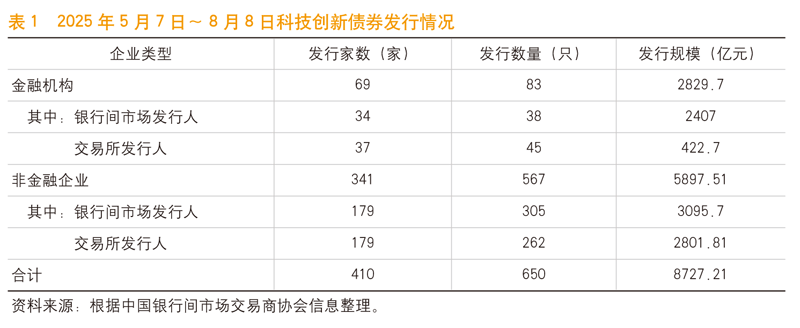
Core Viewpoint - Technological innovation is the primary driving force for high-quality development, and technology finance has become a strategic priority in building a strong financial nation. The establishment of a "Technology Board" in the bond market aims to enhance financial resources for technological innovation and enrich the multi-tiered bond market [1][6]. Group 1: Bond Market and Technology Finance Adaptability - As of July 2025, China's bond market has a stock scale close to 190 trillion yuan, serving as a major venue for direct financing for enterprises, particularly in meeting the financing needs of technological innovation [2]. - The bond market needs innovative institutional arrangements to better adapt to the financing characteristics of technology innovation, which often involves longer cycles and greater uncertainty [2][3]. Group 2: Analysis from Bond Financing Perspective - There is a mismatch between the financing characteristics of technology enterprises and the traditional bond market's supply model, particularly regarding the duration and pricing mechanisms [3]. - The bond market's standardized information disclosure requirements may conflict with technology enterprises' need to keep core technologies confidential, potentially hindering financing efficiency [3]. Group 3: Lifecycle of Technology Enterprises - Different stages of technology enterprises (startup, growth, maturity) have varying financing needs and characteristics, necessitating tailored support from the bond market [4][5]. - Startups often struggle to secure direct financing through bonds due to high uncertainty and revenue characteristics that do not align with market constraints [4]. - Growth-stage enterprises face challenges from competition and management, while mature enterprises have stable cash flows and can issue bonds more readily [5]. Group 4: Innovation in Financing Mechanisms - The "Technology Board" encompasses a complete system for technology innovation bonds, including diverse issuing entities, simplified disclosure requirements, and flexible mechanisms [7]. - The introduction of various financing entities, including private equity and venture capital firms, aims to enhance investment in early-stage and growth-stage technology enterprises [7][8]. Group 5: Market Response and Development - From May 7 to August 8, 2025, 410 institutions issued technology innovation bonds totaling 872.72 billion yuan, indicating strong market engagement [10]. - The issuance of technology innovation bonds has seen significant participation from both financial and non-financial enterprises, with a notable focus on mid-to-long-term bonds [10][13]. Group 6: Risk Mitigation and Credit Enhancement - The establishment of risk-sharing tools aims to provide low-cost funding and enhance credit for technology innovation bonds, facilitating broader participation from private equity firms [15][16]. - Local governments are encouraged to collaborate with risk-sharing tools to mitigate credit risks associated with bond issuance [17]. Group 7: Future Directions for Bond Market Development - Continuous efforts are needed to enhance the bond market's service to technology innovation, including deeper investment research and improved understanding of market rules by technology enterprises [18]. - The development of a multi-tiered bond market requires ongoing policy support and market interaction to address financing challenges faced by technology enterprises [19].

债市情绪偏谨慎
Tianfeng Securities· 2025-09-07 12:13
1. Report Industry Investment Rating The provided content does not mention the industry investment rating. 2. Core Viewpoints of the Report - The trading sentiment in the bond market this week was cautious. The trading volume of funds in the first half - week was small, and the duration of interest - rate bond funds decreased significantly. The purchasing power of the allocation portfolio remained weak, and the bullish power in the bond market was limited [9]. - The bond market vitality index continued to rise slightly. The index was compiled based on the historical quantile levels of bond market leverage ratio, turnover rate, bond fund duration, and the implied tax rate of China Development Bank bonds since 2022 and their correlation coefficients with the bond market trend [10]. - Most interest - rate bond funds have recorded negative returns in the past three months. Since August, the scale of equity funds has slightly declined, while the scale of bond funds has slightly increased. The issuance of newly established bond funds this week was still at a low level [89]. 3. Summary by Relevant Catalogs 3.1 Overall Sentiment - The bond market vitality index continued to rise slightly. As of September 5, the bond market vitality index increased by 2 pcts to 45% compared with August 29, and the 5D - MA increased by 5 pcts to 41% [10]. - Indicators of rising bond market vitality included the trading volume of the active 10Y China Development Bank bond / the balance of 9 - 10Y China Development Bank bonds (the rolling two - year quantile increased from 41% to 63%) and the turnover rate of 30Y treasury bonds (the rolling two - year quantile increased from 24% to 47%) [12]. - Indicators of falling bond market vitality included the median duration of medium - and long - term pure bond funds (the rolling two - year quantile decreased from 99.5% to 92.7%), the implied tax rate of 10 - year China Development Bank bonds (reverse) (the rolling two - year quantile decreased from 81% to 66%), and the excess level of the inter - bank bond market leverage ratio compared with the average of the past four years (the rolling two - year quantile decreased from 11% to 9%) [13]. 3.2 Institutional Behavior 3.2.1 Buying and Selling Strength and Bond Selection - In the current bond market, the order of net buying strength was funds > other product types > large banks > insurance > others > wealth management > rural financial institutions > foreign - funded banks > money market funds, and the order of net selling strength was joint - stock banks > city commercial banks > securities firms. For ultra - long bonds (bonds with a maturity of over 15 years), the order of net buying strength was insurance > funds > other product types > others > foreign - funded banks, and the order of net selling strength was large banks > joint - stock banks > rural commercial banks > securities firms > city commercial banks > wealth management [20]. - Different institutions had different bond preferences. Large banks mainly focused on 3 - 5Y interest - rate bonds; rural commercial banks, insurance companies, and wealth management products had no obvious main bond types; funds mainly focused on 1 - 3Y and 3 - 5Y interest - rate bonds; other product types mainly focused on 3 - 5Y interest - rate bonds [20][25]. 3.2.2 Trading Portfolio - As of September 5, the mean and median durations of the full - sample medium - and long - term pure bond funds decreased by 0.23 years and 0.31 years respectively compared with August 29, reaching 4.40 years and 4.21 years, and were at the 92.7% rolling two - year quantile [38]. - The median durations of pure interest - rate bond funds, interest - rate bond funds, and credit bond funds decreased by 0.64 years, 0.62 years, and 0.13 years respectively, reaching 5.10 years, 4.84 years, and 3.93 years, and were at the 90.0%, 90.0%, and 94.4% rolling two - year quantiles respectively [38][40]. - The median durations of high - performing interest - rate bond funds and credit bond funds decreased by 0.57 years and 0.09 years respectively, reaching 6.40 years and 4.54 years [40]. 3.2.3 Allocation Portfolio - The primary subscription demand for treasury bonds and policy - financial bonds was differentiated this week, with the demand for ultra - long bonds rising. The weighted average full - market multiples of treasury bonds decreased from 2.69 times to 2.66 times, while those of policy - financial bonds increased from 3.02 times to 3.54 times. For bonds with a maturity of 10Y and above, the weighted average full - market multiples of treasury bonds increased from 2.69 times to 3.02 times, and those of policy - financial bonds increased from 2.77 times to 3.74 times [54]. - Large banks' net buying of 1 - 3Y treasury bonds decreased in August. As of September 5, the cumulative net buying of 1 - 3Y treasury bonds this year was 6206 billion yuan [61]. - Rural commercial banks' cumulative net buying of bonds this year was significantly weaker than in previous years, mainly due to the weak net buying of short - term bonds within 1Y. However, the net buying of 7 - 10Y and over 10Y bonds was significantly higher than in previous years [71]. - Insurance companies' net buying of bonds was significantly higher than in previous years, mainly due to the strong buying of ultra - long bonds over 10Y. As of September 5, the ratio of cumulative net bond buying to cumulative premium income reached 45.95%, exceeding 42.62% at the end of September last year [78]. - Wealth management products' net buying of bonds in the secondary market had a slightly lower duration this week but remained at the highest level since February 23, 2024. As of September 5, the weighted average duration of cumulative net bond buying was 1.75 years, a decrease of 0.02 years compared with August 29 [86]. 3.3 Asset Management Product Tracking - Since August, the scale of equity funds has slightly declined, while the scale of bond funds has slightly increased. In September, the scale of bond funds and equity funds increased by 155 billion yuan and decreased by 305 billion yuan respectively compared with the previous month [89]. - The issuance of newly established bond funds this week was still at a low level, with a scale of only 32 billion yuan, down from 48 billion yuan in the previous week [89]. - This week, the net value increases of various types of bond funds have generally expanded, with credit bond funds performing better. The median annualized returns of pure interest - rate bond funds, interest - rate bond funds, and credit bond funds in the past week were 4.0%, 3.6%, and 3.8% respectively. Most pure interest - rate bond funds and interest - rate bond funds have recorded negative returns in the past three months [89].
特朗普关税战走向美国高院,接下来会发生什么?关键时点是哪些?
Hua Er Jie Jian Wen· 2025-09-07 07:01
Core Viewpoint - A legal storm regarding the trade powers of the U.S. President is escalating, with a recent appellate court ruling declaring most of President Trump's global tariff policies illegal, creating uncertainty in U.S. trade strategy [1] Legal Timeline - The legal battle's direction will become clearer in the coming weeks, with a critical date of October 14, when the appellate court's stay expires. If the Supreme Court does not intervene by then, the ruling will take effect, leading to the automatic expiration of tariffs under the International Emergency Economic Powers Act (IEEPA) [1][2] Alternative Tariff Strategies - Even if the IEEPA's use is limited, the Trump administration may still utilize other legal authorizations to maintain tariff pressure, potentially compensating for an expected revenue loss of approximately $150 billion through selective tariff increases [3] Potential Winners - If the Supreme Court restricts presidential tariff powers, large retailers like Amazon and Walmart could benefit from reduced import costs and more competitive pricing. Additionally, exporters from Vietnam, ASEAN countries, Brazil, and India may experience a reduction in trade barriers, creating a positive backdrop for U.S. and global stock markets [4] Potential Losers - The U.S. bond market may face challenges due to decreased tariff revenue exacerbating the already strained fiscal deficit. Furthermore, tariffs on strategic sectors such as semiconductors, electric vehicles, pharmaceuticals, and steel may persist, leading to supply chain volatility. The global shipping and logistics industry could also encounter new compliance challenges and unpredictable costs due to fragmented trade policies [6]
巴西将发行30年期美元债券
Shang Wu Bu Wang Zhan· 2025-09-06 17:51
(原标题:巴西将发行30年期美元债券) CNN巴西网站9月2日报道,巴西财政部将在国际市场进行美元债券发行和回购业务,包括2056年1 月12日到期的30年期美元债券首次发行,以及2030年到期的5年期美元债券二次增发。巴西财政部表 示,开展有关债券业务的原因是提供流动性、为企业提供融资参考以及提前进行到期债务再融资。 ...
上海清算所海洋经济优选债券指数发布
Xin Hua Cai Jing· 2025-09-04 05:48
Group 1 - The Shanghai Clearing House announced the launch of the Shanghai Clearing House Marine Economy Preferred Bond Index, set to be officially released on September 3, 2025 [1] - The index will track bonds issued by entities involved in marine industries such as marine fisheries, oil and gas, electricity, transportation, engineering, and ports, serving as a benchmark for marine economy-themed bond investments [1] - As of September 1, 2025, the index includes 327 sample bonds with a total market value of 497.7 billion, an average yield of 1.92%, and an average modified duration of 3.11 [1]
外汇商品丨8月美股转为净流出——全球资金流动监测仪2025年第八期
Sou Hu Cai Jing· 2025-09-03 08:28
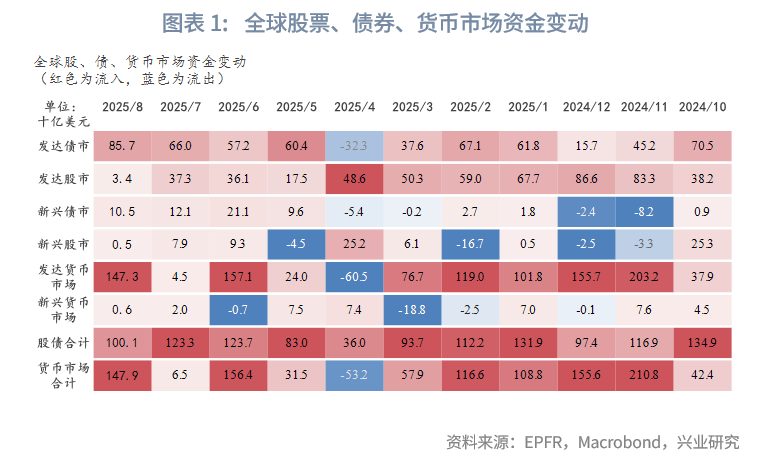
Group 1 - In August 2025, there was a notable net outflow of RMB-denominated assets for the first time since May, indicating a shift in investment trends [1] - Developed currency markets and bond markets saw a month-on-month increase in inflows, particularly in developed currency markets, while emerging stock, bond, and currency markets experienced a decline in inflows [2][4] - In the developed stock markets, US, UK, and Japanese stocks shifted to net outflows, while other European markets saw a decrease in inflow [5] Group 2 - In the developed bond market, US Treasury inflows doubled, while inflows in European bonds decreased month-on-month [3][5] - In emerging bond markets, inflows in China's domestic bond market decreased, but other emerging economies maintained net inflows [3][5] - Sector-wise, the number of inflow sectors in the stock market increased, but the previously significant inflows in technology, finance, and industrial sectors saw a decline in August [3] Group 3 - In August 2025, the inflow of Chinese mainland stocks was 3.14 billion, while Hong Kong stocks saw an inflow of 4.89 billion, indicating a recovery in these markets [8][12] - Conversely, Taiwan experienced a reduction in inflows, and most other emerging markets transitioned to net outflows [5][8] - The inflow of US stocks was negative at -2.3 billion, marking a significant shift from previous months [7]
离岸人民币债券市场面临新发展机遇
工银国际· 2025-09-03 07:49
1. Report Industry Investment Rating - The report does not mention the industry investment rating. 2. Core View of the Report - Since the beginning of 2025, the offshore RMB bond market has continued to thrive in both supply and demand, and the annual issuance is expected to hit a new high. Driven by multiple factors and policy support, the offshore RMB bond market is facing new development opportunities [1]. 3. Summary According to Relevant Catalogs 3.1 Offshore RMB Bond Issuance - As of September 2, 2025, the issuance of offshore RMB bonds has reached a record high for the same period, exceeding RMB 550 billion, and the annual issuance is expected to exceed that of 2024 [2]. 3.2 Drivers of the Thriving Issuance - **Interest rate differential**: The inversion of Sino - US risk - free interest rates makes the RMB financing cost significantly lower than that of the US dollar. Since 2023, the US Treasury yield has been significantly higher than that of China, and although the spread has narrowed, it is still about 200 basis points, making RMB bond financing cheaper, especially for high - rating issuers [4]. - **Yield advantage**: The yield of offshore RMB bonds is higher than that of domestic bonds of the same issuer. Since 2023, the offshore yield of 3 - year Treasury bonds has been on average more than 30 basis points higher than the on - shore yield. After mid - May 2025, the spread narrowed to about 10 basis points. The credit spread of offshore RMB bonds is also generally higher, attracting domestic funds. The expansion of the Bond Connect's "Southbound Link" to non - banking institutions in July 2025 is conducive to attracting more domestic funds [6]. 3.3 Concentration of Issuing Entities - Chinese issuers dominate the offshore RMB bond issuance, accounting for about 60%. In the context of Sino - US interest rate differentials, many Chinese issuers choose to issue offshore RMB bonds for refinancing after the maturity of US dollar bonds [7]. - The issuance of urban investment bonds has increased significantly in the past two years, accounting for more than 30% in 2023 and 2024. The reasons include the rise in US dollar financing costs, the tightening of domestic urban investment bond issuance, and the increased market confidence in urban investment bonds [9][11]. 3.4 Favorable Factors for Market Development - **Financing cost advantage**: It is expected that the situation where the financing cost of offshore RMB bonds is lower than that of US dollar bonds will continue. Although the Fed may cut interest rates, the decline in US long - term bond yields may be limited, while the yield of RMB Treasury bonds still has room to decline [14]. - **Policy support**: The "Southbound Link" was expanded to non - banking institutions in July 2025, and the total quota is expected to be increased, which will increase the demand for offshore bonds and improve market activity [15]. - **Increased demand for non - US assets**: The implementation of the US "Big and Beautiful" Act has increased concerns about the unsustainability of US finances, and the market's demand for RMB assets is expected to rise [15]. - **Infrastructure improvement**: The Ministry of Finance has issued offshore Treasury bonds in Hong Kong for many years, optimizing the yield curve. The Hong Kong Stock Exchange is researching the launch of Chinese Treasury bond futures. The first tokenized offshore RMB public offering bond has been launched, enhancing issuance efficiency and bond liquidity [16].
全球债市“冰火两重天” :一边热烈认购,一边疯狂抛售
Jin Shi Shu Ju· 2025-09-03 06:36
Group 1 - The global bond market is experiencing significant fragility and volatility, with many governments forced to finance heavily in a high-debt and high-interest environment, leading to a paradox of strong short-term demand for high-yield products while long-term risks loom [1] - On Tuesday, European bond markets saw a record single-day issuance, with 28 issuers planning to raise at least €49.6 billion (approximately $57.7 billion), potentially surpassing the previous record of €47.6 billion set earlier this year [2] - The UK successfully raised £14 billion through a record 10-year government bond issuance, attracting over £140 billion in orders, with international buyers accounting for 40% of the allocation [2] Group 2 - Despite rising borrowing costs, banks and corporations are actively entering the market, driven by a surge in investment funds flowing into bond funds during the summer [3] - Saudi Arabia attracted approximately $15 billion in orders for its planned issuance of five-year and ten-year Islamic bonds to cover fiscal deficits and support its "Vision 2030" diversification plan [3] - The global bond market is under pressure from ongoing inflation concerns, fiscal discipline issues, and heavy government bond issuance, leading to rising yields and declining bond prices [4] Group 3 - Long-term bond yields have surged to high levels, with Japan's 20-year government bond yield reaching its highest level since 1999, and the UK’s 30-year bond yield climbing to its highest since 1998 [4] - The recent sell-off reflects traders' concerns over high government spending and its potential inflationary impact, with significant corporate bond issuance and ongoing doubts about the independence of the Federal Reserve adding to market pressure [4] - The Bloomberg Global Bond Index fell by 0.4% on Tuesday, marking the largest single-day decline since June 6, indicating ongoing caution in holding long-term debt [5]
长端利率再度上行,但这次为何欧弱美强?
Guotai Junan Securities· 2025-09-03 06:25
Group 1: Market Trends - The global bond market has experienced a rare synchronized sell-off, with the 30-year U.S. Treasury yield surpassing 5%, marking a new high in over a decade[4] - European long-term bonds, including those from France, Italy, and Germany, have also faced significant selling pressure, with some yields rising more than U.S. Treasuries during certain periods[4] - The rise in long-term rates reflects a return of global term premiums and a shift in market logic, where both U.S. and European long-term rates are increasing, but the euro is weakening, providing a respite for the dollar[3] Group 2: Economic Factors - The increase in European bond yields is more about pricing "risk" rather than "growth," driven by concerns over fiscal discipline, deficit expansion, and energy transition costs[6] - The market's reassessment of European asset credit quality and liquidity has led to a capital flight from the eurozone back to dollar assets[6] - The Federal Reserve's potential interest rate cuts in September could create a dynamic balance between bond market turbulence and policy responses, with the risk of reigniting inflation expectations if cuts are too aggressive[9] Group 3: Investment Implications - The traditional logic of "long-duration government bonds as a safe haven" is being challenged, necessitating a restructuring of asset allocation strategies[10] - In a high-rate environment, high-quality short-duration credit assets and highly liquid instruments may become more attractive, while long-duration investments require more precise risk management[10] - The transition from a "central bank-led pricing system" to a "market-led risk pricing" indicates a deeper change in trust mechanisms within the market, where each rate fluctuation reflects a reassessment of sovereign credit and fiscal discipline[10]