科技

Search documents
智能未来股价创60日新低,流动性枯竭与市场避险情绪成主因
Jing Ji Guan Cha Wang· 2026-02-13 00:11
Core Viewpoint - The stock price of Intelligent Future fell to $1.68 on February 12, marking a 60-day low, primarily due to severe liquidity issues, heightened market risk aversion, and fundamental factors [1]. Stock Performance - The stock opened at $1.79 and closed at $1.68, resulting in a single-day decline of 6.15%, with an intraday low of $1.68 being a new 60-day low [2]. - The trading volume was extremely low, with only $1,700 in transactions and a turnover rate of 0%, indicating a severe lack of buying interest [2]. - Year-to-date, the stock has dropped by 37.31%, and over the past 20 days, it has declined by 38.46%, significantly underperforming the Nasdaq index, which rose by 0.25% during the same period [2]. Reasons for Stock Price Movement - The stock's low liquidity has amplified price volatility, with a total market capitalization of approximately $195 million and daily trading volumes often below $10,000, making the stock susceptible to significant price swings from minimal sell orders [3]. - On February 12, the Nasdaq index fell by 2.03%, reflecting a broader trend of risk aversion in technology stocks, as concerns over excessive investment in AI computing power intensified, leading to capital outflows from high-volatility small-cap tech stocks towards defensive assets [3]. - Despite a low price-to-earnings ratio of 0.15, the company has failed to attract investor interest due to a lack of recent catalysts and increasing competition, raising doubts about its growth sustainability [3]. Industry Context - The last trading day before the Spring Festival saw heightened risk aversion across the market, with over 3,200 stocks in the A-share market declining and leveraged funds continuing to exit [4]. - As a small-cap stock with poor liquidity, Intelligent Future is particularly vulnerable to sell-offs during periods of capital contraction [4].

外资巨头,减持美股科技股
Shang Hai Zheng Quan Bao· 2026-02-12 22:56
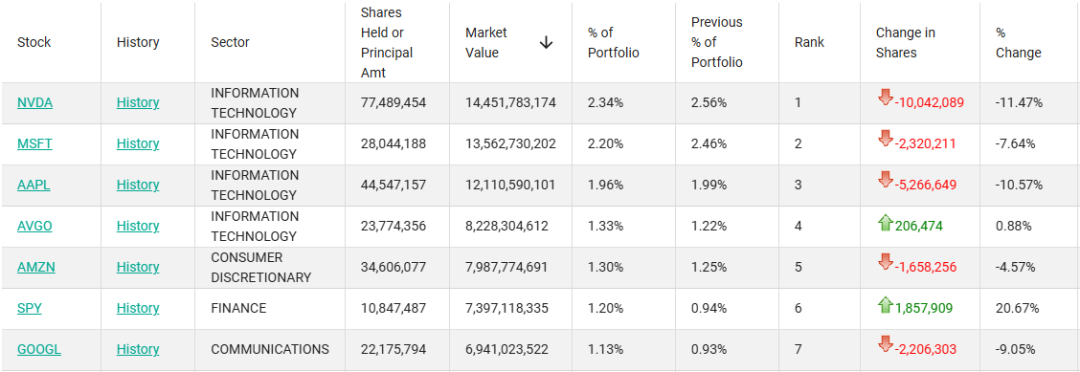
Core Viewpoint - UBS and Goldman Sachs have significantly reduced their holdings in major US tech stocks like Nvidia and Microsoft in Q4 2025, raising market concerns about the tech sector's future performance [1][3]. Group 1: Holdings Reduction - UBS reduced its holdings in Nvidia by 10,042,089 shares, a decrease of 11.47%, and also cut its positions in Microsoft by 2,320,211 shares (7.64%), Apple by 5,266,649 shares (10.57%), Amazon by 1,658,256 shares (4.57%), and Google by 2,206,303 shares (9.05%) [3][4]. - Goldman Sachs also reported reductions, cutting 319,700 shares of Microsoft (5.86%), 247,000 shares of Tesla (8.27%), 343,300 shares of Broadcom (9.33%), and 241,400 shares of META (13.51%) [5]. Group 2: Capital Expenditure Plans - Major tech companies, excluding Nvidia, have announced plans to significantly increase capital expenditures, with Meta projecting up to $135 billion for 2026 (an increase of 87%), Google planning $185 billion, and Amazon announcing a $200 billion capital expenditure plan for 2026 [7]. - Following these announcements, stock prices for Amazon, Google, META, and Microsoft have seen declines of 14.72%, 8%, 6.67%, and 6%, respectively, since February [7]. Group 3: Market Sentiment and AI Investment - There is growing skepticism in the market regarding the return on investment (ROI) from the substantial capital expenditures in AI, which had previously been tolerated by investors [6][8]. - Despite short-term concerns about ROI, some analysts believe that the current investments represent a strategic positioning for future productivity, affirming the long-term trend of AI development [8][9]. Group 4: AI Development Trends - The AI sector is transitioning from a phase of technological exploration to one of large-scale application and infrastructure development, with a focus on increasing computational power and practical AI applications [9]. - The demand for computational resources in the tech industry continues to exceed market expectations, indicating a rapid expansion phase for AI infrastructure [9][10].







激发产业升级活力
Xin Lang Cai Jing· 2026-02-12 22:40
Core Insights - The Jiangning Binjiang Economic Development Zone Chamber of Commerce held its fourth first member representative meeting, electing a new leadership team and outlining key work priorities to enhance enterprise collaboration and industrial upgrading [1] Group 1: Leadership and Structure - The new leadership team includes members from various sectors such as manufacturing, technology, food, and environmental protection, reflecting the chamber's broad representation and organizational cohesion [1] - The newly elected president emphasized the chamber's role as a bridge to support the healthy development of private enterprises and entrepreneurs [1] Group 2: Strategic Initiatives - A strategic cooperation agreement was signed between the chamber and the Bank of China Nanjing Jiangning Branch, aiming to deepen financial service collaboration and assist enterprises in their transformation and upgrading [1] - The bank will provide comprehensive and customized financial support to the chamber's member enterprises [1] Group 3: Knowledge Sharing and Innovation - The meeting featured the first session of the "Binjiang Business Path" lecture series, where an expert in artificial intelligence shared insights on "AI Silicon-based Intelligent Employees," offering cutting-edge ideas for enterprises to advance their digital and intelligent transformation [1] Group 4: Economic Development - The conference is seen as a significant milestone for the chamber's internal development and a collective mobilization for resource integration and collaborative growth within the private economy of the Binjiang Development Zone [1]
芝麻AI速递:昨夜今晨财经热点要闻|2026年2月13日
Sou Hu Cai Jing· 2026-02-12 22:15
Group 1 - The A-share market is expected to revolve around two main themes in 2026: technological innovation and profit recovery amid anti-involution, with overseas expansion and domestic consumption as important supporting factors [2] - China Shenhua received approval from the CSRC for a major acquisition worth 133.598 billion yuan, marking the largest asset purchase under the simplified review process, which will enhance its business scale and profitability [2] - The U.S. labor market data showed a significant increase in non-farm employment, but concerns about data accuracy and structural unemployment issues have led to reduced market confidence and uncertainty regarding the Fed's monetary policy [3] Group 2 - The construction of a unified national electricity market in China is set to enter a new phase, with specific development goals for 2030 and 2035, aimed at improving energy efficiency and enhancing global competitiveness [3] - The rare earth sector in A-shares has seen significant price increases, driven by supply constraints and rising demand from emerging fields, with over 60% of related concept stocks expected to report improved performance [4] - Analyst Hong Hao expressed a positive outlook for A-shares in the short term, predicting that the PPI has bottomed out and the appreciation of the RMB is just beginning, which will lead to a revaluation of Chinese assets [5]
德债小幅上行仍落后美债 欧洲资本减持美债近百亿欧元 美科技板块波动触发机构配置调整
Sou Hu Cai Jing· 2026-02-12 20:23
Core Insights - Recent volatility in the US tech sector has been observed, with the European bond market also experiencing adjustments. German bonds have seen a slight increase but still lag behind US bonds [1] - As uncertainties in US monetary and fiscal policies emerge, more European financial institutions are adjusting their asset allocation strategies, shifting focus towards local European and emerging market economies while reducing reliance on US dollar assets [1] Group 1: Investor Sentiment - A survey conducted by Barclays Bank involving 342 investors managing a total of $7.8 trillion in assets revealed a significant decline in interest towards US hedge funds, with a marked increase in interest for hedge funds in Europe and Asia [1] - JPMorgan's Q4 2025 holdings report indicates a reduction in positions in major US tech giants such as Nvidia, Microsoft, and Apple, alongside an increase in allocations to US Treasury ETFs, reflecting a risk-averse positioning by institutions amid tech sector volatility [1] Group 2: Institutional Actions - The Dutch pension fund ABP disclosed that its holdings in US Treasuries decreased from nearly €29 billion to approximately €19 billion between the end of 2024 and September 2025, indicating a proactive reduction or halt in new allocations to US debt [1] - Several pension institutions in Sweden and Denmark have also initiated reductions in US Treasury holdings, suggesting a gradual distancing of European capital from US dollar assets while the performance of German bonds has not yet caught up with US bonds [1]

上海宽频科技股份有限公司关于股票可能被终止上市的风险提示公告
Xin Lang Cai Jing· 2026-02-12 19:35
证券代码:600608 证券简称:*ST沪科(维权) 公告编号:临2026-006 登录新浪财经APP 搜索【信披】查看更多考评等级 上海宽频科技股份有限公司 ● 由于公司2025年度财务报表审计工作尚未完成,本期开展的花卉类业务产生的收入的商业实质、独立 性及可持续性仍需进一步穿透验证,不排除在后续审计中调整相关收入确认的可能性。年审会计师将进 一步实施审计程序并获取充分、适当的审计证据,以对公司2025年度财务报表发表审计意见,由此可能 导致公司2025年度审定财务报表与2025年度业绩预告存在差异。具体审计意见以年报审计机构出具的 2025年度财务报表审计报告为准。 ● 公司郑重提醒广大投资者注意二级市场投资风险,理性决策,审慎投资。 关于股票可能被终止上市的风险提示公告 本公司董事会及全体董事保证本公告内容不存在任何虚假记载、误导性陈述或者重大遗漏,并对其内容 的真实性、准确性和完整性承担个别及连带责任。 重要内容提示: ● 公司于2025年4月29日披露了《关于公司股票被实施退市风险警示并继续被实施其他风险警示暨停牌 的公告》,公司股票于2025年4月30日起被实施退市风险警示。若公司出现《股票上市 ...

新华资产王德伦:A股2026年可期 多维度改革护航长期发展
Shang Hai Zheng Quan Bao· 2026-02-12 17:42
Core Viewpoint - The Chinese stock market is expected to show a stable and positive development trend by 2026, driven by multiple positive factors such as improved economic competitiveness, the rise of new productive forces, and supportive macro policies [1][2]. Economic Competitiveness - China's overall international competitiveness is continuously improving, which is reflected in the rising valuations of Chinese assets in the capital market [3]. - The economy has shifted from investment-driven to innovation-driven, with technological innovation evolving from following to leading, creating new investment opportunities in the capital market [3]. Policy Environment - Major economies worldwide are adopting fiscal expansion and monetary easing policies, which historically lead to better performance in capital markets [3]. - The institutional environment for the Chinese stock market is expected to improve gradually, providing a more solid foundation for healthy capital market development [3]. Long-term Capital Inflow - Since September 24, 2024, the Chinese stock market has entered an upward channel, supported by policy and institutional frameworks [4]. - To attract long-term capital, three areas of focus are suggested: 1. Cultivating stronger long-term institutional investors by enhancing their operational space and supporting their net asset growth [4]. 2. Expanding investment scope to include overseas ETFs, commodities, and derivatives for institutional investors [4]. 3. Improving the delisting mechanism to ensure a competitive market environment [4]. Asset Allocation Strategy - For 2026, the focus is on assets with long-term value, particularly RMB-denominated assets, with optimism for A-shares and Hong Kong stocks [5]. - While equity assets are expected to perform well in the long term, there is a need to lower return expectations due to significant valuation increases since September 2024 [5]. - Specific sectors to watch include innovative technology stocks, traditional manufacturing companies with global competitiveness, and high-dividend blue-chip assets represented by state-owned enterprises [5]. Investment Strategy - The recommended asset allocation strategy shifts from the traditional "721" model to the "442" strategy, which includes 40% stable assets (fixed income, insurance products), 40% equity (A-shares, Hong Kong stocks), and 20% alternative assets (such as commodities) [7].
海致科技集团(02706)每股定价27.06港元 公开发售获5065.06倍认购
智通财经网· 2026-02-12 14:45
Group 1 - The company, Haizhi Technology Group, announced the results of its share allocation, with a total of 28.0302 million H-shares being globally offered [1] - The final offer price was set at HKD 27.06 per share, resulting in a net fundraising of approximately HKD 655.4 million [1] - The Hong Kong public offering accounted for 10% of the total shares, while the international offering made up 90% [1] Group 2 - The Hong Kong public offering was oversubscribed by 5,065.06 times, indicating strong demand [1] - The international offering was oversubscribed by 8.39 times, reflecting significant interest from global investors [1] - The H-shares are expected to commence trading on the Hong Kong Stock Exchange on February 13, 2026 [1]
[2月12日]指数估值数据(不同品种为何涨幅不同;红利指数估值表更新;领马年红包封面)
银行螺丝钉· 2026-02-12 13:48
Core Viewpoint - The article discusses the current state of the stock market, highlighting the performance of different indices and sectors, and emphasizes the importance of understanding the underlying fundamentals of various investment styles to identify potential opportunities and risks in the market [2][4][10]. Market Performance - The overall market showed a slight increase, with the Shanghai Composite Index and Shenzhen Component Index experiencing minor gains, while the CSI 500 index saw a more significant rise [2]. - The market is characterized by a rotation among different investment styles, with value stocks declining after a previous rise, and growth stocks rebounding after a decline [2][4]. - The Hong Kong stock market experienced a pullback after three consecutive days of gains, with dividend indices showing less volatility compared to technology stocks [2][4]. Earnings and Valuation Insights - In 2024, A-share companies are expected to see a year-on-year decline in earnings, leading to a low valuation star rating of 5.9 [2][4]. - By 2025, earnings growth for A-share companies is projected to be between 5% and 10%, with specific sectors like technology and healthcare showing significant growth rates [4][10]. - The article categorizes companies based on their earnings growth rates into three tiers: 1. **First Tier**: Companies in a booming cycle with earnings growth exceeding 20%, such as A-share technology and Hong Kong healthcare stocks [4]. 2. **Second Tier**: Companies in a recovery phase with earnings growth between a few percent to over 10%, including dividend and low-volatility stocks [4]. 3. **Third Tier**: Companies in a downturn, such as food and beverage sectors, with minimal growth [4]. Investment Strategy - The article emphasizes the importance of diversifying investments across different styles, especially during market downturns, to mitigate risks and capture potential future gains as fundamentals improve [4][10]. - It suggests that patience is required for investments, particularly in low-valued stocks that may take time to recover [5][10]. - The article also provides a valuation table for dividend indices, indicating which stocks are undervalued and suitable for investment [5][7]. Conclusion - The article concludes with a focus on the importance of understanding market dynamics and the fundamentals of different sectors to make informed investment decisions, highlighting the potential for significant returns in the future as market conditions evolve [4][10].