
高技术制造业

Search documents
2025年工业和信息化发展顺利完成全年主要目标 “压舱石”作用稳固
Yang Shi Wang· 2026-01-21 06:18
Group 1 - The core viewpoint is that by 2025, the industrial added value of large-scale industries in China is expected to grow by 5.9% year-on-year, with major annual targets being successfully achieved [1][6] - The added value of large-scale equipment manufacturing and high-tech manufacturing industries is projected to increase by 9.2% and 9.4% year-on-year, respectively, which is 3.3 and 3.5 percentage points higher than the overall industrial growth rate [3][4] - The contribution of the industrial and information technology sectors to economic growth is expected to exceed 40%, reinforcing their role as a stabilizing force for the economy [7] Group 2 - The manufacturing industry's added value is anticipated to maintain a stable share of GDP, with the manufacturing scale likely to remain the largest globally for 16 consecutive years [6] - A total of over 35,000 basic-level, over 8,200 advanced-level, over 500 excellent-level, and 15 leading-level smart factories have been established, along with the cultivation of over 8,000 national green factories [3]

稳、进、新、活,2025工业经济成绩单来了!
Xin Hua Wang· 2026-01-21 06:13
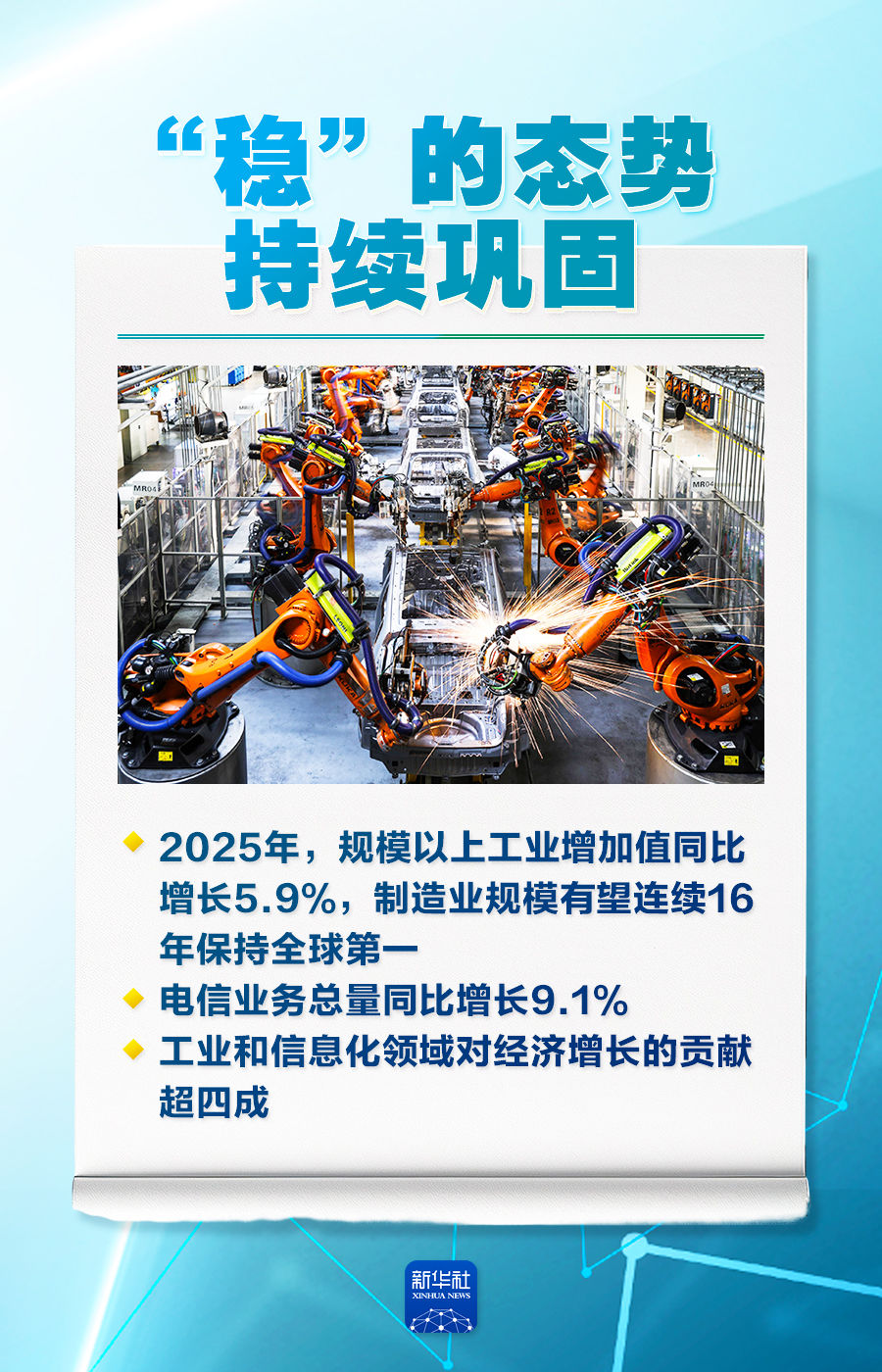
Group 1 - The core viewpoint of the article highlights the achievements in industrial and information technology development in China by 2025, emphasizing qualitative improvements and reasonable quantitative growth in the industrial economy [1] - The industrial and information sectors contribute over 40% to economic growth, characterized by stability, progress, innovation, and vitality [1] Group 2 - The added value of large-scale equipment manufacturing and high-tech manufacturing industries increased by 9.2% and 9.4% year-on-year, respectively [6] - More than 35,000 basic-level, over 8,200 advanced-level, and over 500 excellent-level smart factories have been established, along with the cultivation of 15 leading smart factories [6] - A total of 8,000 national green factories have been cultivated [6] Group 3 - The first phase of 6G technology trials has resulted in the formation of over 300 key technology reserves [10] - The added value of the integrated circuit and electronic special materials industries increased by 26.7% and 23.9% year-on-year, respectively [10] Group 4 - The production of industrial robots increased by 28% year-on-year [11] - The sales of new energy vehicles reached 16.49 million units, representing a year-on-year growth of 28.2% [11] - 5G and optical networks have been integrated into 97 of the 100 national economic categories [11]
新华视点丨解读2025经济数据:稳中向好 向新向优
Xin Hua Wang· 2026-01-21 06:02
Economic Performance Overview - In 2025, China's GDP surpassed 140 trillion yuan, marking a 5.0% increase from the previous year [1] - China maintains its position as the world's second-largest economy, with growth rates among the top of major economies [2] Economic Stability and Growth - The industrial added value above designated size grew by 5.9%, with an average urban unemployment rate of 5.2% [4] - The total value of goods trade reached a new high, and foreign exchange reserves exceeded 3.3 trillion USD [4] - High-tech manufacturing's added value accounted for 17.1% of the total industrial added value, with final consumption contributing over 50% to economic growth [4] Quality of Development - China's economy is transitioning from quantity accumulation to quality enhancement, showcasing stronger resilience and confidence in high-quality development [6] Foreign Trade Dynamics - The total import and export value increased by 3.8%, with exports rising by 6.1% and imports reaching a record high of 18.48 trillion yuan [8] Domestic Demand and Consumption - The total retail sales of consumer goods surpassed 50 trillion yuan, growing by 3.7% year-on-year, highlighting the importance of domestic consumption in economic stability [10] - Service consumption emerged as a significant highlight in the economic performance of 2025 [10]
工业增长重心上移 高技术制造业贡献超四分之一
Xin Jing Bao· 2026-01-21 05:23
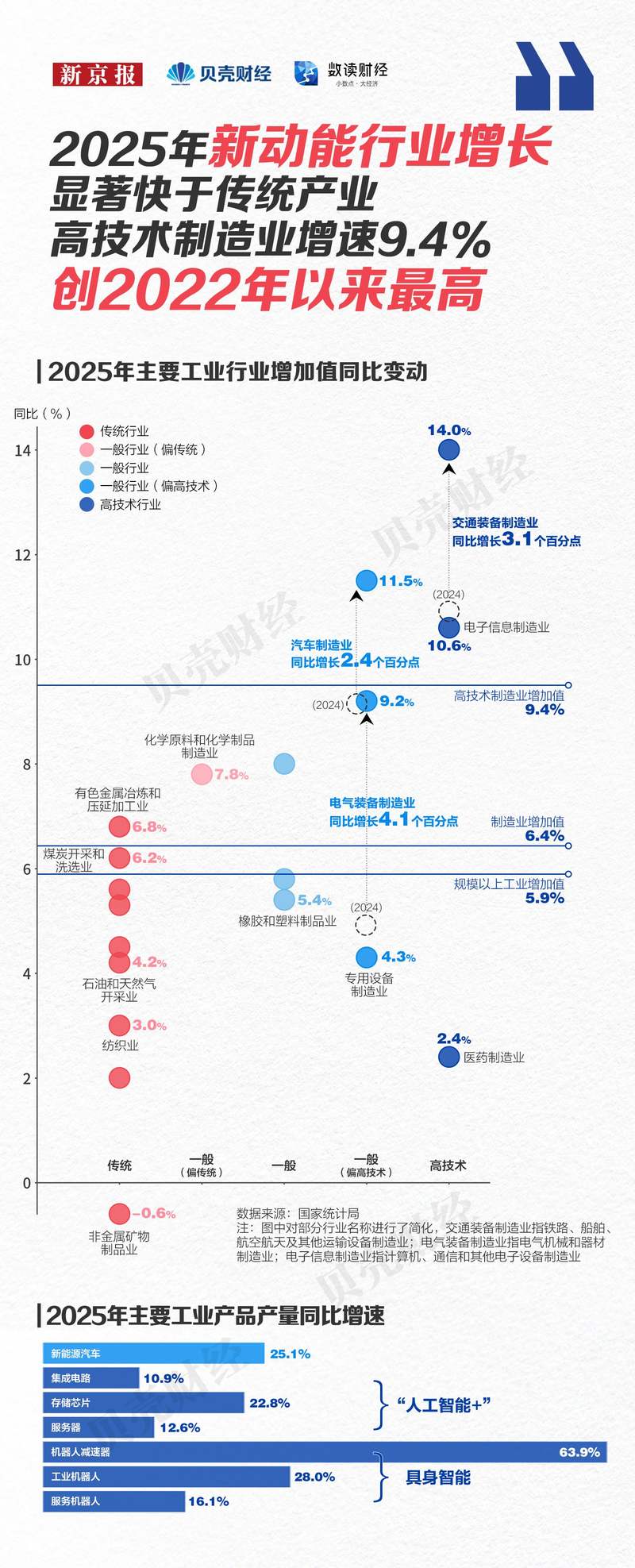
Core Insights - In 2025, China's manufacturing industry is expected to maintain quality growth with a total value added of 34.7 trillion yuan, representing a year-on-year increase of 6.1%, keeping its position as the world's largest manufacturing sector [1] - The growth of the manufacturing sector is shifting from scale expansion to technology-driven advancements, with high-tech manufacturing value added increasing by 9.4%, contributing 26.1% to the growth of large-scale industrial output [1] - New industries are growing faster than traditional sectors, with significant increases in equipment manufacturing (railway, shipbuilding, aerospace) at 14.0%, electronics at 10.6%, and automotive manufacturing at 11.5%, all surpassing the average growth rate of the manufacturing sector [1] Manufacturing Sector Performance - High-tech industries are showing strong momentum with new products, including a 25.1% increase in new energy vehicle production, a 22.8% increase in storage chip production, and a 12.6% increase in server production [1][6] - The application of "Artificial Intelligence+" is accelerating, leading to rapid growth in industrial and service robots, with industrial robot production increasing by 28.0% and service robots by 16.1% [6] Traditional vs. High-tech Industries - Traditional industries are experiencing slower growth, with various sectors such as coal mining and washing, rubber and plastic products, and pharmaceutical manufacturing showing lower year-on-year increases compared to high-tech sectors [4]
2025年装备制造业“压舱石”作用凸显
Zhong Guo Hua Gong Bao· 2026-01-21 04:25
Group 1: Equipment Manufacturing Industry - The added value of the equipment manufacturing industry above designated size accounted for 36.8% of the total industrial output in 2025, an increase of 2.2 percentage points from the previous year [1] - The added value of the equipment manufacturing industry grew by 9.2% compared to the previous year, with a growth rate acceleration of 1.5% [1] - All eight sub-industries within the equipment manufacturing sector achieved growth, with the automotive and electronics industries showing rapid growth rates of 11.5% and 10.6%, contributing 12.4% and 18.1% to the overall industrial growth, respectively [1] Group 2: High-Tech Manufacturing Industry - The added value of high-tech manufacturing above designated size increased by 9.4% year-on-year in 2025, marking the highest growth rate since 2022, with a contribution rate of 26.1% to the overall industrial growth [2] - Key sectors such as integrated circuit manufacturing, aircraft manufacturing, electronic materials manufacturing, and biopharmaceuticals saw added value growth rates of 26.7%, 24.8%, 23.9%, and 12.1%, respectively [2] - The "Artificial Intelligence+" trend significantly boosted the production of storage chips and servers, which grew by 22.8% and 12.6%, respectively [2] Group 3: Digital Products Manufacturing Industry - The added value of digital products manufacturing above designated size rose by 9.3% year-on-year in 2025, with a contribution rate of 20.3% to the overall industrial growth [2] - Industries such as electronic components and smart device manufacturing experienced added value growth of 12.6% and 11.2%, respectively [2] - Production of intelligent manufacturing equipment, including industrial control computers and systems, 3D printing equipment, and CNC metal cutting machine tools, saw significant increases of 86.5%, 52.5%, and 13.7%, respectively [2] Group 4: Overall Industrial Economic Outlook - The industrial economy is projected to achieve rapid growth in 2025, with stable industrial production and significant growth in both equipment and high-tech manufacturing sectors [3] - Traditional manufacturing is undergoing optimization and upgrading, with a focus on implementing new development concepts and strengthening the real economy [3] - The emphasis is on cultivating new growth drivers to lay a solid foundation for high-quality industrial development [3]
2026年稳投资政策或加码丨温彬专栏
2 1 Shi Ji Jing Ji Bao Dao· 2026-01-21 03:31
Economic Overview - In 2025, China's GDP is projected to exceed 140 trillion yuan, achieving a growth rate of 5.0% at constant prices, meeting the annual target despite challenges from U.S. tariff policies and internal economic transitions [1] - The economic growth rates for 2025 were 5.4% in Q1, followed by a decline to 5.2%, 4.8%, and 4.5% in subsequent quarters, ultimately stabilizing at 5.0%, consistent with 2024's growth [1] Consumption Insights - Retail sales of consumer goods grew by 3.7% in 2025, slightly above the 3.5% growth in 2024, with goods consumption increasing by 3.8%, surpassing the growth of dining revenue at 3.2% for the first time in three years [2] - The government expanded the subsidy for replacing old consumer goods from 150 billion yuan to 300 billion yuan, significantly boosting the sales of home appliances and other durable goods [2] Export Performance - Exports measured in U.S. dollars increased by 5.5% in 2025, despite the impact of U.S. tariff policies on global trade [2] - China's trade diversification strategy has successfully established the country as a major trading partner with over 150 nations, with high-tech and high-value-added products driving export growth [2] Investment Trends - Fixed asset investment saw a decline of 3.8% in 2025, with infrastructure investment down by 2.2% and real estate investment plummeting by 17.2% [3] - The central government plans to implement measures to stabilize investment, including increasing central budget investments and optimizing the use of local government special bonds [3] Future Economic Outlook - In 2026, consumption is expected to remain a key driver, with targeted subsidies for replacing old goods and plans to increase residents' income through various channels [3] - Export resilience is anticipated to continue, supported by strong manufacturing capabilities and trade diversification strategies [4] - Overall, the economic outlook for 2026 suggests a focus on stability and quality improvement, with proactive fiscal and monetary policies already in place [4]
2026年稳投资政策或加码
2 1 Shi Ji Jing Ji Bao Dao· 2026-01-20 23:15
Economic Performance Overview - In 2025, China's GDP is projected to exceed 140 trillion yuan, achieving a growth rate of 5.0% at constant prices, meeting the annual target despite challenges from U.S. tariff policies and the transition of old and new economic drivers [1] - The economic growth rate for 2025 was 5.4% in Q1, followed by a decline to 5.2%, 4.8%, and 4.5% in subsequent quarters, ultimately stabilizing at 5.0%, consistent with the growth rate of 2024 [1] Consumption Insights - Social retail sales growth reached 3.7% in 2025, slightly above the 3.5% growth in 2024, with goods consumption growing by 3.8%, surpassing the restaurant revenue growth of 3.2% for the first time in three years [1] - The increase in consumption was driven by the expansion of the "old-for-new" policy, which significantly boosted durable goods consumption [2] Export Dynamics - Exports in 2025 grew by 5.5% in USD terms, despite the impact of U.S. tariff policies on global trade [2] - China's trade diversification strategy has been effective, with the country becoming a major trading partner for over 150 nations, focusing on high-tech and high-value-added products as the main drivers of export growth [2] Investment Trends - Fixed asset investment in 2025 saw a decline of 3.8%, with infrastructure investment down by 2.2% and real estate development investment down by 17.2% [2] - The decrease in investment is attributed to the weakening of old economic drivers, particularly in the real estate market, while investments in high-tech manufacturing and services remained robust [2] Policy Measures and Future Outlook - The Central Economic Work Conference in 2025 emphasized "stabilizing and recovering investment," proposing measures such as increasing central budget investment and optimizing local government bond usage [3] - For 2026, it is anticipated that investment growth will rebound due to policy support and base effects, with consumption continuing to play a crucial role [3] - The government plans to shift from broad "old-for-new" subsidies to more targeted measures, alongside initiatives to increase urban and rural residents' income, which will further stimulate consumption [3] - Export resilience is expected to continue, supported by improved global economic forecasts and China's strong manufacturing capabilities [3][4]
GDP140万亿 宏微观“温差”如何破解
Xin Lang Cai Jing· 2026-01-20 22:59
Economic Overview - In 2025, China's GDP reached 140 trillion yuan, marking a 5.0% increase from the previous year [1][2] - The contribution rates to economic growth from final consumption expenditure, gross capital formation, and net exports of goods and services were 52.0%, 15.3%, and 32.7% respectively [1] Income and Employment - The per capita disposable income for residents in 2025 was approximately 43,400 yuan, with a real growth rate of 5.0% [2] - Average urban survey unemployment rate was 5.2%, below the target of around 5.5% [2] - The average unemployment rate for urban workers aged 30-59 was 4.0%, indicating stability in this demographic [3] Consumer Spending - Per capita consumption expenditure for residents was about 29,500 yuan, with a nominal growth of 4.4% [3] - Significant growth was observed in per capita spending on education, culture, entertainment, and healthcare [3] Structural Challenges - The disparity between macroeconomic growth and individual experiences is attributed to structural adjustments during the transition from old to new economic drivers [4][5] - High-tech manufacturing saw a 9.4% increase in value added, while traditional industries lagged behind, contributing to the perceived "temperature difference" in economic sentiment [5] Statistical Insights - The median per capita disposable income was approximately 36,200 yuan, which is 83.5% of the average [6] - The median income for urban residents was 90.5% of the average, while for rural residents it was 84.7% [6] Policy Recommendations - Experts suggest that addressing the "temperature difference" requires targeted government actions to ensure economic benefits reach all demographics [8] - The Central Economic Work Conference proposed measures to stabilize employment for key groups and improve income distribution [8]
“量质齐升”,中国工业经济韧性强活力足
Ren Min Wang· 2026-01-20 13:05
Group 1 - The core viewpoint of the articles highlights the resilience and vitality of China's industrial economy, which achieved a 5.9% growth in industrial added value in 2025 despite a complex external environment [1] - Industrial production has seen simultaneous improvements in both quality and quantity, with mining, manufacturing, and utility sectors growing by 5.6%, 6.4%, and 2.3% respectively, indicating stable growth in foundational industries and strong manufacturing momentum [1] - The equipment manufacturing sector is accelerating towards high-end, intelligent, and green development, with significant advancements in high-tech and high-value-added equipment, enhancing production efficiency and product quality [1] Group 2 - High-tech manufacturing is rapidly rising, with an added value growth of 9.4%, outpacing overall industrial growth by 3.5 percentage points, showcasing the multiplier effect of high-tech integration in various industries [2] - The production of 3D printing equipment, industrial robots, and new energy vehicles has seen substantial increases of 52.5%, 28.0%, and 25.1% respectively, indicating a transformation in industrial development patterns and higher growth potential [2] - Diverse market entities are collaborating for industrial growth, with state-owned enterprises, joint-stock companies, foreign-invested enterprises, and private enterprises showing growth rates of 4.6%, 6.3%, 3.9%, and 5.3% respectively, supported by improved market conditions and a unified national market [2] Group 3 - Achievements in industrial development are attributed to proactive macro policies from the government, with coordinated efforts in both incremental and stock policies enhancing the upward momentum of the industrial economy [3] - The year 2026 marks the beginning of the "14th Five-Year Plan," emphasizing the need for continued policy support and resource assurance to stabilize growth in key industries and regions [3] - There is a strong focus on tapping into innovation potential and expanding effective demand to ensure that China's industrial economy accelerates towards high-quality development [3]
专访中国政策科学研究会经济政策委员会副主任徐洪才:PPI回升现积极信号,如何巩固物价修复态势?
Xin Lang Cai Jing· 2026-01-20 12:45
Core Viewpoint - The recent data on prices indicates positive signals for the economy, with the Producer Price Index (PPI) showing a narrowing year-on-year decline and the Consumer Price Index (CPI) reaching a three-year high, suggesting a potential recovery in industrial production and consumer demand [1][3]. Economic Indicators - In December 2025, the PPI year-on-year decline narrowed to 1.9%, with a month-on-month increase for three consecutive months, indicating the effectiveness of proactive fiscal and moderately loose monetary policies [3]. - The CPI in December 2025 rose to 0.8% year-on-year, marking the highest level in nearly three years [1]. Consumer Behavior - Final consumption expenditure contributed over 50% to economic growth in 2025, with "self-indulgent consumption" rising, as service retail sales grew by 5.5%, outpacing goods retail sales by 1.7 percentage points [1][9]. - The growth in per capita consumption expenditure was still slower than the growth in per capita disposable income, indicating a need for improved conversion of income into consumption [10]. Industrial Production - The recent month-on-month increase in PPI suggests a recovery in industrial production demand, although the sustainability of this trend remains to be observed [3]. - The high-tech manufacturing sector accounted for 17.1% of the value added in large-scale industries, indicating a long-term trend towards high-tech manufacturing leading industrial development [6]. Policy Recommendations - To maintain the recovery of PPI, it is crucial to expand consumer demand and increase residents' income, especially during the upcoming traditional sales season [4]. - Policies should focus on enhancing consumer rights protection, creating consumption hotspots, and providing direct cash subsidies to low-income groups to stimulate spending [10][11]. Future Outlook - The rise of "self-indulgent consumption" presents a significant growth opportunity, particularly in sectors like health and wellness, which could drive future economic expansion [9]. - The effectiveness of monetary policy is currently limited, as a significant amount of money is not effectively translating into actual demand, highlighting the need for stabilizing expectations in economic work [8].