宏微观温差

Search documents
GDP140万亿 宏微观“温差”如何破解
Xin Lang Cai Jing· 2026-01-20 22:59
Economic Overview - In 2025, China's GDP reached 140 trillion yuan, marking a 5.0% increase from the previous year [1][2] - The contribution rates to economic growth from final consumption expenditure, gross capital formation, and net exports of goods and services were 52.0%, 15.3%, and 32.7% respectively [1] Income and Employment - The per capita disposable income for residents in 2025 was approximately 43,400 yuan, with a real growth rate of 5.0% [2] - Average urban survey unemployment rate was 5.2%, below the target of around 5.5% [2] - The average unemployment rate for urban workers aged 30-59 was 4.0%, indicating stability in this demographic [3] Consumer Spending - Per capita consumption expenditure for residents was about 29,500 yuan, with a nominal growth of 4.4% [3] - Significant growth was observed in per capita spending on education, culture, entertainment, and healthcare [3] Structural Challenges - The disparity between macroeconomic growth and individual experiences is attributed to structural adjustments during the transition from old to new economic drivers [4][5] - High-tech manufacturing saw a 9.4% increase in value added, while traditional industries lagged behind, contributing to the perceived "temperature difference" in economic sentiment [5] Statistical Insights - The median per capita disposable income was approximately 36,200 yuan, which is 83.5% of the average [6] - The median income for urban residents was 90.5% of the average, while for rural residents it was 84.7% [6] Policy Recommendations - Experts suggest that addressing the "temperature difference" requires targeted government actions to ensure economic benefits reach all demographics [8] - The Central Economic Work Conference proposed measures to stabilize employment for key groups and improve income distribution [8]
如何认识5%与140万亿
Sou Hu Cai Jing· 2026-01-19 15:18
Group 1 - China's economy demonstrates resilience, achieving a GDP exceeding 140 trillion yuan with a growth rate of 5% for three consecutive years, supported by strong international competitiveness and diversified export markets [2][3] - The economic scale of 140 trillion yuan enhances China's capacity to respond to risks, providing a robust foundation for future growth and contributing significantly to global economic stability [3] - The transition from old to new economic drivers is evident, with the service sector's contribution to GDP rising from 56.8% in 2024 to 57.7% in 2025, and final consumption's contribution increasing from 44.5% to 52% [4] Group 2 - The high-tech and emerging industries are rapidly growing, with significant increases in value-added output in equipment manufacturing (9.2%) and high-tech manufacturing (9.4%), surpassing the overall industrial growth rate of 5.9% [4] - Challenges remain in the real estate market, requiring policy adjustments to stabilize the sector and address liquidity risks among real estate companies [5] - To boost consumption, a long-term mechanism is needed, focusing on income distribution and social security system optimization, alongside fiscal measures to encourage wage increases [5][6]

国内高频 | 工业生产边际改善(申万宏观·赵伟团队)
赵伟宏观探索· 2026-01-12 16:04
Group 1: Industrial Production - The operating rate of blast furnaces has improved slightly, with a week-on-week increase of 0.4% and a year-on-year rise of 1.3 percentage points to 2.2% [1][4] - Apparent steel consumption has decreased, with a week-on-week decline of 0.6% and a year-on-year drop of 1.5 percentage points to 0.6% [1][6] - Steel social inventory continues to decline, with a week-on-week decrease of 2.5% [1] Group 2: Chemical and Automotive Industries - In the chemical sector, the operating rate of soda ash has significantly increased, with a week-on-week rise of 4.4% and a year-on-year increase of 0.2 percentage points to -2.2% [10][11] - The operating rate of PTA has also improved, with a week-on-week increase of 3.2% and a year-on-year rise of 4.1 percentage points to -4.2% [10][14] - The automotive sector shows weaker performance, with the operating rate of semi-steel tires declining by 2.4% week-on-week and a year-on-year drop of 2.8 percentage points to -13% [10] Group 3: Construction Industry - The cement production and demand have marginally improved, with a week-on-week increase in grinding operating rate of 2.1% and a year-on-year rise of 5.2 percentage points to 9.9% [22][23] - Cement shipment rates have slightly decreased, with a week-on-week decline of 1.5% and a year-on-year increase of 1.9 percentage points to 0.5% [22][26] - Cement inventory continues to decline, with a week-on-week decrease of 0.5% and a year-on-year increase of 0.9 percentage points to 1.3% [22][29] Group 4: Demand Tracking - The average daily transaction area of commercial housing in 30 major cities has decreased by 47.4% week-on-week and a year-on-year drop of 13.6 percentage points to 38.4% [44][45] - The transaction volume in first-tier and second-tier cities remains weak, with week-on-week declines of 30.8% and 61.9% respectively [44][48][51] - Port cargo throughput has also declined, with a year-on-year decrease of 3.6 percentage points to -0.4% [56][63] Group 5: Price Tracking - Agricultural product prices show differentiation, with vegetable and fruit prices decreasing by 0.9% and 0.2% respectively, while egg prices increased by 1.4% [98][99] - The industrial product price index has risen by 1.7% week-on-week, with the energy and chemical price index increasing by 0.7% and the metal price index rising by 3.9% [110][111]

月度前瞻 | 再议宏微观“温差”(申万宏观·赵伟团队)
赵伟宏观探索· 2026-01-12 16:04
Group 1 - The core viewpoint of the article discusses the economic "temperature difference" at the end of 2025, highlighting a divergence between macro indicators like PMI and micro indicators such as production and consumption [2][4][10] - At the end of 2025, production indicators such as high furnace operation and PTA operation showed a decline, while manufacturing PMI increased by 0.9 percentage points to 50.1% in December [2][10] - Consumer high-frequency indicators continued to decline at the end of 2025, yet the overall consumer goods industry PMI rose to 50.4%, indicating a recovery in certain sectors like textiles and apparel [20][10] Group 2 - Investment indicators such as asphalt operation rates and cement shipment rates did not show significant improvement, but the construction industry PMI rose by 3.2 percentage points to 52.8% at the end of 2025 [3][32][10] - The article identifies three reasons for the divergence in macro and micro indicators: the shift in economic growth momentum, the risk of demand overextension in consumer sectors, and the impact of previous debt issues on investment rhythms [4][5][44][67] Group 3 - The article anticipates that service consumption and new infrastructure investments will contribute more than expected to the economy at the beginning of 2026, despite pressures on commodity consumption due to the tapering of "old-for-new" policies [6][78][82] - The easing of the debt impact on investment is expected to lead to a rebound in broad infrastructure and service sector investments in early 2026, with a focus on digital infrastructure and carbon reduction investments [82][86] - The delayed Spring Festival in 2026 is projected to extend the "export rush" window, potentially boosting January export figures [105][110]

“月度前瞻”系列专题之六:再议宏微观温差?-20260112
Shenwan Hongyuan Securities· 2026-01-12 12:48
Group 1: Economic Discrepancies - By the end of 2025, production indicators such as high furnace operation and PTA operation weakened, while manufacturing PMI rose by 0.9 percentage points to 50.1%[3] - Consumer retail volume for automobiles and home appliances showed a downward trend, but the overall consumer goods PMI increased by 1 percentage point to 50.4% in December[3] - Cement shipment rates and rebar apparent consumption remained low, with December year-on-year changes of -1.8% and -10% respectively, yet the construction PMI rose by 3.2 percentage points to 52.8%[4] Group 2: Factors Behind Economic Discrepancies - The shift in economic growth momentum has led to new sectors lacking high-frequency indicators contributing more to the economy, with AI-related industries boosting GDP by approximately 1.5 percentage points[5] - Consumer sectors face "demand overdraw risks," while service consumption, which lacks tracking indicators, has shown resilience, with service retail growth rising since September[5] - Previous debt management affected investment rhythms, with industrial product improvements reflecting raw material purchases rather than actual investments[5] Group 3: Economic Outlook for Early 2026 - The "old-for-new" policy is expected to face downward pressure, but service consumption may benefit from increased policy support, with domestic travel and spending during the New Year holiday exceeding 2019 levels[6] - Infrastructure investment is anticipated to rebound in early 2026 due to reduced special refinancing bond issuance and new infrastructure policies, focusing on digital infrastructure and carbon reduction investments[6] - The delayed Spring Festival in 2026 may extend the "export rush" window, potentially boosting January export figures compared to the previous year[6]
“月度前瞻”系列专题之六:再议宏微观“温差”?-20260112
Shenwan Hongyuan Securities· 2026-01-12 10:13
Group 1: Economic Trends - By the end of 2025, production indicators such as high furnace operation and PTA operation showed a decline, while the manufacturing PMI rose by 0.9 percentage points to 50.1% in December[3] - The overall consumer goods industry PMI increased by 1 percentage point to 50.4% in December, despite a decline in retail sales of automobiles and home appliances[19] - The construction PMI rose by 3.2 percentage points to 52.8% at the end of 2025, despite low cement shipment rates and rebar consumption[26] Group 2: Factors Behind Economic Divergence - The new momentum in economic growth, particularly in AI-related sectors, contributed approximately 1.5 percentage points to GDP growth, while traditional sectors lagged[31] - Consumer high-frequency indicators faced "demand overdraft risks," while service consumption showed resilience, with service retail growth continuing to rise since September[37] - The previous impact of debt restructuring on investment slowed down, but the easing of this effect may lead to a return of investment to high-frequency indicators[41] Group 3: Expectations for Early 2026 - The "old-for-new" consumption policy is expected to face downward pressure, but service consumption may benefit from increased policy support, potentially enhancing resilience[45] - Infrastructure and service sector investments are anticipated to exceed expectations in early 2026 due to the easing of debt restructuring effects and the implementation of proactive investment policies[52] - The delayed Spring Festival in 2026 may extend the "export rush" window, potentially boosting January export figures compared to the previous year[7]
月度前瞻 | 再议宏微观“温差”(申万宏观·赵伟团队)
申万宏源宏观· 2026-01-12 09:31
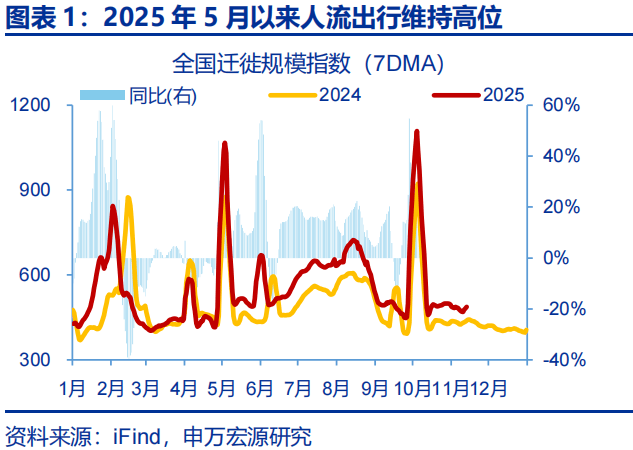
Group 1 - The core viewpoint of the article discusses the economic "temperature difference" at the end of 2025, highlighting a divergence between macro indicators like PMI and micro indicators such as production and consumption [2][10][115] - At the end of 2025, production indicators such as high furnace operation and PTA operation showed a decline, while manufacturing PMI increased by 0.9 percentage points to 50.1% in December [2][10][115] - Consumer high-frequency indicators further declined at the end of 2025, but the overall consumer goods industry PMI rose to a prosperous zone, increasing by 1 percentage point to 50.4% in December [20][10][115] Group 2 - Investment indicators such as asphalt operation rates and cement shipment rates did not show significant improvement, yet the construction industry PMI surged by 3.2 percentage points to 52.8% at the end of 2025 [3][32][10] - The article identifies that the economic growth momentum is shifting, with new momentum areas lacking high-frequency indicators contributing more to the economy [4][44][10] - The service consumption sector, which lacks tracking indicators, has shown significant improvement, contrasting with the consumer goods sector facing "demand overdraft risks" [4][56][10] Group 3 - The article anticipates that service consumption and new infrastructure investments will support the economy at the beginning of 2026, despite pressures on commodity consumption due to the decline of the "old-for-new" policy [6][78][10] - The easing of the debt issuance effect is expected to lead to a rebound in broad infrastructure and service investment at the beginning of 2026 [7][82][10] - The delayed Spring Festival in 2026 is projected to extend the "export rush" window, potentially boosting January export figures [8][105][10] Group 4 - The overall economic situation at the end of 2025 remains within a reasonable range, with a projected GDP growth of around 4.4% for the fourth quarter [8][110][10] - The article concludes that the divergence in macro and micro indicators is primarily due to different recovery paces in economic structures, with policies leaning towards service consumption and new infrastructure investments expected to bolster the economy [8][110][10]

国内高频 | 工业生产边际改善(申万宏观·赵伟团队)
申万宏源宏观· 2026-01-12 09:31
Group 1: Industrial Production - The operating rate of blast furnaces improved slightly, with a week-on-week increase of 0.4% and a year-on-year rise of 1.3 percentage points to 2.2% [1][4] - Apparent steel consumption decreased by 0.6% week-on-week and fell by 1.5 percentage points year-on-year to 0.6% [1][6] - Steel social inventory continued to decline, down 2.5% week-on-week [1] Group 2: Chemical and Automotive Industries - In the chemical sector, the operating rate of soda ash increased significantly by 4.4% week-on-week and rose by 0.2 percentage points year-on-year to -2.2% [10][11] - The operating rate of PTA rose by 3.2% week-on-week and increased by 4.1 percentage points year-on-year to -4.2% [10][14] - The operating rate of polyester filament increased by 0.4% week-on-week and rose by 3 percentage points year-on-year to 4.8%, while the operating rate of automotive semi-steel tires showed weakness, down 2.4% week-on-week and falling by 2.8 percentage points year-on-year to -13% [10][18] Group 3: Construction Industry - The cement production and demand showed marginal improvement, with the national grinding operating rate increasing by 2.1% week-on-week and rising by 5.2 percentage points year-on-year to 9.9% [22][23] - Cement shipment rate decreased by 1.5% week-on-week but increased by 1.9 percentage points year-on-year to 0.5% [22][26] - The cement inventory ratio continued to decline, down 0.5% week-on-week and up 0.9 percentage points year-on-year to 1.3% [22][30] Group 4: Demand Tracking - The average daily transaction area of commercial housing in 30 major cities decreased by 47.4% week-on-week and fell by 13.6 percentage points year-on-year to 38.4% [44][45] - The transaction volume in first-tier and second-tier cities was significantly weaker than the previous year, with first-tier cities down 30.8% week-on-week and 12.7 percentage points year-on-year to 44.5%, and second-tier cities down 61.9% week-on-week and 15.8 percentage points year-on-year to 29.8% [44][48][51] - The freight volume related to domestic demand showed a decline, with railway freight volume down 5.9 percentage points year-on-year to -10.3% and highway freight traffic down 8.4 percentage points year-on-year to -9.7% [56][58] Group 5: Price Tracking - Agricultural product prices showed differentiation, with vegetable and fruit prices decreasing by 0.9% and 0.2% respectively, while egg prices increased by 1.4% [98] - The industrial product price index rose by 1.7% week-on-week, with the energy and chemical price index increasing by 0.7% and the metal price index rising by 3.9% [110][114]

赵伟:2025年经济运行的转折性变化与政策思考——基于宏微观温差视角的分析
申万宏源宏观· 2025-12-20 16:03
Core Viewpoint - The article discusses the significant turning points in China's economy for 2025, highlighting the weakening of the "scar effect" post-pandemic, the diminishing impact of tariff conflicts, the reduced marginal drag from real estate adjustments, and the improved integration of short-cycle frameworks with long-term reform directions [4][5][8]. Group 1: Turning Points in Economic Operation - The impact of the post-pandemic "scar effect" is significantly weakening, as evidenced by improved travel data and a divergence between core CPI and PPI trends [5][6]. - The influence of tariff conflicts on China's economy is diminishing, with exports showing resilience and an improved structure of export goods, indicating a new phase of domestic transformation and upgrading [6][7]. - The marginal drag from real estate adjustments on economic growth is expected to weaken, with new construction leading investment growth and a shift in the housing market dynamics favoring new homes [7][8]. - The integration of short-cycle frameworks with long-term reform directions has improved, with a robust policy system focusing on high value-added production and human-centered demand management [8][9]. Group 2: Recent Economic Indicator Weakness - The decline in investment growth since mid-year is not attributed to a single industry but shows significant regional differentiation, partly due to the "crowding out effect" from accelerated debt reduction efforts [10][11]. - The implementation of "debt clearance" policies has also affected investment funds, creating a similar "crowding out effect," although this is expected to strengthen the microeconomic foundation in the long run [11][12]. - Some regions report insufficient project reserves, which has impacted current investment performance, but this is anticipated to improve in the upcoming planning year [12]. Group 3: Policy Recommendations Based on Macro-Micro Temperature Difference - The phenomenon of "macro-micro temperature difference" has become more pronounced, indicating a disconnect between macroeconomic indicators and micro-level experiences, which is essential for understanding policy directions [13][14]. - Restoring corporate profitability and increasing household income levels are critical policy directions to address the economic cycle issues, emphasizing the need for policies that consider micro-level incentives [15][16]. - Recommendations include focusing on improving residents' income, increasing leisure time, creating favorable consumption environments, and providing quality products, rather than relying solely on leveraging consumption [16].

赵伟:向“改革”要红利——2026年宏观形势展望
Sou Hu Cai Jing· 2025-11-17 06:05
Group 1 - The core viewpoint emphasizes that by 2025, the domestic economic environment will experience significant changes, including the retreat of the "scar effect," the weakening impact of tariff conflicts, and the gradual formation of a new supply-side reform framework [1][8][30] - The "scar effect" is showing signs of retreat, with improvements in consumer behavior and a rapid decline in accounts receivable growth for enterprises, indicating a recovery in economic confidence [15][20] - The trade conflict's impact on the domestic economy is diminishing, with a shift in export structure towards high value-added products and a reduction in the proportion of exports to the US [20][21] Group 2 - The report suggests that the "anti-involution" measures and debt clearance policies are crucial for addressing the stagnation in economic circulation, with a focus on enhancing corporate profitability and revitalizing operations [2][50] - The economic forecast indicates a "non-typical recovery" driven by domestic demand policies, with expectations of improved corporate profitability and investment recovery by 2026 [4][6] - The emphasis on reform in 2026 is seen as a critical period for accelerating economic growth, with a focus on expanding domestic demand and enhancing the efficiency of the economic system [60][79] Group 3 - The report highlights the importance of a unified national market and systemic reforms to enhance economic resilience and competitiveness, particularly in the context of the "14th Five-Year Plan" [63][84] - The focus on service industry development and the acceleration of institutional opening-up are expected to create significant investment opportunities in the coming years [86][87] - The modernization of the industrial system is prioritized, with a clear strategy for upgrading traditional industries and fostering new and future industries [67][73]