
TMT

Search documents
慧博云通:11月25日召开董事会会议
Mei Ri Jing Ji Xin Wen· 2025-11-25 09:31
截至发稿,慧博云通市值为189亿元。 每经头条(nbdtoutiao)——688496,被证监会立案!刚上市业绩就变脸,亏损超1亿元;核心产品受重 创:第一大客户"自产自用",减少采购 (记者 曾健辉) 每经AI快讯,慧博云通(SZ 301316,收盘价:46.68元)11月25日晚间发布公告称,公司第四届第十一 次董事会会议于2025年11月25日以通讯会议的方式召开。会议审议了《关于调整公司组织架构的议案》 等文件。 2025年1至6月份,慧博云通的营业收入构成为:TMT占比59.06%,金融占比30.83%,其他行业占比 10.11%。 ...
科技板块领涨港股 硬科技品种最为吸金
Mei Ri Jing Ji Xin Wen· 2025-11-25 05:31
Core Viewpoint - The Hong Kong stock market is experiencing a strong inflow of funds into the technology sector, particularly in AI and semiconductor-related ETFs, following a significant correction in the sector since October, which has made valuations more attractive [1][2]. Group 1: Market Performance - On November 25, the Hong Kong stock market opened higher, with technology and semiconductor sectors showing strong performance, leading to active trading in related ETFs [1]. - The Hang Seng Technology Index has corrected over 14% from its year-to-date high since October, highlighting the increased attractiveness of valuations in the technology sector [1]. - On November 24, the overall market ETFs saw a net inflow of 14.4 billion yuan, with technology ETFs in Hong Kong being the primary focus for fund accumulation [1]. Group 2: ETF Specifics - The Hong Kong Stock Connect Technology ETF (159262) is the largest product tracking the Hang Seng Stock Connect Technology Index, focusing on hard technology sectors like AI and semiconductors, while excluding automotive, pharmaceutical, and home appliance sectors [2]. - As of November 24, the index has gained 45% over the past year, with an annualized Sharpe ratio of 1.37, both of which are among the best in the Hong Kong technology and internet thematic indices [2]. - The Hong Kong Stock Connect Technology ETF (159262) received a net inflow of 270 million yuan on November 24, making it the top-performing ETF in its category, with a total size nearing 6 billion yuan [1][2]. Group 3: Investment Outlook - Analysts believe that the current valuation of the hard technology sector in Hong Kong offers good value for money, especially as the external environment remains in a rate-cutting cycle, providing a favorable opportunity for reverse positioning [2]. - The Hong Kong Stock Connect Technology ETF (159262) is seen as a key investment tool for capturing recovery opportunities in the Hong Kong technology sector [2]. - Tianfeng Securities highlights that the ETF's index covers a broad range of technology fields, including internet, software, and hardware, making it a more precise investment choice compared to other ETFs that focus on narrower segments [3].
光大期货金融期货日报-20251125
Guang Da Qi Huo· 2025-11-25 04:19
Report Summary 1. Investment Rating - No investment rating for the industry is provided in the report. 2. Core Views - **Stock Index Futures**: The A - share market closed up with fluctuations on November 24, 2025, with National Defense and Military Industry leading the gains and TMT strengthening. The Wind All - A index rose 0.62%, with a trading volume of 1.74 trillion yuan. The CSI 1000 Index rose 1.26%, the CSI 500 Index rose 0.76%, while the SSE 50 Index fell 0.18% and the CSI 300 Index fell 0.12%. After the liquidity rally since June ended, the market refocused on fundamentals. New - quality productivity themes led by AI have optimistic growth expectations for the next three years, especially in the upstream hardware manufacturing of the technology sector. However, these themes have had large gains since June, and lack further catalysts near the end of the year, entering a volatile market in November. Traditional economic sectors like consumption and cyclicals are in a volatile recovery, with limited short - term prospects for a fundamental bull market. Market trading volume, volatility, and risk appetite are decreasing, and the index is expected to fluctuate in the short term. Overseas technology stocks also face expectation divergence, with concerns about AI's actual profitability, an economic data vacuum due to the US government shutdown, and a hawkish Fed stance on a December rate cut leading to a correction in US technology stocks last week [1]. - **Treasury Bond Futures**: On November 24, 2025, treasury bond futures closed higher, with the 30 - year main contract up 0.16%, the 10 - year main contract up 0.08%, the 5 - year main contract up 0.08%, and the 2 - year main contract up 0.01%. The central bank conducted 338.7 billion yuan of 7 - day reverse repurchases on November 24, with a winning bid rate of 1.4%, realizing a net injection of 5.57 billion yuan. Liquidity is reasonably abundant, but the pressure to achieve the annual economic growth target is low, so the expectation of a central bank rate cut is weak, and the bond market lacks upward momentum. In the short term, as November enters a brief domestic economic data vacuum period, the bond market is expected to fluctuate narrowly [1][2]. 3. Daily Price Changes - **Stock Index Futures**: On November 24, 2025, compared with November 21, 2025, IH decreased by 2.0 points (-0.07%) to 2,944.4; IF increased by 6.8 points (0.15%) to 4,435.2; IC increased by 57.6 points (0.85%) to 6,827.6; IM increased by 77.0 points (1.10%) to 7,095.2 [3]. - **Stock Indexes**: The SSE 50 Index decreased by 5.3 points (-0.18%) to 2,950.6; the CSI 300 Index decreased by 5.6 points (-0.12%) to 4,448.0; the CSI 500 Index increased by 51.6 points (0.76%) to 6,869.0; the CSI 1000 Index increased by 88.7 points (1.26%) to 7,156.4 [3]. - **Treasury Bond Futures**: TS increased by 0.008 points (0.01%) to 102.42; TF increased by 0.14 points (0.13%) to 106.00; T decreased by 0.095 points (-0.09%) to 108.34; TL increased by 0.19 points (0.16%) to 115.76 [3]. 4. Market News - The Chinese Foreign Ministry spokesperson Mao Ning stated on November 24 that due to recent wrong remarks on the Taiwan issue by Japanese leaders, which have damaged the foundation and atmosphere of China - Japan - South Korea cooperation, the current conditions are not suitable for holding a China - Japan - South Korea leaders' meeting [4]. 5. Chart Analysis - **Stock Index Futures**: The report provides charts of the trends of IH, IF, IM, IC main contracts, and their respective monthly basis trends [6][7][9]. - **Treasury Bond Futures**: Charts include the trends of treasury bond futures main contracts, treasury bond spot yields, basis of 2 - year, 5 - year, 10 - year, and 30 - year treasury bond futures, inter - delivery spreads of different - term treasury bond futures, cross - variety spreads, and capital interest rates [13][14][18][19]. - **Exchange Rates**: There are charts showing the central parity rates of the US dollar, euro against the RMB, forward exchange rates of the US dollar and euro against the RMB, the US dollar index, euro - US dollar, pound - US dollar, and US dollar - yen exchange rates [22][23][26][27]. 6. Member Introduction - Zhu Jintao, a master of economics from Jilin University, is the director of macro - financial research at Everbright Futures Research Institute, with futures qualification number F3060829 and futures trading consultation qualification number Z0015271 [29]. - Wang Dongying, an index analyst with a master's degree from Columbia University, mainly tracks stock index futures, is responsible for macro - fundamental quantification, key industry sector research, index earnings report analysis, and market capital tracking, with futures qualification number F03087149 and futures trading consultation qualification number Z0019537 [29].
科技板块领涨港股,硬科技品种最为吸金
Mei Ri Jing Ji Xin Wen· 2025-11-25 04:04
Core Viewpoint - The Hong Kong stock market is experiencing a strong inflow of funds into the technology sector, particularly in AI and semiconductor-related ETFs, following a significant correction in the sector since October, which has made valuations more attractive [1][2]. Group 1: Market Performance - On November 25, the Hong Kong stock market opened higher, with technology and semiconductor sectors showing strong performance, leading to active trading in related ETFs [1]. - The Hang Seng Technology Index has corrected over 14% from its year-to-date high since October, highlighting the increased attractiveness of valuations in the technology sector [1]. - On November 24, the overall market ETFs saw a net inflow of 14.4 billion yuan, with technology ETFs in Hong Kong being the primary focus for fund accumulation [1]. Group 2: ETF Specifics - The Hong Kong Stock Connect Technology ETF (159262) is the largest product tracking the Hang Seng Stock Connect Technology Index, focusing on hard technology sectors like AI and semiconductors [2]. - The ETF's top ten holdings include major companies such as Alibaba, Tencent, Xiaomi, Meituan, and SMIC, accounting for nearly 80% of the index, indicating a high concentration in the technology sector [2]. - As of November 24, the index has achieved a 45% increase over the past year, with an annualized Sharpe ratio of 1.37, both of which are among the best in the Hong Kong technology and internet thematic indices [2]. Group 3: Investment Sentiment - Industry experts believe that the current valuation of the hard technology sector in Hong Kong offers good value for money, especially as the external environment remains in a rate-cutting cycle, providing a favorable opportunity for reverse positioning [2]. - The Hong Kong Stock Connect Technology ETF (159262) is seen as a key investment tool for capturing recovery opportunities in the Hong Kong technology sector [2]. - Brokerage firms express optimism about the long-term investment value of the ETF, noting its comprehensive coverage of the technology sector, including internet, software, and hardware, which allows for a more precise focus on core technology areas [3].
早盘直击|今日行情关注
申万宏源证券上海北京西路营业部· 2025-11-25 02:10
Group 1 - The expectation of the Federal Reserve's interest rate cut is impacting global capital markets, with a focus on AI development trends. The weakening of the external market is primarily due to the declining expectation of a rate cut in December, which also indirectly affects the A-share market. There is widespread concern and intense discussion regarding whether there is excessive investment in the AI industry [1] - The A-share market is currently in a typical year-end consolidation phase, characterized by sector rotation, unclear main lines, and balanced allocation [1] - On Monday, both markets experienced a slight rebound, but trading volume significantly decreased. The Shanghai Composite Index opened lower, dipped, and then rebounded slightly, closing still below the short-term moving averages. The Shenzhen Component Index rebounded stronger than the Shanghai index but also failed to reach the short-term moving average [1] Group 2 - The trading volume on that day was around 1.7 trillion yuan, which is a noticeable decrease compared to the previous Friday. Market hotspots were mainly concentrated in the TMT (Technology, Media, and Telecommunications) and military industries [1] - In terms of investment style, small and mid-cap stocks outperformed, while large-cap blue-chip stocks showed weak performance [1] - The Shanghai Composite Index encountered technical resistance and adjusted downward, returning to the consolidation range seen in August and September. After hitting technical resistance in mid-November, the index suddenly adjusted downward, breaking through multiple short-term moving averages [1]


有理财产品短短几天净值跌去10%
21世纪经济报道· 2025-11-24 13:34
Market Overview - The A-share market experienced significant declines, with the Shanghai Composite Index dropping 4.83% and the Shenzhen Component Index falling 6.96% from November 14 to November 21, 2023, particularly a 2.45% drop in one day [1][2]. Impact on Financial Products - Equity-based financial products were the most affected, with 12 products showing a net value decline of over 6%, and 4 products dropping more than 7% during the same period [3]. - The largest decline was observed in the "Huaxia Wealth Tian Gong No. 4 (New Energy Storage Index)" product, which saw a net value drop of 9.77% [3][4]. Performance of Specific Products - Other notable products with significant declines included "Tian Gong No. 5 (AI Computing Power Index)" and "Tian Gong No. 10 (New Energy Operator Index)", with declines of 8.53% and 8.03% respectively [5]. - Actively managed products also faced declines, such as "Zhao Zhuo Consumer Selected No. 1" with a 7.15% drop and "Minsheng Wealth Jin Zhu Quantitative Enhanced No. 1" with a 6.43% decline, the latter experiencing a 3.49% drop in one day [5]. Mixed-Asset Products - Mixed-asset financial products showed varying levels of resilience, with 10 products reporting net value declines exceeding 3% during the same period. The largest decline was 3.98% for "Hangyin Wealth Happiness 99 Excellent Mixed (Debt ESG Balanced Preferred FOF)" [7]. - "Solid Income+" products also faced some net value retraction, but overall declines were limited to within 1.5% due to lower equity investment ratios [7]. Resilient Products - Some mixed-asset products demonstrated better performance during the market downturn, including "Beiyin Wealth Jinghua Huiying Qiu Series 18-Month Closed No. 1" and "Nongyin Wealth Tongxin·Daily Preferred Configuration Product" [8]. General Observations - The majority of equity-based products are directly impacted by market fluctuations, with only a few newly established products not showing net value declines as of November 21 [9].

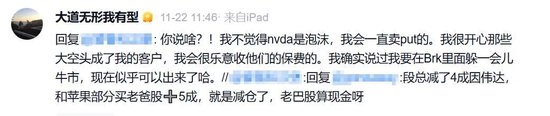
段永平力挺英伟达:“不觉得是泡沫”
Shang Hai Zheng Quan Bao· 2025-11-24 13:29
在近期的震荡行情中,关于AI是否存在泡沫的讨论升温,知名投资人段永平也加入其中。日前,他在 回复网友时表示:"我不觉得英伟达是泡沫,我会一直卖put的。" 近日,段永平在回复网友时表示:"我不觉得英伟达是泡沫,我会一直卖put的。我很开心那些大空头成 了我的客户,我会很乐意收他们的保费的。我确实说过我要在伯克希尔·哈撒韦里面躲一会儿牛市,现 在似乎可以出来了哈。" 根据美股机构投资者13F持仓披露情况,截至2025年三季度末,段永平管理的H&H International Investment持有英伟达59.78万股,持仓市值为1.12亿美元。英伟达位列其第八大持仓。不过,和二季度 末相比,段永平减持英伟达36.7万股。 从近期段永平的发言中,能看出其对英伟达的最新态度。10月以来,段永平曾在雪球多次提及英伟达, 以及自己对AI板块的看法。 从国内市场看,机构依然对科技板块高度关注,大多认为尽管市场出现短期波动,但无碍AI行业的长 期向好趋势。 段永平再谈英伟达 华夏基金表示,TMT行业公募持仓处于高位并伴随丰厚涨幅,叠加年末机构排名临近,或有部分资金 抢跑、提前锁定利润,导致成长风格资金抽离较多。但是,更多 ...

水落石出 | 谈股论金
水皮More· 2025-11-24 09:41
Market Overview - The A-share market saw a slight rebound today, with the Shanghai Composite Index rising by 0.05% to close at 3836.77 points, the Shenzhen Component Index increasing by 0.37% to 12585.08 points, and the ChiNext Index up by 0.31% to 2929.04 points. The total trading volume in the Shanghai and Shenzhen markets was 1.7278 trillion yuan, a decrease of 237.9 billion yuan compared to the previous trading day [2][3]. Market Dynamics - The market experienced a broad-based rally with approximately 4000 stocks rising, a relatively rare occurrence in recent times. However, the trading volume of 1.7 trillion yuan indicates a shrinking market activity [3][4]. - Despite the overall index rebound, the closing price was lower than the opening price, indicating a complex rebound process. The decline in major weighted stocks such as banks, insurance, oil, coal, and liquor has hindered the index's upward momentum, reflecting a market seesaw effect [4]. Sector Performance - The military industry sector showed strong performance, while the TMT (Technology, Media, and Telecommunications) and software development sectors provided crucial support for the index's recovery in the afternoon. This trend aligns with the performance of Alibaba-related stocks in the Hong Kong market and the shift from hardware to software in the Nasdaq market [4]. Liquidity Issues - The A-share market's recent downward trend has been influenced by external factors such as the decline in U.S. stocks, but the core issue lies in internal liquidity problems. The market is characterized by a lack of new capital inflow, with existing funds engaged in zero-sum trading [5]. - Significant shareholder reductions have led to continuous capital outflow, exacerbating liquidity pressure. From January to November this year, the total amount of shares sold by major shareholders reached approximately 400 billion yuan, surpassing the capital raised during IPO years [5]. Market Valuation - Based on the analysis, the value center of the A-share market is identified at 3500 points, with a normal fluctuation range of 500 points above and below. The core driver of price fluctuations remains the supply-demand relationship [6].

水落石出 | 谈股论金
Sou Hu Cai Jing· 2025-11-24 09:35
Market Performance - The Shanghai and Shenzhen stock markets rebounded, with all three major indices showing positive performance, approximately 4000 stocks increased in value, a relatively rare occurrence recently [1] - However, the trading volume was only 1.7 trillion, indicating a shrinking rebound, and the indices closed lower than their opening points, suggesting a complex rebound process [1] Sector Analysis - The banking, insurance, oil, coal, and liquor sectors weakened, which hindered the rebound of the indices, reflecting a market seesaw effect where the adjustment of heavyweight stocks may lead to potential pressure on small-cap stocks in the future [1] - The military industry sector showed strong performance, while the TMT and software development application sectors provided crucial support for the index's recovery in the afternoon [1] External Influences - The A-share market's recent breakdown was influenced by a significant drop in the US stock market, but the core issue lies in internal liquidity problems [2] - The market is characterized by a clear stock game, with insufficient willingness for new capital to enter, and bank funds have not become the dominant force in the market [2] Shareholder Actions - Major shareholders' reduction in holdings has led to continuous capital outflow, exacerbating liquidity pressure, with a total reduction of around 400 billion from January to November this year [2] - Notable reductions include 18 billion from Ningde Times, 9 billion from Oriental Fortune, and 6 billion from WuXi AppTec, contributing to a significant outflow of funds [2] Market Dynamics - The value center of A-shares is identified at 3500 points, with a normal fluctuation range of 500 points, driven primarily by supply and demand dynamics [3] - The upcoming live session will discuss the specific impact of reduction behaviors on the current market evolution [3]
本期缠论视角下或类似于2017年11月底12月初
Guotou Securities· 2025-11-23 08:03
- The report does not contain any quantitative models or factors, nor does it provide any related construction processes, formulas, or backtesting results[1][7][8]