
Funds

Search documents
公司债ETF(511030) 近1月日均成交17.48亿元,国债ETF5至10年(511020)规模创近3月新高,机构:预计债市二季度呈现震荡局面
Sou Hu Cai Jing· 2025-05-06 02:48
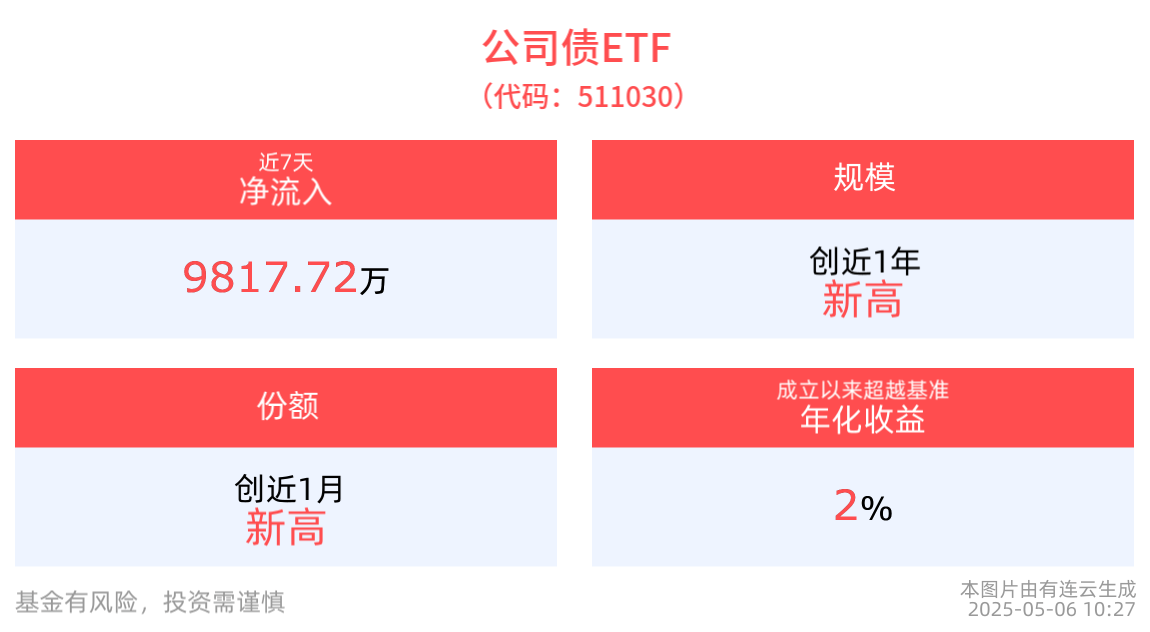
截至2025年5月6日 10:27,公司债ETF(511030)多空胶着,最新报价105.51元。拉长时间看,截至2025年4月30日,公司债ETF近半年累计上涨1.16%。 流动性方面,公司债ETF盘中换手0.33%,成交4435.83万元。拉长时间看,截至4月30日,公司债ETF近1月日均成交17.48亿元。 规模方面,公司债ETF最新规模达133.53亿元,创近1年新高。 份额方面,公司债ETF最新份额达1.27亿份,创近1月新高。 消息面上,4月制造业PMI降至49.0%,为2021年以来四月份的第二低。4月制造业PMI容易季节性回落,今年4月制造业PMI环比降幅明显好于2022年4月及 2020年2月,反映美国高关税对中国经济的影响程度可能明显好于疫情。 机构认为,未来债市需要关注中美关税谈判的进展。倘若未来半年中美达成协议将关税降至年初水平,年内10Y国债收益率高点仍可能到1.9%,2025年经济 仍有望企稳。由于关税谈判艰难,短期或难谈成,我们预计债市二季度震荡。 浙商证券认为近期债市调整仍将持续,但鉴于基本面无明确利空,货币宽松基调不变,建议按利率底部区间震荡思路交易。 流动性方面,国债ETF ...

74家公募年度合赚377.74亿元!27家营收净利双增
Bei Jing Shang Bao· 2025-05-05 14:42
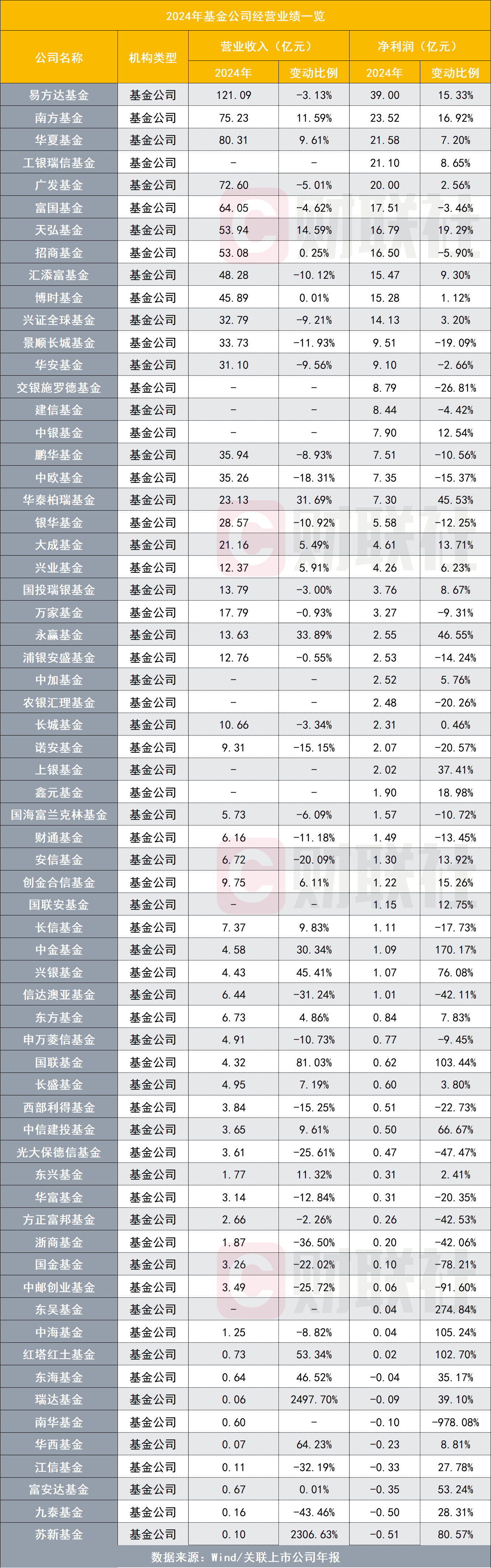
Core Insights - The 2024 annual reports of public fund companies reveal a mixed performance, with nearly half of the companies experiencing revenue growth, while 74 fund companies collectively earned a net profit of 37.774 billion yuan [1][3]. Group 1: Revenue Performance - A total of 64 fund companies reported a combined revenue of 114.148 billion yuan in 2024, with E Fund leading at 12.109 billion yuan, although it saw a slight decline of 3.13% year-on-year [2]. - Six other companies, including Huaxia Fund and Southern Fund, reported revenues exceeding 5 billion yuan, with figures of 8.031 billion yuan and 7.523 billion yuan respectively [2]. - Among the 63 companies with year-on-year data, 31 achieved revenue growth, accounting for 49.21%, with 13 companies seeing growth exceeding 20% [2]. Group 2: Net Profit Performance - The net profit of 74 fund companies totaled 37.774 billion yuan, with E Fund, Southern Fund, and Huaxia Fund leading the rankings with net profits of 3.9 billion yuan, 2.352 billion yuan, and 2.158 billion yuan respectively [3]. - Eleven companies entered the "10 billion club" for net profit, with notable growth from Tianhong Fund, which increased by 19.29% to 1.679 billion yuan [3]. - Two companies, China Ocean Fund and Hongta Hongtu Fund, turned losses into profits, while seven companies, including Nanhua Fund, reported losses [3]. Group 3: Company Strategies and Market Dynamics - The performance disparity among fund companies is attributed to factors such as product strategy iterations and market recognition of flagship products [6]. - Leading fund companies have leveraged brand reputation and comprehensive strength to better attract customers amid a fee reduction trend, while smaller firms face increased competition [7]. - Companies achieving revenue and profit growth have benefited from scale advantages, innovation capabilities, and enhanced service quality, allowing them to capture greater market share [7][8].
蚂蚁财富为何大力布局这个“小众”产品?
Hu Xiu· 2025-05-05 14:04
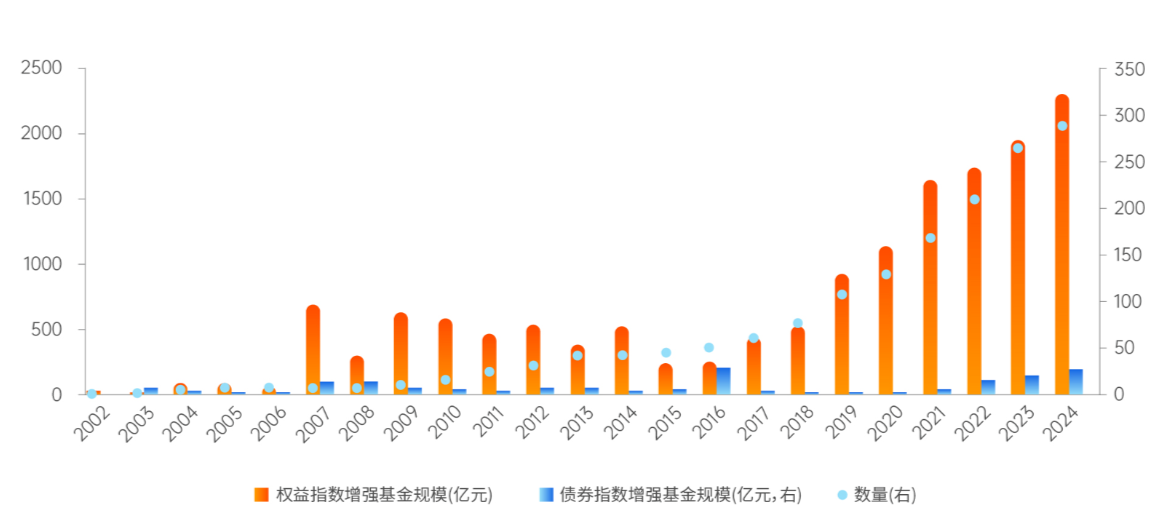
Group 1 - Public funds have been investing in GPUs for quantitative index enhancement products since several years ago [1][3] - The number of newly established and reported public index enhancement products has significantly increased this year [4][15] - Ant Group's wealth management platform has launched a comprehensive index investment service platform, enhancing product and service capabilities for index enhancement funds [5][12] Group 2 - Ant Group's wealth management platform leads the market in index fund distribution, with a total scale of 320.1 billion yuan, far surpassing competitors [6][9] - The index enhancement fund market has seen a substantial increase in attention from fund companies, with many small and medium-sized public funds focusing on this area [15][16] - The overall scale of index enhancement funds reached approximately 212.9 billion yuan by the end of 2024, showing a year-on-year growth of about 10% [18][27] Group 3 - The growth of index enhancement funds has been slower compared to ETFs, with the latter's scale increasing from 0.7 trillion yuan in 2019 to 3.78 trillion yuan in 2024 [17] - The average annual excess return of the index enhancement funds compared to the CSI 300 index is 4.3%, but only 40% of these funds have consistently outperformed the index over five years [19][28] - The complexity of strategies used by fund managers in index enhancement funds makes it challenging for investors to assess their performance [31][32]


主动权益基金前4个月最高涨超64%!这只产品继续领先
Bei Jing Shang Bao· 2025-05-05 13:51
Group 1 - The A-share market showed a mixed performance on the last trading day of April, with the Shanghai Composite Index, Shenzhen Component Index, and ChiNext Index closing at 3279.03, 9899.82, and 1948.03 points, reflecting changes of -0.23%, 0.51%, and 0.83% respectively [3] - As of the end of April, over 52% of actively managed equity funds achieved positive returns, a decrease from 75.84% at the end of March, indicating a significant performance divergence among public funds [3][4] - The top-performing fund, Penghua Carbon Neutral Theme Mixed A, achieved a return of 64.87%, with its top ten holdings primarily in the environmental equipment and AI glasses sectors [3][6] Group 2 - The performance gap between the best and worst performing funds reached 89.84 percentage points, an increase of 5 percentage points from the end of March [4] - The quarterly report revealed that the fund "Caitong Craftsman Preferred One-Year Holding Period Mixed" had an equity investment ratio of 93.58%, with significant adjustments in its top holdings, reflecting a strategic shift towards domestic AI-related investments [5] - The top ten holdings of Penghua Carbon Neutral Theme Mixed also underwent significant changes, with a focus on environmental equipment and AI glasses, and the fund's scale increased dramatically from 1.035 billion to 10.896 billion, a growth of 952.75% [6] Group 3 - The industry outlook for humanoid robots is optimistic, with expectations that 2025 will mark a significant year for embodied intelligence development, enhancing manufacturing efficiency and reducing costs [7] - Despite recent fluctuations due to trade tensions, the humanoid robot sector has shown strong growth potential, providing investment opportunities for those who missed earlier gains [7]

降费这一年,65家基金公司业绩哪家强?全排名出炉
Xin Lang Cai Jing· 2025-05-05 10:34
Core Insights - The overall net profit of 65 fund companies reached 34.115 billion yuan in 2024, an increase of 1.323 billion yuan compared to 2023 [1] - Only 39 out of the 65 fund companies reported a year-on-year increase in net profit, indicating that the majority of companies faced challenges [1] - Less than half of the companies reported a year-on-year increase in revenue, highlighting the impact of fee rate adjustments on the industry [1] Financial Performance Overview - The top 11 fund companies with net profits exceeding 1 billion yuan saw changes in their rankings, with more than half experiencing shifts [5][6] - Two companies, namely Invesco Great Wall Fund and Jiao Yin Schroder Fund, dropped out of the 1 billion yuan net profit tier compared to 2023 [13] - The net profit of Tianhong Fund increased by 19.29% to 1.679 billion yuan, marking the most significant rise among the top companies [8][11] Revenue and Profit Changes - The total management fee income for over half of the fund managers declined, with a total drop exceeding 10 billion yuan [5][14] - The fee rate reform has led to significant revenue impacts, with many companies seeking to enhance their competitive edge [5][19] - Companies like Dongwu Fund reported a remarkable net profit increase of 274.84%, while others like Nanhua Fund faced a staggering loss of 978.08% [15][18] Strategic Responses - Fund companies are focusing on refining their core competencies to adapt to the ongoing fee rate reforms and market changes [19][20] - Companies such as Huaxia Fund and Guotou Ruijin Fund are enhancing their product offerings and digital integration to maintain competitiveness [20][21] - The industry is witnessing a trend where smaller firms are showing significant profit growth, while larger firms are experiencing more pronounced absolute profit changes [18]
一季度“固收+”规模上升,超额收益吸引更多低风险投资者
Sou Hu Cai Jing· 2025-05-03 17:57
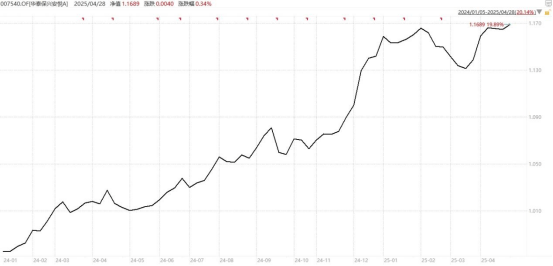
Core Viewpoint - The bond market is experiencing significant volatility in 2025, contrasting sharply with the favorable conditions of 2024, leading to disappointing returns for investors in pure bond funds [1][3]. Group 1: Bond Market Performance - In 2024, the bond market thrived under a loose monetary policy, with some pure bond funds achieving annualized returns exceeding 15%, such as Huatai Baoxing Anyue, which reached 17.96% [1][3]. - However, in the first quarter of 2025, the bond market faced tightening liquidity, resulting in a slowdown in net value growth for pure bond funds, with some even showing negative returns [3][4]. - The 10-year government bond yield saw a notable increase of approximately 30 basis points at the beginning of 2025, impacting the asset values of pure bond funds [3][4]. Group 2: "Fixed Income +" Products - In contrast to the bond market, the A-share market showed strong performance in early 2025, driven by sectors like humanoid robots and AI, benefiting "fixed income +" products that combine equity investments with bonds [4][5]. - "Fixed income +" products, which include a mix of stable bond assets and more aggressive equity investments, outperformed pure bond funds, with average returns of 0.42% compared to 0.37% for pure bond funds by April 30, 2025 [7][8]. - The total scale of "fixed income +" products saw significant growth, with several fund managers reporting increases exceeding 100 billion yuan in 2025 [8][9]. Group 3: Fund Management Strategies - Fund managers are increasingly focusing on diversified strategies to mitigate risks associated with market volatility, emphasizing the importance of a systematic approach to investment [10]. - The performance of "fixed income +" products is heavily influenced by the underlying equity assets, which can lead to greater net value fluctuations compared to pure fixed income products [11][13]. - Investors are advised to carefully select "fixed income +" products that align with their risk preferences to avoid significant deviations from expected outcomes [13].
4月多家公募“组团”自购,重金投资旗下权益产品
Huan Qiu Wang· 2025-05-02 02:27
Group 1 - Multiple public fund institutions have announced self-purchases of their equity products, reflecting confidence in the high-quality development of China's capital market and investment management capabilities since April [1] - Morgan Fund plans to invest no less than 54 million RMB of its own funds in newly launched equity public funds, with a commitment to hold for at least one year [3] - Fangzheng Fubon Fund has invested 5 million RMB of its own funds in the Fangzheng Fubon CSI All Share Free Cash Flow ETF, also committing to a holding period of at least one year [3] Group 2 - Jianxin Fund has announced an investment of no less than 180 million RMB in its equity public products, with an additional 173 million RMB already invested from Q4 2024 to Q1 2025, all with a minimum holding period of one year [3] - Guojin Fund plans to invest 15 million RMB of its own and senior management's funds in its equity funds within three months, with a commitment to hold for at least one year [4] - CITIC Construction Investment Fund has initiated a self-purchase plan of 20 million RMB, with 5 million RMB already invested and a commitment to hold for at least one year [4] Group 3 - Xingsheng Global Fund has announced a self-purchase of no less than 60 million RMB in its equity public funds, committing to a holding period of at least one year [4] - Pengyang Fund has initiated a plan to purchase 30 million RMB in its managed equity public fund products [4] - Several well-known private equity institutions, such as Inno Asset and Kuande Asset, are also actively increasing their investments in Chinese assets, indicating a full deployment of their products [4]

又一公募行业老将退休离任,年内174位新人成为基金经理
Huan Qiu Wang· 2025-05-02 02:27
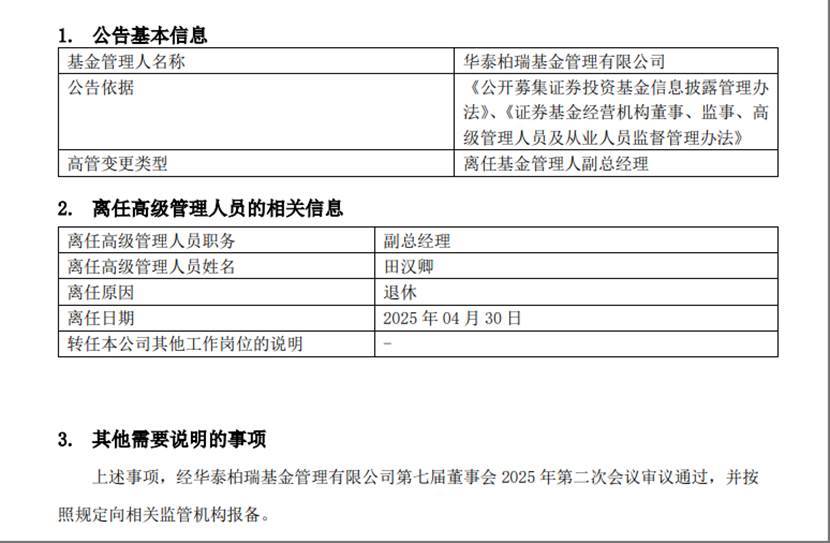
Group 1 - The core point of the news is the retirement of Tian Hanqing from his position as Deputy General Manager of Huatai-PB Fund, effective April 30, 2025, and his resignation from managing ten funds [1][3] - Tian Hanqing has a strong educational background, holding degrees from Tsinghua University and an MBA from the University of California, Berkeley, and has been a significant figure in quantitative investment [4] - Since joining Huatai-PB Fund in 2012, Tian Hanqing has managed the Huatai-PB Quantitative Enhanced Mixed A fund, achieving a return rate of 205.51% since his appointment on August 2, 2013 [4] Group 2 - The announcement of Tian Hanqing's retirement aligns with a trend in the public fund industry where senior executives and fund managers are retiring, as seen with other notable figures in the industry [4] - As of the end of April, the public fund industry has seen 174 new fund managers appointed this year, bringing the total number of fund managers in the industry to over 4,000 [4]
那些在孤独中赚钱的基金经理
雪球· 2025-05-02 00:05
Core Viewpoint - The 2024 version of the non-collaborative fund portfolio underperformed the Wind Mixed Equity Fund Index, with a return of 4.46% compared to the index's 8.86% increase, highlighting the challenges faced by many funds in adapting to the market conditions post the "9.24" rally [2][3]. Fund Performance Summary - The top-performing funds include: - China Merchants Quantitative Selection A: 18.15% - Dongfanghong New Power A: 17.64% - Other funds showed significantly lower returns, with some even reporting negative performance, such as: - Jiashi Value Selection A: -0.45% - Guotou Ruili LOF: -2.69% [5]. 2025 Version Selection Criteria - The selection rules for the 2025 version of the non-collaborative portfolio have been slightly adjusted: - All quantitative funds were excluded to avoid data interference, meaning funds like China Merchants Quantitative Selection will not be included [6]. - A requirement was set that the top industry market capitalization should be below 15% to prevent over-concentration in specific sectors [6]. - Funds must have outperformed the Wind Mixed Equity Fund Index for three consecutive years from 2022 to 2024 [7]. Non-Collaborative Fund Definition - The definition of non-collaborative funds is based on the frequency of stock holdings across funds, with a median holding frequency of less than 105 being the threshold for inclusion [9]. Final Fund List - After applying the filtering criteria, only 10 funds remained eligible for the non-collaborative portfolio, showcasing a mix of familiar and new fund managers [10][13].
破千亿!
Zhong Guo Ji Jin Bao· 2025-05-01 07:21
Core Viewpoint - The total scale of credit bond ETFs in China has surpassed 100 billion yuan for the first time, indicating a significant increase in market interest and investment in this sector [1][2]. Group 1: Market Growth - As of April 29, the total scale of credit bond ETFs reached 100.37 billion yuan, nearly doubling from 54 billion yuan at the end of last year [2]. - The rapid growth of credit bond ETFs is closely related to the issuance of the first batch of eight benchmark market-making corporate bond ETFs at the beginning of the year, which attracted over 245 billion yuan in net inflows [2][3]. - Hai Fu Tong's three products account for over 50% of the total scale, with individual scales of 32.59 billion yuan, 16.19 billion yuan, and 4.88 billion yuan respectively [2]. Group 2: Investment Demand and Product Development - The first batch of benchmark market-making credit bond ETFs primarily tracks indices with AAA-rated issuers, catering to investors seeking low-risk credit bond investments [3]. - There is a strong market demand for credit bond ETFs, and future developments may include expanding the product range to include green bonds and technology innovation bonds [3]. - The industry is also focusing on enhancing investor education to improve market participation and understanding of credit bond ETFs [3]. Group 3: Market Outlook - The foundation for a bull market in the bond market remains unchanged, although increased volatility is expected [3]. - Credit bonds are likely to follow the bullish trend of interest rate bonds, but the absolute yield levels are currently at historical lows, limiting the potential for significant yield declines [3]. - Analysts suggest that while the market may experience fluctuations, the overall direction remains favorable, and investors should consider opportunities in high-quality credit bonds [3].