自动驾驶

Search documents
小马智行、文远知行齐奔港股 Robotaxi商业化进入关键拐点
Zhong Guo Jing Ying Bao· 2025-10-20 14:52
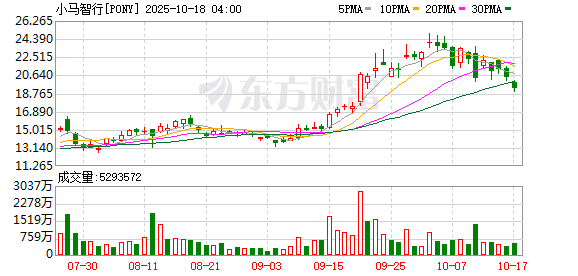
Group 1 - The China Securities Regulatory Commission has confirmed the overseas listing registration of autonomous driving company Pony.ai, which plans to issue no more than 102.1 million ordinary shares and list on the Hong Kong Stock Exchange [2] - Another leading autonomous driving company, WeRide Inc., has also received an overseas listing registration notice, intending to issue no more than 102.4 million ordinary shares for listing on the Hong Kong Stock Exchange [2] - Industry analysis suggests that leading autonomous driving companies are pursuing "dual listings" to broaden financing channels and enhance recognition in international capital markets, especially as the commercialization of Robotaxi is still in its early stages [2] Group 2 - Pacific Securities predicts that with the continuous decline in the costs of sensors, computing chips, and vehicle manufacturing, the cost per kilometer for Robotaxi is expected to drop to 2.1 yuan by 2026 and further to 1 yuan by 2030 [3] - By 2030, the market size for Robotaxi in China is expected to exceed 2.93 trillion yuan, making it one of the most commercially viable segments in autonomous driving applications [3]


争夺“港股Robotaxi第一股”,文远与小马谁将是赢家?
2 1 Shi Ji Jing Ji Bao Dao· 2025-10-20 13:24
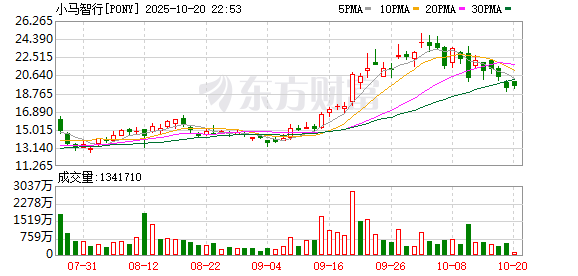
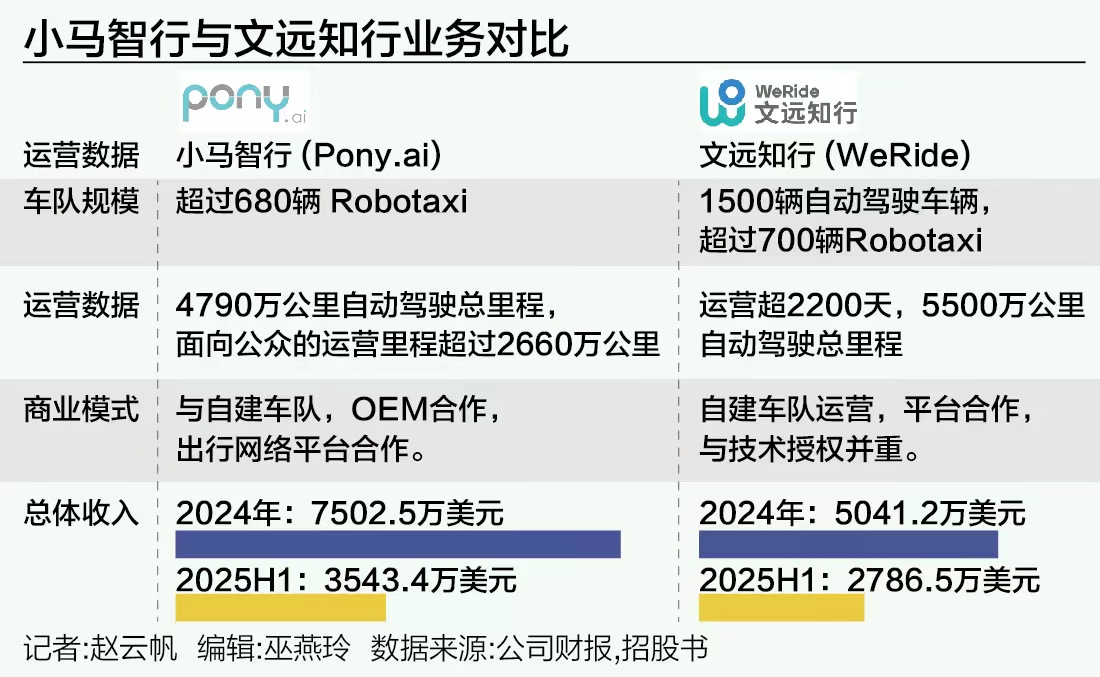
Core Viewpoint - The Chinese capital market is poised for a significant moment in the Robotaxi industry, with Pony.AI and WeRide successfully completing their IPO filings in Hong Kong on October 14 [1] Group 1: IPO and Market Position - Pony.AI and WeRide are set to issue 102.1 million and 102.4 million new shares, respectively, on the Hong Kong Stock Exchange [2] - Both companies have been on parallel paths in their market capitalization and commercialization processes, with WeRide expected to list on NASDAQ in October 2024, followed by Pony.AI in November 2024 [2] - The competition for the title of "first Robotaxi stock" in Hong Kong raises questions about market outlook for both companies [3] Group 2: Operational Data - Pony.AI operates a fleet of over 680 autonomous taxis, with a total autonomous driving mileage exceeding 47.9 million kilometers, and public-facing service mileage of over 26.6 million kilometers [5] - WeRide operates over 700 autonomous taxis, with a total of more than 1,500 autonomous vehicles, including 1,108 owned vehicles and 415 from partners [5] - WeRide has accumulated 2,200 days of continuous operation for its Robotaxi services [6] Group 3: Strategic Focus - Pony.AI has a stronger focus on domestic markets, holding all necessary regulatory permits to operate in four major cities: Beijing, Guangzhou, Shenzhen, and Shanghai [7] - WeRide has a more advanced international presence, operating in 11 countries and over 30 cities, and is the only company with autonomous driving licenses in seven countries [7] Group 4: Revenue and Business Model - In 2024, Pony.AI's revenue from Robotaxi services is projected to be $7.5 million, while WeRide's is expected to be $5.0 million [8] - WeRide's Robotaxi service revenue has increased from $667,700 in 2024 to $865,900 in the first half of 2025, indicating a rising revenue share [9] - Conversely, Pony.AI's Robotaxi service revenue is projected to decrease from $726,600 in 2024 to $325,600 in the first half of 2025 [10] Group 5: Partnerships and Collaborations - Pony.AI has formed a deep partnership with China National Foreign Trade Transportation Group to explore the autonomous freight market [11] - WeRide is focusing on international partnerships, including collaborations with the Abu Dhabi Investment Authority and Saudi Arabia's Public Investment Fund to enhance its operational capabilities [11] Group 6: Regulatory Environment - The regulatory landscape for Robotaxi services in China is evolving, with a more structured approach to approvals and commercial operations in major cities [12] - The industry is transitioning towards a more mature operational phase, with expectations for significant growth in the coming years [12]
Karpathy 回应争议:RL 不是真的不行,Agent 还需要十年的预测其实很乐观
Founder Park· 2025-10-20 12:45
Group 1 - The core viewpoint expressed by Andrej Karpathy is that the development of Artificial General Intelligence (AGI) is still a long way off, with a timeline of approximately ten years being considered optimistic in the current hype environment [10][21][23] - Karpathy acknowledges the significant progress made in Large Language Models (LLMs) but emphasizes that there is still a considerable amount of work required to create AI that can outperform humans in any job [11][12] - He critiques the current state of LLMs, suggesting they have cognitive flaws and are overly reliant on pre-training data, which may not be a sustainable learning method [13][14] Group 2 - Karpathy expresses skepticism about the effectiveness of reinforcement learning (RL), arguing that it has a poor signal-to-noise ratio and is often misapplied [15][16] - He proposes that future learning paradigms should focus on agentic interaction rather than solely relying on RL, indicating a shift towards more effective learning mechanisms [15][16] - The concept of a "cognitive core" is introduced, suggesting that LLMs should be simplified to enhance their generalization capabilities, moving away from excessive memory reliance [19] Group 3 - Karpathy critiques the current development of autonomous agents, advocating for a more collaborative approach where LLMs assist rather than operate independently [20][21] - He believes that the next decade will be crucial for the evolution of agents, with significant improvements expected in their capabilities [21][22] - The discussion highlights the need for realistic expectations regarding the abilities of agents, warning against overestimating their current capabilities [20][21] Group 4 - Karpathy emphasizes the importance of understanding the limitations of LLMs in coding tasks, noting that they often misinterpret the context and produce suboptimal code [47][48] - He points out that while LLMs can assist in certain coding scenarios, they struggle with unique or complex implementations that deviate from common patterns [48][49] - The conversation reveals a gap between the capabilities of LLMs and the expectations for their role in software development, indicating a need for further advancements [52]

智通港股解盘 | 和谈曙光再现恒指一致看多 本周重磅会议值得期待
Zhi Tong Cai Jing· 2025-10-20 12:31
Group 1: Market Reactions and Economic Data - The Hong Kong stock market showed a strong rebound, with the Hang Seng Index rising by 2.42% [1] - The U.S. government shutdown continues, leading to increased public dissatisfaction, highlighted by a nationwide protest involving approximately 7 million participants [1] - China's economic data for the first three quarters of 2025 shows a GDP of 10,150.36 billion yuan, with a year-on-year growth of 5.2%, although consumption and investment have declined [3] Group 2: Robotics and Technology Developments - Yubiquitous Technology secured a contract worth 126 million yuan for the procurement of humanoid robots, adding to its significant order backlog of over 630 million yuan for the Walker series [4] - The robotics sector is experiencing growth, with companies like Yushutech reporting substantial sales figures and aiming for increased production in the coming year [3][4] Group 3: Stock Buybacks and Market Performance - Companies engaging in significant stock buybacks, such as China Resources Gas, are seeing positive market reactions, with shares rising over 4% [5] - Sanhua Intelligent Control announced an increase in its share repurchase price cap, leading to an 8% rise in its stock price [4] Group 4: Shipping and Aviation Industry Trends - The global shipping industry is undergoing a significant reshuffle due to new port fees, benefiting companies like COSCO Shipping Energy, which saw an 8% increase in stock price [6] - The aviation sector is also thriving, with China Eastern Airlines reporting a 9% increase in stock price, driven by a strategic focus on international routes [6] Group 5: IPOs and Investment in Technology - The rapid IPO process for Muxi Integrated Circuit indicates strong regulatory support for technology firms, with related companies experiencing stock price increases [7] - MINIEYE's successful bid for an autonomous driving project marks a significant step in the commercialization of its technology, leading to a 7% rise in its stock price [7] Group 6: Tourism and Hospitality Sector Insights - The tourism industry shows steady demand, with hotel average daily rates and revenue per available room experiencing positive growth, although supply pressures remain [8] - Analysts are optimistic about the Macau gaming sector, particularly for companies like Sands China and Galaxy Entertainment, due to low revenue baselines [8] Group 7: Company Performance and Global Expansion - Shenzhou International reported a revenue increase of 15.3% year-on-year, driven by strong performance in leisure and overseas markets [9] - The company is expanding its global production capacity, with overseas factories accounting for approximately 53% of total garment output [9][10]


谁将成为“Robotaxi港股第一股”?
Shen Zhen Shang Bao· 2025-10-20 11:45
Core Insights - Pony AI Inc. and WeRide Inc. have successfully passed the Hong Kong Stock Exchange hearing, marking a significant milestone in their IPO process [1] - Both companies are set to go public in the U.S. in 2024, with their dual listing in Hong Kong seen as a strategic move to broaden financing channels [1] - The China Securities Regulatory Commission issued a notice for both companies' overseas issuance and listing, with Pony AI planning to issue up to 102,146,500 shares and WeRide up to 102,428,200 shares [1] Company Comparisons - Both companies share similarities in their founding teams and technological focus, having been established just a year apart, with Pony AI founded in 2016 and WeRide in 2017 [2] - Pony AI focuses on Robotaxi services and has partnerships with major automotive companies, while WeRide has diversified into five product lines including Robotaxi, Robobus, and Robovan [3] - In terms of revenue, WeRide reported Q2 2025 revenue of 127 million yuan, a 60.8% year-on-year increase, while Pony AI's revenue for the first half of 2025 reached 35.43 million USD (approximately 251 million yuan), a 43.3% increase [3] Financial and Investment Insights - WeRide's Robotaxi business saw a remarkable revenue growth of 836.7% in Q2 2025, contributing 36.1% to its total revenue [3] - Pony AI's Robotaxi revenue surged by 178.8% in the first half of 2025, amounting to 3.256 million USD (approximately 23.1 million yuan) [3] - WeRide has secured significant investments from major players like Uber, which has committed to invest 100 million USD, and has also attracted investments from Nvidia, Bosch, Renault, and Nissan [5] Market Outlook - The dual IPOs are expected to enhance financing capabilities and attract more investors from the Asian market, while also providing a buffer against geopolitical risks [7] - The global Robotaxi service market is projected to reach 66.6 billion USD by 2030, with a compound annual growth rate of 195.6% from 2025 to 2030 [7] - As leaders in the commercialization of Robotaxi services, both companies are positioned to benefit from the industry's growth and market opportunities [7]
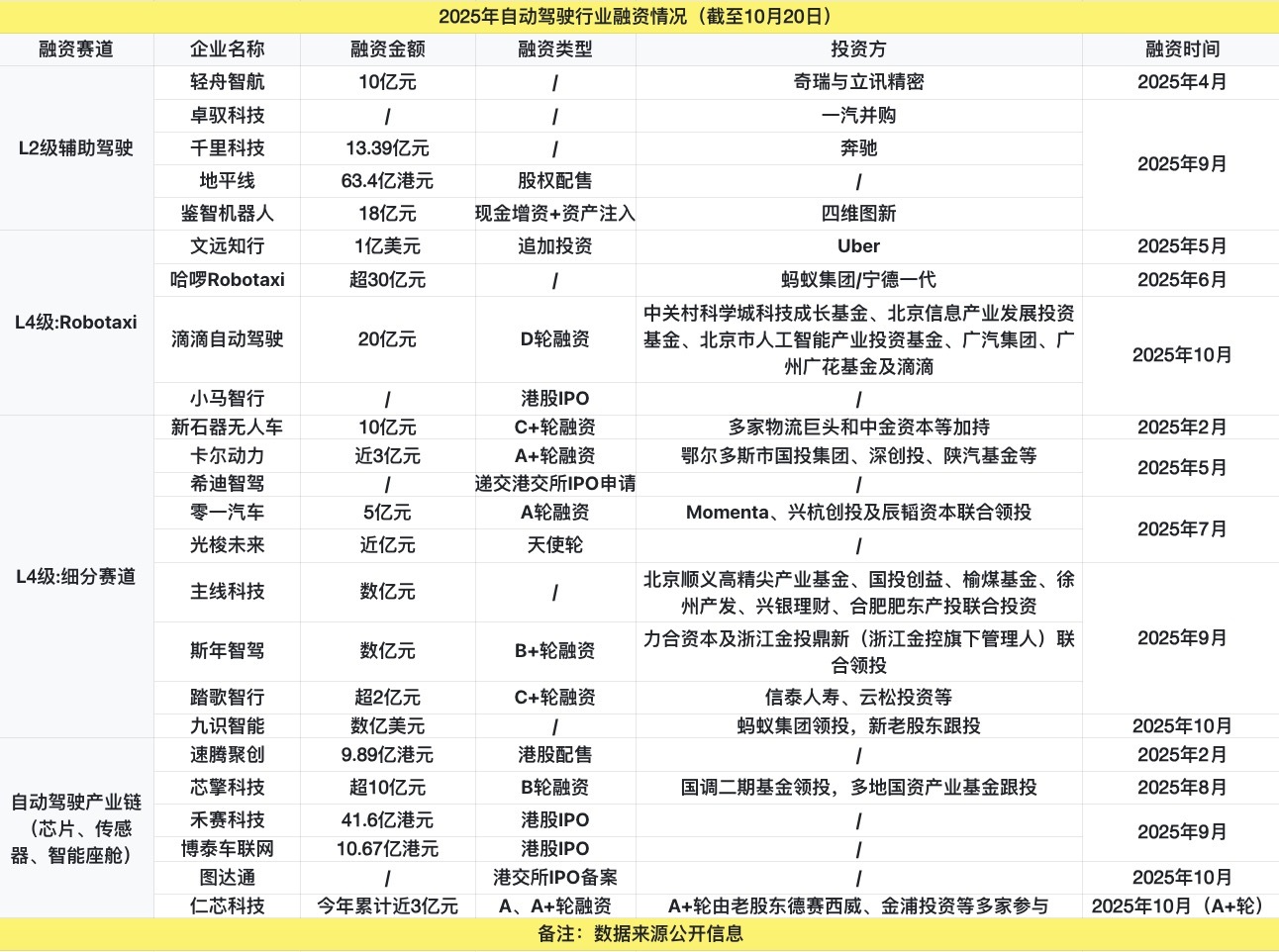
自动驾驶再现融资热,24起融资超350亿元,但行业尚未进入盈利期
Mei Ri Jing Ji Xin Wen· 2025-10-20 11:30
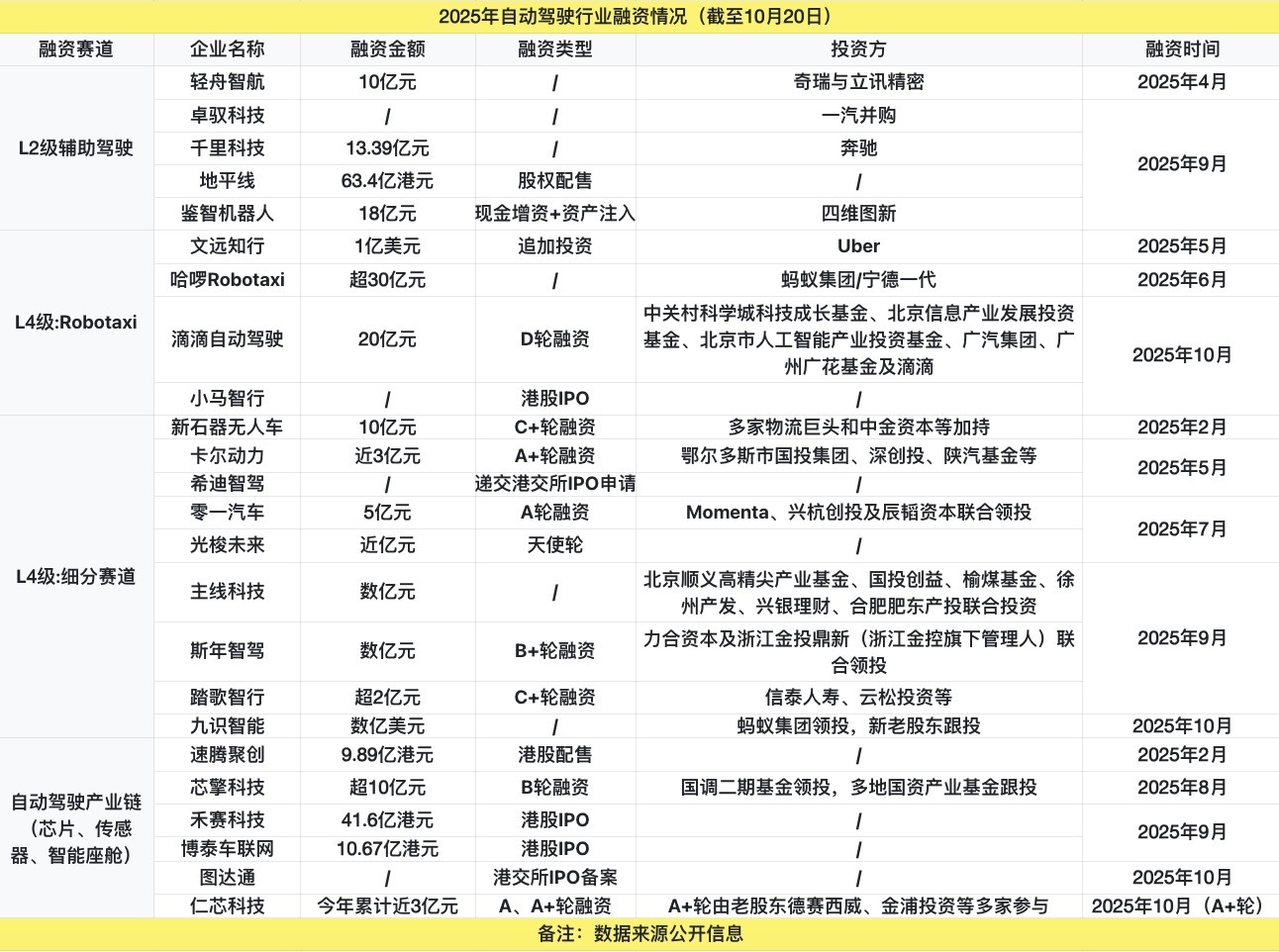
Core Insights - The autonomous driving industry is experiencing a significant resurgence in investment, with over 100 billion RMB raised in 11 financing events in the past month alone, totaling 350 billion RMB for the year as of October 20, 2025, indicating a strong recovery from the previous three years of capital winter [1][2][6] - The financing landscape is characterized by a preference for companies with clear application scenarios, with state-owned and industrial capital increasingly replacing traditional financial investors as key drivers of industry development [6][7] Financing Overview - As of October 20, 2025, there have been 24 financing events in the autonomous driving sector, with a total amount exceeding 350 billion RMB, including 10 events with disclosed amounts of 10 million RMB or more, accounting for 50% of the total financing [2][3] - The L2 level assisted driving segment has seen five financing events, with the largest being Horizon Robotics raising approximately 58.12 billion RMB through a share placement [2][3] - The Robotaxi segment has attracted significant investment, with notable financing events including Didi's 20 billion RMB Series D round and Hello's over 30 billion RMB funding [3][4] Market Dynamics - The L4 level autonomous driving sector is entering a phase of accelerated commercialization, particularly in specific scenarios such as mining and logistics, with nine companies raising over 30 billion RMB [4][6] - The supply chain for autonomous driving, particularly in chips and lidar technology, has also seen substantial financing, with companies like Hesai Technology raising approximately 38 billion RMB through an IPO [4][6] Policy and Technological Support - The autonomous driving industry is supported by a surge in relevant policies, with over 71 policies released in the first half of 2025, including national-level approvals for L3 vehicle production [7][8] - Technological advancements and increased market acceptance are crucial for commercial viability, with L2 level assisted driving penetration exceeding 50% in China, the highest globally [7][8] Financial Performance and Challenges - Despite the financing boom, many companies in the autonomous driving sector remain unprofitable, with significant losses reported alongside revenue growth, indicating ongoing challenges in achieving stable profitability [8][10] - Companies like Horizon Robotics reported a revenue of 1.567 billion RMB in the first half of 2025, a 67.6% increase, but also faced a loss of 5.233 billion RMB, highlighting the financial strain in the industry [8][10] Future Outlook - The market for intelligent connected vehicles in China is projected to grow from 161.1 billion RMB in 2023 to 222.3 billion RMB by 2025, with expectations that China will become the largest autonomous driving market globally by 2030 [10][11] - The emphasis on safety and the gradual expansion of application scenarios for autonomous driving technologies are critical for the industry's future development [11]
自动驾驶再现融资热!24起融资超350亿元,但行业尚未进入盈利期
Mei Ri Jing Ji Xin Wen· 2025-10-20 11:01
Core Insights - The autonomous driving industry is experiencing a significant resurgence in investment, with over 100 billion RMB raised in 11 financing events in the past month alone, and a total of 24 financing events exceeding 350 billion RMB since the beginning of 2025, indicating a strong recovery from the previous three years of capital winter [1][2][7] Financing Overview - The 24 financing events cover four main areas: L2 level assisted driving, L4 level subfields, Robotaxi, and the autonomous driving supply chain, with 10 events having disclosed amounts of 1 billion RMB or more, accounting for 50% of the total financing [2][5] - Notable financing events include Horizon Robotics raising approximately 58.12 billion RMB through share placement, and a strategic investment of 18 billion RMB by NavInfo in PhiGent Robotics to enhance its high-level intelligent driving technology [2][3] Sector-Specific Highlights - The Robotaxi sector has attracted significant investment, with Didi Autonomous Driving securing 20 billion RMB in D round financing and Hello announcing over 30 billion RMB in funding for its entry into the field [5][6] - In the autonomous driving supply chain, chip companies like Chipone Technology raised over 10 billion RMB in B round financing, while Hesai Technology raised approximately 38 billion RMB through a Hong Kong IPO [6][7] Policy and Market Dynamics - The financing landscape is characterized by a shift towards companies with clear application scenarios, with state-owned and industrial capital becoming key drivers of industry development, replacing traditional financial investors [7][8] - The period from 2024 to 2025 has seen a significant increase in policy support, with over 71 relevant policies released in the first half of 2025 alone, including national-level approvals for L3 vehicle production [8][9] Industry Challenges - Despite the influx of capital, most companies in the autonomous driving sector remain in a phase of continuous investment without profitability, with significant losses reported by leading firms such as Horizon Robotics and Pony.ai [9][10] - The industry is expected to face challenges in converting substantial R&D investments into revenue, as the maturity of technology and commercialization processes remain uncertain [9][10] Future Outlook - The market for intelligent connected vehicles in China is projected to grow from 161.1 billion RMB in 2023 to 222.3 billion RMB by 2025, with expectations that China will become the largest autonomous driving market globally by 2030, generating over 500 billion USD in revenue from new car sales and mobility services [10][12]
淘汰赛进入倒计时!Momenta曹旭东:明年中国城市辅助驾驶仅存两三家玩家,全球可能就三四家【附自动驾驶行业市场分析】
Qian Zhan Wang· 2025-10-20 10:26
Core Viewpoint - The CEO of Momenta, Cao Xudong, predicts that the landscape of urban assisted driving will stabilize next year, with only two to three players remaining in China and three to four globally [2]. Group 1: Autonomous Driving Levels - Autonomous driving is categorized into six levels according to the SAE standards, with Level 0 being fully human-driven and Level 5 representing complete automation without human intervention [2][3]. - Level 4 is considered "unmanned driving" in specified scenarios, while Level 5 is the ultimate goal of full automation across all environments [2]. Group 2: Industry Approaches - Traditional automakers adopt a "gradual" approach, starting with lower levels of assisted driving (L1/L2) and progressively enhancing their capabilities [6]. - In contrast, tech companies like Baidu and Huawei pursue a "leapfrog" strategy, aiming directly for higher levels (L4 and L5) due to their strengths in technology and data processing [6]. Group 3: Challenges in Development - The development of L4 and L5 faces significant challenges, including the need for substantial funding, high-tech talent, and a long-term focus on R&D [7]. - Automakers often collaborate with tech companies to leverage mutual strengths in developing autonomous driving technologies [7]. Group 4: Current Industry Landscape - Various companies are at different levels of autonomous driving capabilities, with traditional manufacturers like BYD at L2 and tech firms like Baidu and Huawei at L4/L5 [8]. - New entrants in the automotive sector, such as NIO and Xpeng, are targeting L3 development, while startups like Zhixing and Pony.ai are also focusing on L4/L5 [8]. Group 5: Future Predictions - The transition to fully autonomous driving (L5) is expected to take 8-10 years, with significant barriers in regulations, data, computing power, and liability recognition [10]. - The current phase of assisted driving is viewed as a long-term transitional solution until L5 becomes a reality, which may lead to a significant reduction in private car ownership [10].
全球Robotaxi第一股文远知行通过港交所聆讯:计划通过18C完成在港双重上市
Sou Hu Cai Jing· 2025-10-20 09:46
Core Insights - WeRide Inc. has successfully passed the Hong Kong Stock Exchange hearing and disclosed its post-hearing information on October 19, with CICC and Morgan Stanley serving as joint sponsors [2] Group 1: Company Overview - Founded in 2017, WeRide is the only technology company globally that holds autonomous driving licenses in seven countries: China, UAE, Singapore, France, the USA, Saudi Arabia, and Belgium [5] - The company has expanded its autonomous driving research, testing, and operations in over 30 cities across 11 countries [5] Group 2: Business Expansion - WeRide announced a partnership with Southeast Asian super app Grab to launch its first consumer-facing autonomous driving service in Singapore on September 22 [5] - On September 19, WeRide's Robobus received Belgium's first Level 4 autonomous driving license, further solidifying its status as a leader in the autonomous driving sector [5] - The company launched Saudi Arabia's first Robotaxi trial operation in Riyadh on July 23, marking its third market in collaboration with Uber, with plans to expand to 15 additional cities over the next five years [5] Group 3: Financial Performance - In Q2 2025, WeRide reported revenue of 127 million yuan, a year-on-year increase of 60.8%, with Robotaxi business revenue soaring by 836.7% to 45.9 million yuan [5] Group 4: Investment and Market Outlook - WeRide secured additional investments from major international mobility platforms, including a $100 million equity investment from Uber and several million dollars from Grab [6] - Citigroup raised WeRide's target price to $18.2 and initiated a 30-day upward catalyst observation period, citing the increasing number of Robotaxi deployments and ongoing collaboration with Uber as key growth drivers [7]

小马智行、文远知行争夺“Robotaxi港股第一股” 行业迎来商业化关键拐点
Xin Hua Cai Jing· 2025-10-20 09:28
Core Insights - Pony AI Inc. and WeRide Inc. are set to become the first "Robotaxi" companies to go public in Hong Kong, indicating that autonomous driving technology has reached a level of maturity, transitioning from technical validation to commercial scalability [2][3] Group 1: IPO and Market Context - The simultaneous IPOs of Pony AI and WeRide are influenced by the acceleration of L4 autonomous driving commercialization in China, with multiple regions granting licenses for fully autonomous testing and operations, enhancing regulatory certainty for their listings [2] - The Hong Kong market is more sensitive to domestic policies, which helps in aligning growth expectations for these companies, as their core revenues are derived from domestic Robotaxi projects [2][3] - The need for continuous investment in fleet expansion, computational infrastructure, and data integration makes Hong Kong a suitable market for raising long-term R&D funds [2][3] Group 2: Business Models and Financial Performance - Pony AI focuses on L4 autonomous driving with a dual-engine approach of "Robotaxi + Robotruck," generating revenue from three main segments: Robotaxi services, Robotruck services, and technology licensing [3] - WeRide adopts a diversified strategy with a product matrix that includes Robotaxi, Robobus, and Robovan, generating revenue from product sales and service offerings related to L4 autonomous driving [3] - In Q2 2025, Pony AI reported revenues of 154 million yuan, a year-on-year increase of 75.9%, while WeRide reported revenues of 127 million yuan, up 60.8% year-on-year, indicating that Pony AI has a larger revenue scale and higher growth rate [4] - Both companies are currently unprofitable, with Pony AI reporting a loss of 382 million yuan and WeRide a loss of 406 million yuan, highlighting the challenges in commercializing autonomous driving despite technological maturity [4] Group 3: Market Potential and Trends - The Robotaxi market is seen as having vast potential, currently at a critical juncture from technical validation to commercial scalability, with the cost of lidar technology dropping to 4,000 yuan and vehicle costs nearing breakeven [4] - The Chinese government has opened 32,000 kilometers of testing roads, facilitating the growth of the Robotaxi market [4] - Emerging business models such as B2B2C collaborations, subscription services, and dynamic pricing are being implemented to accelerate user adoption [4] - The Robotaxi sector, projected to be a trillion-yuan market, has attracted numerous companies, including Didi Chuxing, Pony AI, WeRide, and others [4][5]