
纺织服装

Search documents
关税应对策略三部曲(二):柳暗花明
Changjiang Securities· 2025-05-07 12:11
Group 1 - The report highlights that after the tariff increases in 2019, domestic counter-cyclical policies and easing external pressures contributed to a bullish equity market. The "export chain" continues to show significant excess returns, indicating a potential "spring" for exports [4][6][8] - The report notes that the tariffs imposed during the Trump administration altered the export structure but did not significantly change export competitiveness. The share of Chinese exports in global exports showed resilience, recovering from 12.8% in 2017 to 14.2% in 2023 [6][30][18] - The report emphasizes that the market's risk appetite will continue to rise, contingent on policy changes, including potential liquidity releases by the Federal Reserve and significant shifts in domestic export data [4][9][6] Group 2 - The report identifies that the "golden pit" of tariff opportunities should be closely monitored, especially if there are signs of policy easing, such as phase exemptions or progress in bilateral negotiations [9][8][6] - The analysis indicates that during the tariff implementation periods, there were notable "export rush" phenomena, particularly in the periods surrounding the announcements and implementations of tariffs [7][8][64] - The report suggests that companies with high exposure to the U.S. market (over 30%) performed better during the "export rush" periods, particularly in industries like industrial machinery and semiconductors [8][7][6]
外贸优品成了市民“心头好”
Bei Jing Wan Bao· 2025-05-07 07:51
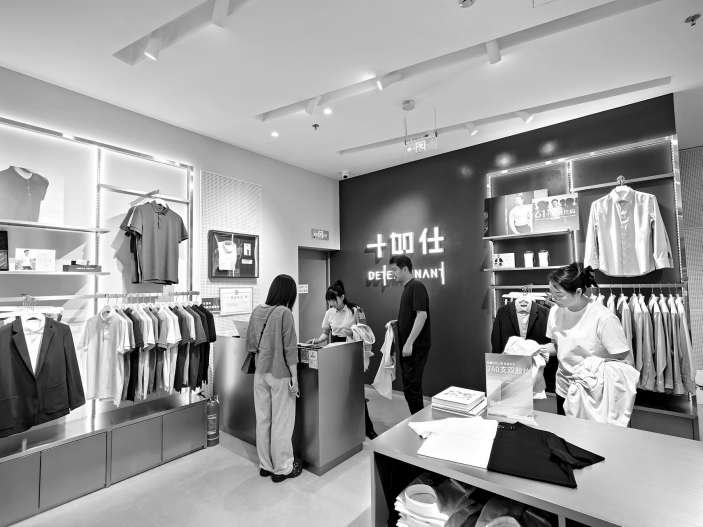
Core Viewpoint - The article highlights the shift of foreign trade companies towards domestic sales due to changes in international trade dynamics, particularly the impact of U.S. tariffs, allowing domestic consumers to access high-quality products at lower prices [1][2]. Group 1: Company Strategies - Yida Group, originally focused on foreign trade, has transitioned to building its own brand after being placed on the U.S. entity list due to its use of Xinjiang cotton [2]. - The company has diversified its product offerings from basic white shirts to a wider range including suits and casual wear, responding to domestic consumer preferences [2]. - Ningbo Today Food Co., Ltd. has shifted its focus to the domestic market after U.S. tariffs, launching new products tailored to local tastes [5][6]. Group 2: Market Dynamics - The domestic market presents challenges for foreign trade companies, including the need for flexibility and rapid response to consumer demands, contrasting with the stability of foreign orders [2]. - The price competitiveness of domestic products is evident, with examples such as canned tuna being sold at approximately 80% less than similar products in the U.S. [5]. - Companies are increasingly recognizing that domestic consumers are open to new brands, which allows for greater market opportunities [7]. Group 3: Regulatory and Supportive Environment - Companies like Ningxia Wofu Baier have faced challenges in rebranding and adapting to domestic market requirements, including packaging changes and brand recognition [10][11]. - Local government support, such as subsidies and loan interest reductions, has been crucial for companies transitioning to domestic sales [11]. - The integration of domestic and foreign trade strategies is emphasized, with companies advised to diversify their market presence to mitigate risks associated with reliance on a single market [12][13].

资产配置专题:价值链视角:中美贸易新变局
Huachuang Securities· 2025-05-07 03:06
Group 1 - The report highlights a significant shift in the US-China trade dynamics since the implementation of Trump's tariffs, with the share of US imports from China dropping from 21.6% in 2017 to 13.4% in 2024, indicating a rapid "de-China-ization" trend [11][13][31] - Conversely, China's exports to the US have increased by 22% from 2017 to 2024, with the export value rising from 429.8 billion USD to 524.7 billion USD, showcasing a contrasting trend in trade statistics [11][12][31] - The report notes that the indirect value added from China in US imports has grown significantly, from 75.3 billion USD in 2017 to 148.9 billion USD in 2024, a 97.7% increase, indicating resilience in the value chain despite direct trade reductions [26][27][31] Group 2 - The analysis indicates that the US's attempts to decouple from China have not significantly reduced the overall trade linkages, with the indirect trade connections through value chains largely compensating for the decline in direct trade [4][31][32] - The report discusses the impact of Trump's tariffs on global supply chains, particularly highlighting that labor-intensive products, which are most affected by tariffs, are the least likely to return to the US [5][37][41] - It emphasizes that the diversification of supply chains is becoming essential for US importers to mitigate tariff risks, particularly in labor-intensive industries, which are expected to accelerate their dispersal [5][48][50]
五一消费延续回暖态势!恒生消费ETF(159699)昨日重拾升势,规模创近1月新高
Sou Hu Cai Jing· 2025-05-07 01:37
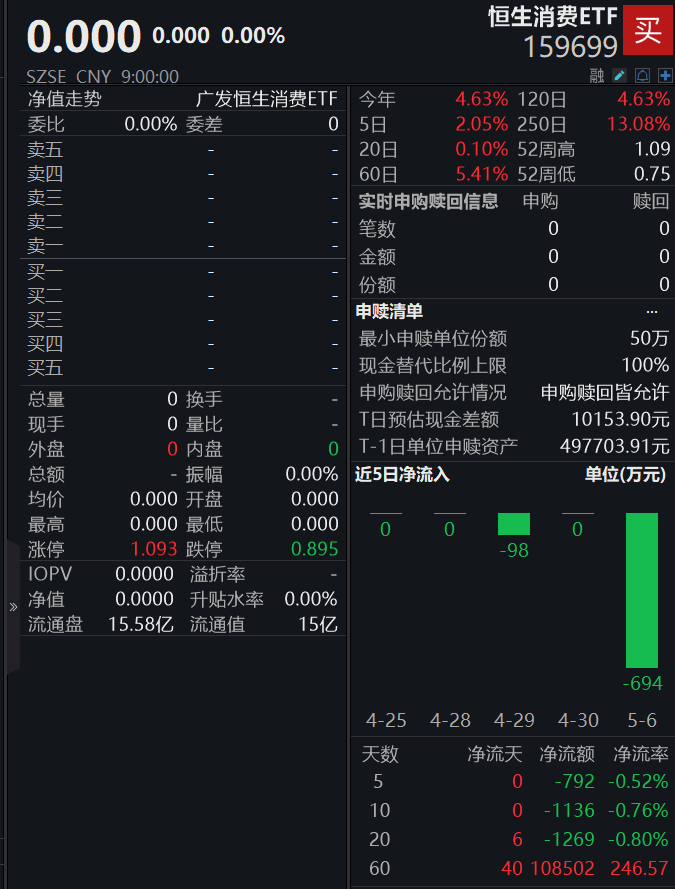
Group 1 - The core viewpoint of the article highlights a significant increase in consumer spending during the May Day holiday, with total expenditure reaching 180.27 billion yuan, a year-on-year growth of 8.0% [1] - The number of cross-regional travelers exceeded 1.465 billion, marking a 7.9% increase compared to the previous year, indicating a robust recovery in domestic tourism [1] - Key retail and catering enterprises reported a sales increase of 6.3% year-on-year during the holiday period, reflecting strong consumer demand [1] Group 2 - The Hang Seng Consumption ETF (159699) saw a rise of 1.33% as of May 6, 2025, with a cumulative increase of 3.65% over the past two weeks, indicating positive market sentiment towards consumer stocks [1] - The ETF's latest scale reached 1.544 billion yuan, a new high in the past month, with significant leverage funds continuing to invest [1] - The financing buy-in amount for the ETF was 5.3328 million yuan, with a financing balance of 4.4631 million yuan, showcasing strong investor interest [1] Group 3 - Huatai Securities reports that the hotel industry is experiencing a recovery with both volume and price increasing, driven by the demand from the lower-tier markets and improved quality-price ratios [3] - The report anticipates a narrowing decline in duty-free sales due to promotional activities and tax rebate policies in Hainan, suggesting a positive outlook for the consumption sector [3] - The firm maintains a favorable view on the consumer sector's fundamentals improving throughout 2025, driven by various consumption stimulus policies [3][4] Group 4 - Shenwan Hongyuan Securities emphasizes the importance of consumption promotion policies in stabilizing growth amid external pressures, categorizing these policies into direct and indirect support measures [5] - Direct measures include subsidies and consumption vouchers, while indirect measures involve tax reductions and fee exemptions, particularly targeting large consumer goods [5] Group 5 - The Hang Seng Consumption ETF (159699) is positioned to benefit from new consumption stimulus policies and supports T+0 trading, focusing on four major sectors: food and beverages, textiles and apparel, home appliances, and tourism [6][8] - The ETF includes leading consumer companies with strong domestic recognition, such as Li Ning, Anta, and Haidilao, providing a diversified investment opportunity [7] - The ETF is noted for its significant scale and flexibility, making it a prominent choice in the Hong Kong market for investors looking to capitalize on consumer trends [8][9]
中金:关税如何影响行业配置?
中金点睛· 2025-05-06 23:34
Core Viewpoint - The article discusses the impact of the recent "reciprocal tariffs" announced by Trump on the global market, particularly focusing on the Chinese market and its recovery trends following the initial shock [1][3]. Market Performance Summary - Following the announcement of tariffs on April 2, the Hong Kong stock market experienced significant volatility, with a notable drop on April 7 that erased all gains for the year. However, by May 2, the Hang Seng Tech Index rebounded by 19.1%, while MSCI China, Hang Seng Index, and Hang Seng China Enterprises Index saw rebounds of 13.6%, 13.5%, and 13.3% respectively. The Shanghai Composite Index and CSI 300 had smaller rebounds of 5.9% and 5.0% [1]. - Sector performance from April 8 to May 2 showed that Information Technology (+29.0%), Healthcare (+19.2%), and Consumer Discretionary (+14.3%) led the gains, while sectors like Banking (+4.9%), Utilities (+5.6%), and Energy (+5.9%) lagged behind [1]. Industry Analysis Framework - The article proposes an industry analysis framework based on demand sources, categorizing industries into three main types: 1. Industries primarily dependent on the U.S. market, which face significant challenges in finding alternative demand. 2. Industries with demand from markets outside the U.S., which are less directly affected by U.S. tariffs. 3. Industries with domestic demand, which are influenced by domestic policy support [4][6]. Impact of Tariffs on Different Industries - Industries with primary demand from the U.S. are categorized based on their ability to find alternative markets and their bargaining power. Sectors like Media, Software Services, and Textiles have shown resilience due to higher profit margins and U.S. import dependency, while smaller firms in shipping and medical supplies face greater challenges [6][10]. - Industries with demand from other markets, particularly those with established market shares and competitive advantages, are expected to perform better. Sectors such as Technology Hardware and Home Appliances have shown potential for growth in non-U.S. markets [11][14]. - Domestic demand-driven industries, particularly in consumption and infrastructure, are closely tied to government policy support. The article highlights the importance of fiscal measures to mitigate external shocks [18][20]. Historical Context and Future Outlook - The article draws parallels with the 2018-2019 trade tensions, noting that the current market dynamics reflect similar patterns of initial decline followed by recovery phases. The sectors that are less dependent on U.S. demand have shown more resilience, while those heavily reliant on U.S. markets have faced significant declines [21][25]. - The potential impact of tariffs on GDP and corporate profits is discussed, with estimates suggesting that a significant drop in exports to the U.S. could lead to a decline in GDP growth and a downward adjustment in profit forecasts for Hong Kong stocks [34][35]. - The article concludes with a projection of market indices under different scenarios, emphasizing the need for policy support to counterbalance the negative effects of tariffs and the importance of sector-specific strategies for investors [37].

2024年北交所上市公司持续回报投资者,分红回购传递发展信心
Xin Jing Bao· 2025-05-06 12:19
随着"并购六条"等多项政策落地,上市公司积极运用融资并购等工具激发创新活力,发展新质生产力。 北交所已有5家上市公司完成再融资,累计融资13.50亿元,3家公司拟发行定向可转债,拟募资金额3.7 亿元,助力企业创新研发,扩大生产规模,实现高质量发展。目前已有3家公司完成重大资产重组,1家 公司拟发行股份购买资产,多家公司通过产业并购获取关键资源,寻求第二增长曲线。纸质包装企业佳 合科技积极"走出去",收购越南同行业纸制品企业股权,助力抢占东南亚市场机遇,去年净利润增长 64.07%。 年报披露后,全部北交所上市公司均将召开年报业绩说明会,提供手机app、微信小程序等多种移动端 参会渠道,提升投资者参与的便利性;积极参与"专精特新""创新成长"等系列主题日活动,传递高质量 发展声音。 资本市场工具助力,赋能企业高质量发展 截至5月6日,北京证券交易所(简称"北交所")全部265家上市公司2024年年报披露工作圆满收官。 2024年报披露期间,超9成盈利公司披露分红预案,叠加中期分红,2024年共计分红金额59.68亿元,占 上市公司净利润的43%。其中超3成公司分红占当期净利润的比例超过50%,32家公司一年多 ...
新华锦:美国关税政策反复及不确定性将对公司造成不利影响
news flash· 2025-05-06 10:51
新华锦(600735)发布股票交易异常波动公告,经自查及发函问询控股股东、实际控制人,公司不存在 应披露而未披露的重大信息。公司控股股东及其一致行动人股份质押比例较高,累计质押公司股份1.82 亿股,占其持股总数的98.02%,占公司总股本的42.43%。公司目前一切生产经营情况正常,内部生产 经营秩序良好,日常经营情况未发生重大变化。美国关税政策的反复及不确定性,将对公司的发制品、 纺织服装出口业务造成不利影响,敬请投资者关注该风险。 ...

2连板新华锦:美国关税政策的反复及不确定性将对公司的发制品、纺织服装出口业务造成不利影响
news flash· 2025-05-06 10:49
2连板新华锦:美国关税政策的反复及不确定性将对公司的发制品、纺织服装出口业务造成不利影响 智通财经5月6日电,新华锦(600735.SH)发布异动公告,经自查,公司目前一切生产经营情况正常,内 部生产经营秩序良好,日常经营情况未发生重大变化。美国关税政策的反复及不确定性,将对公司的发 制品、纺织服装出口业务造成不利影响,公司将持续关注并评估关税事项对公司经营业绩的具体影响。 截至本公告披露日,公司控股股东及其一致行动人合计持有公司股份1.86亿股,占公司股份总数的 43.28%,累计质押公司股份1.82亿股,占其持股总数的98.02%,占公司总股本的42.43%。公司控股股东 及其一致行动人股份质押比例较高。 ...
兴业科技收盘上涨2.06%,滚动市盈率22.08倍,总市值27.81亿元
Sou Hu Cai Jing· 2025-05-06 09:28
Core Viewpoint - The company, Xingye Technology, has shown a modest increase in stock price and maintains a competitive position within the textile and apparel industry, despite a significant decline in net profit in the latest quarterly report [1]. Company Summary - Xingye Technology's stock closed at 9.42 yuan, up 2.06%, with a rolling price-to-earnings (PE) ratio of 22.08 times and a total market capitalization of 2.781 billion yuan [1]. - The company operates in the natural cowhide leather sector, focusing on research, production, and sales of various leather products, including footwear, bags, military, furniture, and specialty functional leathers [1]. - The company's technology center has been recognized as a "National Enterprise Technology Center" by multiple government departments [1]. Financial Performance - In the first quarter of 2025, the company reported revenue of 627 million yuan, representing a year-on-year increase of 5.04%, while net profit was 18.9378 million yuan, reflecting a year-on-year decrease of 45.31% [1]. - The sales gross margin stood at 20.73% for the same period [1]. Shareholder Information - As of March 31, 2025, the number of shareholders for Xingye Technology reached 12,423, an increase of 866 from the previous count, with an average holding value of 352,800 yuan and an average shareholding of 27,600 shares per shareholder [1]. Industry Comparison - The average PE ratio for the textile and apparel industry is 27.45 times, with a median of 21.41 times, positioning Xingye Technology at 63rd in the industry ranking [2].

物产金轮收盘上涨2.50%,滚动市盈率19.15倍,总市值29.69亿元
Jin Rong Jie· 2025-05-06 09:27
Group 1 - The core viewpoint of the articles highlights the performance and market position of Wuchan Jinlun, noting its recent stock price increase and current valuation metrics [1][2] - As of May 6, Wuchan Jinlun's closing price was 14.37 yuan, reflecting a 2.50% increase, with a rolling PE ratio of 19.15, marking a 20-day low [1] - The company's total market capitalization stands at 2.969 billion yuan, while the average PE ratio in the textile and apparel industry is 27.45, with a median of 21.41, placing Wuchan Jinlun at the 58th position in the industry ranking [1][2] Group 2 - As of the first quarter of 2025, eight institutions hold shares in Wuchan Jinlun, with a total of 95.9944 million shares valued at 1.414 billion yuan [1] - The main business of Wuchan Jinlun includes the research, production, and sales of textile combing equipment, stainless steel decorative materials, special steel wire, and equipment manufacturing [1] - The company is recognized as one of the earliest producers of textile combing equipment, with its "Jinlun" brand being a well-known trademark in Jiangsu province, indicating high market recognition and customer loyalty [1] Group 3 - The latest financial results for the first quarter of 2025 show that Wuchan Jinlun achieved a revenue of 525 million yuan, representing a year-on-year decrease of 15.95%, and a net profit of 31.9166 million yuan, down 7.43% year-on-year, with a gross profit margin of 18.87% [1]
