
医药生物

Search documents
【机构指当前可聚焦景气修复与科技主线,中证1000ETF(159845.SZ)盘中成交额超16亿】
Mei Ri Jing Ji Xin Wen· 2026-01-30 06:17
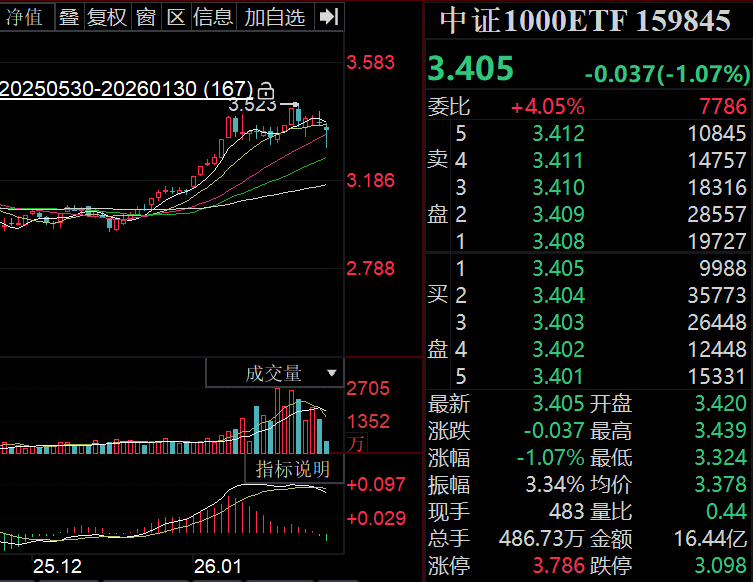
Market Performance - The A-share market showed mixed performance on January 30, with the Shanghai Composite Index declining by 0.64% [1] - The CSI 1000 ETF (159845.SZ) fell by 1.07%, while other major indices such as the SSE 50, CSI 300, and CSI 500 also experienced declines of 0.84%, 0.46%, and 1.48% respectively [1] ETF and Stock Performance - The CSI 1000 ETF's latest price was 3.405, with a decrease of 0.037, representing a drop of 1.07% [2] - Among the top 50 weighted stocks in the CSI 1000 index, notable gainers included Chuangzhong Technology (+7.22%), Jucheng Co. (+6.37%), and Changxin Bochuang (+5.47%), while Huayu Mining and Yahua Group saw declines of -10.01% and -8.23% respectively [2] Industry Analysis - In terms of industry performance, the electronics sector rose by 1.00%, while power equipment fell by 0.17%, pharmaceuticals decreased by 0.73%, computers dropped by 1.57%, and machinery increased by 0.32% [3] - The CSI 1000 ETF experienced a net outflow of 15.893 billion over the last five trading days and 37.948 billion over the last ten days, with the latest fund size at 16.526 billion, reflecting a decrease of 38.12 billion over the past month [3] Economic Context - The Federal Reserve maintained the federal funds rate target range at 3.50% to 3.75%, aligning with market expectations, citing stabilization in the labor market and inflation slightly above the 2% target as reasons for the decision [3] - Future monetary policy will be determined based on subsequent data and risk assessments, without a preset path for interest rate cuts [3] Investment Outlook - Looking ahead to February, the focus for industry allocation will be on signs of recovery and the unfolding of the spring market, emphasizing cyclical and technology sectors [4] - Recommended sectors for attention include electronics, media, machinery (automation and engineering), power equipment (batteries, grid equipment, photovoltaic equipment), basic chemicals, and social services [4] - The CSI 1000 index reflects the price performance of a selection of small-cap stocks in the A-share market, excluding those in the CSI 800 index, and is designed to provide insights into the performance of smaller, more liquid companies [4]

创业板午后强势拉升,高弹性创业板ETF华夏(159957)涨超1.9%
Mei Ri Jing Ji Xin Wen· 2026-01-30 06:17
1月30日,A股三大指数涨跌不一,创业板指午后继续拉升,截止13点10分,创业板ETF华夏(159957) 涨幅1.9%,成交额超9000万元,持仓股天孚通信、光线传媒、泰格医药、新易盛、北京君正等股涨幅 居前。 按申万一级行业分类,创业板ETF华夏指数权重集中于电力设备、通信、电子、医药生物、非银金融等 板块。 (文章来源:每日经济新闻) 创业板指数聚焦高端制造、光伏、新能源等战略性新兴产业,且涨跌幅限制为20%,具备高弹性优势, 在历轮A股反弹行情中领涨宽基指数,或为投资者把握A股牛市的反弹先锋。 创业板ETF华夏(159957)紧密跟踪创业板指,汇聚新质生产力资产,高成长高弹性特征显著。管理费 率0.15%,托管费率0.05%,为同类产品场内最低水平,助力投资者低费率布局创业板。 ...

资金为何密集涌入医疗ETF?
Xin Lang Cai Jing· 2026-01-30 02:49
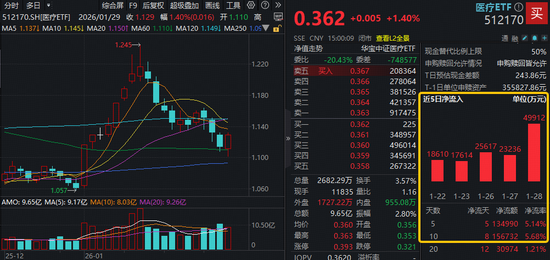
Core Viewpoint - The medical sector is showing signs of recovery in 2026, driven by policy clarity and the realization of innovative outcomes, leading to increased investment interest in medical ETFs [1][19]. Group 1: Current Core Logic and Positive Factors in the Medical Sector - The transition from "selling expectations" to "performance realization" is evident, with domestic medical device innovations gaining global recognition, thus becoming a new growth engine for the industry [3][21]. - The medical sector is experiencing a high proportion of companies meeting or exceeding their 2025 performance forecasts, indicating a favorable industry outlook [3][21]. - The recent surge in AI medical technologies is not just speculative but demonstrates clear cost-reduction and efficiency-enhancing capabilities in hospital operations and drug development [4][23]. Group 2: Policy Environment Changes - The policy environment has shifted from a "speed over quality" approach to one of "value co-creation," with recent signals indicating a more favorable stance on centralized procurement and medical insurance negotiations [6][24]. - Optimizations in the approval process for innovative medical devices and continuous improvements in procurement rules are expected to enhance the competitive landscape and restore profitability for companies [8][26]. - The introduction of a market exclusivity period in the revised Drug Administration Law is expected to boost long-term investment confidence in pharmaceutical R&D [9][27]. Group 3: Financial Support for Medical Equipment Updates - The national "two new" policy, focusing on large-scale equipment updates and consumer goods replacement, has allocated 62.5 billion yuan in special bonds to support medical equipment upgrades, benefiting listed companies in the medical device sector [10][28]. - There is a significant demand for replacing outdated medical equipment in domestic healthcare institutions, coupled with policies favoring domestic alternatives, leading to increased orders and market share for leading companies in imaging, surgical robots, and in-vitro diagnostics [10][28]. Group 4: Reasons for Recent Fund Inflows into Medical ETF (512170) - The medical ETF (512170) has seen substantial inflows, with a single-day capital increase of 499 million yuan on January 28, 2026, and a total of 1.8 billion yuan over nine consecutive trading days, reflecting a shift in market sentiment towards value recovery [1][19][14]. - The medical ETF is currently one of the largest medical-themed ETFs in A-shares, with a market size exceeding 26 billion yuan, driven by high cost-effectiveness and a consensus on bottom valuations [14][32]. - The ETF closely tracks the CSI Medical Index, with significant allocations in medical devices (53.17%) and medical services, making it an attractive option for both institutional and retail investors [14][32][34].
永安期货股指日报
Xin Yong An Guo Ji Zheng Quan· 2026-01-30 02:45
Market Performance - The Shanghai Composite Index rose by 0.16% to 4157.98 points, while the Shenzhen Component fell by 0.3% and the ChiNext Index dropped by 0.57%[1] - The Hong Kong Hang Seng Index increased by 0.51% to 27968.09 points, with the Hang Seng Technology Index declining by 1% and the Hang Seng China Enterprises Index rising by 0.42%[1] - The total market turnover in Hong Kong was 3319.942 million HKD[1] Currency and Economic Relations - The U.S. Treasury Department labeled the Chinese yuan as "severely undervalued" and urged China to allow timely appreciation of its currency[12] - A survey by Goldman Sachs indicated that the majority of investors expect the yuan to appreciate against the U.S. dollar this year[8] Corporate Earnings - Apple reported a record quarterly revenue of 143.8 billion USD, exceeding Wall Street expectations, with a 38% increase in revenue from China[12] - The anticipated net profit for Sunny Optical Technology is expected to increase by 70% to 75%, reaching approximately 4.589 to 4.724 billion RMB[14] Bilateral Agreements - China and the UK reached 11 positive outcomes during Prime Minister Keir Starmer's visit, including the establishment of a yuan clearing bank in the UK and a reduction in whisky import tariffs from 10% to 5%[12]


财信证券晨会纪要-20260130
Caixin Securities· 2026-01-30 00:30
Group 1: Market Overview - The market is experiencing a volatile trading environment with a focus on dividend and consumption sectors, while the hard technology sector is underperforming [5][10] - The Shanghai Composite Index closed at 4157.98, up 0.16%, while the ChiNext Index fell by 0.57% to 3304.51 [5][8] - The trading volume exceeded 32 trillion yuan, indicating a high trading sentiment, but the market continues to show signs of structural differentiation [10] Group 2: Industry Dynamics - Meta's advertising revenue reached $58.137 billion in Q4 2025, a 24% year-on-year increase, with total revenue for the quarter at $59.893 billion [29][30] - UBI Research forecasts a 64% increase in OLED display shipments in 2025, reaching 3.2 million units, driven by higher acceptance and profitability in the sector [31] - Omdia predicts a decline in AMOLED panel shipments for smartphones in 2026, estimating a drop to 810 million units due to rising memory costs and supply shortages [33] Group 3: Company Updates - Tigermed (300347.SZ) expects 2025 revenue between 6.66 billion and 7.68 billion yuan, with a net profit forecasted to grow by 105% to 204% [37][38] - Chunxue Food (605567.SH) anticipates a staggering 340.90% to 426.63% increase in net profit for 2025, driven by market expansion and cost reduction efforts [39][40] - Qingdao Bank (002948.SZ) reported a 7.97% increase in revenue for 2025, with net profit reaching 5.188 billion yuan, reflecting steady growth in assets and loans [43][44]
越涨越买,资金涌入,赛道基金又走红
Zhong Guo Zheng Quan Bao· 2026-01-29 23:32
Group 1 - The core viewpoint of the articles highlights the surge in popularity and investment in sector-specific funds, particularly in areas like non-ferrous metals and AI, driven by impressive performance and investor enthusiasm [1][3] - Sector-specific funds have shown remarkable performance, with some funds experiencing growth rates exceeding 90 times their initial size within a short period, indicating a strong demand for targeted investment strategies [3][5] - The trend of sector funds is further supported by data showing that over half of the newly launched equity funds in early 2026 are sector-focused, particularly in technology, non-ferrous metals, and healthcare [5] Group 2 - The strong inflow of capital into sector-specific funds is evident, with significant net inflows reported in sector ETFs, contrasting with the outflows from broader market ETFs [3][5] - The performance of sector-specific ETFs has been outstanding, with some non-ferrous metal ETFs rising over 30% and certain gold stock ETFs increasing by more than 50%, significantly outperforming the market average [3] - Industry experts caution that while sector funds can yield high returns during favorable market conditions, they also carry inherent risks due to their concentrated exposure, which can lead to substantial losses when market conditions change [4][5]
科创板超260份业绩预告出炉订单增长彰显发展潜力
Zhong Guo Zheng Quan Bao· 2026-01-29 22:56
Core Viewpoint - The performance forecasts for 2025 from over 260 companies listed on the STAR Market indicate a positive trend, with approximately 40% of companies reporting profit increases or turning losses into profits, reflecting a strong connection to national technology innovation strategies and attracting patient capital [1][2]. Group 1: Performance Forecasts - As of January 29, over 260 STAR Market companies have disclosed their 2025 performance forecasts, with 62 companies expecting profit increases, 34 turning losses into profits, and 51 reducing losses [2]. - More than 30 companies are projected to have net profit increases exceeding 100%, with notable companies like Shanghai Yizhong expecting a 760.18% increase, followed by Zhenlei Technology and Baiwei Storage with increases of 529.64% and 427.19% respectively [2]. Group 2: Industry Trends - The expected profit growth is primarily concentrated in sectors such as hardware equipment, semiconductors, and biomedicine, driven by recovering industry demand and breakthroughs in products [2]. - Companies like Zhenlei Technology are capitalizing on increased demand in the special integrated circuit industry and expanding into satellite communication markets, contributing to significant revenue growth [3]. Group 3: Order Growth - Order growth is identified as a key driver for performance increases among STAR Market companies, with Huqiang Technology expecting a 42.70% to 113.94% increase in net profit due to military orders and product structure adjustments [4]. - Chip Origin Co. anticipates a reduction in net losses, supported by record-high new orders, with total new orders for 2025 reaching 5.96 billion, a 103.41% increase year-on-year [4]. Group 4: Recent Orders - Companies are actively sharing their latest order statuses to instill investor confidence, such as Aifute, which announced a procurement order worth approximately 250 million for automotive production line construction [5].
科创板超260份业绩预告出炉 订单增长彰显发展潜力
Zhong Guo Zheng Quan Bao· 2026-01-29 21:02
Core Insights - The article highlights the early disclosure of annual performance forecasts by over 260 companies on the STAR Market, with approximately 40% of them reporting positive growth or recovery in profits [1] - The focus is on the connection between the STAR Market and national technology innovation strategies, particularly in sectors like artificial intelligence and biomedicine, attracting quality companies and long-term capital [1] Group 1: Performance Forecasts - As of January 29, over 260 STAR Market companies have disclosed their 2025 performance forecasts, with 62 companies expecting profit increases, 34 companies turning losses into profits, and 51 companies reducing losses [1] - Among the companies forecasting profit increases, over 30 are expected to see net profit growth exceeding 100%, while 26 companies anticipate growth between 50% and 100% [2] Group 2: Industry Trends - The companies expecting profit growth are primarily in hardware, semiconductors, and biomedicine sectors, benefiting from recovering industry demand and breakthroughs in products [2] - Shanghai Yizhong expects the highest net profit increase of 760.18%, driven by its core product being included in the national medical insurance directory, significantly boosting market access and patient numbers [2] Group 3: Order Growth - Order growth is identified as a key driver for performance increases among some STAR Market companies, with significant new orders contributing to revenue growth [2] - Chip Origin Co. anticipates a narrowing of net losses, supported by record-high new orders, with total new orders for 2025 reaching 5.96 billion, a year-on-year increase of 103.41% [4] - Companies like Aifute have also reported substantial new orders, indicating positive future impacts on their performance [4]


从“持有象征”到“行使实权” 独董公开提名渐入“投服时刻”
Zhong Guo Zheng Quan Bao· 2026-01-29 20:59
Core Insights - The independent director system for listed companies in China is undergoing a significant transformation, with the introduction of the "Management Measures for Independent Directors of Listed Companies" in August 2023, which allows investor protection agencies to publicly solicit shareholder rights and nominate independent directors [1][2] Group 1: Key Developments - The new regulations aim to enhance the representation of minority shareholders, particularly those who have been historically silent [1] - The China Securities Investor Services Center has successfully implemented this system in five cases over a year and a half, covering various ownership structures and regions [1][4] - The evolution of the nomination process has shown a clear trend towards "joint action" and an expansion of the backgrounds of independent directors from industry experience to accounting expertise [2][4] Group 2: Challenges and Responses - Despite a high approval rate of over 99% for the shareholder meetings regarding the nominated independent directors, the actual participation of investors in the solicitation process remains limited, highlighting the ongoing issue of minority shareholders' "free-riding" mentality [2][10] - The operational challenges faced by the China Securities Investor Services Center include the difficulty in uniting shareholders who hold more than 1% of shares to exercise their voting rights [9][10] - Recommendations have been made to improve investor participation through education and the establishment of efficient online authorization systems [10] Group 3: Governance Implications - The involvement of the China Securities Investor Services Center in nominating independent directors represents a shift from external oversight to internal participation in corporate governance [7][8] - The selection of independent directors has focused on their professional qualifications and experience, which is expected to enhance the effectiveness of corporate governance [5][8] - The successful nomination of independent directors is seen as a step towards empowering minority shareholders and improving the balance of power within corporate boards [7][8]




开年以来多家A股公司更新赴港IPO进度条
Zheng Quan Ri Bao Zhi Sheng· 2026-01-29 17:19
Group 1 - As of early 2026, A-share companies are actively listing in Hong Kong, with three companies successfully listed and several others in the process of IPOs [1] - Notable companies such as Dongpeng Beverage and Muyuan Foods are currently in the IPO process, while others like Lanke Technology and Wuxi XianDao have passed hearings [1] - A total of 357 companies are in the IPO queue in Hong Kong, with nearly 30% being A-share companies from strategic emerging industries like new energy and semiconductors [1] Group 2 - Various domestic venture capital institutions and state-owned funds are emerging as cornerstone investors in Hong Kong IPOs, indicating strong interest from institutional investors [2] - Notable cornerstone investors include major insurance companies and state-owned funds, which typically favor large, mature companies with reasonable valuations [2] - The "national team funds" are strategically investing in emerging industries, enhancing market confidence and risk pricing [2] Group 3 - The "A+H" share model has reached a total of 167 companies, with expectations for a new wave of listings starting in Q4 2024, particularly among large-cap companies [3] - Many A-share companies are initiating "A+H" plans, indicating a trend towards dual listings [3] Group 4 - International long-term funds, including sovereign wealth funds and family offices, are increasingly participating as cornerstone investors in Hong Kong IPOs [4] - High-profile international investors such as Abu Dhabi Investment Authority and UBS Global Asset Management are backing several IPOs, reflecting a growing interest in quality projects [4] - The participation of international long-term funds has significantly increased, with many institutions actively seeking to invest in quality A-share companies [4] Group 5 - The involvement of foreign investment banks with a deep understanding of long-term funds' interests facilitates the matching of suitable investment opportunities [5] - These banks have established relationships with Middle Eastern sovereign funds, allowing them to recommend appropriate investment targets [5] Group 6 - International long-term funds tend to focus on long-term holdings rather than short-term trading, indicating a preference for quality investments with a 2-3 year horizon [6] - The investment strategy of these funds emphasizes long-term returns, which aligns with their investment criteria [6]
