
外贸

Search documents
前11月江苏外贸进出口规模创新高
Xin Hua Ri Bao· 2025-12-12 21:37
Core Insights - Jiangsu Province's foreign trade import and export value reached 5.4 trillion yuan in the first 11 months of this year, marking a historical high for the same period, with a year-on-year growth of 6.2%, surpassing the national average by 2.6 percentage points, accounting for 13.1% of China's total import and export value during the same period [1][1][1] Trade Performance - Exports totaled 3.6 trillion yuan, reflecting a growth of 9.4%, while imports amounted to 1.8 trillion yuan, with a modest increase of 0.3% [1][1][1] - General trade showed stable growth with a total of 3.02 trillion yuan, increasing by 4.2%, representing 55.8% of the province's foreign trade, contributing 2.4 percentage points to the overall growth; processing trade reached 1.8 trillion yuan, growing by 9.6% [1][1][1] Product Categories - Electromechanical products accounted for over 70% of exports, significantly driving export growth; specifically, electrical equipment and ships were exported at 217.43 billion yuan and 130.59 billion yuan, respectively, with growth rates of 19.7% and 37%; "new three samples" products saw exports of 167.85 billion yuan, increasing by 14.7% [1][1][1] Belt and Road Initiative - Trade with countries involved in the Belt and Road Initiative constituted half of the province's total trade, with imports and exports reaching 2.7 trillion yuan, a growth of 11.8%, contributing 10.3 percentage points to overall trade growth, and the proportion increased by 2.5 percentage points to 50% compared to the same period last year; trade with ASEAN countries was 977.16 billion yuan, growing by 21% [1][1][1]
四川凉山:2025年社会消费零售总额将突破”千亿”台阶
Zhong Guo Fa Zhan Wang· 2025-12-12 15:25
中国发展网讯 12月10日,四川省凉山州政府新闻办在西昌举行"十四五"高质量发展凉山答卷系列主题新闻发布会(第五场),介绍"十四五"时期凉山服务 业经济高质量发展主要成就。 "十四五"时期,是凉山商务承压奋进、破冰突围的五年,是产业能级持续跃升、发展质效全面提升的五年。凉山商务始终锚定全国全省发展大局,紧扣"促 消费、稳外贸、强流通、惠民生、保安全"战略主线,推动服务业实现质的有效提升和量的合理增长,为全州经济高质量发展筑牢了坚实支撑、注入了强劲 动能。 能级跃升"新台阶",产业支撑愈发强劲。以"4+6"现代服务业体系建设为核心牵引,持续壮大经营主体、集聚发展动能,累计培育规(限)上服务业单位 1800户,形成梯次发展、多点支撑的产业格局。西昌市跻身全国县域商业"领跑县"并获评省级服务业高质量发展培育县,德昌县斩获"全省服务业强县"殊 荣,西昌市、宁南县、越西县入选县域商业建设行动激励县,产业聚集度和核心竞争力显著增强。2021年至2024年,全州服务业增加值接连跨越800亿元、 900亿元、千亿元大关,实现三年三大步的跨越式发展;2025年将历史性突破1200亿元。服务业"压舱石""主引擎"作用愈发凸显,成 ...

万里汇x雨果跨境共同发布|外贸趋势增长洞察报告
Jin Tou Wang· 2025-12-12 00:57
Core Insights - The report analyzes the current state and future trends of China's foreign trade through the lens of the 138th Canton Fair, highlighting a shift from "scale expansion" to "value competition" in foreign trade practices [1][5] Group 1: Market Dynamics - Over 310,000 overseas buyers attended the 138th Canton Fair, with 74,500 exhibition booths and more than 32,000 participating companies, marking a historical high [3] - The fair showcased over 10,000 high-quality enterprises recognized for advanced technology and innovation, with smart products, green energy-efficient appliances, and intelligent robots being the main highlights [3] - Emerging markets are becoming the growth engine for China's foreign trade, with a 14.1% increase in pre-registered buyers, particularly from Belt and Road Initiative countries, which saw a 9.4% growth [5][7] Group 2: Technological Empowerment - AI is becoming a core driver for the development of the foreign trade industry, enhancing user experience and enabling businesses to transition from merely using AI tools to integrating into the AI ecosystem [7][9] Group 3: Compliance and Risk Management - Compliance has become a necessity for long-term profitability in an increasingly complex international trade environment, with 43% of cross-border traders prioritizing compliance as a core focus [9][12] - The instability of tariff policies poses systemic shocks to the foreign trade payment system, necessitating real-time adjustments in transaction prices [9][12] Group 4: Branding and Market Strategy - The market for self-built websites in China reached 1.4 trillion yuan in 2022, with market share expected to grow from 9.8% in 2016 to 41%-50% by 2025, indicating a shift towards brand building in overseas markets [14][16] - Companies are increasingly recognizing the importance of establishing long-term relationships with consumers rather than focusing solely on one-time transactions [14][16] Group 5: Future Trends - The foreign trade landscape is evolving along three clear trends: value reconstruction, deep localization, and compliance resilience, which are essential for companies to find stable growth in changing circumstances [16][18]

中国第一省会,到底“养活”了多少人?
商业洞察· 2025-12-11 09:30
Core Viewpoint - The article emphasizes Guangzhou's unique ability to support a large population and its role as a significant economic hub, highlighting its resilience and capacity to manage a diverse demographic [5][20]. Group 1: Population and Economic Capacity - As of 2024, Guangzhou's registered population is 10.75 million, while the resident population reaches 18.97 million, with actual management exceeding 24 million, comparable to Beijing and Shanghai [7]. - The city accommodates approximately 13.25 million migrant workers daily, reflecting its role as a major employment center [8]. - Guangzhou has 4.2174 million business entities as of October 2025, ranking second among Chinese cities, indicating a strong entrepreneurial environment [8]. Group 2: Foreign Trade Performance - In the first ten months of the year, Guangzhou's total foreign trade reached 1.02 trillion yuan, a year-on-year increase of 12.1%, with exports rising by 20.5%, leading among the top ten foreign trade cities [9]. Group 3: Logistics and Population Management - In the first seven months of the year, Guangzhou processed over 13 billion express deliveries, maintaining the highest volume in the country, significantly surpassing other major cities [12]. - The article suggests that the actual population size of Guangzhou is underestimated, leading to substantial pressure on public services and urban management [13]. Group 4: Economic Behavior of Migrant Workers - Many migrant workers in Guangzhou tend to save on low-end consumption while sending their earnings back home for significant expenses like housing and weddings, indicating a unique economic behavior [15]. Group 5: Urban Challenges and Achievements - Despite its achievements, Guangzhou faces challenges in industrial transformation and urban governance, yet it remains a leading provincial capital with a population burden that exceeds its fiscal capacity [20].

前10月部分行业统计数字看上海经济的韧性与定力
Sou Hu Cai Jing· 2025-12-10 17:04
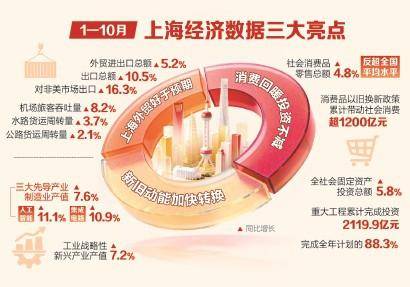
Economic Performance - Shanghai's GDP achieved a remarkable growth of 5.5% in the first three quarters, demonstrating strong resilience despite a complex external environment [1] - The annual growth rate may face some downward pressure due to the high growth base from the previous year's fourth quarter [1] Foreign Trade - Shanghai's foreign trade import and export total increased by 5.2% year-on-year from January to October, with exports rising by 10.5% [2] - Exports to non-US markets grew by 16.3%, indicating strong market competitiveness and expansion capabilities of Chinese and Shanghai enterprises [2] Transportation and Financial Markets - Airport passenger throughput increased by 8.2% due to holiday travel, while waterway and road freight turnover rose by 3.7% and 2.1% respectively [2] - The financial sector saw a total transaction volume of 29.678 trillion yuan in the first three quarters, a year-on-year increase of 12.7% [2] Industrial Transformation - The transformation of Shanghai's economic structure accelerated, with the three leading industries' manufacturing output growing by 7.6% from January to October [3] - The output of integrated circuits and artificial intelligence increased by 10.9% and 11.1% respectively, showcasing the growth of new productive forces [3][4] Consumer and Investment Trends - Retail sales of consumer goods in Shanghai rose by 4.8% year-on-year, surpassing the national average for the first time [5] - Fixed asset investment increased by 5.8% year-on-year, with significant investments in urban renewal projects [5] Employment and Income - Employment remained stable, and the overall price level was steady, with a reduction in the income gap between urban and rural residents [6]
上海前10月经济指标呈现韧性定力
Sou Hu Cai Jing· 2025-12-10 01:52
Core Viewpoint - Shanghai's economy demonstrates strong resilience amid complex external conditions, achieving a notable GDP growth of 5.5% in the first three quarters of the year [2]. Group 1: Trade and Transportation - Shanghai's foreign trade performance has exceeded expectations, with total import and export volume increasing by 5.2% year-on-year from January to October, and exports rising by 10.5%, particularly with a 16.3% increase in exports to non-US markets, showcasing the competitive edge of Chinese and Shanghai enterprises [3]. - Passenger throughput at airports has seen a significant increase of 8.2% during the same period, while waterway and road freight turnover grew by 3.7% and 2.1%, respectively [3]. - The financial sector also showed positive trends, with major financial markets in Shanghai recording a total transaction volume of 29.678 trillion yuan, a year-on-year increase of 12.7% [3]. Group 2: Economic Structure and Growth Drivers - The structural transformation of Shanghai's economy is accelerating, with the output of the three leading industries in manufacturing growing by 7.6% from January to October, including integrated circuits and artificial intelligence, which grew by 10.9% and 11.1%, respectively [5]. - The output of strategic emerging industries in the industrial sector increased by 7.2%, indicating the continuous strengthening of new productive forces [5][6]. Group 3: Consumer and Investment Trends - The total retail sales of consumer goods in Shanghai increased by 4.8% year-on-year, surpassing the national average for the first time, with the "old for new" consumption policy driving over 120 billion yuan in social consumption [8]. - Fixed asset investment in Shanghai grew by 5.8% year-on-year, with significant projects completing investments of 211.99 billion yuan, achieving 88.3% of the annual target [8]. - Urban renewal projects are accelerating, with the completion of various housing renovations and the initiation of 25 "urban village" transformation projects [8].
经济大省展现强劲发展动能(锐财经)
Ren Min Ri Bao Hai Wai Ban· 2025-12-09 22:32
Core Insights - Economic provinces in China play a crucial role in stabilizing the national economy and driving high-quality development, with a clear roadmap emerging from recent "14th Five-Year" planning proposals [1][2] Group 1: Economic Performance - The top ten economic provinces contribute nearly 20% of the country's area and over 60% of GDP, acting as stabilizers and leaders in high-quality development [2] - In the first three quarters of this year, all nine provinces in the top ten exceeded or matched the national average GDP growth rate, showcasing strong development momentum [2] - Jiangsu's GDP surpassed 10 trillion yuan for the first time, while Shanghai and Hunan both exceeded 4 trillion yuan, raising the entry threshold for the "four trillion club" [2] Group 2: Future Planning - Five of the ten economic provinces have set ambitious goals to lead in various aspects, such as Guangdong aiming to double its economic total by 2035 and achieve per capita GDP at the level of developed countries [3] - Jiangsu emphasizes leading in high-quality development, technological innovation, and promoting common prosperity [3] - Zhejiang aims for significant progress in high-quality development and common prosperity demonstration within five years [3] Group 3: Structural Optimization and New Momentum - Economic provinces are pioneers in optimizing development structures and fostering new growth drivers, with policies promoting digital economy and AI [4][5] - Guangdong has released a detailed plan for digital economy development, including initiatives for data circulation and AI core industries, targeting over 440 billion yuan in scale by 2027 [5] - The focus on emerging industries is evident, with provinces like Zhejiang and Shandong prioritizing AI, new materials, and biotechnology in their planning [5] Group 4: Domestic Demand and Investment - Economic provinces are enhancing domestic demand and stabilizing investment through various initiatives, including significant financial allocations for consumer incentives [6] - Guangdong has allocated 3.5 billion yuan for six major consumer policies, while Jiangsu plans to distribute over 400 million yuan in consumption vouchers [6] - Major infrastructure projects are progressing, such as the completion of key bridges and water resource projects, which are expected to benefit millions [6] Group 5: Reform and High-Level Opening - Economic provinces are actively working on deep reforms and high-level openness, with measures to improve the business environment and integrate into the national market [7] - Sichuan has introduced 25 measures to address business environment challenges, while Henan has developed a plan to support the national market integration [7] - Future focus areas include breaking regional collaboration barriers and testing new mechanisms in emerging sectors like low-altitude economy [7]
这份外贸成绩单中,民企成为“主力军”
Xin Hua Wang· 2025-12-09 07:58
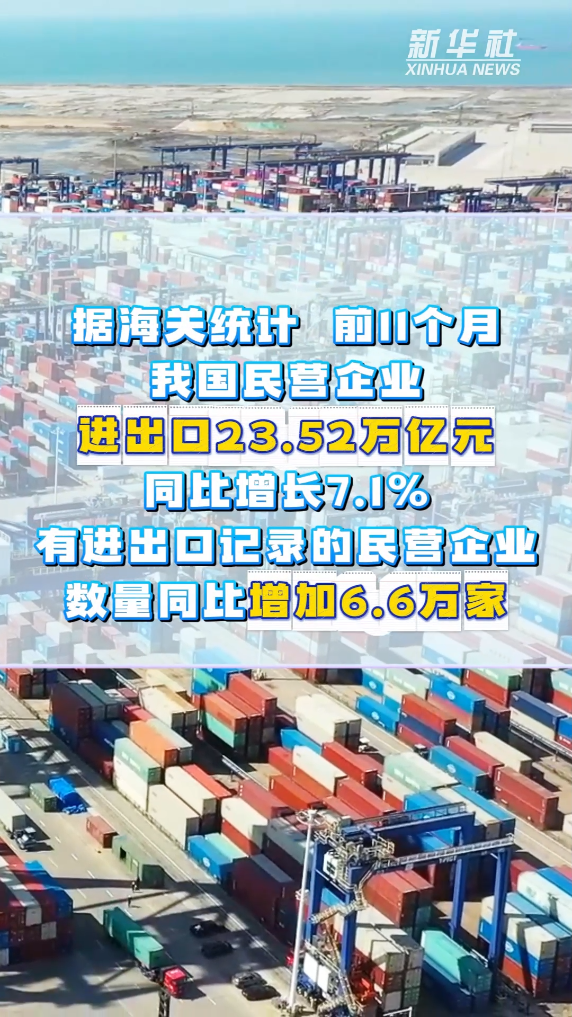
Group 1 - The total value of China's goods trade imports and exports reached 41.21 trillion yuan in the first 11 months of the year, with a year-on-year growth of 3.6%, maintaining the same growth rate as the previous 10 months [1] - In November, the year-on-year growth rate of imports and exports rebounded to 4.1%, marking 10 consecutive months of growth since February [1] - Private enterprises have become the "main force" in this achievement [1] Group 2 - The import and export value of private enterprises reached 23.52 trillion yuan in the first 11 months, with a year-on-year increase of 7.1% [3] - The number of private enterprises with import and export records increased by 66,000 year-on-year [3] - In November, the growth rate of imports and exports for private enterprises accelerated by 3.9 percentage points compared to the previous month, with both exports and imports experiencing growth for nine consecutive months [3]
“十四五”时期广州GDP增量预计达7000亿
Nan Fang Ri Bao Wang Luo Ban· 2025-12-09 07:25
Economic Growth and Development - Guangzhou aims to elevate its economic scale, targeting a GDP of 3.1 trillion yuan by 2024, with an expected GDP increment of 700 billion yuan during the "14th Five-Year Plan" period [1] - The city has maintained a "double trillion, double growth" trend in social retail sales and foreign trade, becoming the third city in China to achieve this milestone [1] - The average annual disposable income growth for urban and rural residents is 5.13% and 6.95% respectively, both exceeding GDP growth [1] Talent and Employment - Guangzhou is implementing the "Million Talents Gather in South Guangdong" initiative, focusing on attracting high-level foreign talent, ranking among the top three in national talent attraction [1] - The city has added 1.634 million new jobs, emphasizing a strategy prioritizing employment [1] Technological Advancements - Guangzhou has made significant strides in technology, with its global ranking in the "Nature Index - Research Cities" rising to 6th, and the "Shenzhen-Hong Kong-Guangzhou" innovation cluster ranking first globally [1] - The city has developed key technologies, including the first domestically built ocean drilling vessel and a new flu drug, showcasing its commitment to national strategic technology [2] Infrastructure and Connectivity - The Nansha area has seen its GDP surpass 230 billion yuan, with a population nearing 1.3 million, attracting over 3,500 Hong Kong and Macau enterprises [2] - Baiyun Airport has become one of China's three comprehensive international aviation hubs, with passenger throughput increasing from 43.77 million in 2020 to 76.37 million by 2024, a growth of 74% [2]
11月外贸数据点评:12月出口有承压风险,但明年韧性仍强
Changjiang Securities· 2025-12-08 23:30
Export Performance - November exports increased by 5.9% year-on-year, exceeding the expected 3.8%[6] - Monthly export value reached $330.35 billion, with imports at $218.67 billion, resulting in a trade surplus of $111.68 billion[6] - Exports to the EU, Africa, and Latin America showed strong growth, with EU exports rising 14.8% year-on-year[6] Trade Dynamics - Exports to the US decreased slightly, with November exports valued at $33.79 billion, a year-on-year decline of 28.6%[6] - Exports to Africa surged by 27.6% year-on-year, with a monthly export value of $20.9 billion[6] - Exports to Latin America also strengthened, with a year-on-year increase of 14.9% and a monthly export value of $26.23 billion[6] Product Categories - High-tech products, electromechanical products, and labor-intensive products saw year-on-year growth rates of 7.7%, 9.7%, and -8.3%, respectively[6] - Integrated circuits and general machinery exports performed strongly, contributing significantly to overall export growth[6] Import Trends - November imports increased by 1.9% year-on-year, below the expected 3%[6] - Major imports included computers and integrated circuits, which showed significant growth in import value[6] Future Outlook - Short-term export pressures are anticipated due to declining container booking volumes since November 9, indicating potential challenges in December[6] - Long-term resilience is expected to be supported by global manufacturing recovery and price advantages of Chinese export goods[6] Risk Factors - Uncertainties surrounding US tariff policies may impact China's export performance, with potential legal challenges affecting future tariff implementations[8]