房地产业

Search documents
中央财办有关负责同志:我国房地产高质量发展仍有较大空间
Xin Lang Cai Jing· 2025-12-16 13:01
(原标题:聚焦中央经济工作会议|中央财办有关负责同志详解2025年中央经济工作会议精神) 从改善性需求看,尽管我国城镇住房总量已经不小,但区位分布、持有结构不均衡,相当部分城镇居民 住房满意度还不够高,存在"以旧换新""以小换大"的改善性需求。不少城市反映,一些群众卖旧房买新 房的意愿上升,今年二手房交易占比已从2021年的28%提高至45%,"好房子"总体不愁卖,说明改善性 需求潜力还很大。 从很多发达国家房地产业发展历程看,在城镇化进入稳定期后,每年仍有数量可观的住房需求,房地产 业增加值在GDP中的占比始终保持在相当比例。我们在城市更新特别是危旧房和城中村改造方面还有很 多工作要做,更好满足城镇居民刚性和改善性住房需求的任务还不少,房地产高质量发展仍有可观前 景。 另一方面,要以构建新模式为牵引推动房地产高质量发展。中央经济工作会议对着力稳定房地产市场、 加快构建房地产发展新模式作出部署。下一步,重点要抓好几件事。 一是从供需两端发力稳市场。供给端要严控增量、盘活存量,鼓励收购存量商品房用于保障性住房等合 理用途,加快消化库存,同时有序推动"好房子"建设。需求端要采取更多针对性措施,充分释放居民刚 性和 ...
漫解税收|发票没法补开换开,还能在税前扣除吗?
蓝色柳林财税室· 2025-12-16 08:28
Group 1 - The article discusses issues related to invoice verification, highlighting that discrepancies in supplier information or invoice codes require further verification or reissuance of the invoice [4] - It mentions that if a company has been deregistered, invoices cannot be reissued, raising concerns about tax deductions for those expenses [9][10] - The article provides guidance on how companies can prove the authenticity of expenses when invoices cannot be reissued due to special circumstances such as deregistration [10] Group 2 - The article clarifies that real estate companies are not eligible for the R&D expense super deduction policy, as specified by tax regulations [17] - An example is given where a construction company incurred 1.5 million yuan in R&D expenses but cannot benefit from the super deduction due to being classified under the real estate industry [18] - It outlines the specific industries that are excluded from the R&D expense super deduction policy, including real estate, which is explicitly mentioned [17][18] Group 3 - The article explains that individual consumers cannot request a special VAT invoice, as the law stipulates that such invoices can only be issued to business entities [20][22] - It cites the VAT regulations that prohibit issuing special VAT invoices to individual consumers, allowing only ordinary invoices [21][22] Group 4 - The article discusses the criteria for determining whether a branch office qualifies as a small and micro enterprise for tax benefits, emphasizing the need to aggregate data from the main office and all branches [25] - It references the announcement from the National Taxation Bureau regarding the management of small and micro enterprise tax incentives [25]


业务招待费只按60%扣?5个误区注意!
蓝色柳林财税室· 2025-12-16 06:48
Group 1 - The article discusses the tax deduction standards for business hospitality expenses incurred by individual businesses, sole proprietorships, and partnerships, allowing a deduction of 60% of the expenses, capped at 5% of annual sales revenue [6] - It clarifies that business hospitality expenses incurred during the establishment phase of a company can be deducted at 60% of the actual expenses, categorized as startup costs [8] - The article emphasizes that certain industries, including real estate, are not eligible for the additional deduction on R&D expenses, despite having incurred legitimate costs [23][24] Group 2 - The article outlines that taxpayers can apply for an extension on tax filings due to unforeseen circumstances such as natural disasters or public health emergencies [21] - It specifies that if financial processing issues prevent the calculation of taxable income, taxpayers may also request an extension for tax filings [21]

明年将发债支持国补,摩尔线程回应拿钱理财
Xin Lang Cai Jing· 2025-12-16 04:45
Group 1 - The Ministry of Finance plans to issue 150 billion yuan of special long-term bonds in 2024 to support consumer subsidies for vehicle trade-ins and related appliances, with an additional 300 billion yuan expected in 2025 [1][17] - The "national subsidy" policy has positively impacted domestic consumption over the past two years, leading to a significant increase in sales, with over 25 trillion yuan in sales generated from trade-in programs benefiting over 360 million people [1][17] - The coverage of the "national subsidy" policy is expected to continue expanding, particularly for durable consumer goods like refrigerators and televisions [1][17] Group 2 - In November, the average sales prices of residential properties in 70 major cities showed a month-on-month decline, with first-tier cities down by 0.4% and second and third-tier cities down by 0.3% and 0.4% respectively [3][18] - The introduction of "home purchase interest subsidy" policies in several cities has led to a short-term increase in new home transactions, with some cities reporting over a 15% month-on-month growth in sales [3][18] - The real estate market is experiencing a downturn, with new home prices remaining relatively stable due to high-quality listings, while second-hand homes are seeing more aggressive price reductions [3][18] Group 3 - In November, the industrial added value for large-scale enterprises grew by 4.8% year-on-year, with a month-on-month increase of 0.44%, while the growth rate for the manufacturing sector was 4.6% [5][20] - High-tech manufacturing sectors, such as 3D printing and industrial robotics, showed significant growth, with production increases of 100.5% and 20.6% respectively [5][21] - The overall industrial growth rate has slowed, with traditional manufacturing sectors like cement and steel continuing to decline, indicating a need for structural adjustments in the economy [5][21] Group 4 - Vanke has faced challenges in extending a 2 billion yuan bond, with all proposed extension plans failing to meet the required approval threshold [7][22] - The company is in a precarious financial situation, with a potential default looming if an agreement with bondholders is not reached within the grace period [7][22] - Vanke's reliance on state-owned shareholders for support has diminished, raising concerns about its ability to navigate its financial difficulties independently [7][23] Group 5 - iRobot has filed for Chapter 11 bankruptcy protection, indicating severe financial distress despite being a pioneer in the robotic vacuum market [9][24] - The company has seen a significant decline in market share due to increased competition from lower-cost Chinese manufacturers and slow product innovation [9][25] - iRobot's financial situation is dire, with liabilities exceeding 500 million dollars and cash reserves dwindling to 24.8 million dollars [9][24] Group 6 - Samsung is reportedly in discussions with AMD regarding a potential partnership for 2nm chip manufacturing, aiming to enhance its position in the high-end semiconductor market [11][26] - Despite previous attempts, Samsung has struggled to gain a significant share in the high-end chip market due to issues with process maturity and yield rates [11][26] - The collaboration with AMD could provide Samsung with leverage in negotiations with other clients, particularly in the context of increasing demand for AI chips [11][26]


住建部部长倪虹:推动房地产高质量发展
Ren Min Ri Bao· 2025-12-15 23:48
12月16日,住房和城乡建设部部长倪虹在人民日报第13版发表署名文章《推动房地产高质量发展(学习 贯彻党的二十届四中全会精神)》。全文如下: 推动房地产高质量发展(学习贯彻党的二十届四中全会精神) 倪虹 党的二十届四中全会通过的《中共中央关于制定国民经济和社会发展第十五个五年规划的建议》(以下 简称《建议》)提出"推动房地产高质量发展",这是以习近平同志为核心的党中央面向"十五五"这一新 的起点,着眼全局作出的重大决策部署。我们要认真学习领会、全面贯彻落实,加快构建房地产发展新 模式,推动房地产高质量发展。 一、深刻认识推动房地产高质量发展的重要意义 (一)推动房地产高质量发展是满足人民美好生活向往的客观需要。安居是人民群众幸福生活的基点。 党的十八大以来,我国房地产市场快速发展,居民住房条件显著改善,城镇人均住房建筑面积超过40平 方米,户均住房超过1.1套。建成世界规模最大的城镇住房保障体系,建设各类保障性住房和棚改安置 住房6800多万套,帮助1.7亿群众喜圆安居梦。当前,人民群众住房需求总体上已经从"有没有"转为"好 不好",而且,随着老龄化、少子化、区域人口增减分化,人们的生产生活方式变化,住房需求 ...
理想和现实之间的房贷贴息
Bei Jing Shang Bao· 2025-12-15 15:51
Core Viewpoint - The discussion around mortgage interest subsidy policies has gained significant attention due to their perceived positive impact and pilot implementations in various cities [1][2]. Group 1: Policy Implementation and Impact - Several cities, including Hangzhou, Nanjing, and Wuhan, have initiated regional mortgage interest subsidy policies since late 2023, aimed at reducing the monthly payment burden for homebuyers [1]. - The subsidy policy is expected to enhance residents' purchasing power, thereby alleviating the consumption pressure caused by high mortgage payments, aligning with the broader goal of expanding domestic demand [2]. - The policy could stimulate both rigid and improved housing demand by lowering the cost of home purchases, contributing positively to the stabilization of the real estate market [2]. Group 2: Economic Considerations and Challenges - While the mortgage interest subsidy can promote real estate market recovery and address consumer pain points, there are concerns regarding fiscal sustainability and the potential increase in local government debt [3]. - The distribution of funding responsibilities between central and local governments needs careful consideration to avoid exacerbating fiscal imbalances [3]. - The policy's implementation should include a set timeframe and gradual reduction to prevent long-term market distortions, and the extent of the subsidies must be managed to avoid excessive risk in the banking sector [3].
崔东树:2025年1-11月汽车生产同比增11% 新能源汽车生产同比增27% 渗透率47%
智通财经网· 2025-12-15 08:45
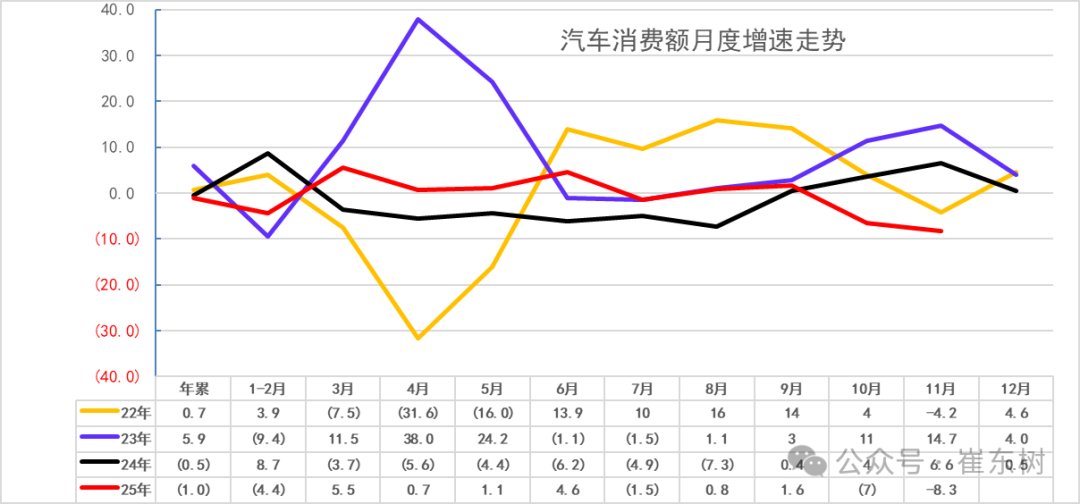
1. 汽车消费恢复较强 自从楼市2021年下跌以来,汽车消费从2020年的3.94万亿元上升到2024年的5.03万亿元,摆脱了2018-2020年连续3年徘徊在3.9万亿元的被动局面。由于房 地产下跌利好消费,买房投资挤压消费问题改善,目前看消费不旺的问题稍有改善。 智通财经APP获悉,乘联分会秘书长崔东树发文称,2025年11月汽车生产352台,同比增2%;新能源汽车生产184万台,同比增17%,渗透率52%;燃油车 生产168万台,同比降10%。2025年1-11月汽车生产3109万台,同比增11%;新能源汽车生产1453万台,同比增27%,渗透率47%;燃油车生产1657万台, 同比持平。2025年1—11月份,全国固定资产投资(不含农户)444035亿元,同比下降2.6%。其中,2025年汽车投资增速达到15.3%,高于总体投资17.9个百 分点。 当前,外部环境更趋复杂严峻,单边主义、保护主义加剧,冲击产业链供应链稳定;国内经济回升向好基础还不稳固,有效需求不足、市场无序竞争等问 题挑战仍然存在,行业稳增长任务依然艰巨。随着车市以旧换新补贴政策,引爆2025年车市,1-3季度效果特别显著,因此20 ...
目标积极务实,政策提质增效,内需主导强化——2025年中央经济工作会议解读
Sou Hu Cai Jing· 2025-12-15 03:58
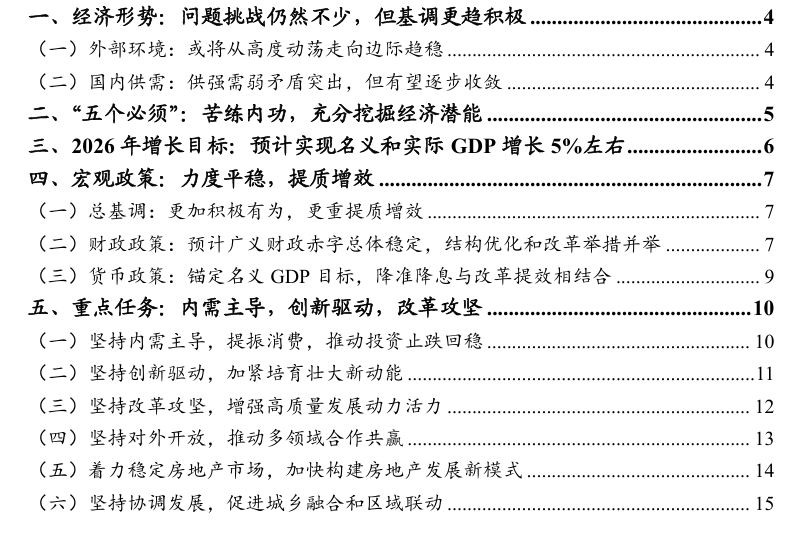
Economic Situation - The economic situation is characterized by persistent challenges, but the overall tone is becoming more positive. The external environment is expected to stabilize marginally, while domestic supply-demand imbalances are highlighted as significant issues [2][10][14]. Five Musts - The meeting outlined "Five Musts" to enhance economic potential, emphasizing the need for internal strengthening to address external challenges, and the importance of policy support and reform innovation [2][16][17]. 2026 Growth Target - The nominal and real GDP growth target for 2026 is set at around 5%. This target aligns with the need for a good start to the 14th Five-Year Plan and is slightly above the lower limit of the expected growth for the next decade [3][18][19]. Macro Policy - The macro policy framework is shifting from "promoting stability through growth" to "enhancing quality and efficiency," indicating a focus on structural optimization and effectiveness rather than just scale and intensity [4][22][25]. Fiscal Policy - The fiscal policy is expected to maintain a broad deficit rate of around 4%, with a focus on optimizing the expenditure structure and increasing investment in social welfare [4][26][28][29]. Monetary Policy - The monetary policy will continue to be moderately loose, with expectations for one rate cut and one reserve requirement ratio reduction in 2026. The focus will be on stabilizing nominal GDP and supporting key sectors [4][32][33][36]. Key Tasks - The emphasis is on domestic demand, innovation-driven growth, and reform efforts. Specific strategies include boosting consumption, stabilizing investment, and enhancing innovation capabilities [5][38][45]. Domestic Demand - The strategy prioritizes domestic demand, with a focus on increasing consumer income and optimizing supply. Retail sales growth is projected to recover to around 4.5% in 2026 [5][38][43]. Innovation - Innovation is positioned as a key task, with plans to strengthen the integration of education, technology, and talent development, and to establish major international technology innovation centers [5][45][46]. Reform - Key reforms will target the elimination of "involution" in competition, the clearing of overdue corporate debts, and the enhancement of the financial supply-side structure to support high-quality development [5][52][53][54]. Opening Up - The commitment to opening up remains strong, with a focus on expanding institutional openness and optimizing the business environment for foreign investment [5][55][56].
明年经济工作怎么干?——中央经济工作会议学习体会
Hua Xia Shi Bao· 2025-12-14 10:40
Core Viewpoint - The Central Economic Work Conference emphasizes a pragmatic and positive approach to economic work for 2026, focusing on stabilizing growth, optimizing structure, and prioritizing people's livelihoods while addressing existing challenges and risks in the economy [2][3][4]. Economic Situation Assessment - The conference acknowledges both achievements and ongoing challenges in the economy, recognizing that many issues are solvable through effort [3][4]. - China's economy demonstrated resilience in 2025, with exports exceeding expectations and capital markets performing well, contributing to a projected GDP growth of around 5% for the year [4][5]. Policy Orientation - The conference continues the previous macroeconomic policy direction of being "more proactive and effective," with an emphasis on fiscal policy being more active and monetary policy remaining moderately loose [3][7]. - There is a shift in focus from external shocks to strengthening domestic economic coordination and managing expectations [8][9]. Structural and Institutional Arrangements - The conference highlights the importance of structural and institutional arrangements, including the establishment of a unified national market and improvements in the local tax system [9][10]. - Emphasis is placed on creating a fair competitive environment and reducing local government interference in market operations [10][11]. Fiscal Policy - The fiscal policy remains proactive, with a focus on increasing spending intensity and optimizing the structure of fiscal expenditures to address local government debt risks [14][15]. - The conference suggests maintaining a fiscal deficit rate of no less than 4% and increasing the scale of new debt to support economic stability [16][17]. Monetary Policy - The monetary policy is expected to remain moderately loose, with potential for interest rate cuts and reserve requirement ratio reductions to support economic growth [21][22]. - Structural tools will be enhanced to support key sectors such as consumption, technology, and elderly care [21][22]. Domestic Demand and Investment - The conference emphasizes the importance of domestic demand, with plans to implement a "rural residents' income increase plan" to boost consumption [23][24]. - Investment policies will shift from merely improving efficiency to stabilizing investment levels, with a focus on increasing central budget investments and optimizing local government bond usage [26][27]. Capital Market Reforms - The conference calls for deepening capital market reforms to enhance its functions and support national strategies, including improving inclusivity for innovative enterprises [28][29]. - There is a focus on increasing the quality of listed companies and promoting long-term investment to stabilize the market [31][32]. Real Estate Market Stability - The conference aims to stabilize the real estate market through targeted measures, including controlling new land supply and promoting the conversion of unsold properties into affordable housing [33][34]. - Emphasis is placed on high-quality housing construction and the establishment of a new development model for the real estate sector [35][36]. Innovation and Industry Development - The conference stresses the importance of innovation, with a focus on strengthening the role of enterprises in driving technological advancements and fostering new growth drivers [37][38]. - Specific industries will be targeted for high-quality development, including traditional sectors transitioning to higher standards and emerging industries expanding their scale [38]. Public Services and Livelihood - The conference reiterates the principle of prioritizing people's livelihoods, with specific measures to enhance employment, education, healthcare, and social security systems [39][40]. - Policies will be introduced to support flexible employment and improve social insurance coverage for new employment forms [39].

上市公司“低空经济”概念数据2000-2024年
Sou Hu Cai Jing· 2025-12-13 08:17
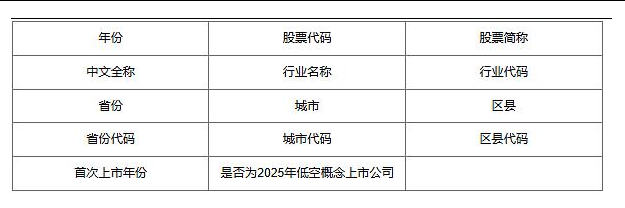
低空经济,是以各种有人驾驶和无人驾驶航空器的各类低空飞行活动为牵引,辐射带动相关领域融合发展的综合性经济形态。2021年2月,中共中央、 国务 院在 《国家综合立体交通网规划纲要》 中首次提出发展低空经济2023年12月,中央经济工作会议将低空经济明确为国家战略性新兴产业2024 年3月,《政 府工作报告》 首次写入低空经济2024年7月,党的二十届三中全会通过的决定中首次写入 "低空经济" 本文参考孙嘉俊等(2025)在《"赋能" 抑或 "负能":企业ESG表现与低空经济企业孵化》一文中关于低空经济概念上市企业名单的整理方法,筛选并整理 了截至2025年12月低空概念上市企业名单,匹配形成上市公司"低空经济"概念数据 数据名称:上市公司"低空经济"概念数据 数据范围:A股上市公司 时间范围:2000-2024年 样本数量:68852条 数据来源:东方财富网、同花顺网 数据说明:低空概念名单整理时间为2025年12月 二、数据指标 | 年份 | 股票代码 | 股票简称 | | --- | --- | --- | | 中文全称 | 行业名称 | 行业代码 | | 首份 | 城市 | 区首 | | 省份代码 | ...