
智能手机

Search documents
从瓷器到手机:广货们的时髦秘诀
2 1 Shi Ji Jing Ji Bao Dao· 2026-02-17 23:02
Core Viewpoint - "Guangdong goods" represent not only cost-effectiveness but also influence global aesthetic trends, showcasing Chinese cultural spirit and manufacturing aesthetics [1][6]. Group 1: Guangdong Goods and Cultural Significance - Guangdong goods are an important part of Chinese manufacturing and serve as a window to the world for Chinese cultural aesthetics [3]. - The aesthetic value of Guangdong goods is deeply rooted in the meticulousness of Guangdong artisans and their pursuit of inner spiritual beauty [3]. - Historical products like lacquerware exported from Guangzhou exemplify the blend of craftsmanship and aesthetics, becoming star products along the "Maritime Silk Road" [3]. Group 2: Modern Transformation and Consumer Preferences - In the context of the digital economy, Guangdong goods have undergone significant transformation, integrating aesthetics and cultural values into their products [3]. - Young consumers today prioritize not only the functional value of products but also the spiritual value they convey, seeking a higher level of resonance with their personal aspirations [4]. - The Guangdong home appliance industry leads the nation in scale, innovation, and export share, focusing on the integration of humanistic aesthetics and manufacturing [4]. Group 3: Fashion and Textile Industry - The Guangdong fashion industry boasts a strong foundation, with significant advantages in clusters and supply capabilities, leading the nation in quick response and cross-border e-commerce [5]. - The province is home to 29 textile and apparel industrial clusters and 53 fashion schools, producing around 150,000 designers [5]. - The ongoing "Wear Guangdong Fashion" initiative aims to upgrade the textile and apparel industry by incorporating Lingnan cultural elements into modern clothing [5]. Group 4: Technology and Aesthetics in Manufacturing - Guangdong's technological products, such as DJI drones and Huawei smart devices, combine innovation with design aesthetics, telling a compelling "technology + aesthetics" story [6]. - The smartphone industry in Guangdong is a major production and innovation hub, evolving from basic communication devices to multifunctional "super platforms" that integrate various aspects of life and aesthetics [6]. - The rise of foldable smartphones and the integration of AI technologies are key trends driving the smartphone industry's evolution in Guangdong [6].

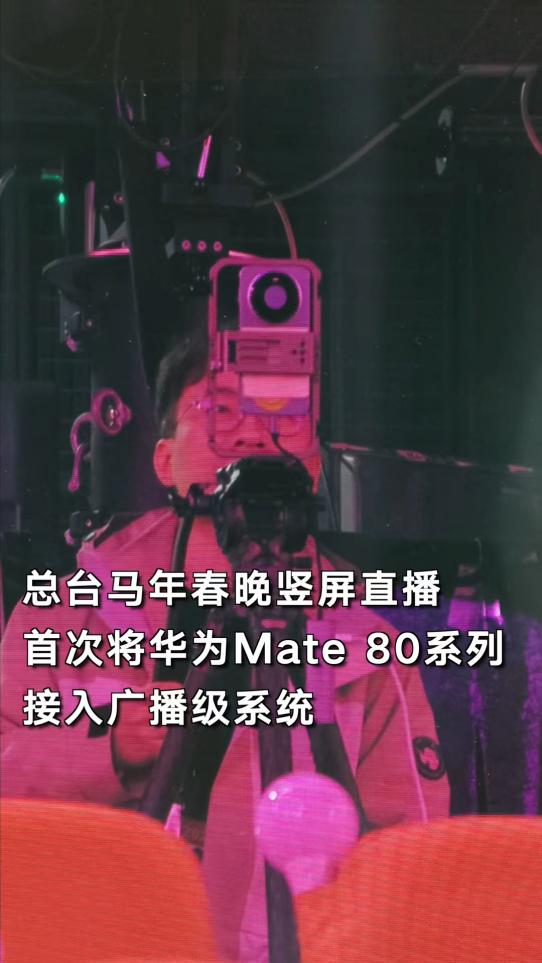
央视首次用手机直播春晚主舞台!揭秘华为Mate 80系列如何通过广电级大考
Xin Lang Cai Jing· 2026-02-17 01:34
Core Viewpoint - The collaboration between Huawei and CCTV for the 2026 Spring Festival Gala marks a significant milestone in mobile imaging technology, transitioning from auxiliary recording to primary creative tool in national-level events [1][27]. Group 1: Collaboration and Background - The partnership between Huawei and CCTV is built on previous successful experiences, notably during the Hongmeng Starlight Gala, where the Huawei Mate 80 series served as the main device for vertical shooting [3][29]. - This collaboration signifies a major transformation in content presentation for the Spring Festival Gala, leveraging the compact and flexible design of the Huawei Mate 80 series to capture unique perspectives [5][31]. Group 2: Technical Challenges - Integrating consumer-grade smartphones into broadcast-level systems presents significant technical challenges, particularly in signal transmission quality, synchronization, and system stability [8][34]. - Key challenges include maintaining a strict delay control of 50-100 milliseconds between mobile and professional cameras, ensuring visual consistency in high-contrast lighting, and achieving reliability during the lengthy live broadcast [10][11][36][37]. Group 3: Technological Innovations - The Huawei Mate 80 series utilizes a "soft-hard core cloud" collaboration to create a stable and high-definition imaging production system, achieving professional-level color accuracy and detail [13][39]. - The device features a dual telephoto camera system and a wide-angle lens, covering focal lengths from 12mm to 135mm, allowing for diverse visual storytelling [16][42]. - The ninth-generation ISP significantly enhances real-time data processing efficiency, doubling the capabilities of the previous generation and improving AI video noise reduction and HDR processing [18][44]. Group 4: Industry Impact - The participation of the Huawei Mate 80 series in the Spring Festival Gala represents a breakthrough in the perception of mobile devices as professional creative tools, challenging traditional reliance on heavy equipment in broadcasting [21][47]. - The introduction of the "super cold dual-phase heat dissipation system" improves thermal performance by 33%, ensuring stable operation during extended broadcasts, supported by a 6000mAh battery for over four hours of continuous use [22][48]. - This shift not only enhances production efficiency but also democratizes high-quality content creation, allowing ordinary users to produce cinematic-quality footage [23][49]. Group 5: Broader Implications - The success of the Huawei Mate 80 series at the Spring Festival Gala reflects a broader narrative of self-reliance in Chinese technology, moving towards a fully autonomous supply chain and reducing dependency on foreign technology [26][50]. - This development sets a new direction for the evolution of mobile imaging, emphasizing innovation without constraints and establishing a foundation for future advancements in the industry [26][50].
消费主义打败民族主义,这是中国消费者身份的理智回归
Sou Hu Cai Jing· 2026-02-16 23:07
Core Viewpoint - Post-pandemic, consumerism in China is overtaking nationalism, with consumers focusing more on quality and value rather than national origin, despite ongoing diplomatic tensions with Japan and the U.S. [2] Group 1: Consumer Behavior Changes - The rise of consumerism over nationalism is evident as consumers prioritize quality, cost-effectiveness, and emotional value in their purchasing decisions [2][8] - The younger generation and urban middle class are increasingly making purchasing decisions based on rationality rather than nationalism, indicating a shift in consumer identity [8][21] - The demand for affordable luxury products has surged, with brands like Xiaomi thriving by offering high-quality products at reasonable prices [20][21] Group 2: Impact of Diplomatic Tensions - Recent diplomatic disputes between China and Japan have not led to widespread boycotts of Japanese products, as seen in the sales growth of Toyota and Sushi restaurants [9][12] - Despite official warnings against travel to Japan, many consumers continue to visit, showing a disconnect between government sentiment and consumer behavior [9][12] - The success of Japanese brands in China, such as Toyota and Sushi restaurants, highlights the diminishing impact of nationalism on consumer choices [9][12] Group 3: Cultural Influence - American cultural products remain popular among Chinese consumers, with Disney's "Zootopia 2" achieving record box office success in China, indicating that cultural ties can transcend political tensions [14] - The appeal of brands like Ralph Lauren is growing among urban consumers, who value quality and brand image over nationalistic sentiments [16] Group 4: Emotional Consumption Trends - Emotional consumption is becoming a significant trend, as consumers seek products that provide emotional comfort and align with their lifestyles, regardless of the brand's origin [21] - The shift towards emotional consumption reflects a broader societal change, where consumers are less influenced by nationalist sentiments and more by personal values and experiences [21]


春节周重磅前瞻:美联储最爱通胀指标,DeepSeek V4或发布
华尔街见闻· 2026-02-15 10:56
Core Viewpoint - The article highlights significant upcoming economic events and data releases, particularly focusing on the AI industry during the Chinese New Year, macroeconomic indicators, and geopolitical developments that may impact global markets [6][7][11]. Group 1: AI Industry Developments - The "AI Spring Festival" is set to be a major theme, with the first Indian AI Summit featuring prominent tech leaders like NVIDIA's CEO Jensen Huang and Google's CEO Sundar Pichai from February 15 to 20 [9][10]. - DeepSeek's new flagship model V4 is expected to be released around mid-February, showcasing improvements in programming capabilities that may surpass existing top models in the market [8]. - Google is set to launch the Pixel 10a smartphone and Android 17 Beta 1 on February 18, coinciding with the AI developments [12]. Group 2: Key Macroeconomic Data and Policy - The U.S. Federal Reserve will release the December PCE inflation data and the fourth-quarter GDP initial estimate on February 20, with expectations of a 0.3% month-on-month increase in core PCE, raising the year-on-year rate to 2.9% [7]. - The fourth-quarter GDP growth is projected to reach 3.0%, exceeding market expectations of 2.8% [7]. - The FOMC meeting minutes from January are anticipated to show increasing support for a prolonged pause in interest rate cuts, although inflation trends may allow for a potential 100 basis points cut later in the year [7]. Group 3: Geopolitical and Market Events - The longest Chinese New Year holiday, lasting nine days from February 15 to 23, will see major stock exchanges, including those in China and Hong Kong, closed [13][14]. - The U.S. Supreme Court is scheduled to rule on the constitutionality of tariffs imposed by former President Trump on February 20, which could significantly impact trade policies and result in over $16 billion in monthly losses for importers if deemed unconstitutional [11]. - Japan will hold a prime ministerial election on February 18, with the current cabinet expected to resign, which may lead to fluctuations in the yen's exchange rate [19].
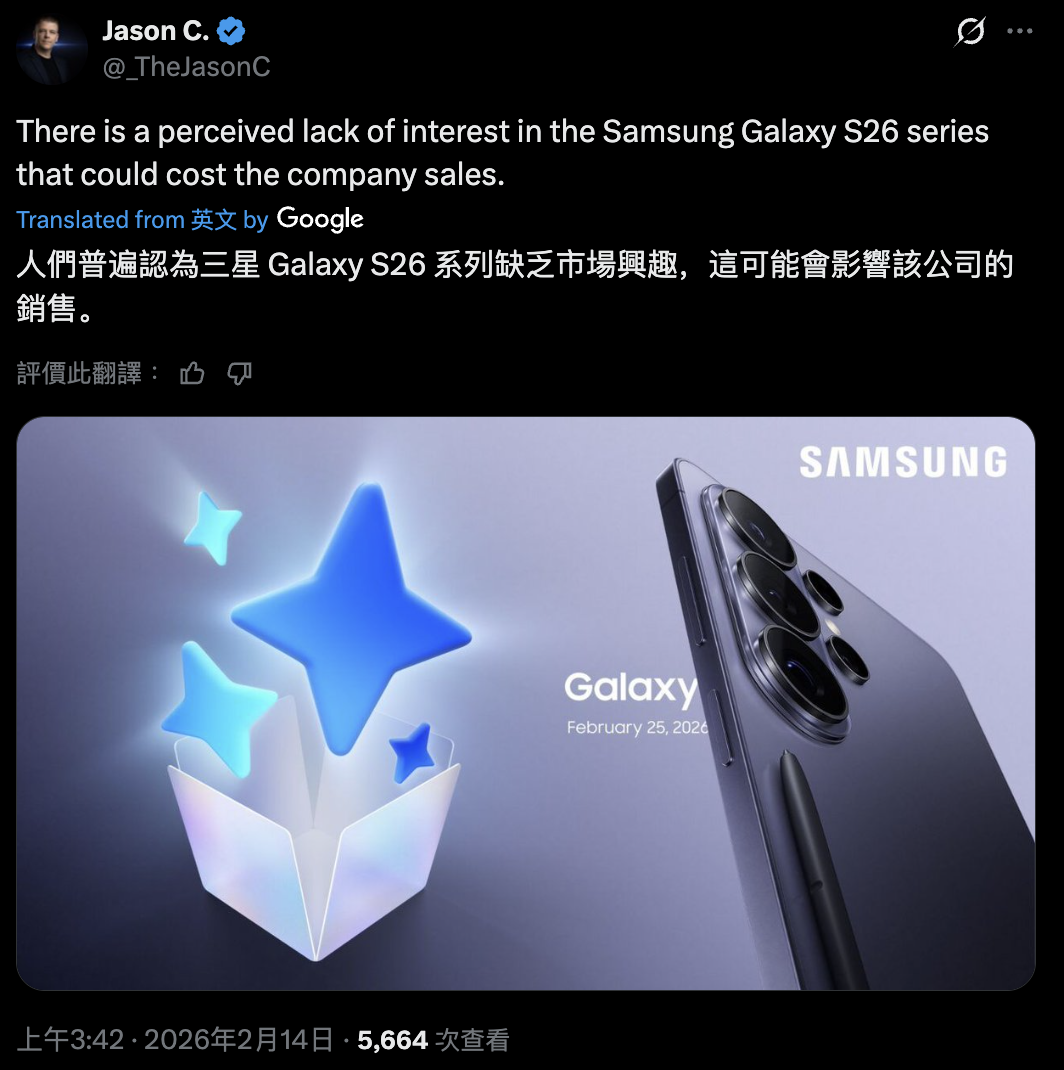
消息称三星Galaxy S26系列手机预售反应冷淡,3400万销量目标难实现
Feng Huang Wang· 2026-02-15 10:14
Group 1 - The core viewpoint indicates that Samsung is facing challenges in achieving its sales target of 34 million units for the Galaxy S26 series due to a significant number of consumers canceling their pre-orders, attributed to the perceived greed of the leadership team [2] - The leadership team, led by Lu Taiwen, set the ambitious sales target based on previously leaked positive feedback, which may not align with current consumer sentiment [2] Group 2 - The Samsung Galaxy S26 Ultra is expected to feature multiple color options including cobalt purple and starry blue, with a rounded corner design and independent camera module [3] - The device is anticipated to support the S Pen and include a 5000mAh battery, enhancing its functionality [3] - The Galaxy S26 series will introduce "privacy display" technology, which automatically reduces side viewing visibility to prevent onlookers from seeing the screen in public settings [3]
内存涨价,千元机的天塌了
创业邦· 2026-02-14 10:16
Core Viewpoint - The article discusses the significant impact of rising storage chip prices on the smartphone industry, particularly affecting mid-range and low-end models, as manufacturers shift focus to higher-margin products due to supply constraints driven by AI infrastructure demand [6][8][16]. Group 1: Market Dynamics - Since the second half of last year, storage chips have experienced a dramatic price surge, with consumer-grade memory modules increasing by over 600%, making them highly valuable investment products [6]. - Major storage chip manufacturers, including Samsung, Micron, and SK Hynix, have reported that their production capacities for DRAM, NAND Flash, and HBM products are fully booked until 2026 [6][16]. - The demand for HBM memory used in AI chips has prioritized its production, leading to a supply squeeze for consumer-grade products, particularly affecting low-end smartphones [8][16]. Group 2: Impact on Smartphone Manufacturers - Transsion, known for its cost-effective models, has been significantly impacted, reporting a 22.6% revenue increase but an 11% drop in net profit, with a two-percentage-point decline in gross margin [8]. - Other smartphone manufacturers are also adjusting their strategies, with many opting to delay the launch of low-cost models and focusing on higher-end devices due to the rising costs of storage components [9][12]. - The cost structure of low-end smartphones is heavily affected by the rising prices of storage chips, which are considered a rigid cost that cannot be easily adjusted [12][14]. Group 3: Pricing Strategies and Market Trends - The article highlights that the average selling price (ASP) of smartphones is expected to exceed $400 for the first time, indicating a shift towards higher-priced models as manufacturers adapt to the changing market dynamics [19]. - As the market for mid-range and low-end smartphones shrinks, manufacturers are likely to prioritize high-end models, which offer greater pricing flexibility and profit margins [17][19]. - The ongoing supply constraints and rising costs may lead to the end of the "thousand-yuan phone era," as manufacturers may find it increasingly difficult to maintain low prices while covering rising component costs [19].



每周观察 | 存储器产值攀升至晶圆代工2倍以上;2026年全球光收发模块出货;2026年全球手机产量;夏普龟山K2工厂计划停工…
TrendForce集邦· 2026-02-14 02:08
Group 1 - The core viewpoint of the article highlights that the AI wave is driving a super cycle, leading to a significant increase in the value of the memory industry, which is expected to reach $551.6 billion by 2026, more than double the value of the foundry industry at $218.7 billion [2] - The memory industry's growth is attributed to supply constraints and soaring prices, which are expected to continue impacting the market [2] Group 2 - The article forecasts that by 2026, over 60% of global shipments of optical transceivers will be 800G or higher, driven by Google's new high-speed interconnect architecture to meet AI's massive computing demands [5] - The global smartphone production is projected to decline by 10% in 2026, with total production expected to drop to approximately 1.135 billion units due to rising memory prices, which may further weaken terminal demand [8][9] - Sharp's Kameyama K2 factory is set to halt operations in August, which may impact Apple's supply of IT panels and electronic paper, as the factory has been a key supplier for Apple [11] - The HBM4 validation is expected to be completed by the second quarter of 2026, with major suppliers like Samsung, SK Hynix, and Micron anticipated to form a supply structure for NVIDIA's HBM4 needs [12]

华为Mate 80系列成为总台马年春晚竖屏直播手机合作伙伴
Bei Jing Shang Bao· 2026-02-13 13:16
据悉,总台马年春晚首次将手机拍摄的舞台画面接入广播级系统,参与竖屏直播信号制作,华为Mate 80系列是央视目前唯一全程直播舞台画面的手机。该系列影像实力全面进化,直播实力获权威背书,将 在除夕之夜为观众呈现沉浸式视听体验。 北京商报讯(记者 陶凤 王天逸)2月13日,北京商报记者获悉,华为Mate 80系列成为2026年总台马年 春晚竖屏直播手机合作伙伴。 ...
通信行业月报:北美云厂商资本开支强劲,CPO商业化应用拐点临近
Zhongyuan Securities· 2026-02-13 08:24
Investment Rating - The report maintains an "Outperform" investment rating for the communication industry [4][7]. Core Insights - In January 2026, the communication industry index increased by 5.47%, outperforming the Shanghai Composite Index (+3.76%), CSI 300 Index (+1.65%), Shenzhen Component Index (+5.03%), and ChiNext Index (+4.47%) [3][13]. - The capital expenditure of the four major North American cloud providers is expected to grow over 60% year-on-year, indicating a turning point for CPO commercialization applications [4][6]. - The retail sales of communication equipment in China increased by 20.9% year-on-year in December 2025, driven by the demand for smartphones [6][44]. - The three major telecom operators in China achieved a total telecom business revenue of 1.75 trillion yuan in 2025, a year-on-year increase of 0.7% [6][45]. Summary by Sections Market Review - The communication industry index rose by 5.47% in January 2026, outperforming major indices [3][13]. - Sub-sectors such as cables, other communication equipment, and system equipment saw increases of 19.70%, 10.72%, and 7.85% respectively [16]. Industry Tracking - The capital expenditure of North American cloud providers reached $126 billion in Q4 2025, a 62% year-on-year increase, with a forecast of over $660 billion for 2026 [24][25]. - AI applications are increasingly driving cloud business growth, with significant investments in AI infrastructure by major cloud providers [30][34]. Telecom Industry Insights - The telecom industry in China is experiencing stable growth, with a focus on new information infrastructure such as 5G and gigabit networks [45]. - The revenue from emerging businesses like cloud computing and big data reached 450.8 billion yuan in 2025, growing by 4.7% year-on-year [45]. Smartphone Market - Global smartphone shipments are projected to grow by 2% in 2025, reaching 1.25 billion units, with AI smartphones expected to penetrate 34% of the market [6][44]. - The latest AI smartphones feature advanced NPU chips with processing power between 60 to 200 TOPS, enhancing user experience through real-time interactions [6]. Investment Recommendations - The report suggests focusing on companies involved in optical devices, optical chips, optical modules, and AI smartphones, including Tianfu Communication, ZTE, and China Mobile [7].
通信行业月报:北美云厂商资本开支强劲,CPO商业化应用拐点临近-20260213
Zhongyuan Securities· 2026-02-13 07:38
Investment Rating - The report maintains an "Outperform" investment rating for the communication industry [4][7]. Core Insights - In January 2026, the communication industry index increased by 5.47%, outperforming the Shanghai Composite Index (+3.76%), CSI 300 Index (+1.65%), Shenzhen Component Index (+5.03%), and ChiNext Index (+4.47%) [3][13]. - The capital expenditure of the four major North American cloud providers is expected to grow significantly, with a projected increase of over 60% in 2026 [6][24]. - The procurement results for special optical cables by China Mobile indicate that eight manufacturers, including Tongding Interconnection and Yangtze Optical Fibre and Cable, have been selected, highlighting the focus on key sectors such as industrial manufacturing and digital government [6][7]. Summary by Sections Industry Performance - The communication industry index showed a strong performance in January 2026, with a 5.47% increase, outperforming major indices [3][13]. - Sub-sectors within the communication industry saw varied performance, with cable, other communication equipment, and system equipment rising by 19.70%, 10.72%, and 7.85% respectively [16]. Telecommunications Sector - In 2025, the telecommunications business revenue reached CNY 1.75 trillion, a year-on-year increase of 0.7% [6][45]. - By December 2025, 5G mobile phone users accounted for 65.9% of total mobile phone users, with a monthly data usage (DOU) of 23.04GB per user, reflecting a 17.0% year-on-year increase [6][45]. Cloud Infrastructure Investment - The combined capital expenditure of the four major North American cloud providers in Q4 2025 was USD 126 billion, marking a 62.0% year-on-year increase [24][25]. - For 2026, the total capital expenditure guidance for these providers exceeds USD 660 billion, with an expected growth of 61.0% [24][25]. AI and Smartphone Market - The retail sales of communication equipment in China increased by 20.9% year-on-year in December 2025, driven by the demand for smartphones [44]. - The global smartphone shipment is projected to grow by 2% in 2025, reaching 1.25 billion units, with AI smartphones expected to penetrate 34% of the market by 2025 [6][44]. Investment Recommendations - The report suggests focusing on companies involved in optical devices, optical chips, optical modules, and AI smartphones, including Tianfu Communication, ZTE, and China Mobile [7][6].



