
农产品

Search documents
瑞达期货红枣产业日报-20251028
Rui Da Qi Huo· 2025-10-28 10:18
Report Summary 1. Relevant Data - **Futures Market**: The closing price of the main futures contract for red dates was 10,445 yuan/ton, up 55 yuan; the main contract's open interest was 185,560 lots, up 440 lots; the net long position of the top 20 futures holders was -9,476 lots, down 4,648 lots; the number of warehouse receipts was 0; the effective warehouse receipt forecast was 0 [2]. - **Spot Market**: The unified - price of red dates in Kashgar was 7.5 yuan/kg (unchanged), in Alar was 7.15 yuan/kg (unchanged), and in Aksu was 6.75 yuan/kg (unchanged). The wholesale price of first - class grey dates in Hebei was 4.8 yuan/jin (unchanged), and in Henan was 4.75 yuan/jin (unchanged). The price of top - grade red dates in Henan was 10.5 yuan/kg (unchanged), in Hebei was 10.55 yuan/kg (down 0.09 yuan), and in Guangdong was 11.6 yuan/kg (unchanged). The price of first - class red dates in Guangdong was 10.6 yuan/kg (unchanged) [2]. - **Upstream Market**: The annual output of red dates was 606.9 million tons, up 318.7 million tons; the planting area was 1.993 million hectares, down 41,000 hectares [2]. - **Industry Situation**: The national red date inventory was 9,103 tons (weekly), up 94 tons; the monthly export volume was 2,283,671 kg, down 81,222 kg; the cumulative monthly export volume was 23,548,402 kg, up 2,283,671 kg [2]. - **Downstream Situation**: The cumulative quarterly sales volume of red dates of Hao Xiang Ni was - 2,981.06 tons, and the cumulative quarterly output increased by 36,480.43 tons year - on - year, with a growth rate of 1.47%, and the sales volume decreased by 34.59% year - on - year [2]. 2. Core View - New - season red dates have not been concentrated for harvest, but inland jujube merchants have gone to production areas to purchase. Some merchants are actively ordering new - season raw materials, while others are buying old stock. The acquisition progress in Hotan and Qiemo areas is relatively fast. The market's acceptance of new goods is worthy of attention. In the future, supply - side pressure will gradually emerge, and the probability of a continued decline in jujube prices increases. It is necessary to pay attention to the mainstream purchase price and quality of new jujubes [2]. 3. Industry News - The mainstream price of general - grade red dates in Aksu is 6.50 - 7.00 yuan/kg, in Alar is 6.80 - 7.50 yuan/kg, in some parts of Kashgar the floor price is 7.50 yuan/kg, in Hotan is 8.00 - 8.50 yuan/kg, in Qiemo is 7.50 - 8.00 yuan/kg, and in Ruoqiang is 8.00 - 8.50 yuan/kg, with high - quality products commanding higher prices. Affected by the solar terms, the harvest time of grey dates is earlier than last year, and the market focus is on the supply of goods available for making warehouse receipts [2].
蛋白数据日报-20251028
Guo Mao Qi Huo· 2025-10-28 07:57
Report Summary 1. Report Industry Investment Rating No information provided. 2. Core Viewpoints - The USDA's estimated ending inventory of US soybeans for the 25/26 season is 300 million bushels, and the expected yield of 53.5 bushels per acre may be revised downward. Exports depend on Sino-US policies. As of the week of October 18, 2025, the planting rate of Brazilian soybeans for the 2025/26 season was 21.7%, up from 11.1% last week, compared to 17.6% in the same period last year and a five-year average of 27.7%. Some areas in Brazil have experienced dry weather recently, but its persistence is not strong, and the expected impact is limited [7]. - In November, domestic soybean meal is expected to start destocking, but the supply of domestic soybean meal in the fourth quarter is still expected to be abundant. If China cannot purchase US soybeans, the supply of soybean meal in the first quarter of next year still needs to be supplemented, and the source of supplementation is uncertain. In the short term, livestock and poultry are expected to maintain high inventory, and the reduction of production capacity is not obvious, which supports the demand for soybean meal. However, the current breeding profit is in a loss, and national policies tend to control the inventory and weight of pigs, which may affect the supply in the far - month. The downstream trading of soybean meal is normal, and the pick - up is good [8]. - Domestic soybean and soybean meal inventories are at historically high levels for the same period; the number of days of soybean meal inventory in feed enterprises has dropped to a low level. Overall, China's soybean purchase contracts are relatively poor, the domestic market valuation is low, the sowing in Brazil is going smoothly, and there are no obvious problems with the planting weather. The supply pressure of domestic soybean and soybean meal spot is still large. Before the Sino - US policy is clear, the market has no obvious driving force and will mainly fluctuate. Pay attention to Sino - US policies and South American weather changes [8]. 3. Summary by Relevant Catalogs 3.1 Basis and Spread Data - **Soybean Meal Spot Basis**: The basis of 43% soybean meal spot (against the main contract) varies by region. For example, in Zhangjiagang it is 28, in Dongguan it is not provided, in Zhanjiang it is 48, and in Fangcheng it is 28. The basis of rapeseed meal spot in Guangdong is 55, with a decrease of 9 [6]. - **Spread Data**: The spread of RM1 - 5 is 1500, with a decrease of 13; the spot spread of soybean meal - rapeseed meal in Guangdong is 300, and the spread of soybean meal - rapeseed meal on the main contract is 597, with a decrease of 11 [7]. 3.2 Supply - related Data - **USDA Estimate**: The estimated ending inventory of US soybeans for the 25/26 season is 300 million bushels, and the expected yield of 53.5 bushels per acre may be revised downward, with exports depending on Sino - US policies [7]. - **Brazilian Planting**: As of the week of October 18, 2025, the planting rate of Brazilian soybeans for the 2025/26 season was 21.7%, up from 11.1% last week, compared to 17.6% in the same period last year and a five - year average of 27.7%. Some areas in Brazil have experienced dry weather recently, but its persistence is not strong, and the expected impact is limited [7]. - **Domestic Supply**: In November, domestic soybean meal is expected to start destocking, but the supply of domestic soybean meal in the fourth quarter is still expected to be abundant. If China cannot purchase US soybeans, the supply of soybean meal in the first quarter of next year still needs to be supplemented, and the source of supplementation is uncertain [8]. 3.3 Demand - related Data - **Livestock and Poultry Demand**: Livestock and poultry are expected to maintain high inventory in the short term, and the reduction of production capacity is not obvious, which supports the demand for soybean meal. However, the current breeding profit is in a loss, and national policies tend to control the inventory and weight of pigs, which may affect the supply in the far - month. The downstream trading of soybean meal is normal, and the pick - up is good [8]. 3.4 Inventory - related Data - **Domestic Inventory**: Domestic soybean and soybean meal inventories are at historically high levels for the same period; the number of days of soybean meal inventory in feed enterprises has dropped to a low level [8].
广东汕尾农产品走俏深圳食博会 签约订单金额超3000万元
Zhong Guo Xin Wen Wang· 2025-10-28 06:18
Core Insights - The Guangdong Shantou agricultural products achieved significant sales at the Shenzhen Food Expo, with total transaction and intended order amounts exceeding 30.25 million yuan [1][4]. Group 1: Sales Performance - The on-site agricultural product sales reached over 2.31 million yuan, with 2,228 intended orders [1]. - The Shantou exhibition area showcased a variety of high-quality agricultural products, including seafood, sweet potatoes, and specialty teas, attracting considerable interest from attendees [3]. Group 2: Product Highlights - The exhibition featured live seafood, such as grouper and sea urchins, which enhanced the appeal of the products [3]. - A specific product, "丸管家" fish balls, achieved daily sales exceeding 10,000 yuan during the expo [3]. Group 3: Branding and Marketing Strategy - The newly launched regional public brand "Shan Nong Ling Xian" was promoted through various activities, including product matching events and cultural performances [4]. - The government aims to enhance the brand's visibility and influence by consolidating traditional sales channels and expanding into online e-commerce [5].



印外长苏杰生硬刚美国:25%惩罚性关税不怕,34%俄油进口一分不减
Sou Hu Cai Jing· 2025-10-28 04:20
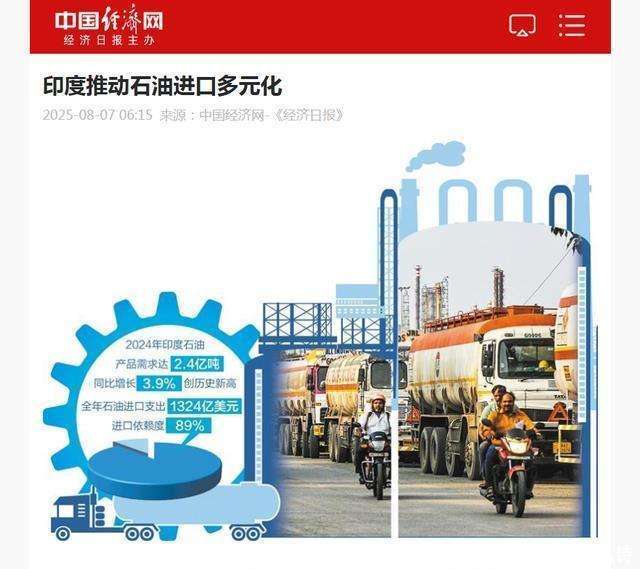
Core Viewpoint - The article discusses India's firm stance against U.S. pressure regarding oil imports from Russia, highlighting India's strategic economic calculations and diplomatic maneuvers to maintain its energy security and economic interests [2][4][24]. Group 1: India's Energy Economic Calculations - India imports 85% of its crude oil and is the world's third-largest oil consumer, with a daily consumption sufficient to circle Mumbai port multiple times [4][6]. - Since the outbreak of the Russia-Ukraine conflict in 2022, India has increasingly turned to Russian oil, which is priced 10 to 15 USD cheaper per barrel than Middle Eastern oil, allowing India to save over 4 billion USD annually [4][6]. - Russian oil has become India's largest supply source, accounting for 34% of total imports, with 1.6 million barrels supplied daily [6][7]. Group 2: U.S. Miscalculations - The U.S. imposed a 25% tariff on India due to failed trade agreements and later increased tariffs related to Russian energy imports, using the justification that India's purchases exacerbate the Ukraine conflict [9][24]. - India's Foreign Minister highlighted the inconsistency in U.S. policy, questioning why other nations can continue purchasing Russian oil while India is singled out [9][24]. Group 3: India's Dual Response Strategy - India has initiated a "dual response" strategy, seeking new trade agreements to mitigate the impact of U.S. tariffs, such as a free trade agreement with the UK that has led to a 22% increase in exports of textiles and agricultural products [12][24]. - India is also actively collaborating with other nations to expose Western hypocrisy regarding energy needs, gaining support from countries like Brazil and South Africa [14][24]. Group 4: Energy Countermeasures - India is challenging Western energy pricing power by collaborating with Saudi Arabia, the UAE, China, and Russia to develop third-party energy markets in Africa, providing low-cost oil to African nations [18][24]. - The upcoming BRICS "Energy Security Conference" in 2025 aims to unify member countries for joint oil procurement, enhancing India's negotiating power with oil-producing nations [20][24]. Group 5: U.S.-India Relations - The U.S. attempts to rally allies in the Asia-Pacific region to pressure India, but India is pursuing dialogue with China and renewing military cooperation with Russia, emphasizing the importance of partnerships over confrontation [22][24]. - India's actions reflect a calculated approach to safeguard its interests, demonstrating that developing countries' voices and needs should not be overlooked in international relations [24].
谈判预好,美豆大涨提振豆粕
Hong Ye Qi Huo· 2025-10-28 03:23
Group 1: Report Overview - The report is titled "Negotiations Look Promising, Sharp Rise in US Soybeans Boosts Soybean Meal" and is dated October 28, 2025 [1] - The report is from the Financial Research Institute of Hongye Futures, written by Chen Chunlei [3] Group 2: Market Performance - The Soybean No. 1 2601 contract continued its oscillating rebound. The spot price slightly increased; the market price of Fuyin soybeans rose from 4000 yuan/ton to around 4040 yuan/ton. The soybean basis strengthened oscillatingly, and the premium on the futures decreased [4] - The Soybean Meal 01 contract stopped falling and rebounded. The spot price of soybean meal recovered; the price of Zhangjiagang 43% protein soybean meal rose from 2870 yuan/ton to around 2910 yuan/ton. The basis strengthened oscillatingly, and the futures maintained a slight premium [4] Group 3: Domestic Soybean Situation - Domestic soybean harvesting is nearing completion with quality differentiation. As of October 24, the remaining soybean ratio in Heilongjiang reached 95%, 75% in Anhui, 70% in Henan, and 75% in Shandong. Heilongjiang's soybeans are of good quality, while those in North China are of poor quality [4] - Soybean supply is abundant, and initial Sino-US talks are promising. In September, domestic soybean imports were 12.87 million tons, a 4.8% increase from the previous month and a 13.2% increase year-on-year. From January to September, cumulative imports were 86.185 million tons, a 5.3% increase year-on-year. There is a possibility of purchasing US soybeans. As of October 24, the arrival volume of soybeans at oil mills was 2.145 million tons, a slight decrease from the previous month, and the port soybean inventory was 9.731 million tons, also a slight decrease but at a recent high [4] Group 4: US Soybean Situation - US soybeans rebounded significantly. The US government is still shut down, but some agricultural services are open, and subsidy funds have been issued. The US soybean harvest may be near completion. The positive expectation of Sino-US negotiations boosted US soybeans to a nearly one-year high [5] Group 5: Oil Mill Operations - The operating rate of oil mills continued to rise, and soybean meal inventory increased again. The profit from crushing Brazilian soybeans declined due to high costs. As of October 24, the operating rate of oil mills was 65.13%, a rebound from the previous month. The soybean crushing volume was 2.3674 million tons, reaching a recent high. The soybean inventory at oil mills was 7.513 million tons, a slight decrease from the previous month. The soybean meal output was 1.87 million tons, a rebound from the previous month. The soybean meal inventory at oil mills was 1.0546 million tons, a slight increase from the previous month, and the unfulfilled contracts for soybean meal were 4.2125 million tons, a further decline from the previous month [5] Group 6: Feed Demand - Feed demand is strong. In the pig farming sector, pig prices rebounded from a low level, and the loss margin narrowed. As of October 24, the profit from purchasing piglets for fattening was -289.07 yuan per head, a significant loss, while the profit from self-breeding and self-fattening was -185.68 yuan per head, with the loss narrowing. In the poultry sector, egg prices declined again, and egg-laying hens were in a loss-making situation, with insufficient culling, and the inventory in September remained at a historical high. As of October 24, the inventory days of soybean meal at feed mills were 7.95 days, a slight increase from the previous month [6] Group 7: Market Outlook - Domestic soybean harvesting is nearing completion, with quality differentiation, and prices have stabilized and rebounded. Domestic soybean supply is high, and there is a possibility of importing US soybeans under the expectation of Sino-US negotiations. The operating rate of oil mills is rising, and soybean meal inventory is increasing again. Demand is strong. Soybean No. 1 will oscillate and rebound, and soybean meal will oscillate and stabilize. Enterprises are advised to make purchases on dips as needed [6]
玉米期货月报-20251028
An Liang Qi Huo· 2025-10-28 02:55
Report Industry Investment Rating - Not provided in the given content Core Views - The new - season corn maintains a supply - loose pattern. Although low port inventory supports prices, downstream demand lacks growth, the deep - processing industry is in continuous loss, and feed consumption is mainly rigid. Wheat substitution has effectively supplemented the market supply, but its substitution effect is expected to weaken as wheat prices approach the policy bottom and new - season corn is listed. Currently, long and short factors are intertwined, and the market is in a key game stage. In the short term, the downward trend of corn has not reversed, and it is expected to continue to test the 2100 yuan/ton support level. The listing rhythm of new - season corn should be focused on. If the decline is fully released in time and space, the market driving logic may gradually switch later. Attention should be paid to the progress of new - grain listing and the recovery of downstream demand [5][41] Summary by Directory 1. Corn Market Structure - As of the end of September, the corn index price dropped below the 2150 yuan/ton support level. It is expected to continue to decline and may even over - decline to below 2100 yuan/ton. Recently, the supply in North China has increased, and the price has been low. The rotation of state - owned grain reserves and the arrival of imported substitutes have increased market supply. Downstream enterprises have sufficient inventories, and the demand for corn replenishment from feed enterprises is suppressed. Overall, the corn index may decline further [7] - The overall structure presents a Contango structure, with 01 contract at a discount to 05 contract and 05 contract at a discount to 09 contract [8] 2. Market行情 Analysis 2.1 Corn Market Supply is Loose, Laying the Foundation for Low Prices - **Supply - demand balance and cost decline**: The new - season corn market shows "slightly increased supply and stable rigid demand". In 2025, the national corn output is expected to be 29,616 tons, a year - on - year increase of 0.4%. Since July 1, the import corn auction has supplemented the market, and wheat substitution has squeezed the corn consumption space. The planting cost in Northeast China has decreased, and the estimated port - collection price is around 2100 yuan/ton, close to the current futures price [11] - **Reduction in import demand**: In August 2025, the import of major grains decreased significantly year - on - year. From January to August, the cumulative import of corn was 88 tons, a year - on - year decrease of 78%. The decrease in imports is related to China's policies to promote corn self - sufficiency and adjust the feed structure [15] - **Decrease in wheat substitution**: In 2025, the wheat output increased by about 4% month - on - month. Due to weak downstream demand, wheat has a price advantage over corn, and the substitution is expected to be between 2000 - 3000 tons. As the price difference between wheat and corn narrows, the substitution will gradually decrease [18] 2.2 Downstream Demand Remains Rigid but without Increment, with Limited Boosting Effect - **Pig price and capacity reduction**: In the feed - breeding sector, the policy has promoted the reduction of sow inventory since July, but the process is slow. As of August 2025, the national pig inventory was 424.47 million, and the sow inventory was 40.48 million, still higher than the normal level. The pig price is below the cost, and the industry may further reduce capacity [22] - **Loss in deep - processing industry**: Corn consumption is mainly in feed - breeding and deep - processing. The deep - processing industry is facing continuous losses, and the profit pressure restricts the increase in the start - up rate and raw - material procurement demand [24] 2.3 Low Port Inventory Increases Price Elasticity - As of September 19, the corn inventory in northern and southern ports has decreased to a medium - low level in recent years. The decrease in northern port inventory may be due to the exhaustion of grass - roots surplus grain and the hoarding of traders, while the decrease in southern port inventory reflects the decrease in arrival volume and stable downstream picking - up. Low port inventory weakens the buffer effect, making price fluctuations more sensitive to supply and demand changes [37] 3. Market Outlook - The new - season corn maintains a supply - loose pattern. Low port inventory supports prices, but downstream demand lacks growth. Although the import of grains has decreased, wheat substitution still supplements the market. As wheat prices approach the policy bottom and new - season corn is listed, the substitution effect is expected to weaken. The market is in a key game stage. In the short term, the downward trend of corn has not reversed, and it is expected to test the 2100 yuan/ton support level. Attention should be paid to the listing rhythm of new - season corn and the recovery of downstream demand [41]
农产品期权策略早报-20251028
Wu Kuang Qi Huo· 2025-10-28 02:35
Report Summary 1. Investment Rating The provided content does not mention the industry investment rating. 2. Core Viewpoint The overall trend of agricultural products shows that oilseeds and oils are weakly volatile, eggs and other products are volatile, soft commodities like sugar are slightly volatile, and grains like corn and starch are weakly and narrowly volatile. The strategy suggests constructing option portfolio strategies mainly based on sellers, as well as spot hedging or covered strategies to enhance returns [2]. 3. Summary by Category 3.1 Futures Market Overview - **Price and Volume Changes**: Different agricultural product futures show various price and volume changes. For example, soybean meal (M2601) rose by 1.33% to 2,973, with a trading volume of 914,000 lots, a decrease of 39,300 lots; while palm oil (P2601) fell by 1.03% to 9,016, with a trading volume of 462,400 lots, an increase of 7,100 lots [3]. 3.2 Option Factors - **Volume and Position PCR**: Reflects the sentiment and strength of the option market. For instance, the trading volume PCR of soybean meal is 0.80, and the position PCR is 0.61 [4]. - **Pressure and Support Levels**: Determined by the strike prices of the maximum positions of call and put options. For example, the pressure level of soybean meal is 3,100, and the support level is 2,800 [5]. - **Implied Volatility**: Most agricultural product options' implied volatility is at a relatively low level compared to historical averages, except for some products like jujube, where the implied volatility is rising [6]. 3.3 Option Strategies for Different Products - **Oilseeds and Oils Options** - **Soybean**: Fundamental factors include the planting progress of Brazilian soybeans. The option strategy suggests constructing a neutral call + put option combination strategy and a long collar strategy for spot hedging [7]. - **Soybean Meal**: Based on factors such as trading volume and basis, the strategy includes a bear - spread strategy for put options, a short - biased call + put option combination strategy, and a long collar strategy for spot hedging [9]. - **Palm Oil**: Considering factors like production in Malaysia, the strategy includes a short - biased call + put option combination strategy and a long collar strategy for spot hedging [9]. - **Peanut**: With changes in trading volume and price, the strategy mainly focuses on a long collar strategy for spot hedging [10]. - **Agricultural By - product Options** - **Pig**: Given the current price and market sentiment, the strategy includes a bear - spread strategy for put options, a short - biased call + put option combination strategy, and a covered call strategy for spot [10]. - **Egg**: Based on factors such as the expected number of newly - laid hens, the strategy includes a bear - spread strategy for put options and a short - biased call + put option combination strategy [11]. - **Apple**: Affected by climate factors, the strategy includes a long - biased call + put option combination strategy and a long collar strategy for spot hedging [11]. - **Jujube**: Considering factors like the picking progress in Xinjiang, the strategy includes a long - biased wide - straddle option combination strategy and a covered call strategy for spot hedging [12]. - **Soft Commodity Options** - **Sugar**: Based on domestic price changes, the strategy includes a short - biased call + put option combination strategy and a long collar strategy for spot hedging [12]. - **Cotton**: Considering factors such as price index and basis, the strategy includes a short - biased call + put option combination strategy and a covered call strategy for spot hedging [13]. - **Grain Options** - **Corn**: Given the current market situation of upstream and downstream, the strategy includes a short - biased call + put option combination strategy [13].
油脂油料早报-20251028
Yong An Qi Huo· 2025-10-28 01:44
Group 1: Industry Investment Rating - No information provided Group 2: Core Viewpoints - As of the week ending October 23, 2025, the U.S. soybean export inspection volume was 1,061,375 tons, in line with market expectations, and the cumulative export inspection volume for this crop year was 6,715,111 tons, lower than the same period last year [1] - As of last Thursday, the planting rate of soybeans in Brazil's 2025/26 season reached 36% of the expected sown area, unchanged from the same period last year [1] - From October 1 - 25, 2025, Malaysia's palm oil production increased by 2.78% month - on - month, with a 1.63% increase in fresh fruit bunch yield and a 0.22% increase in oil extraction rate [1] - Different institutions' data on Malaysia's palm oil exports from October 1 - 25, 2025 showed different trends: SGS reported a 23.79% increase, while AmSpec reported a 0.3% decrease and ITS reported a 0.4% decrease [1] Group 3: Summary by Related Catalogs Overnight Market Information - U.S. soybean export inspection volume as of the week ending October 23, 2025 was 1,061,375 tons, with market expectations of 1,000,000 - 1,500,000 tons, and the previous week's revised volume was 1,590,264 tons [1] - As of the week ending October 24, 2024, the U.S. soybean export inspection volume was 2,630,651 tons [1] - The cumulative U.S. soybean export inspection volume for this crop year was 6,715,111 tons, compared to 10,643,999 tons in the same period last year [1] - Brazil's 2025/26 season soybean planting rate reached 36% as of last Thursday, unchanged from the same period last year and up from 24% the previous week [1] - From October 1 - 25, 2025, Malaysia's palm oil production increased by 2.78% month - on - month, fresh fruit bunch yield increased by 1.63%, and oil extraction rate increased by 0.22% [1] - SGS reported that Malaysia's palm oil exports from October 1 - 25, 2025 were 985,301 tons, a 23.79% increase from the same period last month [1] - AmSpec reported that Malaysia's palm oil exports from October 1 - 25, 2025 were 1,182,216 tons, a 0.3% decrease from September [1] - ITS reported that Malaysia's palm oil exports from October 1 - 25, 2025 were 1,283,814 tons, a 0.4% decrease from the same period last month [1] Spot Prices - Spot prices of various products (bean meal in Jiangsu, rapeseed meal in Guangdong, soybean oil in Jiangsu, palm oil in Guangzhou, and rapeseed oil in Jiangsu) from October 21 - 27, 2025 are provided [5] Others - Information on precipitation in major producing countries, import soybean crushing profit on the futures market, and grease import profit are mentioned but no specific data is provided [1] - Information on grease basis, grease and oilseed price spreads on the futures market, and protein meal basis are mentioned but no specific data is provided [8][10][13]
农产品早报-20251028
Yong An Qi Huo· 2025-10-28 01:38
研究中心农产品团队 2025/10/28 | 玉米/淀粉 | | | | 玉米 | | | | | 淀粉 | | | --- | --- | --- | --- | --- | --- | --- | --- | --- | --- | --- | | 日期 | 长春 | 锦州 | 潍坊 | 蛇口 | 基差 | 贸易利润 进口盈亏 | 黑龙江 | 潍坊 | 基差 | 加工利润 | | 2025/10/21 | 2020 | 2130 | 2170 | 2310 | -14 | 40 195 | 2700 | 2800 | 226 | 112 | | 2025/10/22 | 2020 | 2130 | 2180 | 2300 | -3 | 30 185 | 2700 | 2800 | 229 | 112 | | 2025/10/23 | 2050 | 2110 | 2190 | 2290 | -30 | 30 176 | 2700 | 2800 | 205 | 112 | | 2025/10/24 | 2050 | 2110 | 2190 | 2280 | -23 | 20 142 | 2700 | 2800 ...
赤峰全国名特优新农产品数量达102个
Nei Meng Gu Ri Bao· 2025-10-28 01:37
Core Insights - The city of Chifeng has successfully included Arukorqin beef jerky and Ningcheng mushrooms in the 2025 second batch of national special and superior new agricultural products, bringing the total number of such products to 102, ranking second in the autonomous region [1][2] Group 1: Product Certification and Quality - National special and superior new agricultural product certification involves a rigorous three-tier review process at the city, province, and national levels, emphasizing the four characteristics of "quality, nutrition, safety, and health" [1] - Products that are certified can display a unique label on their packaging, enhancing consumer trust and increasing market recognition and brand premium [1] Group 2: Agricultural Development Strategy - Chifeng has leveraged its unique ecological resources and deep agricultural and livestock traditions to cultivate distinctive agricultural and livestock products [1] - The city’s agricultural product quality safety center collaborates with local agricultural departments to select high-quality native varieties and employs modern cultivation and breeding techniques along with a comprehensive quality control system to achieve both "superior varieties" and "stable yields" [1] - Through various branding and promotional activities, Chifeng's agricultural products have gained increasing recognition and reputation, establishing a differentiated competitive advantage in the national agricultural product market [1] Group 3: Product Categories - The 102 national special and superior new agricultural products from Chifeng cover 12 major categories, including grains and oils, meat, fruits and vegetables, traditional Chinese medicine, dairy products, edible fungi, and poultry [2] - The three leading categories—specialty grains, high-quality dairy and meat, and green fruits and vegetables—account for over 80% of the total, creating a development pattern of "multi-category collaboration and leading main categories" [2]