非银金融

Search documents
可转债周报:“反内卷”背景下如何配置转债-20250708
Changjiang Securities· 2025-07-08 12:53
Report Summary 1. Report's Industry Investment Rating The provided content does not mention the industry investment rating. 2. Core Viewpoints of the Report - The convertible bond market continued a mild recovery this week, with a style focused on stable allocation. The market center of gravity shifted from growth to low - valuation and fundamental - improvement directions. The "anti - involution" policy continued to advance, and the expectation of optimizing the supply - demand pattern of cyclical industries such as steel, building materials, and automobiles increased, which was expected to drive the emergence of structural opportunities for convertible bonds. [2][6] - In terms of valuation, the parity range stretched overall, while the valuation in the market - price range compressed overall with some structural differentiation. The implied volatility increased slightly, and the marginal improvement of sentiment might require attention to short - term overheating risks. [2][6] - Among individual bonds, medium - duration bonds with elasticity and positive - stock catalysis expectations performed prominently. The primary - market supply advanced steadily, with frequent clause - gaming and redemption announcements, reflecting the continuous local capital - gaming willingness. It was recommended to focus on medium - term valuation repair and rotation opportunities driven by policies on the basis of defense. [2][6] 3. Summary According to Relevant Catalogs "Anti - Involution": Which Industries and Convertible Bonds Are Expected to Benefit - The "anti - involution" related market strengthened. Policies in industries such as steel, photovoltaic equipment, building materials, and automobiles were expected to improve the supply - demand pattern and increase profit expectations. Some industries' capital expenditures entered a downward phase, and the overall investment intensity returned to the historical center. [15] - The valuation structures of convertible bonds in different industry sectors were significantly differentiated. The steel sector had prominent equity characteristics, the photovoltaic sector had a relatively high premium rate, the building - materials sector was debt - driven, and the automobile sector had obvious internal structural differentiation. [20] Market Theme Weekly Review - **Equity Theme Weekly Review**: The A - share market continued a structural market. High - prosperity sectors such as medicine and electronics were active, while AI - related themes were sluggish. It was recommended that investors adopt a strategy framework that balanced high - low switching, event - driven, and style equilibrium. [30] - **Convertible Bond Weekly Review**: The convertible bond market continued to rise slightly. The CSI Convertible Bond Index rose 1.21%, and large - cap convertible bonds led the rise. Valuation in the parity range generally increased, while that in the market - price range was structurally differentiated. It was recommended to grasp individual bonds in defensive low - price sectors and flexibly respond to structural rotations. [34] Market Weekly Tracking - **Main Stock Indexes Strengthened, with Medicine and "Anti - Involution" as the Main Lines This Week** - Main stock indexes generally strengthened, with the Shanghai Composite Index rising 1.4%, the Shenzhen Component Index rising 1.3%, and the ChiNext Index leading with a 1.5% increase. However, the willingness of incremental funds to enter the market was low, and the net outflow of main funds increased significantly, indicating a marginal decline in risk appetite. [36][37] - By industry, cyclical and pharmaceutical sectors such as steel, medicine, and building materials were relatively dominant, while technology - growth sectors such as computer and non - bank finance were weak. In terms of trading volume, the medicine and military - industry sectors were favored by funds, while the TMT sector shrank. [42][43] - The trading structure of the market was significantly differentiated. High - prosperity and cyclical - manufacturing sectors were the focus of capital. The military - industry and new - consumption sectors had a high degree of crowding, and it was recommended to pay attention to the sector - rotation opportunities of sectors with continuously low trading - volume quantiles such as food and beverage. [48] - **The Convertible Bond Market Followed the Uptrend, with Large - Cap Convertible Bonds Performing Well** - The convertible bond market continued to rise, with the CSI Convertible Bond Index rising 1.21%. The large - cap convertible bond index led the rise, and the trading activity increased slightly. [54] - By parity range, the valuation of the convertible bond market stretched overall, while by market - price range, it showed structural differentiation and overall compression. The implied volatility of the convertible bond market rose slightly, and the median price of convertible bonds increased. [56][57][61] - By sector, the convertible bond market generally strengthened, with the concentration slightly decreasing. The power - equipment sector continued to lead the rise, and the trading volume of the medicine, basic - chemical, and automobile sectors ranked among the top three. [65] - Individual convertible bonds generally strengthened, with high - elasticity and cyclical sectors performing well. The top - rising convertible bonds were mostly driven by positive stocks, and the market preferred medium - duration bonds with certain elasticity. [67][70] Primary - Market Tracking and Clause Gaming - **New Bond Issuance and Subscription**: Two convertible bonds were listed (Anke Convertible Bond and Dianhua Convertible Bond), and two were open for subscription (Bo 25 Convertible Bond and Libo Convertible Bond). [75] - **Issuance Plan Updates**: Two listed companies updated their convertible - bond issuance plans, with one being accepted by the exchange and one passing the shareholders' meeting. The total scale of projects at and after the exchange - acceptance stage was over 6.2 billion yuan. [76][77] - **Clause - Gaming Announcements** - **Downward - Revision - Related Announcements**: Fourteen convertible bonds announced the expected trigger of downward revision, fifteen announced not to revise downward, and one proposed downward revision. [79][81] - **Redemption - Related Announcements**: Four convertible bonds announced the expected trigger of redemption, three announced not to redeem in advance, and four announced early redemption. [86][87]
主力资金丨大跌!热门股尾盘遭主力资金抛售
Zheng Quan Shi Bao Wang· 2025-07-08 11:40
Group 1 - The core point of the article highlights the net inflow of main funds into various industries, with a total of 65.68 billion yuan flowing into the Shanghai and Shenzhen markets on July 8, including 59.68 billion yuan into the ChiNext market and 57.92 billion yuan into the CSI 300 index [2] - Among the 13 industries with net inflows, the electronics industry led with a net inflow of 40.76 billion yuan, followed by the computer industry with 26.6 billion yuan, and the communication, power equipment, and non-bank financial industries each exceeding 16 billion yuan [2] - In contrast, 18 industries experienced net outflows, with the pharmaceutical and biological industry seeing the largest outflow of over 15 billion yuan, followed by public utilities, national defense, and basic chemicals, each with outflows exceeding 5 billion yuan [3] Group 2 - A total of 77 stocks had net inflows exceeding 1 billion yuan, with 9 stocks seeing inflows over 4 billion yuan. Zhongyou Capital topped the list with a net inflow of 9.01 billion yuan, closing at the daily limit [4] - Pengding Holdings ranked second with a net inflow of 6.41 billion yuan, while other notable stocks with significant inflows included Zhongji Xuchuang, N Yitang, Dongfang Caifu, and Inspur Information, with inflows of 5.85 billion yuan, 5.16 billion yuan, 5.16 billion yuan, and 4.86 billion yuan respectively [6] - On the other hand, 37 stocks had net outflows exceeding 1 billion yuan, with Changshan Pharmaceutical leading the outflow at 8.3 billion yuan, followed by Jinyi Culture, Rongfa Nuclear Power, and Shaoneng Shares [7][8] Group 3 - At the end of the trading day, there was a net inflow of 35.8 billion yuan, with the ChiNext market contributing 12.97 billion yuan and the CSI 300 index contributing 13.24 billion yuan [9] - Among the stocks with significant end-of-day inflows, Dongfang Caifu led with a net inflow of 2.21 billion yuan, followed by Hangang Co., Zhongzhou Special Materials, and Ningde Times [10][11] - Conversely, 7 stocks experienced end-of-day net outflows exceeding 0.6 billion yuan, with Changshan Pharmaceutical again leading with a net outflow of 1.65 billion yuan, closing down 12.8% [12]






2025年上半年A股上市公司市值500强名单出炉
天天基金网· 2025-07-08 11:32
Core Viewpoint - The total market capitalization of the top 500 A-share listed companies in the first half of 2025 reached 68.24 trillion yuan, an increase of 3.16 trillion yuan from the previous quarter [2][3]. Group 1: Market Capitalization Overview - The top three companies by market capitalization are Industrial and Commercial Bank of China (2.71 trillion yuan), China Construction Bank (2.47 trillion yuan), and China Mobile (2.43 trillion yuan) [3]. - The banking sector saw a total market capitalization of 15.23 trillion yuan, increasing by 1.86 trillion yuan compared to the end of 2024 [2]. Group 2: Industry Distribution - The electronics industry has the highest representation with 61 companies, accounting for 12.2% of the total, with the highest market cap company being SMIC (704.13 billion yuan) [4]. - The non-bank financial sector has 41 companies, making up 8.2%, with China Life Insurance having the highest market cap at 1,164.22 billion yuan [4]. - The pharmaceutical and biotechnology sector includes 40 companies, representing 8%, with BeiGene (359.77 billion yuan) as the highest market cap company [4]. Group 3: Regional Distribution - Beijing leads with 86 listed companies, accounting for 17.2% of the total, with the highest market cap company being Industrial and Commercial Bank of China (2.71 trillion yuan) [7]. - Guangdong follows with 73 companies, representing 14.6%, with BYD having the highest market cap at 1,823.74 billion yuan [7]. - Shanghai has 52 companies, making up 10.4%, with the highest market cap company being Bank of Communications (706.91 billion yuan) [7]. Group 4: Significant Market Movements - A total of 13 companies have a market capitalization exceeding 1 trillion yuan, with China Ping An returning to this group after a 10.94% increase in the second quarter [10]. - Among the top 500 companies, 106 saw their market capitalization increase by over 10 billion yuan, with China Construction Bank leading with an increase of 271.91 billion yuan [12][13].

债券通“南向通”扩容!首次将非银机构纳入合资格投资者范围
Sou Hu Cai Jing· 2025-07-08 11:24
Core Insights - The Hong Kong Securities and Futures Commission announced the expansion of the Bond Connect program, allowing a wider range of non-bank financial institutions to participate, including brokers, insurance companies, wealth management, and asset management firms [2][3] Group 1: Impact on Non-Bank Financial Institutions - The inclusion of non-bank financial institutions as qualified investors will enhance their ability to meet diverse investment needs and optimize asset allocation, especially in the context of low domestic bond yields [3] - Non-bank institutions manage over 26 trillion yuan in assets, which can improve offshore asset allocation efficiency and promote diversified strategies, thereby supporting the marketization of offshore RMB bond pricing [3][4] Group 2: Market Liquidity and Capital Flow - The expansion is expected to result in an annual net outflow exceeding 800 billion yuan, which will further enhance market liquidity and broaden the offshore RMB bond market [4] - The collaboration between the "Southbound Trading" and "Hong Kong Stock Connect RMB Counter" is anticipated to create a closed-loop asset allocation system that accelerates RMB internationalization [4] Group 3: Strengthening Hong Kong's Position - The introduction of a re-pledging mechanism and multi-currency settlement measures is significant for consolidating Hong Kong's status as a RMB hub, enhancing liquidity by over 40% [5] - The integration of stock and bond markets in Hong Kong is expected to deepen the RMB liquidity pool, potentially surpassing London within three years [5] Group 4: Long-term Financial Market Integration - The optimization of the Bond Connect program will facilitate deeper interconnectivity between domestic and international financial markets, expanding the scale of capital flows in both directions [6] - The shift from policy-based to institutional openness in China's financial landscape is emphasized, with a focus on maintaining a balance between market vitality and financial security [6]
38股特大单净流入资金超2亿元
Zheng Quan Shi Bao Wang· 2025-07-08 10:07
Market Overview - The net inflow of large orders in the two markets reached 17.109 billion yuan, with 38 stocks seeing net inflows exceeding 200 million yuan, led by Zhongyou Capital with a net inflow of 999 million yuan [1][2] - The Shanghai Composite Index closed up by 0.70% today, with a total of 2,292 stocks experiencing net inflows and 2,442 stocks seeing net outflows [1] Industry Performance - Among the 15 industries with net inflows, the electronics sector had the highest net inflow of 5.568 billion yuan, with an index increase of 2.27%. The power equipment sector followed with a net inflow of 3.721 billion yuan and a rise of 2.30% [1] - The industries with net outflows included public utilities, which saw the largest outflow of 1.185 billion yuan, followed by the pharmaceutical and biological sector with an outflow of 1.147 billion yuan [1] Individual Stock Performance - The top stocks with net inflows exceeding 200 million yuan included Zhongyou Capital (999 million yuan), Industrial Fulian (990 million yuan), and Hangang Co. (889 million yuan). These stocks averaged a rise of 13.10%, outperforming the Shanghai Composite Index [2][3] - Stocks with the largest net outflows included Changshan Pharmaceutical (-718 million yuan), Huagong Technology (-382 million yuan), and Jinyi Culture (-357 million yuan) [2][3] Detailed Stock Data - The top stocks with significant net inflows are as follows: - Zhongyou Capital: 8.65 yuan, +10.05%, 999 million yuan, Non-bank Financial [2] - Industrial Fulian: 26.38 yuan, +10.01%, 990 million yuan, Electronics [2] - Hangang Co.: 9.58 yuan, +9.99%, 889 million yuan, Steel [2] - The stocks with the largest net outflows are: - Changshan Pharmaceutical: 40.52 yuan, -12.80%, -718 million yuan, Pharmaceutical [3] - Huagong Technology: 44.93 yuan, +1.03%, -382 million yuan, Machinery [3] - Jinyi Culture: 4.75 yuan, +7.47%, -357 million yuan, Textile and Apparel [3]



国泰海通 · 晨报0709|煤炭、非银、机械
国泰海通证券研究· 2025-07-08 09:41
每周一景: 云南兰坪澜沧江山谷河流村庄风光 点击右上角菜单,收听朗读版 【煤炭】新能源步入下半场,电煤压力最大已过 投资建议: 近年来伴随着新能源装机高增,新能源发电量高速增长,对煤电的挤压效益日益明显,市场担忧在新能源的挤压下未来煤电将进入负增长阶段, 从而导致电煤消费进入下行通道。而我们认为新能源高速发展时代已过,2025年起随着新能源"430、531"新政出台,并且考虑到当前电网巨大的消纳压力 和新能源项目盈利性下降明显,我们判断未来新能源发电将减速,对煤电的边际冲击减弱,我们测算电煤的需求拐点或将在2027年。 新能源步入下半场,电煤已过压力最大时刻,2026年压力缓解,2027年有望迎来向上拐点。 我们认为新能源新政带来的未来现金流确定性下降,将有望促 使新能源装机开始下降,2024年将可能成为历史新能源装机的大顶,也意味着对于火电替代压力最大的在2025年。而展望整体全社会用电量的需求端,随着 近年来用电结构变化,以新能源汽车、AI相关、储能为主导驱动力的第三产业及城乡居民用电成为拉动边际用电量提升的主要方向,有望推动全社会用电量稳 步增长。我们判断随着需求端的稳步增长,与2025年6月开始新能源 ...

主力资金动向 74.37亿元潜入电子业
Zheng Quan Shi Bao Wang· 2025-07-08 09:37
Core Insights - The electronic industry saw the highest net inflow of funds today, amounting to 7.437 billion yuan, with a price increase of 2.27% and a trading volume increase of 27.09% compared to the previous trading day [1][2] - The public utilities sector experienced the largest net outflow of funds, totaling -2.297 billion yuan, with a price decrease of -0.37% and a trading volume decrease of -1.77% compared to the previous trading day [1][2] Industry Summary - **Electronic**: - Trading volume: 8.246 billion shares - Trading volume change: +27.09% - Turnover rate: 2.99% - Price change: +2.27% - Net inflow: 7.437 billion yuan [1] - **Electric Equipment**: - Trading volume: 8.720 billion shares - Trading volume change: +26.87% - Turnover rate: 3.53% - Price change: +2.30% - Net inflow: 3.678 billion yuan [1] - **Computer**: - Trading volume: 7.146 billion shares - Trading volume change: +12.84% - Turnover rate: 4.02% - Price change: +1.73% - Net inflow: 3.540 billion yuan [1] - **Public Utilities**: - Trading volume: 6.850 billion shares - Trading volume change: -1.77% - Turnover rate: 1.73% - Price change: -0.37% - Net outflow: -2.297 billion yuan [1][2] - **Healthcare**: - Trading volume: 6.303 billion shares - Trading volume change: +6.24% - Turnover rate: 2.31% - Price change: +0.31% - Net outflow: -2.285 billion yuan [2]
【金工】被动资金持续加仓港股ETF,医药主题基金净值优势显著——基金市场与ESG产品周报20250707(祁嫣然/马元心)
光大证券研究· 2025-07-08 09:03
Market Performance Overview - The domestic equity market continued its upward trend, with the CSI 300 index rising by 1.54% during the week of June 30 to July 4, 2025. Gold prices also saw a significant increase. The steel, building materials, and banking sectors experienced the highest gains, while the computer, non-bank financial, and beauty care sectors faced the largest declines [3]. - All types of fund indices achieved positive returns, with ordinary equity funds rising by 1.60% [3]. Fund Product Issuance - The domestic new fund market saw a decrease in activity, with 23 new funds established, totaling 5.328 billion units issued. This included 13 equity funds, 4 bond funds, 5 mixed funds, and 1 fund of funds (FOF). In total, 36 new funds were issued across the market, comprising 25 equity funds, 6 bond funds, and 5 mixed funds [4]. Fund Product Performance Tracking - The long-term thematic fund indices continued to rise, with the pharmaceutical theme fund showing the highest increase of 5.70%. Other themes such as finance and real estate, industry rotation, and balanced industry funds also performed well, while TMT and national defense industry funds lagged behind [5]. ETF Market Tracking - Stock ETFs experienced a net outflow of 20.817 billion yuan, primarily from large-cap broad-based ETFs, while Hong Kong stock ETFs saw a significant inflow of 7.821 billion yuan. The median return for stock ETFs was 1.35%, while the median return for Hong Kong stock ETFs was -0.75% [7]. - The median return for cross-border ETFs was 1.32%, with a net inflow of 0.375 billion yuan. Commodity ETFs had a median return of 1.12% and a net inflow of 2.24 billion yuan. The Sci-Tech Innovation Board theme ETF saw a net inflow of 0.84 billion yuan, while other broad-based ETFs experienced net outflows totaling 23.298 billion yuan [7]. Fund Positioning Monitoring - The estimated equity positioning of actively managed funds decreased by 0.44 percentage points compared to the previous week. Increased allocations were observed in the pharmaceutical, national defense, and electronics sectors, while reductions were noted in non-ferrous metals, household appliances, and electric equipment sectors [8]. ESG Financial Product Tracking - Twelve new green bonds were issued this week, with a total issuance scale of 33.461 billion yuan. The domestic green bond market has steadily developed, with a cumulative issuance scale of 4.63 trillion yuan and a total of 3,954 bonds issued as of July 4, 2025 [9]. - In terms of fund performance, the median return for actively managed equity, passive equity index, and bond ESG funds was 1.22%, 1.89%, and 0.15%, respectively. Funds focused on low-carbon economy, carbon neutrality, and the Belt and Road Initiative showed significant performance advantages [9].

516新规后并购怎么玩?8个案例告诉你7大审核法律要点!
梧桐树下V· 2025-07-08 03:57
Core Viewpoint - The new regulations from the China Securities Regulatory Commission (CSRC) allow unprofitable hard technology assets to be injected into listed companies, marking a significant policy stimulus for mergers and acquisitions (M&A) following previous initiatives like the "Eight Articles" for the Sci-Tech Innovation Board and local billion-dollar M&A funds [1] Group 1: M&A Market Overview - The M&A market has been heating up, with increasing corporate interest and participation [2] - The average M&A amount in 2024 across various industries shows significant growth compared to the past decade, with notable increases in sectors like defense and light manufacturing [5] Group 2: Regulatory Framework - Despite the loosening of policies, regulatory scrutiny remains stringent, as evidenced by a medical group's failed acquisition due to compliance issues [8] - Key regulatory standards for major asset restructuring in different boards (Main Board, Sci-Tech Innovation Board, and Growth Enterprise Market) have been outlined, emphasizing the need for profitability and revenue thresholds [9] Group 3: Legal Review Points - The article discusses the legal review points for M&A, including the requirements for unprofitable enterprises and the implications for controlling shareholders regarding share reduction post-restructuring [12] - A course is offered to dissect the legal aspects of M&A through real case studies, focusing on compliance and regulatory standards [10][15]

中际旭创等获融资资金买入排名前三丨资金流向日报
2 1 Shi Ji Jing Ji Bao Dao· 2025-07-08 03:17
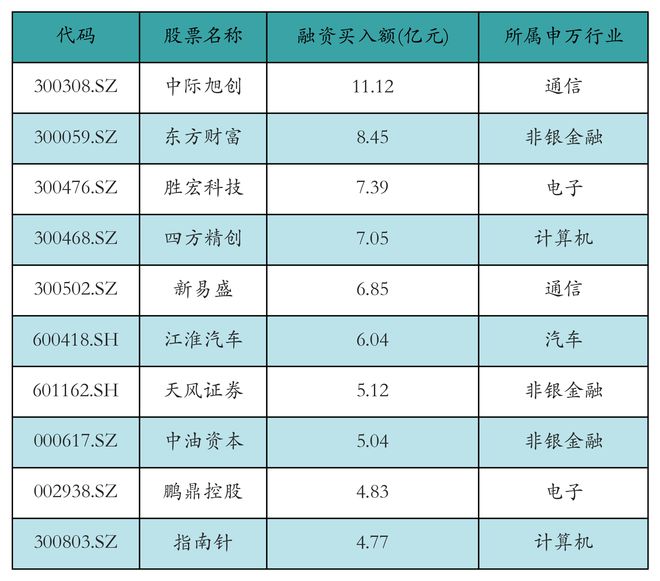
Market Overview - The Shanghai Composite Index rose by 0.02% to close at 3473.13 points, with a daily high of 3474.8 points [1] - The Shenzhen Component Index fell by 0.7% to close at 10435.51 points, reaching a high of 10501.31 points [1] - The ChiNext Index decreased by 1.21%, closing at 2130.19 points, with a peak of 2155.69 points [1] Margin Trading and Securities Lending - The total margin trading and securities lending balance in the Shanghai and Shenzhen markets reached 18534.69 billion yuan, with a financing balance of 18404.95 billion yuan and a securities lending balance of 129.74 billion yuan, an increase of 64.08 billion yuan from the previous trading day [2] - The Shanghai market's margin balance was 9380.08 billion yuan, up by 32.0 billion yuan, while the Shenzhen market's balance was 9154.61 billion yuan, increasing by 32.08 billion yuan [2] - The top three stocks with the highest margin buying were: - Zhongji Xuchuang (11.12 billion yuan) in the communication sector - Dongfang Caifu (8.45 billion yuan) in non-bank financials - Shenghong Technology (7.39 billion yuan) in electronics [2] Fund Issuance - A total of 42 new funds were issued, including various ETFs and mixed funds focused on technology innovation and clean energy [3][4][5] - Notable fund issuances include: - Dachen Insight Advantage Mixed Fund - ICBC Credit Suisse Shanghai Stock Exchange Science and Technology Innovation Board 200 ETF - Huaxia CSI AAA Technology Innovation Corporate Bond ETF [3][4][5] Top Net Purchases on the Dragon and Tiger List - The top 10 net purchases on the Dragon and Tiger list included: - Qingdao Jinwang with a net purchase of 19530.8 million yuan, closing at 9.25 yuan, with a 9.99% increase [6] - Jingbeifang with a net purchase of 16122.2 million yuan, closing at 25.63 yuan, with a 10.0% increase [6] - Rongfa Nuclear Power with a net purchase of 13478.41 million yuan, closing at 9.83 yuan, with a 9.96% increase [6]