
交通运输等

Search documents
市场全天震荡拉升,创业板指涨近2%
Dongguan Securities· 2025-11-26 01:39
Market Overview - The A-share market experienced a strong upward trend, with the ChiNext Index rising nearly 2% [2] - Major indices opened higher, with the Shanghai Composite Index up 0.36% and the Shenzhen Component Index up 0.85% [2] - By the end of the trading day, all three major indices closed in the green, with over 4,300 stocks rising and nearly 100 stocks hitting the daily limit [2] Sector Performance - The top-performing sectors included Communication (up 3.54%), Media (up 2.85%), and Non-ferrous Metals (up 2.42%) [2] - Conversely, sectors such as Defense and Military Industry and Transportation showed declines, with the former down 0.32% [2] - Concept indices like F5G and Co-packaged Optics (CPO) performed well, while sectors like Shipbuilding and Poultry showed weaker performance [2] Monetary Policy Insights - On November 25, the central bank conducted a 1 trillion yuan Medium-term Lending Facility (MLF) operation, indicating a continued accommodative monetary policy stance [3] - The net MLF injection for November is expected to reach 100 billion yuan, marking the ninth consecutive month of increased MLF operations [3] Technical Analysis - The trading volume in the Shanghai and Shenzhen markets reached 1.81 trillion yuan, an increase of 84.4 billion yuan from the previous trading day [4] - The Shanghai Composite Index broke through the short-term resistance level of 3,850 points, with a peak of 3,882 points during the day [4] - Despite some pressure from the 5-day moving average, the market sentiment remains cautious, with a notable rotation among sectors and a need for valuation digestion in previously high-performing sectors [4] Long-term Outlook - The report suggests that the fundamental resilience of listed companies remains intact, with a positive long-term trend for the A-share market [4] - Emerging industries are highlighted as structural bright spots amid economic transformation, with liquidity trends expected to continue supporting the market [4] - Recommended sectors for focus include dividends, TMT (Technology, Media, and Telecommunications), and new energy [4]
粤开市场日报-20251125
Yuekai Securities· 2025-11-25 07:41
Market Overview - The A-share market saw a broad increase today, with the Shanghai Composite Index rising by 0.87% to close at 3870.02 points, the Shenzhen Component Index increasing by 1.53% to 12777.31 points, the ChiNext Index up by 1.77% to 2980.93 points, and the Sci-Tech 50 Index gaining 0.43% to 1302.17 points [1] - Overall, 4297 stocks rose while 991 stocks fell, with a total trading volume of 18121 billion yuan, an increase of 844 billion yuan compared to the previous trading day [1] Industry Performance - Among the Shenwan first-level industries, the top gainers included telecommunications, media, non-ferrous metals, comprehensive, and electronics, with respective increases of 3.54%, 2.85%, 2.42%, 2.21%, and 2.14% [1] - The only sectors that experienced declines were defense and military industry, and transportation, with decreases of 0.32% and 0.11% respectively [1] Concept Sector Performance - The leading concept sectors in terms of growth included optical modules (CPO), optical chips, optical communications, fiberglass, lithium battery electrolytes, cross-strait integration, 6G, copper-clad laminates, circuit boards, RF and antennas, Chinese corpus, high-speed copper connections, and online games [2] - Sectors such as aquaculture, air transportation selection, China Shipbuilding System, and aircraft carrier concepts experienced a pullback [2]
19个行业获融资净卖出,计算机行业净卖出金额最多
Zheng Quan Shi Bao Wang· 2025-11-13 01:56
Core Insights - As of November 12, the latest market financing balance is 24,840.85 billion yuan, showing a decrease of 30.78 billion yuan compared to the previous trading day [1] - Among the 12 primary industries, the non-ferrous metals sector saw the largest increase in financing balance, rising by 6.55 billion yuan [1] - The industries with notable increases in financing balance include telecommunications, electronics, and transportation, with increases of 5.66 billion yuan, 4.83 billion yuan, and 2.86 billion yuan respectively [1] - Conversely, 19 industries experienced a decrease in financing balance, with the computer, electric equipment, and automotive sectors seeing the largest declines of 14.78 billion yuan, 13.04 billion yuan, and 7.50 billion yuan respectively [1] Industry Financing Changes - The non-ferrous metals industry has the highest financing balance at 1,196.41 billion yuan, with a growth rate of 0.55% [1] - The telecommunications sector follows with a financing balance of 1,104.28 billion yuan, reflecting a growth rate of 0.51% [1] - The electric equipment industry has a financing balance of 2,198.02 billion yuan, showing a decrease of 13.04 billion yuan, which corresponds to a decline of 0.59% [2] - The automotive industry has a financing balance of 1,203.26 billion yuan, with a decrease of 7.50 billion yuan, resulting in a decline of 0.62% [2] - The environmental protection sector has a financing balance of 190.17 billion yuan, with a decrease of 2.32 billion yuan, marking a decline of 1.20% [2]
《国家碳达峰试点(成都)实施方案》印发 绿色低碳产业竞争力到2030年处于全国前列
Si Chuan Ri Bao· 2025-11-12 06:48
Core Points - Chengdu government has issued the "Implementation Plan for National Carbon Peak Pilot (Chengdu)" to effectively promote carbon peak initiatives before 2030 [1][2] - The overall goal is to reduce energy consumption and carbon emissions per unit of GDP, enhance the competitiveness of green low-carbon industries, and establish a robust policy framework for green low-carbon development by 2030 [1] Group 1: Key Areas of Focus - The plan outlines eight key areas of work, including promoting clean and efficient energy use and optimizing industrial structure [2] - Specific initiatives include the construction of low-carbon and zero-carbon parks, enhancing green building standards, and implementing energy consumption limits for public buildings [2] Group 2: Policy Innovations - The plan proposes the exploration of a dual control system for carbon emissions and the establishment of a product carbon footprint management system [2] - Tasks include developing a rapid reporting system for carbon emissions in industrial enterprises and creating a carbon budget management system [2]
价格全方位多维跟踪体系(2025.11):成本高企与利润分化并存
Guoxin Securities· 2025-11-07 12:15
Core Insights - The report highlights a structural divergence in the prices of major production materials, with 23 out of 49 materials experiencing price increases, while 24 saw declines, indicating a mixed market environment [1][2][3] - Key price increases are observed in upstream coal and non-ferrous metals, particularly copper and aluminum, driven by replenishment demand and cost support [1][2] - Conversely, significant price drops are noted in agricultural products and certain chemicals, reflecting weak downstream consumption and excess supply pressures [1][2] Price Tracking of Major Production Materials - As of October 2025, coal prices have slightly rebounded to 670-680 RMB/ton, while WTI crude oil has decreased to 57 USD/barrel [3] - Non-ferrous metals, including copper and aluminum, have shown strong performance, with copper prices reaching 86,430 RMB/ton and aluminum prices exceeding 21,000 RMB/ton [1][3] - The chemical sector exhibits notable price differentiation, with sulfuric acid prices surging over 700 RMB/ton, while other chemical products like plastics and fertilizers continue to decline [1][2][3] Year-on-Year Price Changes - Year-on-year comparisons reveal that coal prices have decreased by approximately 10%-25%, with the decline rate narrowing, indicating a marginal improvement in supply-demand dynamics [2] - Agricultural products, particularly live pigs, have seen a significant price drop of around 37%, negatively impacting the overall agricultural sector [2] - The non-ferrous metals sector has shown resilience, with electrolytic copper and aluminum prices increasing by 17.4% and 7.3% respectively, reflecting strong international metal market conditions and domestic demand recovery [2] Industry Price Trends - The report indicates that industries such as new energy, new materials, and high-end equipment are experiencing high material price levels and ongoing cost pressures, while traditional sectors like textiles and construction are facing low output prices due to weak downstream demand [4] - Profit margins remain robust in sectors like new energy vehicles and high-end manufacturing, while industries such as chemical fibers and construction materials are under pressure due to high input costs and weak output [4]
基本面高频数据跟踪:电厂耗煤回升
GOLDEN SUN SECURITIES· 2025-10-27 06:38
Report Industry Investment Rating No information about the report industry investment rating is provided in the content. Core Viewpoints - The current Guosheng Fundamental High - Frequency Index is 128.4 points (previous value: 128.3 points), with a year - on - year increase of 6.0 points (previous value: 5.9 points), and the year - on - year growth rate has widened. The long - short signal of interest - rate bonds has been downgraded, with a signal factor of 4.7% (previous value: 4.9%) [1][9]. - In terms of production, the industrial production high - frequency index is 127.4 (previous value: 127.4), with a year - on - year increase of 5.4 points (previous value: 5.5 points), and the year - on - year growth rate has narrowed. - In terms of total demand, the high - frequency index of commercial housing sales is 42.0 (previous value: 42.2), with a year - on - year decrease of 6.1 points (previous value: 6.1 points), and the year - on - year decline remains unchanged; the high - frequency index of infrastructure investment is 122.1 (previous value: 122.0), with a year - on - year increase of 8.7 points (previous value: 8.4 points), and the year - on - year growth rate has expanded; the high - frequency index of exports is 143.6 (previous value: 143.6), with a year - on - year increase of 1.3 points (previous value: 1.4 points), and the year - on - year growth rate has narrowed; the high - frequency index of consumption is 120.6 (previous value: 120.6), with a year - on - year increase of 3.7 points (previous value: 3.6 points), and the year - on - year growth rate has expanded [1][9]. - In terms of prices, the monthly - on - monthly forecast of CPI is 0.0% (previous value: 0.1%); the monthly - on - monthly forecast of PPI is 0.0% (previous value: 0.0%) [1][9][10]. - The high - frequency inventory index is 162.7 (previous value: 162.5), with a year - on - year increase of 8.2 points (previous value: 8.4 points), and the year - on - year growth rate has narrowed. - The high - frequency transportation index is 131.9 (previous value: 131.7), with a year - on - year increase of 10.2 points (previous value: 10.1 points), and the year - on - year growth rate has expanded. - The high - frequency financing index is 240.4 (previous value: 239.8), with a year - on - year increase of 30.3 points (previous value: 30.3 points), and the year - on - year growth rate remains unchanged [2][10]. Summary by Relevant Catalogs Total Index: Fundamental High - Frequency Index Remains Stable - The Guosheng Fundamental High - Frequency Index is 128.4 points, with a year - on - year increase of 6.0 points, and the year - on - year growth rate has widened. The long - short signal factor of interest - rate bonds is 4.7%, a decrease from the previous value [1][9][11]. Production: Polyester Operating Rate Slightly Increases - The electric - furnace operating rate is 60.9%, unchanged from the previous value; the polyester operating rate is 89.1%, an increase from the previous value of 88.0%; the semi - tire operating rate is 73.7%, an increase from the previous value of 72.7%; the full - tire operating rate is 65.6%, an increase from the previous value of 64.5%; the PTA operating rate is 76.0%, an increase from the previous value of 75.6%; the PX operating rate is 86.3%, a decrease from the previous value of 87.3%; the coal dispatch at Qinhuangdao Port is 46.9 tons, a decrease from the previous value of 54.4 tons [11][16]. Real Estate Sales: Commercial Housing Transaction Area Slightly Declines - The commercial housing transaction area in 30 large and medium - sized cities is 28.7 million square meters, a decrease from the previous value of 31.0 million square meters; the land premium rate of transactions in 100 large and medium - sized cities is 2.0%, unchanged from the previous value [26]. Infrastructure Investment: Infrastructure High - Frequency Index Rises Steadily - The infrastructure high - frequency index is 122.1, with a year - on - year increase of 8.7 points, and the year - on - year growth rate has expanded. The operating rate of local refineries is 50.0%, a decrease from the previous value of 50.3% [11][35]. Exports: Export Container Freight Rate Index Continues to Decline - The CCFI index is 993 points (previous value: 973 points); the RJ/CRB index is 299.6 points (previous value: 294.2 points) [43]. Consumption: Daily Average Box Office of Movies Continues to Decline - The daily average box office of movies is 32.82 million yuan, a decrease from the previous value of 37.49 million yuan [54]. CPI: Pork Prices Slightly Decrease - The latest average wholesale price of pork is 17.7 yuan/kg, a decrease from the previous value of 18.3 yuan/kg; the latest average wholesale price of 28 key - monitored vegetables is 5.2 yuan/kg, an increase from the previous value of 5.0 yuan/kg; the latest average wholesale price of 7 key - monitored fruits is 7.0 yuan/kg, a decrease from the previous value of 7.1 yuan/kg; the latest average wholesale price of dressed chickens is 17.7 yuan/kg, an increase from the previous value of 17.6 yuan/kg [60]. PPI: Prices of Coal, Copper, Aluminum, and Oil Have All Increased - The closing price of thermal coal (produced in Shanxi) at Qinhuangdao Port is 765 yuan/ton, an increase from the previous value of 727 yuan/ton; the futures settlement price of Brent crude oil is 63 US dollars/barrel, an increase from the previous value of 62 US dollars/barrel; the spot settlement price of LME copper is 10,679 US dollars/ton, an increase from the previous value of 10,588 US dollars/ton; the spot settlement price of LME aluminum is 2,814 US dollars/ton, an increase from the previous value of 2,765 US dollars/ton [65]. Transportation: Subway Passenger Volume Slightly Declines - The subway passenger volume in first - tier cities is 39.59 million person - times, a decrease from the previous value of 40.26 million person - times; the highway logistics freight rate index is 1050 points, an increase from the previous value of 1049 points; the number of domestic flights is 13,007, an increase from the previous value of 12,790 [75]. Inventory: Electrolytic Aluminum Inventory Decreases - The electrolytic aluminum inventory is 11.8 tons, a decrease from the previous value of 16.8 tons; the soda - ash inventory is 170.6 tons, an increase from the previous value of 169.3 tons [84]. Financing: Net Financing of Local Bonds Significantly Increases - The net financing of local bonds within the week is 165.8 billion yuan, an increase from the previous value of - 19.8 billion yuan; the net financing of credit bonds is 135.2 billion yuan, a decrease from the previous value of 184.7 billion yuan; the 6M national - share bank acceptance bill rediscount rate is 0.6%, a decrease from the previous value of 0.7%; the average value of the bill rate minus the certificate of deposit rate is - 1.00%, a decrease from the previous value of - 0.93% [95].
今日17.25亿元主力资金潜入银行业
Zheng Quan Shi Bao Wang· 2025-10-14 13:01
Core Insights - The banking sector experienced the highest net inflow of funds, amounting to 1.725 billion, with a price change of 2.51% and a turnover rate of 0.55% [1] - The electronics sector faced the largest net outflow of funds, totaling 29.910 billion, with a price change of -4.64% and a turnover rate of 4.04% [1][2] Industry Summary - **Banking**: - Trading volume: 7.298 billion shares - Change in trading volume: +24.50% - Net inflow: 1.725 billion [1] - **Electronics**: - Trading volume: 11.160 billion shares - Change in trading volume: -0.84% - Net outflow: -29.910 billion [1][2] - **Food and Beverage**: - Trading volume: 1.392 billion shares - Change in trading volume: +4.88% - Net inflow: 1.174 billion [1] - **Coal**: - Trading volume: 3.574 billion shares - Change in trading volume: +36.05% - Net inflow: 0.498 billion [1] - **Transportation**: - Trading volume: 5.048 billion shares - Change in trading volume: +13.59% - Net inflow: 0.198 billion [1] - **Petrochemicals**: - Trading volume: 1.921 billion shares - Change in trading volume: +3.64% - Net inflow: 0.175 billion [1] - **Utilities**: - Trading volume: 6.797 billion shares - Change in trading volume: +13.13% - Net inflow: 0.025 billion [1] - **Real Estate**: - Trading volume: 5.849 billion shares - Change in trading volume: +25.35% - Net outflow: -1.257 billion [1]
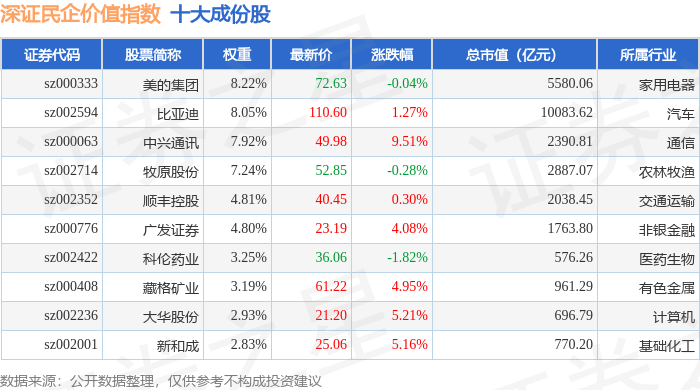
10月9日深证民企价值(970072)指数涨2.57%,成份股中兴通讯(000063)领涨
Sou Hu Cai Jing· 2025-10-09 11:13
Core Insights - The Shenzhen Private Enterprise Value Index (970072) closed at 3567.74 points, up 2.57%, with a trading volume of 86.68 billion yuan and a turnover rate of 3.08% [1] - Among the index constituents, 37 stocks rose while 13 fell, with ZTE Corporation leading the gainers at 9.51% and Shentong Express leading the decliners at 2.12% [1] Index Constituents Summary - The top ten constituents of the Shenzhen Private Enterprise Value Index include: - Midea Group (8.22% weight) at 72.63 yuan, down 0.04%, with a market cap of 558.01 billion yuan [1] - BYD (8.05% weight) at 110.60 yuan, up 1.27%, with a market cap of 1008.36 billion yuan [1] - ZTE Corporation (7.92% weight) at 49.98 yuan, up 9.51%, with a market cap of 239.08 billion yuan [1] - Muyuan Foods (7.24% weight) at 52.85 yuan, down 0.28%, with a market cap of 288.71 billion yuan [1] - SF Holding (4.81% weight) at 40.45 yuan, up 0.30%, with a market cap of 203.84 billion yuan [1] - GF Securities (4.80% weight) at 23.19 yuan, up 4.08%, with a market cap of 176.38 billion yuan [1] - Kelun Pharmaceutical (3.25% weight) at 36.06 yuan, down 1.82%, with a market cap of 57.63 billion yuan [1] - Zangge Mining (3.19% weight) at 61.22 yuan, up 4.95%, with a market cap of 96.13 billion yuan [1] - Dahua Technology (2.93% weight) at 21.20 yuan, up 5.21%, with a market cap of 69.68 billion yuan [1] - Xinhengcheng (2.83% weight) at 25.06 yuan, up 5.16%, with a market cap of 77.02 billion yuan [1] Capital Flow Analysis - The net inflow of main funds into the index constituents totaled 3.165 billion yuan, while retail funds saw a net outflow of 755 million yuan [3] - ZTE Corporation had a significant net inflow of 302.8 million yuan from main funds, while it experienced a net outflow of 218.1 million yuan from retail funds [3] - BYD saw a net inflow of 89.4 million yuan from main funds, with retail funds experiencing a net outflow of 26.3 million yuan [3]


A股“最惨”板块跌麻了,什么情况?
Zheng Quan Shi Bao Wang· 2025-09-12 03:23
Core Viewpoint - Despite the overall upward trend in the A-share market, many low-priced stocks have declined, with some falling below the 1 yuan face value, indicating market differentiation and the ongoing process of resource optimization [1][2]. Group 1: Market Performance - The A-share market has seen significant growth, with the average stock price reaching 26.15 yuan and the median at 16.28 yuan as of September 11 [1]. - There are currently 28 stocks priced below 2 yuan, with an average decline of 1.48% since August, while major indices like the Shanghai Composite Index and Shenzhen Component Index have risen by 8.45% and 17.89%, respectively [2]. Group 2: Characteristics of Low-Priced Stocks - All 28 stocks priced below 2 yuan are from the main board, with no representation from the ChiNext, Sci-Tech Innovation Board, or Beijing Stock Exchange [3]. - The real estate sector dominates this group, with 7 stocks, followed by construction decoration, steel, and basic chemicals, each with 3 stocks [3]. - The majority of these low-priced stocks are small to mid-cap, with 16 stocks having a market capitalization below 10 billion yuan, and only 1 stock exceeding 50 billion yuan [3]. Group 3: Financial Performance - More than half of the low-priced stocks have reported a decline in revenue for the first half of the year, with 15 stocks showing a year-on-year decrease [3]. - Over 60% of these stocks have also experienced a drop in net profit attributable to shareholders [3]. Group 4: ST Stocks and Risks - A significant portion of the low-priced stocks, 13 out of 28, are ST (Special Treatment) stocks, indicating serious financial issues [4]. - Companies like *ST Gao Hong and *ST Su Wu are facing severe risks, including potential delisting due to fraudulent activities and financial mismanagement [4].
最高24个跌停板,A股“最惨”板块跌麻了,什么情况?
Zheng Quan Shi Bao· 2025-09-11 14:55
Group 1 - The overall A-share market has been rising significantly, yet many low-priced stocks have declined, with some falling below the 1 yuan face value, indicating a "vote with feet" from the market [1][2] - As of September 11, the average stock price in the A-share market was 26.15 yuan, while the median was 16.28 yuan, showing a general upward trend in stock prices [1] - There are currently 28 stocks priced below 2 yuan, with an average decline of -1.48% since August, contrasting sharply with the major indices which have seen increases of 8.45% to 31.16% [2] Group 2 - All 28 stocks priced below 2 yuan are from the main board, with no representation from the ChiNext, Sci-Tech Innovation Board, or Beijing Stock Exchange [3] - The real estate sector is the most represented among these low-priced stocks, with 7 companies, followed by construction decoration, steel, and basic chemicals, each with 3 companies [3] - The majority of these low-priced stocks are small to mid-cap, with 16 stocks having a market capitalization below 10 billion yuan, and only 1 stock exceeding 50 billion yuan [3] Group 3 - More than half of the 28 low-priced stocks have reported a decline in revenue year-on-year for the first half of the year, and over 60% have seen a drop in net profit attributable to shareholders [3][4] - A significant portion of the low-priced stocks are ST (Special Treatment) stocks, with 13 out of 28 classified as such, indicating serious financial issues [4] - Specific companies like *ST Gao Hong and *ST Su Wu are facing severe risks, including potential delisting due to fraudulent activities and financial mismanagement [4]
