电脑

Search documents
关税阻力持续存在使得美国制造业陷入低迷
Shang Wu Bu Wang Zhan· 2025-12-03 16:38
Group 1 - The US manufacturing index decreased from 48.7 in October to 48.2 in November, remaining below the neutral level of 50 for nine consecutive months, indicating ongoing challenges for US factories due to import tariffs [1] - Only four industries experienced growth in November, including computers, electronics, and machinery, while several sectors such as wood, transportation, and apparel faced contraction [1] - Transportation equipment manufacturers are implementing structural adjustments in response to the tariff environment, including layoffs and shifting production overseas [1] Group 2 - Chemical product manufacturers report that tariffs and economic uncertainty continue to suppress demand for construction materials like adhesives [1] - Electrical equipment, appliance, and component manufacturers express concerns over a "chaotic trade environment" [1] - Other producers indicate that rising tariffs, government shutdowns, and increasing global uncertainty contribute to a persistently weak business environment [1] Group 3 - The US Supreme Court's recent questioning of the legality of Trump's tariffs has intensified speculation about potential overturning of these tariffs, which could lead to greater chaos [1] - Market expectations suggest that if the Supreme Court issues an unfavorable ruling, Trump may pivot to alternative trade strategies [1]
多位基金经理加仓港股,聚焦AI应用和创新药
Huan Qiu Wang· 2025-11-10 01:09
Group 1 - Notable fund managers have increased their positions in Hong Kong stocks during the third quarter, particularly in AI applications and innovative pharmaceuticals, leading to discussions about a potential market rebound in Hong Kong [1] - Daiwa Securities Group reported that mainland Chinese investors are realizing profits in Hong Kong stocks through the Stock Connect mechanism, with a focus on sectors such as electronics, computers, and military industries, while also increasing holdings in high-dividend stocks like energy and metal producers [1] Group 2 - Citic Securities' research indicates that not only the TMT sector but also non-ferrous metals and chemicals are experiencing price increases influenced by AI narratives, with these sectors collectively accounting for over 60% of institutional holdings [4] - The strategy for portfolio adjustment is not to avoid AI narratives but to select stocks with a rising trend in ROE from a low base, suggesting that AI narratives are affecting the slope of market trends rather than the overall trend itself [4]

被产业链“寄予厚望”,AIPC现在如何了?
经济观察报· 2025-11-08 08:03
Core Viewpoint - The optimism surrounding AIPC (Artificial Intelligence Personal Computer) from manufacturers may not be reliable, as the AI experience that consumers can directly perceive is still immature [6][23]. Group 1: AIPC Market Dynamics - Lenovo's AIPC sales are on the rise, indicating a growing trend in the market [3]. - Intel reported a revenue of $13.65 billion in Q3 2025, marking a 2.8% year-on-year increase, attributed to AIPC demand [4]. - By the end of 2025, Intel expects to supply processors for over 100 million AIPC units [4]. Group 2: Hardware and Software Ecosystem - AIPC integrates a Neural Processing Unit (NPU) alongside traditional CPU and GPU, enhancing AI task execution [2][7]. - The AIPC market is driven by various chip manufacturers, including Intel, AMD, and Qualcomm, each offering unique architectures and capabilities [9][10]. - Microsoft leads the operating system market with its "Copilot+PC" standard for AIPC, requiring a minimum NPU performance of 40 TOPS and 16GB of RAM [11]. Group 3: Consumer Experience and Challenges - Despite high expectations, AIPC's software ecosystem is fragmented, and many productivity applications do not effectively utilize the NPU [5][20]. - Users report dissatisfaction with AI functionalities, citing issues with accuracy and usability [19][20]. - The physical limitations of local devices pose challenges for running high-parameter AI models, impacting user experience [22]. Group 4: Future Outlook - The rapid growth of AIPC is closely tied to the end of support for Windows 10, pushing businesses to upgrade [18]. - The true potential of AIPC may not be realized until the developer ecosystem matures and AI applications become more robust [23][24]. - AIPC penetration is projected to exceed 50% by 2028, indicating a long-term growth trajectory [24].




上海:前三季度高技术产品进口超过6000亿元 同比增长
Jing Ji Guan Cha Wang· 2025-10-28 03:30
Core Insights - The eighth China International Import Expo is being prepared, with significant growth in high-tech product imports in Shanghai [1] Group 1: High-Tech Product Imports - In the first three quarters of this year, Shanghai's high-tech product imports exceeded 600 billion yuan, marking a year-on-year increase of 6.4% [1] - Compared to the same period in 2017, high-tech product imports have grown by 39.1% [1] - Notable growth was observed in specific categories, with computer and its components increasing by 151.2% and analytical and testing instruments rising by 50.7% [1] Group 2: Consumer Goods Imports - Shanghai's port accounted for over 40% of the national imports of cosmetics, wine, luggage, watches, medicinal materials, and pharmaceuticals [1]
端侧AI需求爆发改写联想(00992)估值逻辑
智通财经网· 2025-10-21 11:42
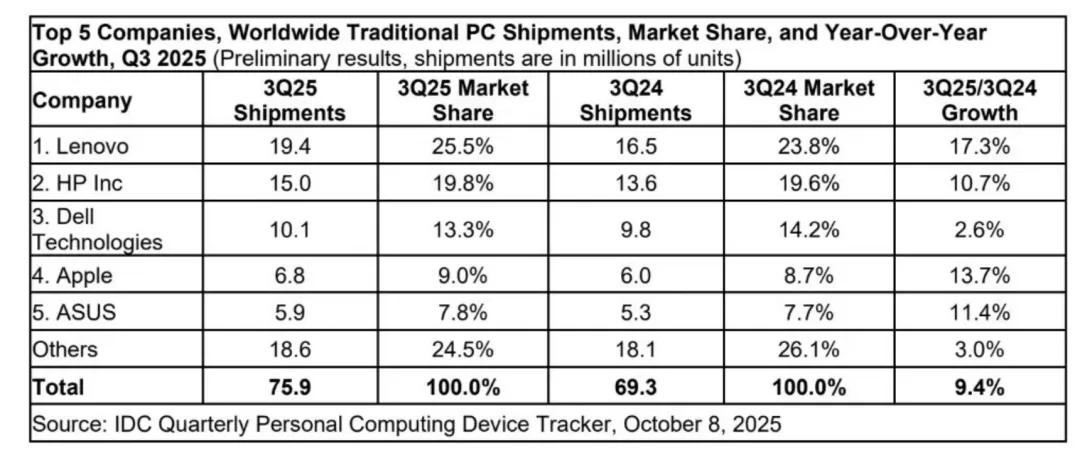
智通财经APP获悉,据国际数据公司(IDC)发布的《全球季度个人计算设备追踪报告》,2025年第三季度全球PC市场出货总量达到7590万台,同比增长 9.4%。 与过去多年不同,全球PC市场的重新繁荣并非是因厂商库存调整,而是进入了由人工智能驱动的新一轮市场爆发周期。IDC的这份报告中的数据显示,在 AI PC市场占据优势的头部厂商的市场份额加速攀升,在端侧AI的竞争格局中亦形成战略领先。 联想集团与惠普在PC市场的竞争已并非仅是基于销售规模,而更多是由抢夺端侧AI入口的战略驱动。 AI计算的初期阶段,核心能力集中在云端,但这种模式的固有缺陷已日益暴露:高昂的API调用成本、网络往返造成的高延迟,以及企业对敏感数据隐私 和主权的严格要求。 英伟达、OpenAI、微软等全球AI巨头已对端侧AI的巨大潜力形成共识:必须将算力竞争推向终端设备,将AI从"云端工厂"带至"物理世界",而在AI终端 中,PC是数量规模最为庞大的。 稍早前,英伟达宣布将以50亿美元注资英特尔,其中一项重要的合作就是关于AI PC。按照黄仁勋的说法,由这次合作带来的"AI PC"市场规模可能达到 500亿美元。英特尔对英伟达的战略价值是可在 ...
别再用小字游戏,消耗用户的信任
3 6 Ke· 2025-10-16 11:06
Core Viewpoint - The article discusses the controversial use of "small print" in advertising, highlighting how it misleads consumers and erodes trust in brands and the industry as a whole [4][9][12] Group 1: Advertising Practices - The use of "small print" in advertisements has become a long-standing issue in the industry, where exaggerated claims are often followed by disclaimers that are difficult to read [4][5] - Advertisers exploit cognitive biases by using large, eye-catching text to attract attention while burying important details in small print, which consumers often overlook [4][9] - This strategy is seen as low-risk and high-reward for advertisers, as regulatory bodies typically focus on whether disclaimers are present rather than their visibility [4][5] Group 2: Consumer Trust and Misleading Practices - Misleading advertising practices directly undermine consumer trust, as customers are often unaware of the hidden conditions that accompany attractive offers [9][10] - Once consumers feel deceived, their trust in the brand diminishes rapidly, leading to a long-term loss of credibility [9][11] - The negative impact of misleading advertising extends beyond individual brands, diluting the overall trust in the industry and prompting consumers to become increasingly skeptical of all marketing messages [12][13] Group 3: Long-term Consequences - The short-term gains from "small print" tactics can lead to significant long-term repercussions, including public backlash and reputational damage [10][12] - Brands may face substantial public relations costs to mitigate the fallout from consumer outrage, which can far exceed the initial benefits of misleading advertising [10][11] - The prevalence of such practices can create a "race to the bottom" in the industry, where ethical companies suffer while those employing deceptive tactics gain market share [12][13] Group 4: Recommendations for Brands - Brands are encouraged to prioritize transparency and honesty in their advertising, moving away from deceptive practices that rely on "small print" [15][16] - It is essential for brands to consider what information consumers genuinely need to know, placing important details prominently rather than hiding them [15][16] - Building long-term trust with consumers is more valuable than short-term sales boosts, as trust is a critical component of brand loyalty [15][16]


乔布斯:从被逐到王者归来,创业投资的不朽启示
Sou Hu Cai Jing· 2025-09-16 12:06
Core Insights - Steve Jobs' journey exemplifies resilience and vision in the face of adversity, transforming setbacks into opportunities for innovation and growth [2][3][5] Group 1: Early Career and Setbacks - In 1985, Steve Jobs was ousted from Apple, marking a significant setback in his career, which he later transformed into a chance for reinvention [2] - Jobs recruited John Sculley from PepsiCo with a compelling vision, but internal conflicts led to his removal from Apple [2][3] Group 2: Second Ventures - After leaving Apple, Jobs invested millions in Pixar and NeXT, despite initial failures, demonstrating a long-term investment strategy focused on future value [3][4] - Pixar's success with "Toy Story," which grossed $373 million, marked a turning point for both the company and the animation industry [3] Group 3: Return to Apple - Upon returning to Apple in 1997, Jobs implemented the Pareto principle, cutting 70% of the product line to focus on core offerings, leading to a profitable turnaround [4] - The launch of the iMac in 1998 sold 800,000 units in five months, contributing to Apple's profitability of $309 million that year [4] Group 4: Innovation and Growth - Under Jobs' leadership, Apple introduced groundbreaking products like the iPod, iPhone, and iPad, significantly increasing its market value to $350 billion by 2010 [4] - By the time of Jobs' passing in 2011, Apple's market capitalization reached $2.9 trillion, solidifying its status as the most valuable company in history [5] Group 5: Lessons for Entrepreneurs and Investors - Entrepreneurs should maintain unwavering belief in their vision and prioritize innovation to meet evolving consumer demands [5][6] - Investors are encouraged to adopt a long-term perspective, recognizing potential in emerging sectors and diversifying investments to mitigate risks [5]



2亿美元之差,千亿美元蒸发,谁在“绑架”英伟达;美法院裁定特朗普大部分全球关税政策非法;泰国政坛“地震”;ChatGPT被控致美16岁少年自杀 | 一周国际财经
Mei Ri Jing Ji Xin Wen· 2025-08-30 02:45
Group 1 - Nvidia reported impressive earnings with a quarterly revenue of $46.743 billion, a 56% year-over-year increase, but fell short of market expectations by $200 million in data center revenue, leading to a market reaction that saw its market value drop by over $180 billion in two trading days [7][10][12] - The company's market capitalization reached approximately $4.3 trillion, accounting for 8% of the S&P 500 index and 14.43% of the Nasdaq 100 index, indicating a significant concentration of market value [15][20] - Analysts have raised Nvidia's target prices, reflecting continued confidence in its growth potential, with estimates suggesting it could reach a market cap of $5 trillion by early 2026 [14][13] Group 2 - The AI data center spending is now a major driver of U.S. economic growth, surpassing consumer spending for the first time, highlighting a shift in economic dynamics [20][21] - Major tech companies, including Alphabet, Microsoft, Meta, and Amazon, are expected to invest a total of $400 billion in capital expenditures this year, primarily for AI infrastructure [21] - Nvidia's revenue structure is highly concentrated, with two major clients accounting for 39% of its total revenue, raising concerns about the risks associated with such dependency [21][20] Group 3 - The market's reaction to Nvidia's earnings reflects a broader issue of "dependency syndrome" in the U.S. stock market, where the performance of a single company can significantly influence overall market trends [8][15] - The S&P 500 index's growth has been heavily reliant on Nvidia, with estimates suggesting that 35% of the index's market value increase in the first half of the year came from this single company [16][20] - The current market dynamics indicate that any significant decline in Nvidia's stock could lead to a broader market downturn, with projections suggesting a potential 4.4% drop in the S&P 500 if Nvidia's stock falls by 25% [16][20]


手机关机也会被追踪?这是真事,但无需担心
3 6 Ke· 2025-08-18 04:06
Group 1 - The article emphasizes the importance of storytelling for niche brands to attract consumer attention in competitive industries like smartphones [1][6] - It highlights that leading brands dominate advanced technology components, leaving smaller manufacturers to rely on storytelling and concepts to survive [1][5] - The article critiques certain brands that market themselves as "eco-friendly" while using outdated hardware at high prices [3][5] Group 2 - A new smartphone from the brand "Unplugged" is introduced, which exemplifies the trend of high-priced, low-spec devices that rely on privacy protection narratives [6][11] - The specifications of the Unplugged phone include a MediaTek Dimensity 1200 chipset, 8GB RAM, 256GB storage, and a 108MP main camera, but it runs a custom AOSP system without Google services [8][9] - The phone is priced at $989 with a monthly subscription service of $12.99, raising concerns about its value proposition [11] Group 3 - The article discusses the phone's features, such as microSD card support for storage expansion and a unique circuit breaker design that claims to prevent monitoring while the phone is off [14][15] - It explains the concept of "incomplete shutdown" in smartphones, similar to the "fast startup" feature in computers, which can lead to battery drain even when the device is turned off [22][27] - The article concludes that while privacy concerns may be overstated, the issue of battery consumption due to incomplete shutdowns is a valid concern for users [27][25]

美股芯片、电脑巨头股价大跌
2 1 Shi Ji Jing Ji Bao Dao· 2025-08-07 00:31
Group 1 - The core viewpoint of the news is that the U.S. government, under President Trump, plans to impose approximately 100% tariffs on chips and semiconductors, while products manufactured in the U.S. will not incur any fees [1] - Due to the tariff policy, U.S. retailers are forced to raise product prices, leading to increased costs for consumers [1][3] - In June, the price of computers in the U.S. rose nearly 5% compared to the same month last year, with projections indicating a potential short-term price increase of 18.2% for electronics if the tariff policy continues [1][3] Group 2 - The average effective tariff rate on imported goods in the U.S. has reached 18.3%, the highest level since 1934, which could result in an average increase of $2,400 in annual spending per American household by 2025 [3] - The stock prices of major chip companies, such as AMD, have significantly declined due to poor earnings reports, with AMD's stock dropping over 9% at one point [4][6] - AMD reported a second-quarter revenue of $7.7 billion and a gross margin of 40%, while Supermicro Computer's revenue guidance for the next quarter was lowered to between $6 billion and $7 billion, with a 17.5% reduction in the fiscal year 2026 revenue forecast [6][7]