芯片半导体

Search documents
股票市场概览:资讯日报:谷歌母公司Alphabet拟发行200亿美元债券-20260210
Guoxin Securities Hongkong· 2026-02-10 13:52
Market Overview - The U.S. stock market saw all three major indices rise, with the Nasdaq increasing by nearly 1%, the Dow Jones slightly up, and the S&P 500 rising by 0.5%[2] - The Hang Seng Index closed at 27,027, up 1.76%, while the Hang Seng Tech Index rose by 1.34% to 5,418[3] Key Stock Performances - AI application stocks showed strong performance, with Zhizhu rising by 36.22% and MINIMAX-WP increasing by 11.71%[9] - Chip and semiconductor stocks also performed well, with Lanke Technology up 63.72% on its first trading day[9] - Major financial stocks rose, with Ping An Insurance increasing by over 4%[9] Economic Indicators - Alphabet plans to issue $20 billion in bonds, exceeding the initial estimate of $15 billion, to support its financial strategies[14] - The global semiconductor market is expected to face significant supply shortages from 2026 to 2027, according to Goldman Sachs[9] International Market Trends - The Nikkei 225 index rose by 3.89%, driven by expectations of stable governance under Prime Minister Fumio Kishida[12] - Japanese defense stocks surged following Kishida's electoral victory, with Kawasaki Heavy Industries rising by 17%[12] Commodity Insights - Gold and precious metal stocks saw significant gains, with Wan Guo Gold rising over 8%[9] - Morgan Stanley predicts that major metals like gold and silver may enter a consolidation phase but are not at the end of a bull market[9]
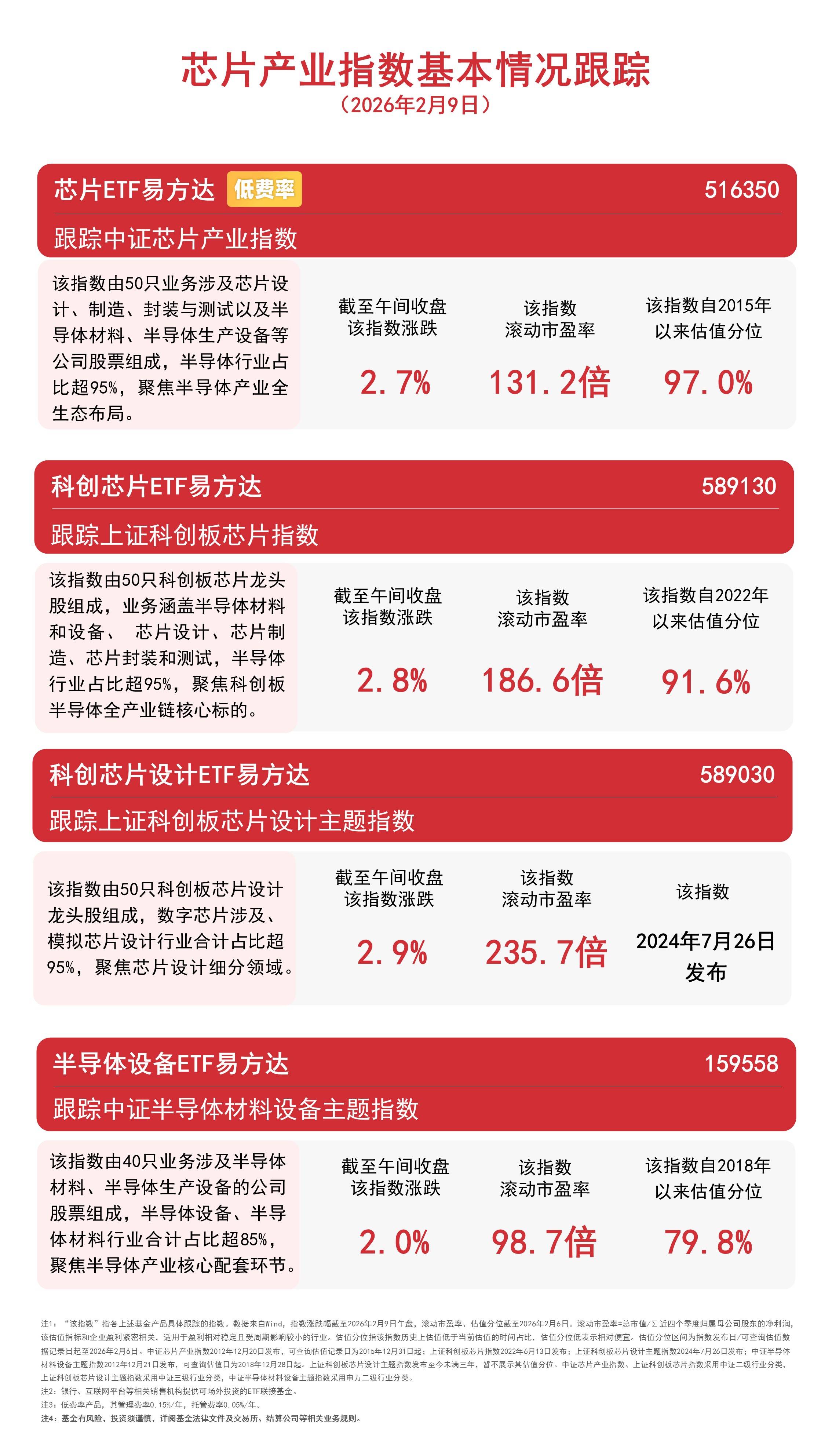
芯片半导体板块爆发,关注科创芯片设计ETF易方达(589030)、半导体设备ETF易方达(159558)投资价值
Sou Hu Cai Jing· 2026-02-09 05:25
Group 1 - The semiconductor sector, including photolithography machines, memory chips, advanced packaging, and semiconductor equipment, experienced a collective surge in early trading on February 9, with significant index increases [1] - The Shanghai Stock Exchange Sci-Tech Innovation Board Chip Design Theme Index rose by 2.9%, while the Sci-Tech Innovation Board Chip Index increased by 2.8%, and the CSI Chip Industry Index climbed by 2.7% [1] - The CSI Semiconductor Materials and Equipment Theme Index saw a 2.0% rise, and the semiconductor equipment ETF managed by E Fund (159558) recorded a net subscription of 14 million units in half a day [1] Group 2 - The Sci-Tech Innovation Board Chip Design Theme Index consists of 50 leading chip design stocks, covering semiconductor materials and equipment, chip design, manufacturing, packaging, and testing, with over 95% of the industry represented [5] - The E Fund Sci-Tech Chip Design ETF tracks the Sci-Tech Innovation Board Chip Design Theme Index, which focuses on the digital and analog chip design sectors, also comprising over 95% of the industry [5] - The E Fund Semiconductor Equipment ETF tracks the CSI Semiconductor Materials and Equipment Theme Index [5]

任泽平:此轮牛市十年一遇
泽平宏观· 2026-02-07 16:06
Core Viewpoint - A new bull market has begun since September 2024, driven by strong policy support, a new technological revolution, and abundant liquidity, marking it as a once-in-a-decade opportunity for investors [2][10]. Group 1: Characteristics of the Current Bull Market - This bull market is described as "epic" and is the third significant bull market since 2000, following the "super cycle bull" from 2004-2007 and the "reform bull" from 2014-2015 [3][5]. - The current bull market is characterized by a significant rise in stock indices, with the Shanghai Composite Index increasing by 56.2% and the ChiNext Index rising by 122.2% from their respective lows [6]. - Trading volume has surged, with daily trading exceeding 3 trillion yuan, compared to a few hundred billion before September 2024 [9]. Group 2: Driving Forces Behind the Bull Market - The bull market is supported by three main drivers: continuous policy easing, a new technological revolution, and abundant liquidity, creating a "confidence bull" [11]. - Policy easing includes significant monetary policy adjustments, such as interest rate cuts and relaxed housing market regulations, which have greatly exceeded market expectations [11]. - The technological revolution is marked by advancements in artificial intelligence, robotics, and semiconductor industries, which are leading the market's growth [12]. - The liquidity situation has led to a phenomenon of "asset scarcity," with increased household savings and a surge in retail investor participation, as evidenced by a 213.1% year-on-year increase in new A-share accounts [11][12]. Group 3: Historical Missions of the Bull Market - This bull market is seen as fulfilling three historical missions: supporting the development of new productive forces, aiding in major power competition, and repairing household balance sheets [14]. - The growth of new productive forces is crucial for transitioning to high-quality economic development, with the stock market providing necessary capital for high-tech and innovative enterprises [15]. - The bull market plays a strategic role in the context of U.S.-China competition, particularly in high-tech sectors, which are vital for national security and economic stability [15]. - The recovery of household balance sheets is essential, as the real estate market has seen significant declines, and the stock market's growth can help offset these losses and stimulate consumer spending [16]. Group 4: Future Prospects and Outlook - The sustainability of the bull market depends on continued macroeconomic policy easing, including further interest rate cuts and fiscal measures to stimulate demand [19][20]. - There is a need for deep reforms in the capital market to ensure a healthy development environment, which could lead to a prolonged bull market rather than volatile fluctuations [20]. - Historical patterns indicate that the A-share market has experienced shorter bull markets compared to longer bear markets, highlighting the need for structural changes to achieve a more stable market environment [21].
杨德龙:深度解析近期市场反复震荡行情
Xin Lang Cai Jing· 2026-02-06 08:28
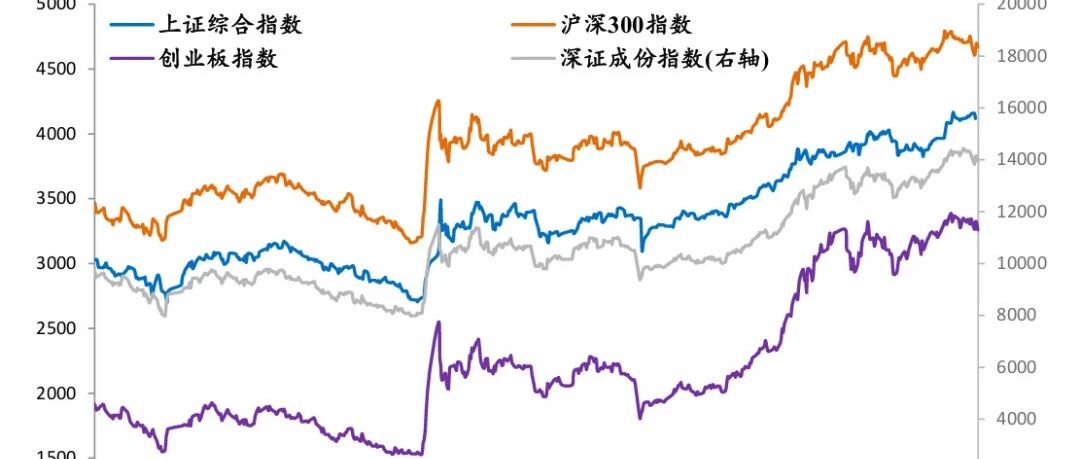
Market Overview - The market has experienced a volatile adjustment this week, with significant pullbacks in previously high-performing sectors like technology and resources, while the consumer sector, particularly branded liquor, has seen a historic rebound [1][8] - The financial sector has also shown some recovery during this period [1] Market Characteristics - The market in 2025 exhibited a "dumbbell" characteristic, with one end represented by high-dividend sectors like banks, which have surged due to large capital seeking stable returns, leading many bank stocks to reach new highs last year [1][9] - The other end of the "dumbbell" consists of technology innovation sectors benefiting from the "14th Five-Year Plan," including humanoid robots, semiconductor chips, computing algorithms, solid-state batteries, quantum technology, controllable nuclear fusion, and commercial aerospace, which have shown active performance [1][9] Market Predictions - The prediction for 2026 indicates a more diversified market style with more sectors participating in rotation, where technology stocks remain a key focus but not the only one. The expected sequence of the bull market is "small growth stocks first, followed by medium growth stocks, and finally traditional stocks" [9][10] - The current market rotation rhythm aligns with this prediction [9] Market Sentiment - At the beginning of the year, the market saw a strong upward trend, with the Shanghai Composite Index experiencing consecutive gains and trading volumes nearing 40 trillion yuan, while margin financing balances reached a historical high of approximately 2.7 trillion yuan [2][9] - Despite recent adjustments, particularly in technology stocks due to profit-taking pressures, the overall upward trend of the market remains intact, indicating that the current phase is a normal adjustment within a slow bull market [10] Investment Strategy - Investors are advised to consider their stock structure when deciding whether to hold stocks or cash during the holiday season. Holding quality stocks or funds is recommended, while those with overheated stocks lacking fundamental support should consider taking profits [11] - A balanced investment strategy is suggested, with one-third of the portfolio allocated to technology stocks, one-third to "medium growth stocks" (such as military, non-ferrous metals, and new energy), and one-third to "traditional stocks" (like branded liquor) to achieve a balance between risk and return [12] Gold and Silver Market - It is recommended to maintain about 20% of the investment portfolio in gold assets to enhance long-term stability. Recent fluctuations in gold prices, including a significant rise to over $5,000 per ounce followed by a sharp decline, serve as a reminder for investors to avoid chasing prices [13][14] - The long-term upward trend in gold and silver prices remains unchanged, driven by factors such as high U.S. government debt and a global trend towards "de-dollarization," which has led to increased allocations in precious metals [14][6]
杨德龙:马年有望延续慢牛长牛趋势,板块轮动或呈现“先小登、再中登、后老登”顺序
Ge Long Hui· 2026-02-04 07:23
Group 1 - The core viewpoint is that the A-shares and Hong Kong stocks are expected to continue a slow bull market trend in the upcoming Year of the Horse, with a noticeable increase in market profitability and further sector rotation anticipated [1] - Different sectors are being referred to in a way that reflects structural differentiation: technology stocks are humorously called "small Deng stocks," while traditional sectors like liquor are referred to as "old Deng stocks." New energy, military industry, and non-ferrous metals (including precious metals) are seen as "medium Deng stocks" [1] - The expected order of sector rotation in a slow bull market is "first small Deng, then medium Deng, and finally old Deng" [1] Group 2 - In terms of industry allocation, it is essential to align with the "14th Five-Year Plan" and relevant policy directions, with a focus on technological innovation [1] - Key areas of focus in the technology sector include semiconductor chips, artificial intelligence, innovative pharmaceuticals, solid-state batteries, and computing power algorithms, as well as future technologies like controllable nuclear fusion and quantum technology [1] - The real estate sector is still in an adjustment period, but core areas in first-tier cities may see a rebound due to scarcity and demand support, with transaction volumes potentially increasing [1] Group 3 - In the precious metals sector, the price increase in the Year of the Horse is unlikely to replicate the gains of the past two years due to already high price levels, but the long-term trend remains unchanged [2] - Allocating about 20% of an investment portfolio to gold assets over a 5-10 year horizon is still considered an effective way to hedge against inflation and currency devaluation [2]
【微聚焦】全省首投AIC基金成功运作,赋能芯片领军企业落子市北
Xin Lang Cai Jing· 2026-02-03 12:52
Core Insights - The first AIC (Asset Investment Company) private equity fund in Qingdao, named Qingdao Ronghui Xinkai Qihang, has successfully completed its first project investment and is now in a stable operational phase [1][3] - This fund, with a total scale of 220 million yuan, focuses on the semiconductor and new generation information technology sectors, aligning with Qingdao's "10+1" innovative industrial system [1][3] Investment Focus - The fund's initial investment targets the domestic smart cockpit chip project, led by the industry leader, Xinqing Technology, which has core technological advantages in smart cockpit and smart driving chip R&D [2][4] - Xinqing Technology has registered a subsidiary in Qingdao, focusing on chip-related scientific research and technical services, filling a gap in high-end automotive chip R&D and sales in the Shibei District [4][5] Operational Efficiency - The fund achieved a rapid operational timeline, completing the entire process from cooperation intention to project investment in just four months, showcasing the "Qingdao speed" and strong collaboration between government and financial institutions [1][3] - The successful operation of the fund is attributed to the collaborative efforts of local government and financial entities, providing a "one-stop" service to ensure quick startup and operation of Xinqing Technology [5]
逾千家A股公司业绩预喜沪市首份年报出炉
Zhong Guo Zheng Quan Bao· 2026-02-02 20:45
Group 1 - The A-share annual report disclosure for 2025 has commenced, with Chip导科技 being the first to release its report, showing a revenue of 394 million yuan, an 11.52% year-on-year increase, and a net profit of 106 million yuan, a 4.91% decrease [1] -沃华医药 reported a revenue of approximately 817 million yuan, a 6.96% year-on-year increase, and a net profit of about 95.71 million yuan, a 162.93% year-on-year increase, focusing on proprietary Chinese medicine products [2] - 指南针 achieved a revenue of approximately 2.146 billion yuan, a 40.39% year-on-year increase, and a net profit of about 228 million yuan, an 118.74% year-on-year increase [2] Group 2 - A total of 3,056 A-share companies have disclosed their 2025 performance forecasts, with 1,095 companies expected to report positive results, indicating significant performance differentiation [3] - Among the companies, 678 are expected to achieve a net profit growth of over 10%, and 231 companies are projected to exceed 100% growth, with some companies like 宁波富邦 and 广东明珠 expecting over 1,000% growth [3] - 619 companies are expected to have a net profit exceeding 100 million yuan, with 136 companies projected to exceed 1 billion yuan, including major players like 紫金矿业 and 中国神华 [3] Group 3 - The non-ferrous metals, automotive, chemical, and semiconductor industries are showing signs of recovery, with leading companies performing exceptionally well [4] - In the non-ferrous metals sector, gold mining companies are particularly strong, with 西部黄金 expecting a net profit of 425 to 490 million yuan, a year-on-year increase of 46.78% to 69.23% [4] - The semiconductor industry is benefiting from high order volumes and capacity utilization rates, indicating a positive outlook for the sector [4] Group 4 - 芯原股份 reported a significant increase in new orders, with a total of 5.96 billion yuan in new orders for 2025, a 103.41% year-on-year increase, and a substantial backlog of orders expected to enhance future profitability [5] - The company noted that over 73% of its new orders are related to AI computing, with over 50% in data processing, indicating a strong focus on these growth areas [5] - Following the performance forecasts, many companies have attracted institutional research interest, focusing on order volumes, production progress, and industry trends [5] Group 5 - 东芯股份 indicated that niche memory product prices are rising due to supply constraints caused by industry cycles, leading to a positive operational outlook [6] - 中集集团 expects a significant decline in container manufacturing performance for 2025 due to high base effects from 2024, but maintains a long-term positive outlook on container demand linked to global trade growth [7]
杨德龙:2026年消费板块有望从“低配”转为“标配”科技股仍是投资主线之一
Xin Lang Cai Jing· 2026-02-02 19:05
Core Viewpoint - The macroeconomic recovery in China is expected in 2026, driven by policies aimed at boosting domestic demand, investment, and consumption, which will improve economic indicators and stabilize various sectors [1][2]. Economic Recovery and Investment Direction - The "three drivers" of economic growth—consumption, investment, and exports—are facing slowdowns, but policies such as trade-in programs and increased subsidies are expected to stimulate consumption [1][2]. - Infrastructure construction will be accelerated to stabilize investment growth, particularly in traditional and new infrastructure projects like data centers and charging stations [2][3]. - The consumer sector is anticipated to recover, especially in traditional consumption areas like liquor and food, as well as new consumption fields [2][4]. Capital Market Dynamics - The capital market is expected to deepen its recovery, supported by a significant amount of maturing deposits (estimated at 50 trillion yuan) that may flow into equities and bonds for better returns [3]. - The stock market has shown strong performance at the beginning of 2026, with the Shanghai Composite Index experiencing a continuous upward trend and increased trading volume [3][4]. - Various sectors, including technology, new energy, and precious metals, are expected to perform well, with a notable increase in investor confidence [3][4]. Sector-Specific Insights - The humanoid robot industry is transitioning from early development to mass production, with significant potential for commercial applications and orders in 2026 [6]. - The semiconductor industry remains a focus for policy support, with ongoing investments aimed at overcoming key technological challenges [7]. - The new energy sector, previously affected by overcapacity, is expected to see a turnaround due to government initiatives aimed at improving competition and fostering growth [8]. Long-term Trends and Strategic Assets - The competition between nations is increasingly centered around power and computing capabilities, with China holding a significant advantage in electricity generation [9]. - Precious metals like gold and silver are gaining attention as strategic assets amid global economic shifts, with potential for long-term investment despite short-term volatility [10]. - The biopharmaceutical sector is experiencing divergence, with innovative drugs showing promise for future growth, while generic drugs face challenges [10].
杨德龙:2026年消费板块有望从“低配”转为“标配” 科技股依是投资主线之一
Xin Lang Cai Jing· 2026-02-02 09:25
Economic Outlook - In 2026, China's macro economy is expected to achieve a recovery growth, with policies focusing on boosting domestic demand as a key strategy [1][14] - The "three drivers" of economic growth—consumption, investment, and exports—are facing varying degrees of slowdown, prompting policy measures to stimulate consumption and stabilize investment [1][14] Consumption Sector - Consumer spending is anticipated to rebound, particularly in traditional consumption peaks like the Spring Festival, benefiting sectors such as liquor, food and beverage, and new consumption areas [2][15] - The retail sales growth rate fell to 0.9% in December, the lowest in two years, but is expected to recover as the market's wealth effect improves [4][17] - Many consumer stocks are at historical low valuations, suggesting potential for recovery as the sector transitions from "underweight" to "balanced allocation" [4][17] Investment Sector - Infrastructure construction, including traditional and new infrastructure projects, is set to drive fixed asset investment growth, which had previously contracted due to declining real estate investment [2][15] - The government is expected to increase subsidies and implement trade-in programs to stimulate consumer spending and investment [1][14] Technology Sector - The technology sector remains a primary investment focus, with significant potential in areas like humanoid robots, semiconductor chips, and AI-related fields [5][18] - The humanoid robot industry is transitioning from concept to production, with expectations for increased orders and market performance in 2026 [19] - The semiconductor industry is a critical area for policy support, particularly in high-end chips, with ongoing investments in R&D expected to yield breakthroughs [20] Renewable Energy Sector - The renewable energy sector, previously marked by overcapacity and price wars, is anticipated to recover as policies aim to reduce excess capacity and improve competitive dynamics [21] - Solid-state batteries are expected to gradually replace traditional lithium batteries, representing a significant technological advancement in the sector [21][22] Capital Market Dynamics - A substantial amount of fixed-term deposits, estimated at 50 trillion yuan, is set to mature, with a portion likely to flow into capital markets, supporting the ongoing bull market [3][16] - The stock market has shown strong performance, with significant trading volumes and a bullish sentiment among investors, particularly in sectors like new energy and precious metals [3][16] Precious Metals - Recent surges in international gold prices have heightened investor interest in precious metals, with a long-term bullish outlook despite potential short-term volatility [10][23]
全省首投AIC基金成功运作,赋能芯片领军企业落子市北
Sou Hu Cai Jing· 2026-02-02 02:31
Core Insights - The first AIC (Asset Investment Company) equity investment fund in Qingdao, named Qingdao Ronghui Xinke Qihang Private Equity Investment Fund, has successfully completed its first project investment and is now in a stable operational phase [1][3]. Group 1: Fund Overview - The fund, with a total scale of 220 million yuan, focuses on the semiconductor and new generation information technology sectors, aligning with Qingdao's "10+1" innovative industrial system [3]. - The fund was established by Nongyin Investment and is the first AIC pilot fund in Qingdao, demonstrating efficient progress by completing the entire process from cooperation intention to actual investment in just four months [3][6]. Group 2: Investment Focus - The fund's initial investment targets the domestic smart cockpit chip project, led by Chip Technology, a leading company in the automotive chip sector, which possesses core technological advantages in smart cockpit and smart driving chip development [5]. - The establishment of Qingdao Chip Technology Co., Ltd. in the Shibei District fills a gap in high-end automotive chip research and sales, promoting a chain effect that attracts upstream and downstream supporting enterprises [5]. Group 3: Collaborative Efforts - The successful operation of the fund is attributed to the collaborative efforts of both municipal and district levels, optimizing the business environment and providing one-stop services to ensure rapid operational startup for Chip Technology [6]. - This model of "government guidance, capital leadership, and market operation" leverages the advantages of AIC funds as "patient capital" and facilitates a dual approach of capital and industry engagement [6].