集装箱航运

Search documents
A股10月回购月报:多家公司年内推出两期回购方案,美的单月回购金额再超20亿元!
Mei Ri Jing Ji Xin Wen· 2025-11-13 02:32
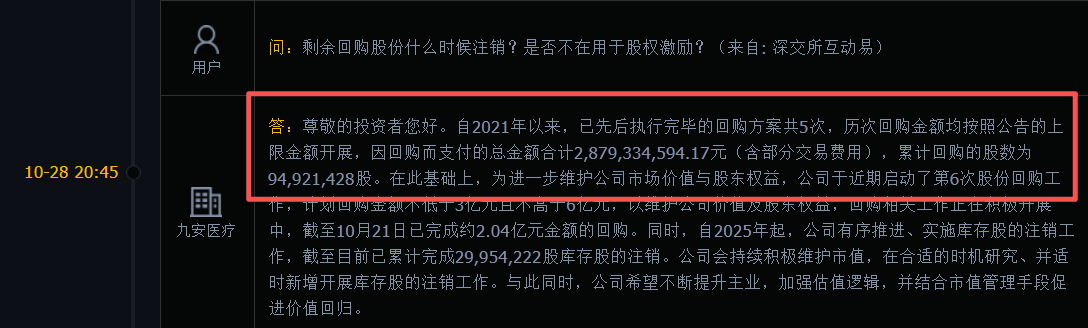
Core Viewpoint - The trend of share buybacks among A-share listed companies is becoming more normalized, with many companies implementing multiple buyback plans within the year, indicating a strategic approach to maintaining market value [1][2][12]. Group 1: Buyback Plans and Execution - In October, 24 companies announced new buyback plans, with a total proposed buyback amount of approximately 6.65 billion yuan, a 67.55% increase from September's 3.969 billion yuan [2]. - Among the 24 companies, 13 planned to buy back over 100 million yuan, accounting for 54.17% of the total [2]. - Companies like Midea Group led the buyback efforts, with a single-month buyback exceeding 2 billion yuan for two consecutive months [1][7]. Group 2: Notable Companies and Their Strategies - Zhijiang Biology announced a buyback plan of 60 million to 120 million yuan, utilizing both self-funding and special loans, and has already initiated the buyback with a total payment of 2.0881 million yuan [3]. - Nine安医疗 has been actively maintaining its market value through buybacks, having completed five buyback plans since 2021, with a total payment of approximately 2.879 billion yuan [4][5]. - 中远海控 also launched a buyback plan of 749 million to 1.498 billion yuan, despite its stock price exceeding the buyback price limit, demonstrating confidence in its market value [6]. Group 3: Market Performance and Trends - The buyback execution rate was notably high in October, with 50% of the announced plans already initiated [4]. - Companies are increasingly using buybacks as a core method for market value management and shareholder returns, reflecting a more rational and mature approach to capital management [12]. - The overall market performance of companies like Zhijiang Biology has been positive, with a year-to-date increase of over 80% in stock price [3].




集装箱市场升温 贸易风向标马士基上调全年盈利与增长预期
智通财经网· 2025-11-06 09:05
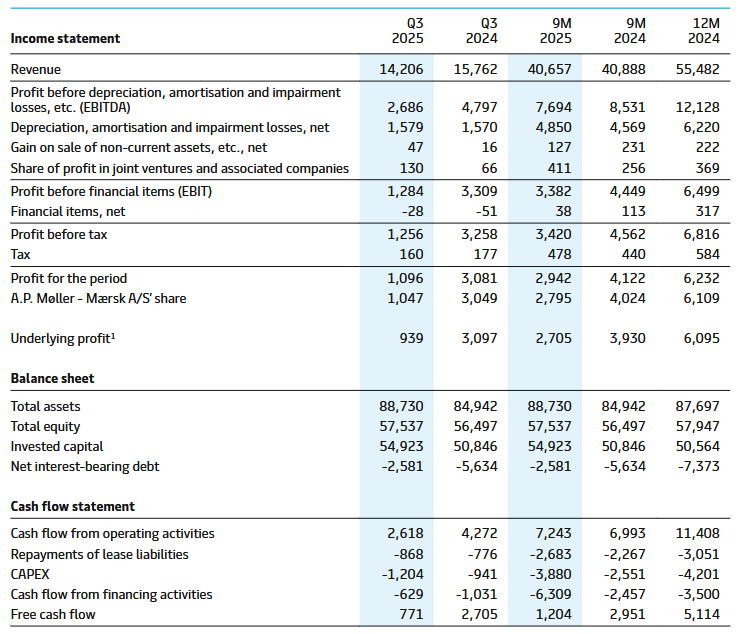
Core Insights - Maersk's Q3 2025 earnings exceeded expectations, prompting an upward revision of its full-year profit forecast and global container market growth predictions [1][2] Financial Performance - Q3 2025 revenue was $14.206 billion, a decrease of 9.9% from $15.762 billion in the same period last year [1][2] - Underlying profit for Q3 2025 was $939 million, down 69.7% from $3.097 billion year-over-year [1][2] - Earnings per share were $69, lower than $193 in the previous year but above analysts' expectations of $62 [1] Profit Forecast and Market Growth - The company raised its full-year underlying EBITDA forecast to between $9 billion and $9.5 billion, up from a previous estimate of $8 billion to $9.5 billion [2] - The global container market is now expected to grow approximately 4%, an increase from the prior forecast of 2% to 4% [2] Market Dynamics - Exports from Far East Asia, particularly China, continue to drive robust cargo volume growth [3] - Despite a contraction in cargo volume to North America, especially from China to the U.S., consumer demand has shown surprising resilience [3][4] - Maersk's ability to adjust its profit expectations reflects its strength amid mixed performance from industry peers [3] Operational Resilience - The company has demonstrated considerable resilience to macroeconomic shocks, adapting to complex supply chain needs despite adverse tariff measures [4] - Ongoing disruptions in Red Sea shipping are expected to persist throughout the year, alleviating some global overcapacity issues and boosting freight rates earlier this year [4]
集装箱产业风险管理日报-20250910
Nan Hua Qi Huo· 2025-09-10 10:47
Report Information - Report Title: Container Industry Risk Management Daily Report [1] - Date: September 10, 2025 [1] - Analyst: Fu Xiaoyan [1] Industry Investment Rating - Not provided in the report Core Views - The intraday trend of the container shipping index (European line) futures was in line with expectations, with the main contract being undervalued but lacking driving forces, resulting in a stalemate [3]. - For hedgers, the strategy suggested yesterday can be attempted. When the futures price does not drop significantly (>30%), the "selling options + buying futures" combination has a high probability of maintaining profitability [3]. - Operationally, it is recommended to enter and exit quickly [3]. Summary by Directory EC Risk Management Strategy Recommendations - For position management, if one has already obtained positions but the shipping capacity is full or the booked cargo volume is poor, and there are concerns about falling freight rates, to prevent losses, one can short container shipping index futures based on the company's positions to lock in profits. The recommended hedging tool is EC2510, with a suggested selling entry range of 1350 - 1450 [2]. - For cost management, if shipping companies increase blank sailings or the market peak season is approaching, and one hopes to book shipping spaces according to order situations, to prevent rising freight rates from increasing transportation costs, one can buy container shipping index futures at present to determine the booking cost in advance. The recommended hedging tool is EC2510, with a suggested buying entry range of 1150 - 1250 [2]. Core Contradictions - In the morning session of the container shipping index (European line) futures, there was obvious early buying by bulls, but they were defeated by the weak spot market expectations. The market was in a stalemate between bulls and bears and ended in consolidation [3]. - As of the close, all contracts had varying degrees of position increases, with the EC2512 contract having the largest increase in positions. Except for the two rebounding forward contracts, it had the smallest decline [3]. - From the changes in the positions of the top 20 institutional holders on the exchange, in the EC2510 contract, bulls reduced their positions by 293 to 25,913, bears increased their positions by 288 to 28,509, and the trading volume decreased by 7,636 to 17,281 (bilateral) [3]. Bullish Interpretations - In July 2025, China's automobile exports continued to show a trend of increasing volume and price. The number of automobile exports reached 694,000, a year-on-year increase of 25.6% and a month-on-month increase of 12.1%. The total import and export volume of automobile products was $24.98 billion, a year-on-year increase of 7% and a month-on-month increase of 6.4%. Among them, the export amount was $20.48 billion, a year-on-year increase of 13.6% and a month-on-month increase of 6% [4]. - MSC, Maersk, and HMM have successively announced their suspension plans for the Golden Week [4]. Bearish Interpretations - The net profit of the global container shipping industry declined significantly in the second quarter of this year. According to a report by a shipping finance analyst, the shipping industry achieved a net income of $4.4 billion in the second quarter, a sharp drop of 56% from the first quarter's $9.9 billion and a significant decline of 63.7% compared to the same period in 2024 [5]. - According to the daily "Freight Rate Note" data, in mid - to late September, the average online booking quote for 20GP containers by shipping companies continued to decline, while the average quote for 40GP containers remained stable [5]. EC Basis Daily Changes - On September 10, 2025, the basis of EC2510 was 299.06 points, with a daily increase of 1.30 points and a weekly decrease of 151.54 points [7]. - The basis of EC2512 was -107.54 points, with a daily increase of 8.90 points and a weekly decrease of 179.94 points [7]. - The basis of EC2602 was 42.46 points, with a daily increase of 3.40 points and a weekly decrease of 197.14 points [7]. - The basis of EC2604 was 320.46 points, with a daily increase of 10.70 points and a weekly decrease of 198.04 points [7]. - The basis of EC2606 was 122.56 points, with a daily decrease of 9.40 points and a weekly decrease of 209.94 points [7]. - The basis of EC2608 was -33.54 points, with a daily increase of 8 points and a weekly decrease of 197.64 points [7]. EC Price and Spreads - On September 10, 2025, the closing price of EC2510 was 1267.4 points, with a daily decrease of 0.10% and a weekly decrease of 4.20% [7]. - The closing price of EC2512 was 1674.0 points, with a daily decrease of 0.53% and a weekly decrease of 1.60% [7]. - The closing price of EC2602 was 1524.0 points, with a daily decrease of 0.22% and a weekly decrease of 0.65% [7]. - The closing price of EC2604 was 1246.0 points, with a daily decrease of 0.28% and a weekly decrease of 0.73% [7]. - The closing price of EC2606 was 1443.9 points, with a daily increase of 0.66% and a weekly increase of 0.19% [7]. - The closing price of EC2608 was 1600.0 points, with a daily decrease of 0.39% and a weekly decrease of 0.59% [7]. Container Shipping Spot Quotes - On September 18, for Maersk's shipping schedule from Shanghai to Rotterdam, the total quote for 20GP containers was $1050, a decrease of $52 compared to the September 17 schedule, and the total quote for 40GP containers was $1760, a decrease of $88 compared to the September 17 schedule [9]. - On September 18, for Hapag - Lloyd's shipping schedule from Shanghai to Rotterdam, the quote for 20GP containers was $1035, an increase of $100 compared to the September 17 schedule, and the quote for 40GP containers was $1535, a decrease of $200 compared to the September 17 schedule [9]. - On September 25, for ONE's shipping schedule from Shanghai to Rotterdam, the quote for 20GP containers was $1244, a decrease of $300 compared to the September 22 schedule, and the quote for 40GP containers was $1943, unchanged from the September 22 schedule [9]. Shipping Index Changes - The SCFIS European route index was 1566.46 points, a decrease of 207.14 points or 11.68% compared to the previous value [10]. - The SCFIS US - West route index was 980.48 points, a decrease of 33.42 points or 3.30% compared to the previous value [10]. - The SCFI European route was $1315/TEU, a decrease of $166 or 11.21% compared to the previous value [10]. - The SCFI US - West route was $2189/FEU, an increase of $266 or 13.83% compared to the previous value [10]. - The XSI European line was $2324/FEU, a decrease of $32 or 1.36% compared to the previous value [10]. - The XSI US - West line was $2248/FEU, an increase of $54 or 2.5% compared to the previous value [10]. - The FBX composite freight rate index was $2080/FEU, an increase of $44 or 2.16% compared to the previous value [10]. Global Major Port Waiting Times - On September 9, 2025, the waiting time at Hong Kong Port was 0.830 days, a decrease of 0.393 days compared to September 8 and 1.434 days compared to the same period last year [17]. - The waiting time at Shanghai Port was 1.697 days, an increase of 0.374 days compared to September 8 and 1.183 days compared to the same period last year [17]. - The waiting time at Yantian Port was 0.807 days, a decrease of 0.134 days compared to September 8 [17]. - The waiting time at Singapore Port was 0.569 days, a decrease of 0.193 days compared to September 8 and 0.453 days compared to the same period last year [17]. - The waiting time at Jakarta Port was 1.422 days, an increase of 0.329 days compared to September 8 and 1.454 days compared to the same period last year [17]. - The waiting time at Long Beach Port was 1.849 days, an increase of 0.247 days compared to September 8 and 1.925 days compared to the same period last year [17]. - The waiting time at Savannah Port was 1.953 days, an increase of 0.980 days compared to September 8 and 1.403 days compared to the same period last year [17]. Ship Speeds and Number of Container Ships Waiting at Suez Canal Ports - On September 9, 2025, the speed of container ships with a capacity of over 8000 TEU was 15.852 knots, a decrease of 0.017 knots compared to September 8 and 15.904 knots compared to the same period last year [26]. - The speed of container ships with a capacity of over 3000 TEU was 14.789 knots, a decrease of 0.084 knots compared to September 8 and 15.205 knots compared to the same period last year [26]. - The speed of container ships with a capacity of over 1000 TEU was 13.29 knots, an increase of 0.062 knots compared to September 8 and 13.525 knots compared to the same period last year [26]. - The number of ships waiting at the Suez Canal port anchorages was 20, a decrease of 2 compared to September 8 and an increase of 8 compared to the same period last year [26].

中远海控2025半年报:EBIT255亿元,EBIT率23%!领跑行业!
Xin Lang Cai Jing· 2025-08-28 21:08
Core Viewpoint - The report highlights the resilience and growth of China COSCO Shipping Holdings Co., Ltd. in the face of global trade disruptions, showcasing its strategic focus on container shipping and digital supply chain integration [1][2]. Financial Performance - In the first half of 2025, the company achieved operating revenue of 109.099 billion yuan, a year-on-year increase of 7.78% - The EBIT was 25.494 billion yuan, reflecting a growth of 3.40% - The EBIT margin reached 23.37% - The net profit attributable to shareholders was 17.536 billion yuan [1]. Business Strategy - The company continues to deepen its core container shipping business and digital supply chain operations, enhancing synergy between the two sectors to provide integrated logistics solutions [1]. - As of June 30, 2025, the self-owned container fleet comprised 557 vessels, with a total capacity exceeding 3.4 million TEUs [1]. - The company has demonstrated market sensitivity by dynamically adjusting capacity on key routes, including Far East to Northwest Europe and trans-Pacific routes, while expanding supply to emerging markets [1]. Port and Shipping Coordination - The company has strengthened its collaborative layout in global port hubs, enhancing its integrated service capabilities through effective "mainline + feeder" configurations at key ports like Qianhai and Piraeus [1]. Innovation and Sustainability - China COSCO Shipping is focused on customer needs, driving product innovation across the supply chain and integrating digital and green technologies to build a sustainable competitive advantage [2]. - The company has made significant strides in digital transformation and green low-carbon initiatives, including the order of 42 dual-fuel methanol-powered vessels with a total capacity of 780,000 TEUs [2]. Response to Global Trade Changes - The company is navigating profound adjustments in the global trade landscape, influenced by U.S. trade policies and geopolitical tensions, while also addressing the impacts of technological and green revolutions [2]. - The company aims to enhance its global digital supply chain operations and investment platform through core business upgrades, ecosystem development, and technological innovation [2].
大行评级|摩根大通:集装箱航运前景分化 上调中远海控及东方海外国际目标价
Ge Long Hui· 2025-08-11 04:34
Industry Overview - The demand landscape in the container shipping and shipbuilding industry is increasingly divergent, with Maersk observing strong demand outside the U.S. market while maintaining a cautious stance towards the U.S. due to tariff uncertainties [1] - ICTSI reported no signs of early shipments at its ports, indicating a potential slowdown in activity [1] Company Insights - Maersk has raised its guidance due to strong demand in markets outside North America, contrasting with Ocean Network Express (ONE), which has downgraded its full-year outlook due to reliance on U.S. routes [1] - The logistics managers' index (LMI) indicates high inventory levels influenced by U.S. retail sales and pre-stocking activities, which may affect shipping demand [1] Strategic Factors - The industry is facing challenges from the Red Sea crisis, port congestion, shipbuilding activities, and the implications of Section 301 tariffs, complicating strategic and investment decisions [1] - Ongoing debates regarding the International Maritime Organization (IMO) emission standards are further complicating strategic planning within the industry [1] Stock Recommendations - The company maintains a positive outlook on COSCO Shipping Holdings' H-shares and A-shares, raising target prices to HKD 21 and HKD 24 respectively, and also holds a positive view on Orient Overseas International, increasing its target price to HKD 179, all rated as "Buy" [1]
ONE下调全年预期
Sou Hu Cai Jing· 2025-08-04 09:28
Core Viewpoint - ONE is facing significant challenges due to declining freight rates and market uncertainty, with a notable drop in net profit for the first quarter of 2025 compared to the previous year [1] Financial Performance - ONE reported a net profit of $86 million for Q1 2025, a substantial decrease from $779 million in the same period last year [1] - Compared to Q1 2025, profits decreased by $223 million [1] - The company has revised its full-year net profit forecast from $1.1 billion to $700 million and revenue expectations from $17.5 billion to $17.1 billion [1] Market Conditions - The overall market environment is not as strong as initially expected, with high uncertainty remaining for the global environment in FY 2025 [1] - Recent trade disputes have complicated market visibility for the second half of the fiscal year [1] - Concerns over the trade tariffs implemented by former President Trump have emerged as a significant worry for the industry [1] Shipping Industry Dynamics - The container shipping industry is expected to continue utilizing the Cape of Good Hope route, which reportedly consumes about 7% of global capacity [1] - Continuous delivery of new ships is anticipated to inject additional capacity into the market [1] - Spot freight rates on the China-US West Coast have plummeted by 59% since June 1, while rates to the US East Coast have dropped by 43% [1] Future Scenarios - The company previously outlined two contrasting market scenarios: one predicting stable business conditions with revenues of $17.5 billion and net profits of $1.1 billion, and another reflecting a challenging year with revenues of $16.5 billion and net profits of only $250 million [2]
中国外运(601598.SH):拟增持3亿元至6亿元安通控股股份
Ge Long Hui A P P· 2025-08-01 09:26
Core Viewpoint - China National Foreign Trade Transportation Group (China Foreign Trade) plans to increase its stake in Antong Holdings, aiming to enhance cooperation in container shipping and improve its competitive edge in the logistics sector [1] Group 1: Stake Acquisition - As of the announcement date, China Foreign Trade's subsidiaries hold a total of 0.0039% of Antong Holdings' shares [1] - The company intends to increase its holdings between 300 million yuan (approximately 43 million USD) and 600 million yuan (approximately 86 million USD) over the next 12 months, starting from July 31, 2025 [1] - The maximum purchase price is set at 3.2 yuan per share [1] Group 2: Strategic Implications - The acquisition is expected to facilitate resource complementarity in core areas such as container shipping routes and self-owned containers [1] - This move supports China Foreign Trade's development of a "new type of carrier" business model, aiming to provide comprehensive solutions and standardized products to target market customers [1] - The strategy focuses on actively strengthening supply chain connections to enhance the company's core competitiveness [1]


霍尔木兹海峡会被关闭吗?大摩讨论了三种可能
Hua Er Jie Jian Wen· 2025-06-18 07:24
Core Viewpoint - The geopolitical tensions in the Middle East, particularly regarding the Strait of Hormuz, are reshaping the global shipping landscape, with a low probability of a complete closure of the strait despite Iranian threats [1][2]. Shipping Market Impact - The oil tanker shipping sector is expected to benefit significantly from the reduction in "dark fleet" capacity, while container shipping will be relatively less affected [1][2]. - The Strait of Hormuz is strategically important for energy transport, with 11% of global maritime trade passing through it, including 34% of maritime oil exports and 30% of liquefied petroleum gas exports [1][2]. Scenarios for Strait Closure - Scenario 1: Military conflict may not disrupt oil flow, and the tanker market will remain stable during the off-peak season in Q2 2025 [2]. - Scenario 2: A decline in Iranian exports could reduce "dark fleet" transport volumes, increasing demand for legitimate tankers [2]. - Scenario 3: Broader risks to oil exports in the Gulf region could create uncertainty in tanker shipping, potentially leading to longer transport distances from the Atlantic to Asia [2]. Comparison with Red Sea Route - The potential closure of the Strait of Hormuz would have a limited impact on container shipping compared to the disruption of the Red Sea route, which reduced global effective capacity by about 10% in H1 2024 [2]. - Only 3% of global container trade passes through the Strait of Hormuz, making its closure less impactful on global container shipping capacity [2].
上海到洛杉矶的船舱里,挤满了中国商品
阿尔法工场研究院· 2025-05-21 14:48
Core Viewpoint - The temporary trade truce between the US and China has led to a significant surge in shipping demand from China to the US, with container bookings more than doubling in a week, indicating a rebound in trade activity [2][3]. Group 1: Shipping Demand and Pricing - Container bookings from China to US ports surged to approximately 228,000 TEUs, more than doubling from the previous week following the trade agreement [2]. - The Drewry World Container Index reported a significant increase in shipping prices, with spot rates from Shanghai to Los Angeles rising about 16% to $3,136 per 40-foot container, marking the largest increase of the year [2]. - International air cargo flights also saw a nearly 18% increase in the number of flights, reflecting heightened demand across transportation modes [2]. Group 2: Supply Chain and Manufacturing Impact - The surge in orders is attributed to "pre-stocking" as retailers aim to avoid high tariffs, coinciding with a critical shopping season where goods take about a month to reach the US [3]. - Manufacturing facilities, such as those producing home appliances, are operating at full capacity to meet the increased demand, with clients requesting the resumption of previously paused orders [7]. - Shipping companies, including Maersk, are increasing their capacity in response to the rise in bookings, indicating a recovery in shipping operations [7]. Group 3: Market Conditions and Trends - Despite the recent uptick in shipping activity, overall shipping levels remain on par with last year, suggesting that many retailers are either ordering less than in previous years or are waiting for more certainty in the market [7]. - The proportion of canceled sailings has decreased significantly from 25% to 13%, indicating a return to more stable shipping operations [8]. - Recent trade data from Asia shows that the trade policies have caused disruptions, with South Korea's exports down 2.4% year-on-year and Japan's exports growing only 2%, the weakest growth in seven months [9].
中美海运集装箱预订量飙升,万科再获深铁15亿借款 | 财经日日评
吴晓波频道· 2025-05-15 16:03
Group 1: Social Financing and Monetary Policy - In April, China's social financing scale increased by 1.16 trillion yuan, with a year-on-year increase of 1.22 trillion yuan, totaling 16.34 trillion yuan in the first four months, which is 3.61 trillion yuan more than the same period last year [1] - The broad money supply (M2) reached 325.17 trillion yuan, growing by 8% year-on-year, while the narrow money supply (M1) was 109.14 trillion yuan, up by 1.5% [1] - The widening M2-M1 gap indicates overall market liquidity is ample, but the flow of funds into the real economy needs improvement [2] Group 2: International Relations and Trade - China will implement a visa-free policy for citizens of Brazil, Argentina, Chile, Peru, and Uruguay from June 1, 2025, facilitating business and tourism [3] - The expansion of China's "visa-free circle" is expected to boost tourism and foreign investment, as more international visitors gain direct experience of China [4] Group 3: Shipping and Trade Volume - Container bookings from China to the U.S. surged by 277% to 21,530 twenty-foot equivalent units (TEUs) following the recent tariff agreement, indicating a strong rebound in trade activity [5] - The increase in shipping demand is attributed to traders taking advantage of the temporary tariff suspension to stock up on goods [6] Group 4: Venture Capital and Technology Financing - Seven Chinese government departments announced the establishment of a national venture capital guidance fund to support long-term investments in technology [7] - The initiative aims to enhance financing for technology companies, particularly in their early stages, addressing the challenges of converting research into marketable products [8] Group 5: Corporate Earnings and Market Performance - Tencent reported a 13% year-on-year increase in revenue for Q1, reaching 180 billion yuan, while net profit decreased by 7% to 47.82 billion yuan [9] - Despite strong performance in gaming and advertising, Tencent's e-commerce strategy faces challenges, with unclear long-term planning [10] Group 6: Real Estate Financing - Vanke received a loan of up to 15.52 billion yuan from its largest shareholder, Shenzhen Metro Group, as part of ongoing financial support amid market challenges [11] - The cumulative loans from Shenzhen Metro to Vanke have reached nearly 12 billion yuan this year, highlighting the ongoing financial strain on Vanke [12] Group 7: U.S. Treasury Yields and Economic Outlook - The 30-year U.S. Treasury yield approached 5%, reflecting concerns over rising fiscal deficits and the impact of proposed tax cuts [13] - The relationship between rising Treasury yields and the dollar's strength is weakening, indicating market uncertainty regarding U.S. economic prospects [14] Group 8: Stock Market Trends - The Chinese stock market experienced fluctuations, with the Shanghai Composite Index falling by 0.68% amid mixed sector performance [15] - Consumer stocks showed resilience, while technology sectors faced adjustments, reflecting a cautious market sentiment [15]