锂电

Search documents
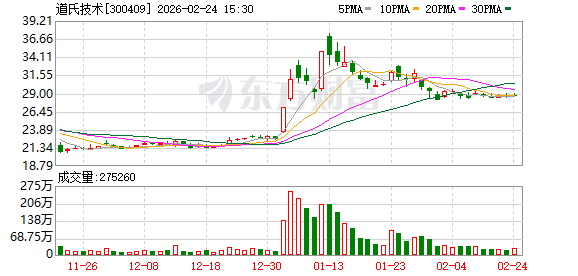
道氏技术:主要客户覆盖了比亚迪股份有限公司等众多锂电行业知名公司
Zheng Quan Ri Bao· 2026-02-24 09:11
Group 1 - The core viewpoint of the article highlights that Daos Technology's carbon materials segment has gained widespread recognition among major clients in the lithium battery industry due to its excellent product quality and strong market reputation [2] - Major clients include well-known companies such as BYD Company Limited and Contemporary Amperex Technology Co., Limited (CATL) [2] - The company's products are well-received in the market, indicating a strong position within the industry [2]




国金证券:锂电量价主升浪叠加固态新技术突破 产业链景气度多元开花
智通财经网· 2026-02-24 07:23
Group 1: Lithium Industry Insights - The lithium carbonate price increased to 170,000 yuan/ton in January, up 42% from the previous month, while lithium hydroxide rose to 165,000 yuan/ton, up 62% [1] - The lithium battery industry saw a production increase of 35%-60% year-on-year in February, with separators and electrolytes exceeding 50% growth [5] - The overall lithium battery supply chain remains in a high prosperity phase despite a slight month-on-month production decline due to the Spring Festival [5] Group 2: New Energy Vehicle Market - In December, China's wholesale sales of new energy passenger vehicles reached 1.42 million units, a year-on-year increase of 3%, while the total for the year was 14.21 million units, up 26% [3] - The European market showed strong growth with a 35% year-on-year increase, while the U.S. market faced a decline of 35% due to the expiration of federal tax credits [3] Group 3: Energy Storage Developments - In December, China's installed energy storage capacity reached 63 GWh, a year-on-year increase of 95%, with a total of 146 GWh for the year, up 33% [4] - Europe added 33 GWh of energy storage capacity in 2025, a 46% increase, driven by large utility projects [4] Group 4: New Technologies in Battery Production - The solid-state battery industry is accelerating towards large-scale application, with global shipments expected to reach 36 GWh by 2025 [8] - Companies like CATL and Toyota are making significant advancements in solid-state battery technology, with mass production planned for 2027 [8] Group 5: Investment Recommendations - Companies in the lithium supply chain, such as CATL, EVE Energy, and Keda Industrial, are recommended for investment due to rising prices in lithium and related materials [9]

开年利是!头部基金给出马年投资“寻宝图”
Zhong Guo Jing Ji Wang· 2026-02-24 05:13
Core Viewpoint - The A-share market is expected to focus on technology as the main theme for 2026, with attention also on consumer and dividend sectors as investment opportunities [1] Group 1: Investment Strategies and Themes - E Fund emphasizes the increasing value of dividend assets in a low-interest-rate environment, with dividend yields around 5% and a potential influx of funds into these assets in 2026 [1] - 华夏基金 suggests that concerns over tightening overseas liquidity may be overestimated, and long-term investors could find attractive entry points in sectors like AI, media, and lithium batteries [2] - 富国基金 predicts a "central oscillation upward" trend for the A-share market in 2026, driven by recovery opportunities in consumption and real estate [3] - 汇添富 identifies A-shares as the most promising asset for 2026, highlighting the clear trend in the AI industry and the potential for valuation increases [8] - 博时基金 recommends focusing on emerging industries, resource upgrades, and domestic demand recovery as key investment directions for 2026 [10] Group 2: Sector-Specific Insights - 国泰基金 notes a policy shift towards domestic demand, which is expected to enhance China's economic outlook and asset returns, suggesting a good time for mid-term adjustments in sectors like AI and power equipment [5] - 鹏华基金 highlights the wine sector's potential for valuation recovery in 2026, while also emphasizing the attractiveness of the tourism sector in Hong Kong stocks [6][7] - 景顺长城 focuses on the long-term structural benefits for the equity market, particularly in technology sectors like AI, semiconductors, and consumer electronics [9] - 银河基金 discusses the commercial viability of space solar power and the need for domestic companies to overcome challenges in reusable rocket technology [11] - 东方红 suggests that cyclical sectors have high potential but require supply-side adjustments, while advocating for a bottom-up approach to identify undervalued stocks [12]
未知机构:长江电新节后观点全面开花看好电新大行情总体长-20260224
未知机构· 2026-02-24 03:35
Summary of Conference Call Records Industry Overview - The conference call primarily discusses the renewable energy sector, focusing on solar energy, energy storage, lithium batteries, wind power, and electric power equipment. The overall sentiment is optimistic about the growth potential in these areas, particularly in North America and China [1][2][3][4]. Key Points and Arguments Solar Energy - The North American visits by solar equipment companies and changes in U.S. trade policies are expected to catalyze the space solar and energy storage markets [1] - The Solar Association's January cost analysis provides support for price recovery in the industry, with a need to monitor demand expectations for traditional solar trends [1] - Companies recommended for investment include space solar battery and satellite power firms such as JunDa, RiSheng, MingYang, JingNeng, and TianHe, as well as equipment manufacturers with strong order visibility like MaiWei, AoTeWei, JingSheng, and ShuangLiang [1] Energy Storage - The first implementation guidelines for large-scale energy storage (OBBB) have been released, alleviating the most pessimistic expectations, while the expiration of fentanyl and equivalent tariffs presents a marginal benefit for U.S. energy storage sentiment [2] - Anticipation of increased orders for North American AIDC energy storage and the introduction of provincial pricing regulations in China are expected to stimulate market activity [2] - The household storage sector is showing resilience in Q1, with strong performance in Ukraine, Australia, and the UK, and expectations for significant month-on-month production increases in March [2][3] Lithium Batteries - Post-holiday production is expected to continue rising, potentially reaching new highs, with a favorable window for price negotiations across the supply chain [3] - Long-term recommendations focus on battery segments, particularly companies with alpha potential like Ningde and Yiwei, while also suggesting investments in undervalued separator and copper foil sectors [3] - Companies with price elasticity in the lithium iron phosphate segment, such as PuTaiLai, Enjie, JiaYuan, TianCi, FuLin, YuNeng, and ShangTai, are also recommended [3] Wind Power - Emphasis on the new wind power cycle starting in the 14th Five-Year Plan, with expectations for commercial aerospace developments and profitability recovery in wind turbine manufacturing [4] - Recommended companies in the wind power sector include DaJin, HaiLi, TianShun, and MingYang Intelligent [4] Electric Power Equipment - During the Spring Festival, PJM plans to invest $11.8 billion in the power grid to support data centers, while OpenAI has announced a $600 billion investment plan with $1,000 billion in financing [4] - Continued recommendations for "North America Power Shortage 3+3" include transformers from SiYuan, Igor, and JinPan, as well as AI power solutions from SiFang, MaiMi, and KeShiDa [4] - Focus on high-voltage transformer export expansion with companies like TeBei, WangBian, BaiYun, AnKao, and HongYuan [4] New Directions - Attention is drawn to Tesla's contract situation and upcoming robot version releases, with recommended robotics companies including SanHua, XinQuan, SiLing, FuSai, RongTai, BeiTe, and MingZhi, along with potential suppliers like KeDaLi [4]
晨会纪要-20260224
Guoxin Securities· 2026-02-24 02:58
Group 1: Macro and Strategy - The report highlights three major industry opportunities for the 2026 bull market: 1) The technology sector led by AI, with a shift from hardware to application expansion, focusing on humanoid robots and AI+ fields 2) The "double low" characteristics of real estate and liquor sectors, which are at historical low valuations and may see a recovery due to improving fundamentals and policy support 3) Changes in the supply-demand dynamics of resource products, which are expected to improve under the backdrop of anti-involution policies and global demand support [8][10][11] Group 2: AI Industry - The AI industry is expected to see a shift from hardware to application, with significant growth in sectors such as governance, finance, manufacturing, education, and healthcare driven by policy support and technological advancements [9] - The report emphasizes the importance of the AI application acceleration, particularly in edge computing and AI+ related fields, as well as the continued investment in the computing power supply chain driven by domestic substitution [9] Group 3: Nuclear Fusion Industry - The nuclear fusion sector is identified as a key area for future energy systems, with its potential for near-infinite energy, high energy density, and minimal environmental impact [12][13] - The report discusses the challenges of achieving nuclear fusion, including the extreme conditions required for the reaction and the need for advanced materials and technologies [13][14] - Various approaches to achieving controlled nuclear fusion are outlined, with the Tokamak device being the most mature and commercially viable option [14] - The report forecasts that China will achieve demonstration power generation from nuclear fusion around 2030, with full commercialization expected by 2050 [14][16] Group 4: Investment Recommendations - The report recommends focusing on key players in the nuclear fusion supply chain, including main device manufacturers, superconducting material suppliers, and companies holding nuclear power operation licenses [16] - It suggests that the nuclear fusion industry is entering a phase of accelerated development, driven by increased capital expenditure and technological advancements [15][16]

2026年第27期:晨会纪要-20260224
Guohai Securities· 2026-02-24 02:55
Group 1: Weichuang Electric / Automation Equipment - The company is strengthening collaborations to promote technological innovation and market expansion in the robot-driven component business [4] - Plans to establish a joint venture in Thailand with Zhejiang Rongtai to expand the smart robot electromechanical integration market, with both parties holding 50% shares [4] - The company aims to deepen industry demand and continue global expansion, focusing on regions like Asia, Africa, and Latin America while enhancing product offerings [5] - Revenue projections for 2025-2027 are estimated at 1.977 billion, 2.444 billion, and 3.108 billion yuan, with net profits of 288 million, 346 million, and 419 million yuan respectively [6] Group 2: Lenovo Group / Computer Equipment - Lenovo reported FY2026Q3 revenue of approximately 22.204 billion USD, an 18% year-on-year increase, with a net profit of 546 million USD, down 21% year-on-year [7][8] - The adjusted net profit increased by 36% year-on-year, driven by efficiency optimization and a high-end product mix [8] - The Infrastructure Solutions Group (ISG) is undergoing strategic restructuring, expected to accelerate the return to profitability in FY2027 [9] Group 3: Shipping and Ports Industry - National import and export total reached 45.47 trillion yuan in 2025, with a 3.8% year-on-year growth [13] - Container throughput at major coastal ports reached 31.198 million TEUs, a 7% year-on-year increase [15] - The Baltic Dry Index (BDI) rose by 135.95% year-on-year, indicating a significant increase in dry bulk shipping rates [19] Group 4: Google-A / Overseas - Google reported Q4 2025 revenue of 113.828 billion USD, an 18% year-on-year increase, with a net profit of 33.455 billion USD, up 30% year-on-year [25] - Search advertising revenue grew by 17% year-on-year, driven by AI innovations enhancing user experience and monetization efficiency [26] - Google Cloud revenue surged by 48% year-on-year, reaching 17.7 billion USD, with a significant increase in annual recurring revenue [27] Group 5: Yutong Technology / Packaging Printing - The company plans to acquire 51% of Huayan Technology for 449 million yuan, aiming to enhance its capabilities in precision manufacturing [32][34] - The acquisition is expected to leverage industry synergies and empower the second growth curve, focusing on high-profile clients like Google and Samsung [34] - Revenue projections for 2025-2027 are estimated at 19.069 billion, 21.001 billion, and 23.077 billion yuan, with net profits of 1.608 billion, 1.798 billion, and 1.980 billion yuan respectively [34] Group 6: NetEase-S / Gaming - NetEase reported Q4 2025 revenue of 27.5 billion yuan, a 3% year-on-year increase, with a net profit of 6.2 billion yuan, down 28.8% year-on-year [36][37] - The gaming segment showed resilience with a revenue of 22 billion yuan, driven by strong performance from popular IPs and new game launches [38] - The company is focusing on AI-driven strategies to enhance operational efficiency and optimize its business structure [39] Group 7: Aidi Pharmaceutical / Biopharmaceuticals - The company is advancing its international product launch and received GMP certification from Tanzania, facilitating entry into the African market [43] - Revenue for 2025 is projected at 721 million yuan, a 72.57% year-on-year increase, with a focus on HIV innovative drug sales [43] - Multiple new drug pipelines are actively progressing, with significant clinical trial approvals received [44] Group 8: Meituan-W / Local Life Services - Meituan is projected to achieve total revenue of 916 billion yuan in Q4 2025, with a core local business revenue of 648 billion yuan, reflecting a competitive landscape [45][46] - The company is strategically increasing investments in marketing and rider incentives to enhance operational efficiency amid fierce competition [46] - Long-term growth potential is anticipated through refined operations in instant delivery and overseas expansion [49] Group 9: Huahong Semiconductor / Semiconductors - Huahong Semiconductor reported Q4 2025 revenue of 660 million USD, a 22.4% year-on-year increase, with a wafer shipment of 1.45 million pieces [50]




未知机构:瑞浦兰钧更新20260223今天港股锂电板块迎来开门红瑞浦兰-20260224
未知机构· 2026-02-24 02:40
瑞浦兰钧更新-20260223 今天港股锂电板块迎来开门红,瑞浦兰钧大涨15%,底部发完业绩预告至今已上涨38%,我们持续重点推荐,公司 目前仍是被低估的弹性较大的储能电芯核心标的! 根据业绩预告,公司25全年实现6.3-7.3e利润,对应25H2实现利润约7-8e,大超市场预期。 根据业绩预告,公司25全年实现6.3-7.3e利润,对应25H2实现利润约7-8e,大超市场预期。 业绩反转核心原因包括:户储盈利好,规模效应带来费用分摊,25年四费已降至9%以下,后续仍有下降空间等 26年预计公司电池出货量120GWh,同比+40%,预计储能电池占比超60%,其中户储占比30%+、大储占比30%、 商用车占比25%、乘用车占比预计15%,公司受购置税、补贴等政策影响较小,储能和商用车增长逻辑更顺且价格 传导更加顺利。 业绩反转核心原因包括:户储盈利好,规模效应带来费用分摊,25年四费已降至9%以下,后续仍有下降空间等 瑞浦兰钧更新-20260223 今天港股锂电板块迎来开门红,瑞浦兰钧大涨15%,底部发完业绩预告至今已上涨38%,我们持续重点推荐,公司 目前仍是被低估的弹性较大的储能电芯核心标的! 价格层面,公 ...
动储收官迎新高,碳酸锂趋势反转 | 投研报告
Zhong Guo Neng Yuan Wang· 2026-02-24 02:36
Core Insights - The lithium battery sector is experiencing significant price increases, with lithium carbonate rising to 170,000 yuan/ton (+42% MoM) and lithium hydroxide to 165,000 yuan/ton (+62% MoM) [1] - In December, China's wholesale sales of new energy passenger vehicles reached 1.42 million units, showing a year-on-year increase of 26% [1] Group 1: Lithium Battery Market - The lithium battery sector has shown strong performance since January 2026, outperforming major indices like the CSI 300 and SSE 50 [2] - The lithium-related sectors have seen monthly transaction values increase, with the low-altitude economy segment rising by 44% [2] - The market is currently focused on the lithium battery sector, with many segments at historically high valuation levels [2] Group 2: Carbonate Lithium Cycle and New Technologies - The lithium carbonate market is undergoing a cyclical reversal, driven by inflation in the supply chain and the emergence of new technologies like sodium batteries [3] - Historical analysis indicates that from 2015 to 2025, lithium carbonate has experienced two complete cycles, with the next upturn expected to be driven by domestic energy storage capacity subsidies and new energy vehicle replacement policies [3] Group 3: New Energy Vehicle Sales - December saw a mixed performance in the new energy vehicle market, with China and Europe showing strong growth while the U.S. market faced challenges [4] - In December, new energy vehicle sales in China, Europe, and the U.S. were 1.42 million, 300,000, and 80,000 units respectively, with year-on-year growth rates of +3%, +35%, and -35% [4] Group 4: Energy Storage Developments - In December, China's energy storage installations reached 63 GWh, a significant increase of 95% MoM and 441% YoY, driven by year-end project completions [5] - The U.S. energy storage market saw a total installation of 39 GWh for the year, with a year-on-year growth of 39%, although this was below expectations due to uncertainties from the Inflation Reduction Act [5] Group 5: Price Trends and New Technologies - Lithium salt and cathode materials have seen strong price increases due to policy changes, with lithium carbonate and lithium hydroxide prices rising by 74% and 95% respectively [6] - The solid-state battery industry is accelerating towards commercialization, with significant advancements in production and technology expected by 2025 [7] Group 6: Investment Recommendations - The lithium battery sector is poised for a price and volume surge in 2026, with a focus on companies involved in lithium, separators, and solid-state technology [8]


动储收官迎新高,碳酸锂趋势反转
Zhong Guo Neng Yuan Wang· 2026-02-24 01:26
Group 1: Lithium Battery Market Insights - The price of lithium carbonate reached 170,000 yuan/ton, an increase of 42% compared to the previous month, while lithium hydroxide was priced at 165,000 yuan/ton, up 62% month-on-month [1][2] - In December, the wholesale sales of domestic new energy passenger vehicles reached 1.42 million units, showing a month-on-month increase of 3% but a decrease of 10% compared to the previous month; the total for the year was 14.21 million units, reflecting a year-on-year growth of 26% [1][2] Group 2: Market Performance Review - Since January 2026, the lithium battery sector has shown active performance, with most segments outperforming the CSI 300 and SSE 50 indices; the lithium mining and negative electrode segments saw significant gains, with the lithium mining sector leading with a 26% increase [3] - The monthly transaction volume for most lithium battery-related sectors increased, with the low-altitude economy segment experiencing the highest growth of 44% [3] Group 3: Industry Trends and Innovations - The lithium carbonate market is experiencing a cyclical reversal, leading to inflation across the industry chain and the emergence of new technologies such as sodium batteries; historical analysis indicates that from 2015 to 2025, lithium carbonate has undergone two complete cycles driven by policy and demand [4] - The solid-state battery industry is accelerating towards commercialization, with expectations of 36 GWh of global solid-state battery shipments by 2025; advancements in materials and production processes are being made, with companies like CATL and NIO making significant progress [8] Group 4: Energy Storage Developments - In December, domestic energy storage installations reached 63 GWh, a year-on-year increase of 95% and a month-on-month increase of 441%, driven by year-end project completions; the total for the year was 146 GWh, reflecting a 33% year-on-year growth [6] - The U.S. energy storage market saw a total installation of 39 GWh for the year, with a year-on-year growth of 39%, although this was below expectations due to uncertainties from the Inflation Reduction Act [6] Group 5: Investment Recommendations - In 2026, the lithium battery sector is expected to experience a significant increase in both volume and price, alongside breakthroughs in solid-state technology; companies recommended for investment include CATL, EVE Energy, and Keda Technology, among others [9]
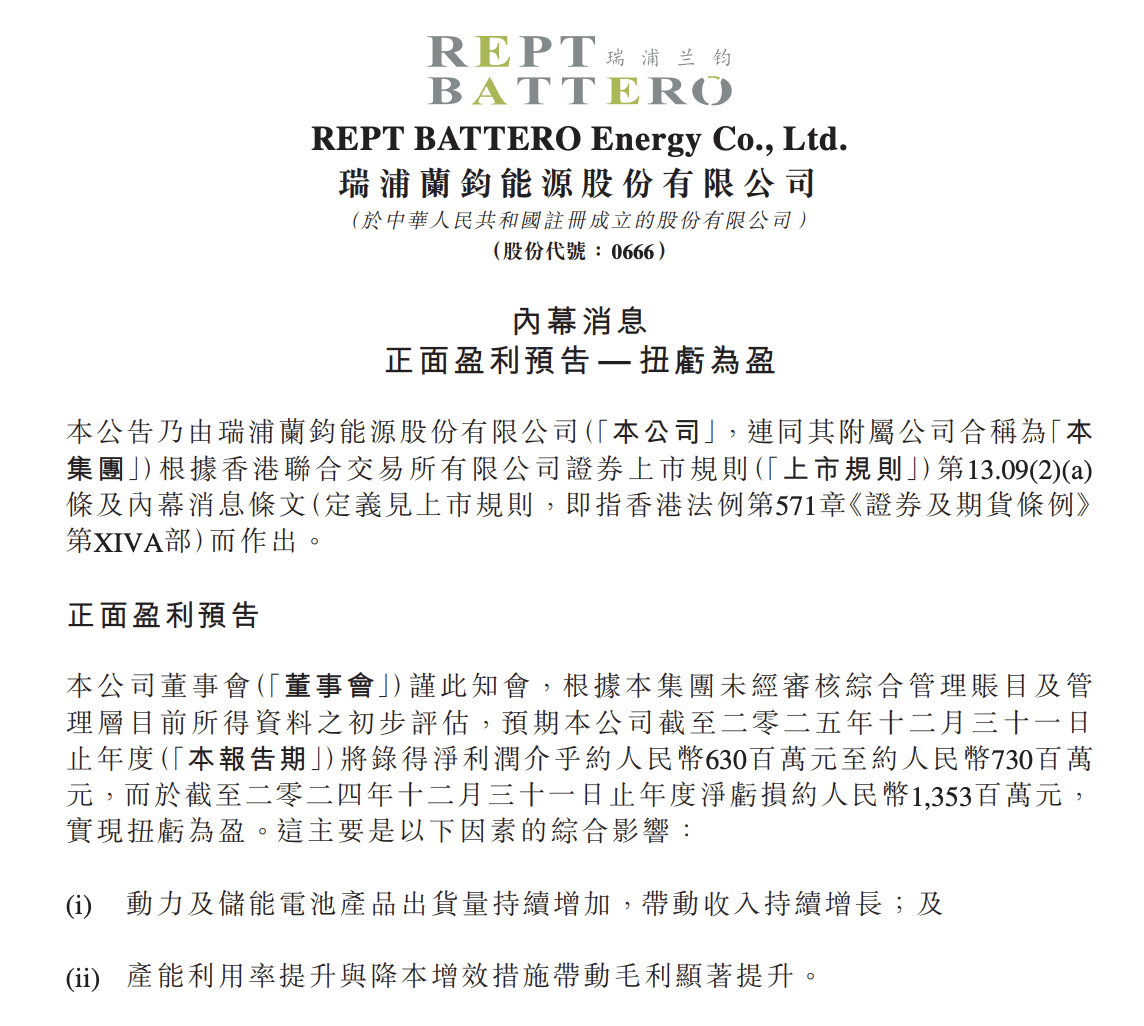
净赚超6.3亿!储能巨头瑞浦兰钧,扭亏为盈
Sou Hu Cai Jing· 2026-02-24 01:08
Core Viewpoint - The global energy storage market is experiencing a surge in demand, leading to improved financial performance for related companies, particularly for leading firms like Ruipu Lanjun, which is expected to turn a profit by 2025 after significant losses in 2024 [1][4]. Group 1: Company Performance - Ruipu Lanjun forecasts a net profit of 630 million to 730 million yuan for the year ending December 31, 2025, a significant turnaround from a net loss of 1.353 billion yuan in 2024 [1][4]. - The company's recovery is attributed to increased shipment volumes of power and energy storage battery products, which have driven steady revenue growth [4]. - The improvement in gross profit margins is also due to enhanced capacity utilization and cost reduction measures [4]. Group 2: Market Position and Competition - Ruipu Lanjun is a core subsidiary of Qingshan Group, focusing on the design, research, production, and sales of lithium-ion battery solutions for electric vehicles and smart power storage [4]. - The company is primarily positioned in the new energy heavy truck battery segment, with a projected battery installation volume of 94.8 GWh in 2025, accounting for 64% of the total commercial vehicle battery installation volume in China [4]. - Despite being ranked sixth in the market with 5.7 GWh, Ruipu Lanjun faces stiff competition from industry leaders like CATL and BYD, which dominate the market [4][7]. Group 3: Industry Outlook - The energy storage demand explosion is expected to alleviate some competitive pressures in the lithium battery industry, although the clearing of mid-tier companies will accelerate [8]. - The industry is likely to see a further increase in concentration, benefiting leading firms as they navigate through the current market challenges [8]. - Analysts predict that Ruipu Lanjun will continue to benefit from economies of scale and integrated transformation, with net profits expected to grow further by 2026 [8].