券商

Search documents
全球大公司要闻 | 芯片涨价潮蔓延,安踏123亿元出海扫货
Wind万得· 2026-01-28 00:30
Group 1 - A new wave of price increases in the global chip industry has emerged, with Samsung Electronics raising LPDDR memory prices for iPhones by over 80% and SK Hynix by nearly 100%. Domestic companies like Zhongwei Semiconductor and Guokewai have also announced price hikes of 15%-50% and 40%-80% respectively for their products [2] - Guotai Junan forecasts a net profit of 27.533 billion to 28.006 billion yuan for 2025, representing a year-on-year growth of 111%-115%. Shenwan Hongyuan expects a net profit of approximately 9.1 billion to 10.1 billion yuan, with a growth of 74.64%-93.83% [2] - Anta Sports has signed an agreement to acquire a 29.06% stake in German sports brand Puma for 1.506 billion euros (approximately 12.28 billion yuan), which will make Anta the largest single shareholder of Puma if the transaction is completed [2] Group 2 - Micron Technology announced a $24 billion investment to build a new memory chip manufacturing facility in Singapore, aiming to meet the growing demand for NAND storage chips in AI and data center applications, with production expected to start in the second half of 2028 [3] - Corning has secured a procurement order worth up to $6 billion from Meta for optical cables, primarily for AI data center construction, further solidifying its market position in fiber optic communications [3] Group 3 - Pizaihuang's controlling shareholder, Jiulongjiang Group, plans to increase its stake in the company by investing between 300 million and 500 million yuan from February 1 to July 31, demonstrating confidence in the company's future development [5] - Hengrui Medicine's drug HRS-5346 has been included in the list of breakthrough therapies, which will accelerate its research and approval process, positively impacting the company's innovative drug pipeline [5] - Shennan Circuit expects a net profit increase of 68%-78% for 2025, driven by sufficient orders, high capacity utilization, and improved profitability from product structure optimization [5] - Zhongjin Gold anticipates a net profit increase of 41.76%-59.48% for 2025, influenced by rising gold prices and increased mineral gold production [5] Group 4 - Ganfeng Lithium expects a net profit of 1.1 billion to 1.65 billion yuan for 2025, turning a profit compared to previous losses, with a fair value change gain of approximately 1.03 billion yuan from its holdings in Pilbara Minerals Limited [6] - Wanda Film forecasts a net profit of approximately 480 million to 550 million yuan for 2025, achieving profitability due to the recovery of the domestic film market and improved operational efficiency [6] Group 5 - Samsung Electronics plans to produce 1 million units of the Galaxy Wide Fold smartphone, targeting competition with Apple's potential foldable products [11] - SK Hynix's market capitalization has surpassed $400 billion due to surging demand for high-bandwidth memory (HBM), with the company considering establishing an AI investment department in the U.S. [11] - Toyota is recalling approximately 162,000 Tundra vehicles in the U.S. due to multimedia display screen issues, while also facing a 9% decline in new car registrations in the EU [11] - LG Energy will supply batteries for Tesla's humanoid robots, marking its expansion into non-automotive applications in the power battery sector [11]



昔日百亿基金经理,如今业绩倒数
Sou Hu Cai Jing· 2026-01-27 07:52
Core Viewpoint - In 2025, 97% of nearly 4,370 actively managed equity funds achieved positive returns, with the highest return exceeding 230%, although 129 funds experienced a decline in net value, including six funds managed by Wang Mingxu, who significantly underperformed benchmarks [2][4][5]. Group 1: Fund Performance - Wang Mingxu managed eight funds, with six established before 2025 recording negative returns in that year, specifically: -16.31% for Guangfa Domestic Demand Growth A, -15.47% for Guangfa Value Advantage, -14.55% for Guangfa Value Selection A, -13.34% for Guangfa Ruiming Two-Year Holding A, -12.60% for Guangfa Steady Selection Six-Month Holding A, and -12.50% for Guangfa Balanced Selection A [4][7]. - The three-year performance of these six funds significantly lagged behind their benchmarks, with net value growth rates of -15.10% to -16.76%, underperforming benchmarks by 31.68 to 37.91 percentage points [5][7]. Group 2: Investment Strategy and Holdings - The six funds managed by Wang Mingxu exhibited similar investment strategies, primarily focusing on sectors such as real estate, brokerage, high-end liquor, and city commercial banks, with attempts to invest in the internet data center industry [8][9]. - Despite a strategy that included reducing exposure to real estate and increasing stakes in city commercial banks and high-end liquor, the overall performance of these sectors was disappointing, with the liquor index declining by 6.67% in the first three quarters of 2025 [8]. Group 3: Management Scale and Response - Wang Mingxu's management scale has significantly decreased, dropping from 306.52 billion yuan in mid-2021 to 72.65 billion yuan by the end of 2025 [9]. - An inquiry was sent to Guangfa Fund regarding Wang Mingxu's performance and management issues, but no response was received by the time of reporting [10].

牛市旗手何时归?春季行情下的金融板块破局之路
Xin Lang Cai Jing· 2026-01-27 03:20
Core Viewpoint - The non-bank financial sector has experienced significant fluctuations, with the insurance sector reaching a five-year high before facing a two-week correction, highlighting a divergence in the driving logic between insurance and brokerage firms [1] Group 1: Insurance Sector Value Reassessment - The insurance sector is undergoing a value reassessment driven by liability-side reforms, asset-side recovery, and regulatory easing, leading to sustained fundamental improvements since 2025 [2] - Structural optimization on the liability side is central to the value recovery, with regulatory changes lowering the guaranteed interest rates for various insurance products, thus alleviating long-term risks and improving the cost structure [3] - The asset side has seen a reversal in returns, with the ten-year government bond yield stabilizing at 1.84% by the end of 2025, improving the industry's profit outlook and driving significant profit growth among major insurers [4] - Regulatory easing and product strategy optimization have created a synergistic effect, supporting valuation recovery in the insurance sector, particularly through the promotion of dividend insurance products [5] Group 2: Liquidity Support in the Insurance Sector - The influx of medium- to long-term funds into the market has become a key feature since 2025, with these funds favoring high-dividend assets, making the insurance sector a primary beneficiary [6] - Policies initiated in early 2025 aimed at promoting medium- to long-term funds entering the market have provided comprehensive institutional support for insurance investments [6] - A positive cycle has formed where increased returns from equity investments lead to more funds flowing into the insurance sector, enhancing liquidity and market activity [7] Group 3: Brokerage Sector Performance and Future Direction - The brokerage sector is experiencing a paradox of high earnings growth but stagnant stock prices, attributed to regulatory changes and shifts in market funding flows [8] - Despite impressive earnings growth in 2025, the brokerage sector has not led market rallies, contrasting sharply with its role during the 2015 bull market, due to intensified regulation and a shift in investor focus [9] - Mergers and acquisitions are seen as a necessary path for restructuring the brokerage industry, with government support aimed at enhancing international competitiveness and optimizing resource allocation [12] Group 4: Structural Opportunities in Non-Bank Financial Sector - The non-bank financial sector is positioned for structural opportunities as the equity market recovers, benefiting from increased trading volumes and improved profitability in both brokerage and insurance sectors [13] - The brokerage sector is currently undervalued, with significant potential for valuation recovery, particularly through mergers and acquisitions that enhance competitive positioning [14] - The insurance sector is expected to see continued growth in new policy premiums, driven by attractive product offerings in a low-interest-rate environment, making it a core focus for investment [15]
A股三大指数集体低开,沪指跌0.18%
Feng Huang Wang Cai Jing· 2026-01-27 01:41
Market Overview - A-shares opened lower with all three major indices declining: Shanghai Composite Index down 0.18%, Shenzhen Component Index down 0.23%, and ChiNext Index down 0.09% [1] Institutional Insights - Huaxi Securities suggests that the current market is in the mid-stage of a "slow bull" trend, with the Shanghai and Shenzhen 300 Index currently at mid-levels compared to previous bull markets in 2007, 2015, and 2021 [2] - The risk premium for the Shanghai and Shenzhen 300 Index is at 5.27%, indicating potential for further market growth as historical lows were around 2.5% [2] - Recommended sectors for investment include technology (AI computing, applications, robotics, space photovoltaics), industries benefiting from "de-involution" and price increases (chemicals, non-ferrous metals), and sectors with high growth in annual performance forecasts (electronics, machinery, pharmaceuticals) [2] Sector Analysis - CITIC Securities reports that the home appliance sector will face pressure in Q4, with a focus on the national subsidy policy adjustment in 2026 targeting core categories and rural markets [3] - The subsidy will cover six major home appliance categories with a 15% subsidy for first-level energy efficiency, with an initial allocation of 62.5 billion yuan aimed at rural markets [3] - JD.com is investing 30 billion yuan to implement a program expected to reach 30-40 million rural residents, positioning the rural market as a key growth area for 2026 [3] Lithium Battery Sector - CITIC Jinpu indicates that lithium battery inflation is beginning, with clear price trends in rigid capacity segments, although upper limits remain uncertain [4] - The current lithium cycle is compared to the previous photovoltaic cycle, suggesting that price increases have not negatively impacted demand, leading to simultaneous volume and price growth across the industry [4] - Price adjustments are expected to be driven by capacity expansion rather than demand contraction, with stock prices likely to follow the trend of volume and price increases in the industry [4]
如何看待大金融股票配置
2026-01-26 15:54
Summary of Conference Call Records Industry Overview - The real estate market is entering the second half of its adjustment phase, with a narrowing decline but remaining sensitive to policy changes. The key to bottoming out house prices is the improvement in employment and income driven by total demand expansion. Currently, the static holding of properties is still at a disadvantage compared to interest rates [1][6] - The pricing of real estate stocks should adopt a bifurcated approach, incorporating the implied net profit from current projects and the discounted future profits from ongoing land acquisitions, aligning closely with the DCF model to effectively reflect long-term value [1][7] - The stock market typically bottoms out before the real estate market, with leading real estate companies' stock prices already showing relative clarity at their bottoms. If the decline in house prices slows over the next three years, these companies' stock prices have room for growth [1][9] Key Points on Real Estate Sector - The core logic of real estate pricing can be analyzed from both asset and self-occupancy perspectives. The asset perspective considers interest rates as opportunity costs, while the self-occupancy perspective focuses on loan interest rates. The return from holding real estate includes rental income, annual depreciation, transaction taxes, and income or rental growth [3] - Different cities have varying implicit depreciation rates due to their property value structures. Core cities have lower depreciation rates due to higher land value ratios, while lower-tier cities require higher return rates due to higher building value ratios [4] - Total demand expansion is crucial for driving income and rental growth, which is essential for the real estate market's recovery [5] Banking Sector Insights - Recent performance reports from listed banks indicate a recovery in revenue growth, with net interest margins stabilizing and net interest income growth rebounding as key factors. The market is focusing on the 2026 performance outlook, favoring quality city commercial banks, particularly in Jiangsu, Zhejiang, Shandong, and Sichuan-Chongqing regions [2][21] - The banking sector has faced recent adjustments primarily due to funding conditions, including sell-offs by public funds and changes in trading sentiment. Despite this, the medium-term outlook for the equity market remains positive, and quality bank stocks are seen as undervalued [13][15] - The current ROE for banks is on a slow downward trend, but the pace is moderate, and profit growth remains stable. The PB valuation is currently below net asset value, indicating a potential for strong rebounds during recovery phases [17] Investment Recommendations - In the context of a slow bull market, both the insurance and brokerage sectors are expected to benefit from long-term trends. Investors are advised to increase allocations in these sectors, particularly as insurance companies optimize asset-liability matching and benefit from low-interest environments [11][14] - Despite recent pressures on bank stocks from ETF outflows, quality bank stocks are seen as having significant recovery potential. Investors are encouraged to focus on undervalued mid-sized banks for excess returns [15] - The demand for dividend-yielding assets remains strong, with major banks' dividend yields rising above 4%, making them attractive for long-term investment [18] Notable Performers - Nanjing Bank has shown outstanding performance with double-digit revenue growth despite high base comparisons in Q4 2025. Interest income growth rates for Nanjing Bank and Hangzhou Bank reached 38% and 21%, respectively, driven by high growth and stabilized interest margins [20] Market Outlook - The market is currently focused on the 2026 performance outlook, with a strong recommendation for quality city commercial banks in key regions. The overall sentiment is cautiously optimistic, with expectations of a gradual recovery in the banking sector [21]
这轮牛市在春节前能到4500点吗?
Sou Hu Cai Jing· 2026-01-26 12:23
Group 1 - The market is unlikely to experience a sustained rally, and differentiation among stocks will soon occur, indicating that some investments may underperform significantly [1] - Investors should focus on buying and holding stocks that exhibit a clear upward trend, as market signals are often distorted by personal emotions and thoughts [2][3] - The current market does not require more intelligent investors, as many fail to understand the prevailing trends [3] Group 2 - The end of a bull market often involves trapping a large number of retail investors, and currently, many are hesitant to participate, believing that the market has peaked at 4000 points [4] - The concept of a bull market is fundamentally a global "debt liquidation game," where economic cycles are essentially debt cycles [4][5] - The U.S. historically used gold to "magically" eliminate debt by manipulating its price, which serves as a model for understanding current debt management strategies [6][7][8] Group 3 - The stock market's core function is to facilitate debt resolution for companies and governments, transforming future cash flow expectations into equity securities [9] - Recent policies in China aim to address local government debt risks by increasing the valuation of core state-owned assets, similar to the U.S. approach with gold [10] - State-owned enterprises can leverage high stock prices for debt financing, either through collateralized loans or by issuing new shares to raise capital for debt repayment [11][12] Group 4 - The ultimate goal of these strategies is not to extract principal from investors but to elevate asset prices and facilitate debt resolution, with banks unlikely to fail due to systemic support mechanisms [13] - Bull markets often emerge during economic downturns and conclude when the economy is strong, driven by factors such as currency appreciation, monetary easing, and policy support [14] - The potential for a significant influx of global capital into Chinese markets is anticipated following U.S. Federal Reserve actions, creating a symbiotic relationship between U.S. financial interests and Chinese assets [14] Group 5 - The nature of A-shares is characterized by short bull markets followed by prolonged bear markets, with significant waiting periods for recovery [15] - Accumulating sufficient capital before a bull market is essential for maximizing profits, as opportunities can be wasted without adequate preparation [15]
赛道分化,有色完胜,近1年豪涨130%,159876又新高!军工急踩刹车,创业板人工智能尾盘突发!
Xin Lang Ji Jin· 2026-01-26 11:28
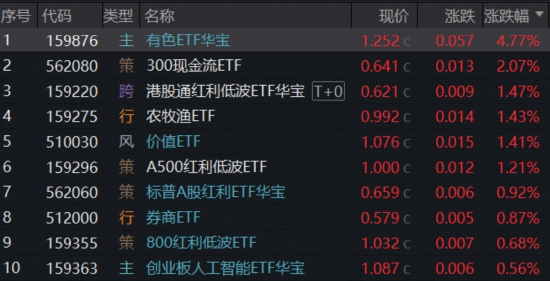
Market Overview - On January 26, the market experienced slight fluctuations, with all three major indices closing down, while banks and brokerages supported the Shanghai index, which closed down by 0.09% [1] - The total trading volume for the day reached 3.25 trillion yuan [1] Sector Performance - The non-ferrous metals sector maintained a strong position, while previously strong sectors like commercial aerospace and semiconductors showed significant pullbacks [1] - Precious metals surged, with spot gold prices breaking the $5,000 per ounce mark for the first time in history, and the Huabao Non-Ferrous ETF (159876) rising by 4.77%, reaching a new historical high [2][4] - The non-ferrous metals index has seen a growth of over 130% in the past year [2] ETF Highlights - The Huabao Non-Ferrous ETF (159876) saw a net subscription of 140 million units in a single day, indicating strong investor interest [2][4] - The top-performing financial ETFs, including the broker ETF (512000), also showed signs of recovery, with a price increase of 0.87% [2] - The AI sector, particularly the Huabao Entrepreneurial AI ETF (159363), managed to close up by 0.56% despite a general pullback in the AI sector, with significant capital inflow of over 2.1 billion yuan in the past 10 days [8] Investment Insights - Analysts from Guotai Junan Securities believe that the Chinese market is undergoing a broad revaluation, with opportunities in both technology and non-technology sectors, emphasizing a barbell strategy focusing on quality growth [3] - The IDC data center sector is seen as a low-point opportunity, with expectations for a rebound in valuations and performance due to increased capital expenditures from major domestic companies [10] - The military industry, despite recent volatility, is expected to remain in an upward demand cycle over the next five years, with opportunities in military trade, commercial aerospace, and large aircraft sectors [13]



股指期货周报:分化整理,小强大弱-20260126
Cai Da Qi Huo· 2026-01-26 08:28
Report Summary 1. Report Industry Investment Rating - Not provided in the given content 2. Core Viewpoints - The A-share market showed a differentiated consolidation last week, with small-cap indices outperforming large-cap ones. The basis discount of the four stock index futures varieties improved significantly, and the main contracts entered the futures premium mode. The bullish market of A-shares is expected to continue in the future, with sufficient liquidity in the first quarter and theme rotations centered around the "15th Five-Year Plan" [2][4] 3. Summary by Directory Market Review - Last week, the four stock index futures varieties mainly showed differentiated consolidation, with relatively large increases in CSI 500 and CSI 1000. The basis discount of the four stock index futures varieties improved significantly, and the main contracts entered the futures premium mode. The basis of the main futures contracts (futures - spot) was 5.61 for IH, 6.70 for IF, 68.03 for IC, and 45.86 for IM. The A-share market showed a differentiated consolidation, with the weekly lines of the Shanghai and Shenzhen stock markets closing in the positive territory. The small and medium-sized indices were relatively strong, and the daily trading volume of the two markets remained above 2.5 trillion yuan, exceeding 3 trillion yuan on Friday. The money-making effect spread from a structural one to the whole market. The space photovoltaic + commercial space sector remained hot, basic metals and precious metals strengthened, power grid equipment benefited from the trillion-level investment plan, and the logic of semiconductor domestic substitution and technological iteration remained unchanged. Meanwhile, the large financial sector (banks/insurance/securities) adjusted continuously, and sectors such as liquor and home appliances performed poorly [2] Comprehensive Analysis - Macroscopically, the actual GDP in 2025 achieved a 5.0% growth, the same as in 2024, showing a "high in the front and low in the back" structure with external demand better than internal demand, and positive changes appeared in the price level. Overseas, the global bond market experienced a sell-off due to the statements of Trump and Koike Yuriko. The geopolitical risk in the US also reached an inflection point on January 21, and the global panic has been significantly alleviated, with a low possibility of a US or global liquidity crisis in the future. Looking forward, with sufficient liquidity in the first quarter, theme rotations will revolve around the "15th Five-Year Plan", and the fundamentals and corporate earnings are gradually being revised upwards, so the bullish market of A-shares is expected to continue [3][4]
A股收评 | 三大指数集体收跌 黄金涨势如虹!板块掀涨停潮
智通财经网· 2026-01-26 07:13
Market Overview - The market experienced a significant decline with all three major indices closing lower, particularly the ChiNext and Sci-Tech 50 indices showing notable adjustments [1] - The trading volume exceeded 30 trillion for two consecutive days, with over 3,700 stocks declining [1] - The Shanghai Composite Index fell by 0.09% to 4,132.61 points, while the Shenzhen Component Index dropped by 0.85% to 14,316.64 points, and the ChiNext Index decreased by 0.91% to 3,319.15 points [2] Sector Performance - The financial sector, including brokerage and insurance stocks, led the market with gains, while resource stocks, particularly in non-ferrous metals and precious metals, showed strong performance [1] - Notable stocks included Sichuan Gold and China National Offshore Oil Corporation, which reached historical highs [1] - Conversely, popular sectors such as semiconductors, commercial aerospace, and AI applications faced significant declines, with China Satellite hitting its daily limit down [1] Fund Flow - Major capital inflows were observed in sectors such as securities, banking, and small metals, with key stocks like Wangsu Science & Technology, CITIC Securities, and Zijin Mining attracting significant net inflows [3] Regulatory Updates - The Shanghai Futures Exchange imposed restrictions on 16 clients involved in trading tin and silver futures for failing to declare actual control relationships, limiting their trading and withdrawal capabilities for one month [4] Policy Developments - Guangdong Province is set to deepen reforms in the Shenzhen Stock Exchange's ChiNext board, aiming to enhance innovation and high-quality development by 2026 [5] - Henan Province plans to support leading enterprises in forming innovation alliances and enhancing their technological capabilities, with a focus on key sectors such as advanced materials and high-end equipment [6] Market Sentiment and Future Outlook - CITIC Securities suggests that market confidence is gradually recovering, with potential for recovery in sectors that are relatively undervalued and logical [8] - Zhongtai Securities emphasizes a dual focus on technology and resource sectors, predicting that the economic environment will favor investment in these areas [7] - Dongfang Securities notes that market panic is subsiding, and the market is slowly regaining upward momentum, driven by policy catalysts and industry trends [9]
【申万宏源策略 | 一周回顾展望】春季行情仍沿着既定路径前进
申万宏源研究· 2026-01-26 06:23
Core Viewpoint - The "steady and far-reaching" strategy is driving the transition of the spring market into subsequent phases, but it has not disrupted the established path of the spring market rally [2][3]. Group 1: Spring Market Dynamics - The spring market is characterized by incremental speculation, supported by factors such as the pre-New Year surge in the CSI A500 ETF, post-New Year insurance market optimism, and foreign capital inflows [3]. - The market is expected to maintain a favorable environment for bullish positions, with a complete rotation of sectors and a broadening of profit effects [3]. - Short-term, the focus is on identifying bottom assets, with cyclical Alpha investments expanding towards more cyclical turning points [2][3]. Group 2: Market Positioning and Future Outlook - The spring market is seen as an extension of the high valuation phase leading to a structural technology market expected in 2025, with a likely consolidation phase following the spring rally [4]. - The market is anticipated to face increasing resistance as the overall profit effect approaches high levels, limiting the time and space for the post-New Year rally [3][4]. - The cyclical Alpha is becoming a key focus for identifying low-position opportunities, with sectors like commercial aerospace and AI applications showing potential for rebounds [5][8]. Group 3: Sector Performance and Investment Opportunities - The current market is concentrating on low-position sectors, with cyclical Alpha (such as non-ferrous metals and chemicals) expanding towards cyclical turning points [5][8]. - Notable sectors for potential rebounds include commercial aerospace and AI applications, while sectors with relatively low profit effects like high-dividend stocks and pharmaceuticals are expected to see rotation and catch-up [8]. - Long-term investment themes remain focused on technology and cyclical Alpha, with specific attention on sectors like semiconductor, energy storage, and commercial aerospace [8].