煤炭开采

Search documents
上市公司回购、增持、分红月度跟踪(2026年1月):春季行情迎来开门红,AH股回购增持规模有所回落-20260205
Shenwan Hongyuan Securities· 2026-02-05 05:28
Group 1 - The report highlights the establishment of two structural monetary policy tools by the central bank to support the stable development of the capital market, with a total combined quota of 800 billion yuan, which is expected to reshape the A-share ecosystem [4][8] - In January, the total amount applied for stock repurchase and increase loans decreased by 11% month-on-month, primarily due to an 86% decline in the amount applied for increases [9][8] - The A-share repurchase situation in January showed a significant decline, with the total repurchase amount at approximately 14.93 billion yuan, down 33% from December, and the number of repurchase plans also decreased by 42% [11][8] Group 2 - The report indicates that in January, the total amount of repurchases and increases in the A-share market was approximately 149.3 billion yuan, with 77% of the funds being self-owned or raised funds [11][20] - The report identifies three companies with the largest proposed repurchase amounts: Jinkai New Energy (5-6 billion yuan), Century Huatong (3-6 billion yuan), and Jintian Co., Ltd. (2-4 billion yuan) [11][20] - In January, the Hong Kong stock market saw a repurchase amount of approximately 12.83 billion Hong Kong dollars, a decrease of 41% from December, with Tencent Holdings, Xiaomi Group-W, and Sunny Optical Technology being the top three companies by repurchase amount [26][20] Group 3 - The report lists companies that have announced new repurchase and increase plans in January, providing insights into their fundamentals, current valuations, and the proportion of repurchase/increase amounts [31][32] - It also tracks new dividend commitments from listed companies, with a notable commitment from Yanghe Brewery to distribute no less than 100% of the net profit attributable to shareholders as cash dividends for the years 2025-2027 [34][33]





煤炭、有色、油气2026何去何从?
Shang Hai Zheng Quan Bao· 2026-02-05 00:55
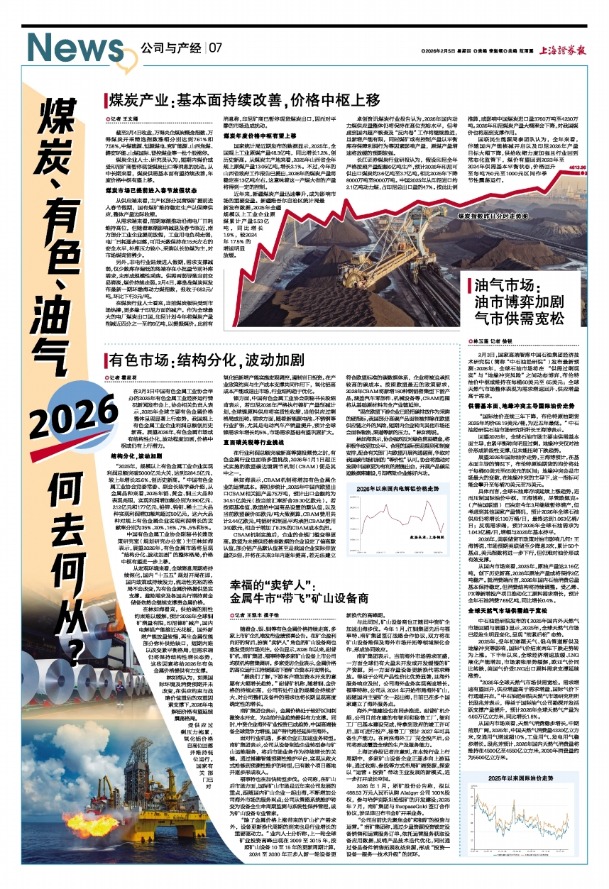
Group 1: Coal Industry - The coal industry is experiencing continuous improvement in its fundamentals, with the price center expected to rise in the medium to long term [7] - As of February 4, the Wande Central Enterprise Coal Concept Index and the Wande Coal Mining Selected Index increased by 7.61% and 7.58% respectively, with several coal stocks hitting the daily limit [7] - Short-term coal prices may be affected by news of Indonesian miners suspending spot coal exports, but the overall supply-demand fundamentals are expected to improve [7] Group 2: Non-Ferrous Metals Market - The non-ferrous metals market is showing structural differentiation and increased volatility, with significant price increases expected in 2025 [11] - The total profit of China's regulated non-ferrous metal industrial enterprises is projected to reach a historical high [11] - The market may experience structural differentiation and heightened volatility in 2026, with potential for further price increases [11] Group 3: Oil and Gas Market - The global oil market is predicted to experience a dynamic interplay between supply-demand surplus and geopolitical risks, with Brent crude oil prices expected to stabilize between $60 and $65 per barrel by 2026 [10] - The global natural gas market is showing a recovery in demand growth, with supply increases outpacing demand [10]

“代表通道”上的“开花结果”记
Xin Lang Cai Jing· 2026-02-04 22:38
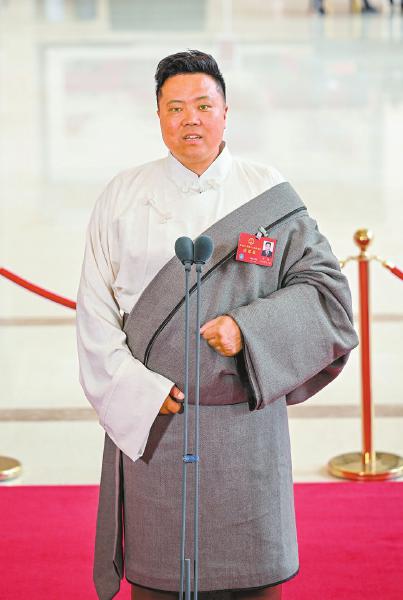
Group 1 - The article highlights the efforts of provincial representatives in Sichuan to improve local communities through various initiatives, focusing on ecological protection, cultural heritage, and child welfare [5][6][8][10][12] - A representative from Ganzi Prefecture emphasizes the integration of ecological protection and economic development, showcasing successful initiatives in grassland restoration and livestock management that have led to increased income for local herders [6][7] - Another representative discusses the transformation of cultural assets in Zigong, leveraging local salt and dinosaur heritage to boost tourism and economic growth, with significant visitor numbers and revenue reported [8][9] Group 2 - A coal mining representative presents strategies for ecological restoration in mining areas, including the successful greening of waste rock piles and the implementation of solar energy projects, demonstrating a shift towards sustainable practices in the coal industry [10][11] - The article also features a representative dedicated to supporting left-behind children, highlighting the establishment of safety measures for vulnerable groups and the positive impact of community support on children's well-being and educational outcomes [12][13][14]
华坪炜森能源有限公司成立,注册资本2000万人民币
Sou Hu Cai Jing· 2026-02-04 16:39
Group 1 - A new company, Huaping Weisen Energy Co., Ltd., has been established with a registered capital of 20 million RMB, fully owned by Hainan Shaoshang Investment Co., Ltd. [1] - The legal representative of Huaping Weisen Energy Co., Ltd. is Lu Yihong [1]. - The company is located in Huaping County, Lijiang City, Yunnan Province, and is classified as a limited liability company [2]. Group 2 - The business scope of Huaping Weisen Energy Co., Ltd. includes coal mining, construction labor subcontracting, and road freight transportation, among other activities [2]. - The company is involved in various sectors such as coal washing, sales of coal and its products, and renewable energy services including solar and wind power technology [2]. - The operational period of the company is set until February 4, 2026, with no fixed term thereafter [2].
淮北矿业:截至2026年1月31日股东总户数42186户
Zheng Quan Ri Bao· 2026-02-04 12:40
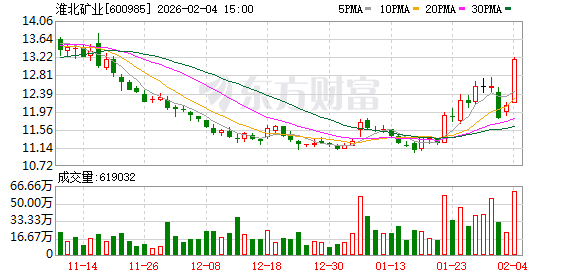
Core Viewpoint - Huabei Mining reported that as of January 31, 2026, the total number of shareholders is 42,186 [2] Company Information - The company actively engages with investors through an interactive platform [2] - The total number of shareholders indicates a significant level of investor interest and participation in the company [2]

应用软件股,大跌!
Zhong Guo Ji Jin Bao· 2026-02-04 12:21
Market Overview - The Hong Kong stock market showed mixed results, with the Hang Seng Index up by 0.05% closing at 26,847.32 points, while the Hang Seng Tech Index fell by 1.84% to 5,366.44 points, and the Hang Seng China Enterprises Index decreased by 0.05% to 9,048.38 points [2] Technology Sector Performance - Major technology stocks mostly declined, with Tencent Holdings down nearly 4%, Bilibili and NetEase dropping over 3%, and Baidu down nearly 3%. Xiaomi and Meituan also fell by over 1% [4] - Apple-related stocks weakened, with companies like Q Technology, FIH Mobile, and GoerTek dropping over 4%, while Sunny Optical Technology fell over 1% [4] - Semiconductor stocks generally decreased, with Shanghai Fudan down over 5%, Hua Hong Semiconductor down over 4%, and SMIC down over 2% [4] Application Software Sector - The application software sector experienced significant declines, with Kingdee International falling over 12%, Jushuitan down over 11%, Inspur Digital down nearly 10%, and China Software International down over 6% [7][11] - The overall sentiment in the software sector was affected by fears stemming from a new automation tool launched by AI startup Anthropic, leading to the largest single-day drop since April of the previous year [11] Lithium Battery and Coal Stocks - Lithium battery stocks saw gains, with CATL rising over 4% [5] - Coal stocks also performed well, with Yanzhou Coal Mining up over 10%, China Coal Energy up over 8%, and China Shenhua Energy and Shougang Resources both up over 5% [5] Government Initiatives - Hong Kong's Financial Secretary Paul Chan emphasized the importance of aligning with the national "14th Five-Year Plan" to enhance Hong Kong's role as an international financial, shipping, and trade center, as well as to support the development of an international innovation and technology hub [12] - The government plans to introduce a new mechanism to fully integrate with the national development strategy, which includes creating a five-year plan for Hong Kong [12][13]
淮北矿业:公司正在制定估值提升计划
Zheng Quan Ri Bao Wang· 2026-02-04 11:43
Group 1 - The company, Huaibei Mining (600985), is currently formulating a valuation enhancement plan [1] - The plan will be disclosed promptly after being approved by the board of directors [1] - Investors are encouraged to pay attention to future announcements regarding this plan [1]
强势反弹+板块共振!中煤能源(601898)封板涨停,多重利好共振修复
Jin Rong Jie· 2026-02-04 11:33
Core Viewpoint - The strong performance of China Coal Energy (601898) on February 4, with a 10% increase in stock price, is attributed to multiple factors including business fundamentals, sector sentiment, and a rebound from previous declines [2]. Group 1: Stock Performance - On February 4, China Coal Energy's stock surged to the daily limit, closing at 14.08 yuan, with a total trading volume of 9.55 billion yuan, approximately 2.3 times higher than the previous trading day [1]. - The stock experienced a net inflow of 159.13 million yuan from main funds, indicating strong market interest [1]. Group 2: Business Fundamentals - China Coal Energy's core business includes coal production and trade, coal chemical products, mining equipment manufacturing, pithead power generation, and financial services, with key products being thermal coal, coking coal, polyolefins, urea, and methanol [2]. - The company has a competitive advantage in coal mining, with production costs lower than most coal enterprises in China [2]. - The domestic fertilizer market is experiencing structural price increases, significantly enhancing short-term profitability for the company [2]. Group 3: Future Prospects - The company anticipates an additional production capacity of 6.4 million tons per year for coal and 900,000 tons per year for coal chemicals by the end of 2026 or 2027, which is expected to improve long-term profitability [2]. - Following a 7.38% drop in stock price on February 2, the market pressure was released, allowing for a potential rebound, further amplified by the collective rise in the coal mining sector [2].

谨慎加仓?
第一财经· 2026-02-04 11:18
Market Overview - The A-share market shows a divergent pattern, with the Shanghai Composite Index recovering above 4100 points, driven by strong performances in coal, real estate, liquor, and banking sectors [3] - A total of 3,252 stocks rose while 2,126 stocks fell, indicating a market trend of more gains than losses [3] - The market style has shifted significantly, with traditional blue-chip and cyclical sectors leading the gains, while technology growth sectors experienced notable pullbacks [3] Trading Volume and Market Sentiment - The trading volume in both markets decreased by 2.49%, reflecting a high-low switch and a consolidation phase [4] - Funds are being reallocated from high-valued technology growth stocks to low-valued traditional blue-chip and cyclical stocks, indicating a structural adjustment in investment strategies [4] - There is an increase in risk-averse sentiment among investors, with some short-term traders choosing to take profits and exit the market [4] Fund Flow Dynamics - Institutional investors are significantly adjusting their portfolios, moving funds away from high-valuation growth stocks in AI applications, computing hardware, and semiconductors, and into sectors like space photovoltaic, hydrogen energy, coal, liquor, and banking [6] - Retail investors are following suit, with some testing the waters in low-valuation sectors while reducing their exposure to high-volatility growth stocks [6] Investor Sentiment - Retail investor sentiment stands at 75.85%, indicating a relatively optimistic outlook among individual investors [7]

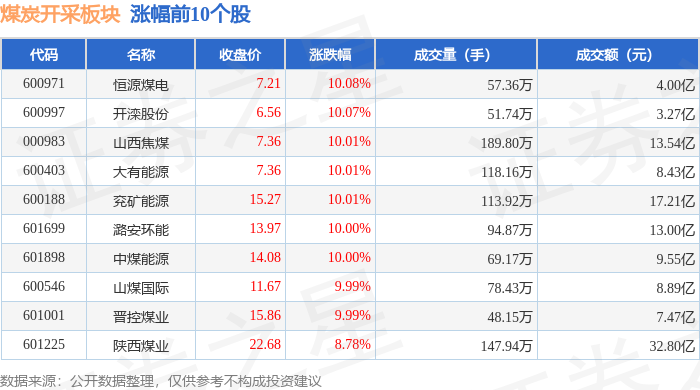
煤炭开采板块2月4日涨7.75%,恒源煤电领涨,主力资金净流入21.32亿元
Zheng Xing Xing Ye Ri Bao· 2026-02-04 08:56
Group 1 - The coal mining sector experienced a significant increase of 7.75% on February 4, with Hengyuan Coal Power leading the gains [1] - The Shanghai Composite Index closed at 4102.2, up 0.85%, while the Shenzhen Component Index closed at 14156.27, up 0.21% [1] - Key stocks in the coal mining sector showed substantial price increases, with Hengyuan Coal Power rising by 10.08% to a closing price of 7.21, and other notable increases from Kailuan Shares and Shanxi Coking Coal, both up by 10.01% [1] Group 2 - The coal mining sector saw a net inflow of 2.132 billion yuan from main funds, while retail investors experienced a net outflow of 1.171 billion yuan [1] - Major stocks like Dazhou Energy and Shanxi Coking Coal had significant main fund inflows, with Dazhou Energy receiving 2.07 billion yuan, representing 24.49% of its trading volume [2] - Retail investors showed a negative trend, with significant outflows from stocks such as Zhongmei Energy and Shanxi Coking Coal, indicating a shift in investor sentiment [2]