金属

Search documents
大涨!有色金属板块,集体爆发!
证券时报· 2025-12-23 04:34
Core Viewpoint - A-shares market shows strong performance with major indices rising, particularly the metals sector driven by surging precious metal prices [1][4][6] Group 1: Market Performance - Major indices in the A-shares market performed well, with the Shanghai Composite Index continuing to rise and the ChiNext Index surpassing the 3200-point mark [1][4] - The non-ferrous metals sector led the gains, with the sector's index rising over 2% during the session [4] Group 2: Sector Highlights - The surge in precious metal prices has significantly boosted the non-ferrous metals sector, making it one of the main highlights of the market [2][3] - Specific stocks such as Zhangyuan Tungsten Industry and Xianglu Tungsten Industry hit the daily limit up, while others like Shenzhen New Star and Shandong Gold also saw substantial gains [4] Group 3: Precious Metals - Precious metals prices continued to rise sharply, with domestic futures for platinum and palladium hitting their daily limits and reaching new highs [6] - The main platinum futures contract peaked at 619.95 yuan per gram, while palladium reached 555.15 yuan per gram, both marking new records since their listings [6] Group 4: New Stocks Performance - Three new stocks listed on the A-shares market all experienced significant increases, with Nanbaichuan seeing a rise of over 240% [11][12] - Other new listings like Xihua Technology and Tiansu Measurement also reported impressive gains of over 180% and 150%, respectively [13][14]








铜价冲顶后高位盘整 工业金属今年步入牛市共振
Ge Long Hui· 2025-12-23 03:39
格隆汇12月23日|在周一创下距离每吨12000美元仅差几美元的历史新高后,铜价出现回落,投资者正 在权衡经历了数月强劲上涨后的下一步走向。不过由于对明年供应短缺的担忧,铜价仍有望创下2009年 以来的最大年度涨幅。近几日,铜市情绪受益于更广泛的风险资产反弹,但其核心驱动力是市场预期大 量金属将持续流入美国,从而耗尽其他地区的库存。尽管如此,仍有更谨慎的声音指出,全球需求依然 相对疲软。建信期货分析师在报告中表示,当前的铜价上涨缺乏需求支撑,主要由宏观经济因素和供应 端动态驱动。但在市场情绪的推动下,预计价格将继续上涨。工业金属今年表现强劲,铝、锌、锡、铅 和镍也都有望实现年度上涨。 ...
广发早知道:汇总版-20251223
Guang Fa Qi Huo· 2025-12-23 02:00
1. Report Industry Investment Rating - Not provided in the given content 2. Core Views of the Report - The report provides a comprehensive analysis of various financial and commodity markets, including futures, stocks, and bonds. It assesses the market trends, supply - demand dynamics, and price movements of different assets, offering trading strategies and outlooks based on current economic and industry conditions [2][3][8] 3. Summary by Relevant Catalogs 3.1 Daily Selections - **Nickel**: Low valuation and mine - end news drive the sentiment, but the short - term reality is weak and the medium - term fundamentals are loose. The price is expected to oscillate and repair in the short term, with the main contract reference range of 116000 - 124000 [2] - **Styrene**: Supply - demand expectations are weak, and the rebound space is limited. The EB02 contract is expected to oscillate in the 6300 - 6700 range in the short term [3] - **Coking Coal**: Spot prices fluctuate, and the futures rebound. Short - term trading can consider going long on the 2605 contract [4] - **Oils and Fats**: Due to the approaching Christmas holiday, they are expected to show an interval oscillation trend. Palm oil may rebound, while soybean oil and rapeseed oil have limited upward space [5] - **Silver**: Driven by funds during the holiday, it strengthens the upward trend. It is recommended to buy on dips to increase the trading safety margin [7] 3.2 Financial Derivatives 3.2.1 Financial Futures - **Stock Index Futures**: The A - share market rebounded, and the main contracts of the four major stock index futures rose. The current trend is expected to be interval oscillation, and it is recommended to wait and see cautiously [8][9][10] - **Treasury Bond Futures**: LPR remained unchanged, and the stock market was strong, suppressing the bond market. It is recommended to view it as an oscillation, and if participating in trading, enter and exit quickly and stop profit in time [12][13] 3.2.2 Precious Metals - The prices of gold, silver, platinum, and palladium all rose. The market has a positive expectation for the future price of precious metals, and it is recommended to hold long positions unilaterally [15][16] 3.2.3 Container Shipping Index (European Line) - The index is rising, and it is expected to show an oscillating upward pattern in the short term [18] 3.3 Commodity Futures 3.3.1 Non - ferrous Metals - **Copper**: The price is oscillating at a high level. The short - term recommendation is to wait and see, with the main contract reference range of 92500 - 95000 [23] - **Alumina**: It is expected to oscillate at a low level around the cash cost line, with the main contract reference range of 2450 - 2650 yuan/ton [26] - **Aluminum**: It is expected to maintain a wide - range oscillation, with the main contract reference range of 21800 - 22600 yuan/ton [29] - **Aluminum Alloy**: It is expected to continue to oscillate at a high - level interval, with the main contract reference range of 20800 - 21600 yuan/ton [32] - **Zinc**: The TC stops falling and stabilizes, and the price oscillates. The main contract should pay attention to the support at 22850 - 22950 [35] - **Tin**: The short - term fundamentals are still strong, and it is recommended to hold long positions and buy on dips [40] - **Nickel**: The price is expected to oscillate and repair in the short term, with the main contract reference range of 116000 - 124000 [43] - **Stainless Steel**: It is expected to oscillate and adjust in the short term, with the main contract reference range of 12300 - 13000 [46] - **Lithium Carbonate**: It is expected to have a wide - range oscillation, with the main contract reference range of 11.2 - 11.6 million [51] - **Polysilicon**: It is in a high - level oscillation, and it is recommended to wait and see [54] - **Industrial Silicon**: It is expected to oscillate at a low level, and attention should be paid to the implementation of production cuts [56] 3.3.2 Ferrous Metals - **Steel**: It is expected to maintain an interval oscillation, with the rebar in the 3000 - 3200 range and the hot - rolled coil in the 3150 - 3350 range [58] - **Iron Ore**: It is expected to maintain an interval oscillation, with the reference range of 730 - 820. It is recommended to conduct short - term operations on the 05 contract [61] - **Coking Coal**: It is recommended to go long on the 2605 contract on dips [64] - **Coke**: It is recommended to go long on the 2605 contract on dips [67] - **Silicon Iron**: It is expected to oscillate in the 5400 - 5650 range [70] - **Manganese Silicon**: It is expected to be weak, and it is recommended to try shorting when the price rebounds above the Ningxia spot cost [73] 3.3.3 Agricultural Products - **Meal**: The domestic soybean meal market is in a loose pattern, and attention should be paid to the performance of the main contract around 2750 [77] - **Pigs**: The spot price is stable, and the disk is expected to have support around 11000 [79] - **Corn**: The disk may maintain a weak pattern, but the downward space is limited. Attention should be paid to the selling sentiment and policy release [82] - **Sugar**: The raw sugar price is in a bearish pattern, and the domestic market is oscillating at the bottom. It is recommended to maintain a bearish mindset [83] - **Cotton**: The US cotton is oscillating at the bottom, and the domestic market's upward trend slows down. It is expected to oscillate in a strong - level interval [85] - **Eggs**: The supply is still loose, and it is expected to oscillate weakly this week [87] - **Oils and Fats**: They are expected to show an interval oscillation trend. Palm oil may rebound, while soybean oil and rapeseed oil have limited upward space [91] - **Jujubes**: The supply - demand expectation is bearish, and the price is running weakly. Attention should be paid to the market consumption [93] - **Apples**: The demand is weak, and the rebound height is limited. It is recommended to exit long positions opportunely [94] 3.3.4 Energy and Chemicals - **PX**: It is expected to continue a relatively strong trend in the short term. It is recommended to reduce long positions on rallies and take a long - term low - buying approach [96] - **PTA**: It follows the raw material PX. It is recommended to reduce long positions on rallies and take a long - term low - buying approach [99] - **Short - fiber**: It follows the raw material, and the supply - demand expectation is weak [100] - **Bottle - grade PET**: The domestic supply is expected to increase, and the processing fee will be compressed in the short term [102] - **Ethylene Glycol**: It is expected to oscillate at a low level in the short term [103] - **Pure Benzene**: It is expected to oscillate in the 5300 - 5600 range [105] - **Styrene**: It is expected to oscillate in the 6300 - 6700 range in the short term [107] - **LLDPE**: It is recommended to wait and see [108] - **PP**: Attention should be paid to the expansion of PDH profits [109] - **Methanol**: It is recommended to pay attention to the shrinkage of MTO05 [110] - **Caustic Soda**: The price is expected to run weakly [112] - **PVC**: It is expected to maintain an interval arrangement and then weaken after a rebound [114] - **Soda Ash**: It is recommended to go short on rallies [116] - **Glass**: It is recommended to wait and see [117] - **Natural Rubber**: It is expected to oscillate in the 15000 - 15500 range, and it is recommended to wait and see [120] - **Synthetic Rubber**: It is expected to oscillate in the short term. Attention should be paid to the pressure of BR2602 around 11200 - 11300 [122]
【光大研究每日速递】20251223
光大证券研究· 2025-12-22 23:05
Group 1: Fund Market Overview - Financial and real estate themed funds performed well, while TMT themed funds saw a net value decline [5] - A total of 40 new funds were established in the domestic market, with a combined issuance of 18.321 billion units [5] - Stock ETFs experienced significant inflows, particularly in large-cap broad-based ETFs, Hong Kong stock ETFs, and TMT themed ETFs [5] Group 2: Real Estate Market Insights - From January to November 2025, the transaction area of residential land in 100 cities decreased by 15.1% year-on-year, totaling 221 million square meters [5] - The average transaction floor price increased by 9.4% year-on-year to 6,295 yuan per square meter, with first-tier cities seeing a 29.5% increase [5] Group 3: Steel Industry Analysis - The price gap between hot-rolled and rebar steel is at its lowest level in six years [6] - High furnace capacity utilization rates have been below last year's levels for three consecutive weeks [6] - The price of tungsten concentrate reached a new high since 2012, while the capacity utilization rate for electrolytic aluminum hit a historical high [6] Group 4: Oil and Gas Sector Performance - China National Offshore Oil Corporation (CNOOC) received an "AA" rating in ESG, ranking 10th among 527 companies in the petrochemical sector [7] - The company has improved its board independence and risk management, actively addressing climate change and implementing carbon reduction measures [7] Group 5: Public Utilities Sector Update - In November, electricity generation increased by 2.7% year-on-year, with marginal improvements in the growth rates of nuclear, photovoltaic, and wind power [8] - The SW public utilities sector index fell by 0.59%, ranking 25th among 31 SW primary sectors [8] Group 6: Pharmaceutical and AI Integration - Ant Group rebranded its AI health application to "Ant Ai Fu," which saw a surge in downloads shortly after launch [8] - The product iteration transforms low-frequency medical visits into high-frequency health management, creating a digital closed loop from consultation to insurance claims [8] Group 7: Automotive Industry Developments - Botai Carlink, established in 2009, went public in September 2025, ranking third in China's passenger car intelligent cockpit domain control suppliers with a market share of 7.3% [8] - In the first five months of 2025, the company ranked second in the new energy passenger car cockpit domain control market with a market share of 13.11% [8]
工业金属板块12月22日涨2.46%,白银有色领涨,主力资金净流入12.24亿元
Zheng Xing Xing Ye Ri Bao· 2025-12-22 09:03
以上内容为证券之星据公开信息整理,由AI算法生成(网信算备310104345710301240019号),不构成投资建议。 从资金流向上来看,当日工业金属板块主力资金净流入12.24亿元,游资资金净流出7.61亿元,散户资金 净流出4.62亿元。工业金属板块个股资金流向见下表: 证券之星消息,12月22日工业金属板块较上一交易日上涨2.46%,白银有色领涨。当日上证指数报收于 3917.36,上涨0.69%。深证成指报收于13332.73,上涨1.47%。工业金属板块个股涨跌见下表: ...


日度策略参考-20251222
Guo Mao Qi Huo· 2025-12-22 05:36
1. Report Industry Investment Ratings - **Bullish**: Copper, Aluminum, Nickel, Stainless Steel, Tin, Silver, Platinum, Palladium, Carbonate Lithium, BR Rubber, PTA [1] - **Bearish**: Industrial Silicon, Palm Oil, Rapeseed Oil, Fuel Oil [1] - **Sideways**: Stock Index, Bond Futures, Zinc, Precious Metals, Rebar, Hot Rolled Coil, Iron Ore, Manganese Silicon, Ferrosilicon, Glass, Soda Ash, Coal, Coke, Cotton, Sugar, Corn, Soybean, Pulp, Log, Crude Oil, Asphalt, Urea, Propylene, PVC, Caustic Soda, LPG, Container Shipping to Europe [1] 2. Core Views of the Report - In the short - term, the stock index is expected to continue its weak performance, but the adjustment since mid - November has opened up space for the upward movement of the stock index next year [1]. - Asset shortage and weak economy are beneficial to bond futures, but the central bank has recently warned of interest rate risks [1]. - The macro - sentiment has improved, and the prices of some non - ferrous metals and precious metals are showing positive trends, while the prices of some agricultural products and energy - chemical products are under pressure or in a sideways pattern [1]. 3. Summary by Related Categories Macro - financial - **Stock Index**: In the short term, it will continue to be weak. The adjustment since mid - November provides a layout window for the upward movement next year. Investors can consider gradually building long positions during the adjustment [1]. - **Bond Futures**: Asset shortage and weak economy are favorable, but the central bank has warned of short - term interest rate risks. Attention should be paid to the Bank of Japan's interest rate decision [1]. Non - ferrous Metals - **Copper**: With the Bank of Japan's interest rate hike and the recovery of market risk appetite, the copper price is running strongly [1]. - **Aluminum**: The industrial drive is limited, but the macro - sentiment has improved, and the aluminum price is oscillating strongly [1]. - **Zinc**: The fundamentals have improved and the cost center has moved up, but the price is under pressure. Attention should be paid to low - buying opportunities [1]. - **Nickel**: The global nickel inventory is still high. Due to supply concerns, the Shanghai nickel has rebounded significantly recently. Attention should be paid to Indonesian policies and macro - sentiment. In the long - term, the primary nickel market is in an oversupply situation [1]. - **Stainless Steel**: The price of raw material nickel iron has stabilized, and the social inventory has decreased slightly. The steel mills' production reduction in December is expected to increase. The futures price has continued to rebound, and short - term operations are recommended [1]. - **Tin**: The short - term macro - sentiment has improved, and the tin price has strengthened due to capital speculation [1]. Precious Metals and New Energy - **Precious Metals**: The Bank of Japan's interest rate hike and geopolitical tensions support the price, but the Fed officials' remarks bring short - term volatility risks [1]. - **Silver**: Macro - drivers, supply - demand imbalance, and increasing ETF holdings are beneficial, but short - term volatility risks need to be vigilant [1]. - **Platinum and Palladium**: The outer - market platinum price has reached a new high, and the inner - market may follow the upward trend. However, due to the high premium of the domestic futures price and the exchange's risk - control measures, short - term volatility risks should be noted [1]. - **Industrial Silicon**: Northwest production is increasing while Southwest production is decreasing. The production schedules of polysilicon and organic silicon in December are decreasing [1]. - **Polysilicon**: There is an expectation of capacity reduction in the long - term. The terminal installation in the fourth quarter has increased marginally. Large manufacturers have a strong willingness to support prices [1]. - **Carbonate Lithium**: It is in the traditional peak season for new energy vehicles, with strong energy - storage demand. The supply side has increased production resumption [1]. Black Metals - **Rebar and Hot Rolled Coil**: The basis and production profit are not high, and short - selling is not recommended [1]. - **Iron Ore**: The near - month contract is restricted by production cuts, but the far - month contract still has upward potential [1]. - **Manganese Silicon and Ferrosilicon**: The direct demand is weak, the supply is high, and the price is under pressure [1]. - **Glass and Soda Ash**: The supply - demand situation is acceptable, the valuation is low, and the downward space is limited [1]. - **Coal and Coke**: After the negative news was digested, there were signs of stabilization. Attention should be paid to whether downstream enterprises will carry out winter storage replenishment [1]. Agricultural Products - **Palm Oil**: Although the high - frequency data has improved, it is difficult to change the expectation of loose supply in the producing areas. Rebound short - selling is recommended [1]. - **Soybean Oil**: It is affected by the weak performance of the CBOT market and other domestic oils and is running weakly [1]. - **Rapeseed Oil**: The short - term raw - material shortage theme is expected to be over, and the global main producing areas are expected to have a good harvest. Short - selling the 05 contract is recommended [1]. - **Cotton**: The new domestic crop has a strong harvest expectation, and the purchase price of seed cotton supports the cost of lint. The downstream demand is weak, but there is rigid replenishment demand. The market is currently in a situation of "supported but without a driver" [1]. - **Sugar**: There is a global surplus and a large - scale supply of new domestic crops. The short - selling consensus is relatively consistent. If the price continues to fall, there will be strong cost support [1]. - **Corn**: The market supply - demand tension has eased, but farmers are still reluctant to sell. The inventory at each link is at a historical low, and there is expected to be stocking demand before the Spring Festival [1]. - **Soybean**: The US soybean export is weak, and the Brazilian soybean is expected to have a good harvest. The inner - market is expected to oscillate weakly [1]. - **Pulp**: The futures price is affected by weak demand and strong supply expectations. It is recommended to wait and see for unilateral operations and consider the 1 - 5 reverse spread [1]. - **Log**: Affected by the decline in the outer - market quotation and spot price, the 01 contract is under pressure and is expected to oscillate weakly [1]. Energy - Chemicals - **Crude Oil**: OPEC + has suspended production increases until the end of 2026, and there are uncertainties in the Russia - Ukraine peace agreement and US sanctions on Venezuelan oil exports [1]. - **Fuel Oil**: It follows the trend of crude oil in the short term, and there are factors such as the possible falsification of the 14th Five - Year Plan's rush - work demand and sufficient supply of Mare crude oil [1]. - **Asphalt**: The profit is relatively high [1]. - **BR Rubber**: The cost has increased, the price has risen, the operating rate has remained high, and the market sentiment is strong [1]. - **PTA**: The PX price is strong, the PTA device is operating at a high load, and the polyester pre - holiday stocking sales have improved [1]. - **Ethylene Glycol**: The price has fallen due to inventory accumulation, and the cost support has weakened [1]. - **Short - fiber**: The price closely follows the cost [1]. - **Benzene and Naphtha**: The cost provides some support, but the overall production economy is negative. The spot market sentiment has recovered, and the total inventory remains high [1]. - **Urea**: The export sentiment has eased, the domestic demand is insufficient, but there is support from the cost side [1]. - **Propylene**: The supply pressure is large, the downstream improvement is less than expected, but the cost support is strong [1]. - **PVC**: The supply pressure is increasing, the demand is weakening, and the price is oscillating in a range [1]. - **Caustic Soda**: The procurement rhythm has slowed down, the operating load is high, and there is inventory pressure in Shandong [1]. - **LPG**: The international oil and gas market has returned to the basic - face loosening logic, and the domestic C3/C4 production and sales are smooth [1]. Others - **Container Shipping to Europe**: The price increase in December was less than expected, the peak - season price - increase expectation was priced in advance, and the shipping capacity supply in December was relatively loose [1].
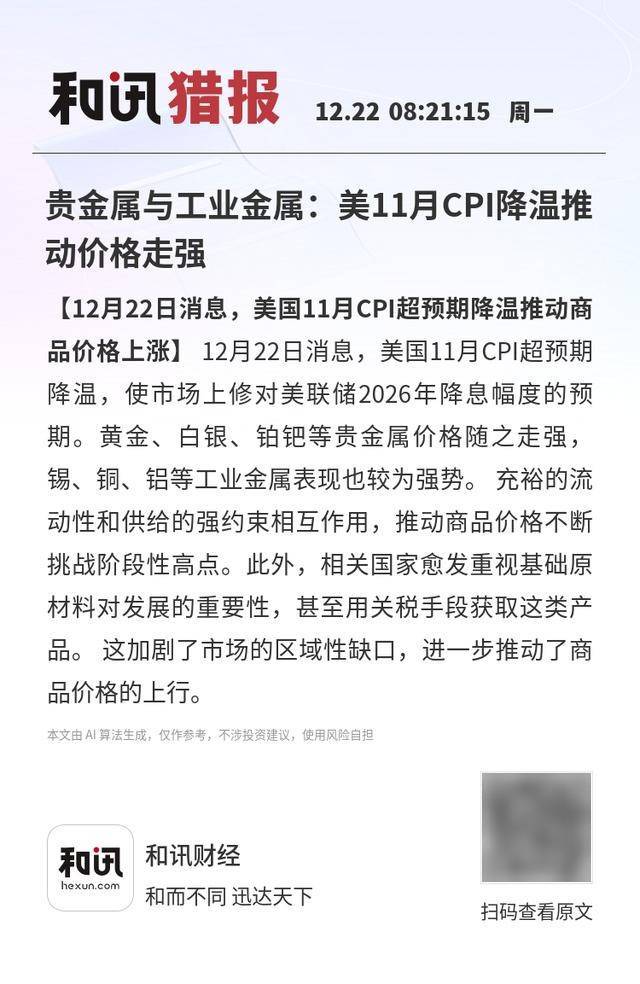
贵金属与工业金属:美11月CPI降温推动价格走强
Sou Hu Cai Jing· 2025-12-22 00:57
本文由 AI 算法生成,仅作参考,不涉投资建议,使用风险自担 和讯猎报 12.22 08:21:15 周一 贵金属与工业金属:美11月CPI降温推 动价格走强 【12月22日消息,美国11月CPI超预期降温推动商 品价格上涨】 12月22日消息,美国11月CPI超预期 降温,使市场上修对美联储2026年降息幅度的预 期。黄金、白银、铂把等贵金属价格随之走强, 锡、铜、铝等工业金属表现也较为强势。充裕的流 动性和供给的强约束相互作用,推动商品价格不断 挑战阶段性高点。此外,相关国家愈发重视基础原 材料对发展的重要性,甚至用关税手段获取这类产 品。这加剧了市场的区域性缺口,进一步推动了商 品价格的上行。 【12月22日消息,美国11月CPI超预期降温推动商品价格上涨】12月22日消息,美国11月CPI超预期降 温,使市场上修对美联储2026年降息幅度的预期。黄金、白银、铂钯等贵金属价格随之走强,锡、铜、 铝等工业金属表现也较为强势。充裕的流动性和供给的强约束相互作用,推动商品价格不断挑战阶段性 高点。此外,相关国家愈发重视基础原材料对发展的重要性,甚至用关税手段获取这类产品。这加剧了 市场的区域性缺口,进一步推动 ...
金属市场这一年:金价“一骑绝尘” 有色“夺冠在望” 行业彻底火了
Zhong Guo Ji Jin Bao· 2025-12-22 00:50
(原标题:金属市场这一年:金价"一骑绝尘" 有色"夺冠在望" 行业彻底火了) 【导读】金价"一骑绝尘",有色"夺冠在望",金属行业迎来高光时刻 【编者按】2025年接近尾声,中国基金报推出"2025年终报道",梳理总结2025年公募基金、券商行业、热门产业发展变化和大事件,展望2026年 股市机会和基金行业发展前景,以飨读者。 2025年的交易时钟已来到尾声,金属市场从未像今年这样,能源革命、产业升级与全球宏观政策的博弈同时展开,整体呈现"贵金属领涨、工业金 属分化、小金属底部抬升"的格局,并以惊人的涨幅震撼投资者。 黄金、白银、铜三大金属自1980年以来首次在同一个日历年度内创下新高。黄金价格年内50次刷新纪录,累计涨幅超60%,成为年内表现最亮眼 的资产之一;白银、铂金等贵金属紧随其后,工业金属和小金属在供需紧平衡中孕育机会。 惊人的涨幅、分化的格局、重估的逻辑……2025年的金属市场以其极致表现载入史册。然而,当狂欢的钟声渐息,新的问题随之浮现:在历史性 高点之后,是盛宴的尾声,还是新周期的起点?2026年的投资时钟,又将指向何方? "金属牛市" "都说白银是'穷人的黄金',但我今年靠它翻身了。"上海白 ...
金价“一骑绝尘”,有色“夺冠在望”,金属行业彻底火了
Zhong Guo Ji Jin Bao· 2025-12-21 13:22
【导读】金价"一骑绝尘",有色"夺冠在望",金属行业迎来高光时刻 【编者按】2025年接近尾声,中国基金报推出"2025年终报道",梳理总结2025年公募基金、券商行业、热门产业发展变化和大事件,展望2026年股市机会 和基金行业发展前景,以飨读者。 中国基金报记者 赵心怡 2025年的交易时钟已来到尾声,金属市场从未像今年这样,能源革命、产业升级与全球宏观政策的博弈同时展开,整体呈现"贵金属领涨、工业金属分 化、小金属底部抬升"的格局,并以惊人的涨幅震撼投资者。 黄金、白银、铜三大金属自1980年以来首次在同一个日历年度内创下新高。黄金价格年内50次刷新纪录,累计涨幅超60%,成为年内表现最亮眼的资产之 一;白银、铂金等贵金属紧随其后,工业金属和小金属在供需紧平衡中孕育机会。 惊人的涨幅、分化的格局、重估的逻辑……2025年的金属市场以其极致表现载入史册。然而,当狂欢的钟声渐息,新的问题随之浮现:在历史性高点之 后,是盛宴的尾声,还是新周期的起点?2026年的投资时钟,又将指向何方? "金属牛市" "都说白银是'穷人的黄金',但我今年靠它翻身了。"上海白银期货投资者林薇展示着手机上的交易记录:年初账户余额不 ...

金价“一骑绝尘”,有色“夺冠在望”,金属行业彻底火了
中国基金报· 2025-12-21 13:18
【导读】 金价"一骑绝尘",有色"夺冠在望",金属行业迎来高光时刻 【编者按】2025年接近尾声,中国基金报推出"2025年终报道",梳理总结2025年公募基金、券商行业、热门产业发展变化和大事件,展 望2026年股市机会和基金行业发展前景,以飨读者。 林薇的自信来自白银的大幅上涨。2025年,白银堪称贵金属市场的最大"黑马"——年内涨幅超过100%,刷新历史高点。 中国基金报记者 赵心怡 2025年的交易时钟已来到尾声,金属市场从未像今年这样,能源革命、产业升级与全球宏观政策的博弈同时展开,整体呈现"贵金属领 涨、工业金属分化、小金属底部抬升"的格局,并以惊人的涨幅震撼投资者。 黄金、白银、铜三大金属自1980年以来首次在同一个日历年度内创下新高。黄金价格年内50次刷新纪录,累计涨幅超60%,成为年内表现 最亮眼的资产之一;白银、铂金等贵金属紧随其后,工业金属和小金属在供需紧平衡中孕育机会。 惊人的涨幅、分化的格局、重估的逻辑……2025年的金属市场以其极致表现载入史册。然而,当狂欢的钟声渐息,新的问题随之浮现:在 历史性高点之后,是盛宴的尾声,还是新周期的起点?2026年的投资时钟,又将指向何方? "金属 ...