
航空

Search documents
1750亿美元败仗刚签字,白宫反手全球加税10%:这不是贸易,是战争!
Sou Hu Cai Jing· 2026-02-23 17:05
Core Viewpoint - The article discusses the U.S. government's decision to impose a 10% "defensive tariff" on nearly all imported goods, excluding Canada and Mexico, following a WTO ruling that required the U.S. to refund $175 billion due to unlawful tariffs on Chinese products. This move is seen as a retaliatory measure and a shift in global trade dynamics, leading to significant market reactions and potential conflicts with other nations [1][3][5]. Group 1 - The U.S. is imposing a 10% tariff on almost all imports, which covers approximately 96% of imported goods, as a response to a WTO ruling that mandated the return of $175 billion due to previous tariffs deemed illegal [1][3]. - The immediate market reaction included a 700-point drop in Tokyo stock futures and a 1.8% decline in the euro against the dollar, indicating a significant global market impact [3][5]. - The U.S. is using the additional tariff revenue, estimated at $120 billion annually, to fund military initiatives in the Indo-Pacific region, including the deployment of anti-ship missiles and unmanned underwater vehicles [7][9]. Group 2 - Countries such as the EU and Japan have quickly responded with their own lists of retaliatory tariffs, targeting U.S. products like Harley-Davidson motorcycles and bourbon whiskey, indicating a rapid escalation in trade tensions [5][9]. - China has initiated its own countermeasures, including applying for "cross-retaliation" at the WTO and extending export approval times for critical minerals, which could significantly impact U.S. industries reliant on these materials [9][11]. - The average tariff rate on Chinese goods entering the U.S. has now reached 31%, with similar high rates for other countries, suggesting a broadening of the trade conflict that could involve multiple global players [13][15]. Group 3 - The article highlights that the U.S. decision to impose tariffs is not just a trade issue but also a strategic maneuver to compel countries to choose sides in a global conflict, with military implications tied to economic actions [7][9]. - The U.S. faces potential backlash from its own citizens, as the new tariffs could lead to an increase of $820 in annual expenses for American households, negating previous tax cuts [15]. - The article concludes that the U.S. is in a precarious position, with its economic and military strategies facing significant challenges, and the potential for increased litigation against it in the coming months [15][17].


暴风雪扰乱美国东北部航空旅行
Xin Lang Cai Jing· 2026-02-23 14:56
Group 1 - A major storm has led to the cancellation of over 5,000 flights across the United States due to low visibility weather conditions caused by blizzards in New York and Boston [1][2] - Airlines such as United Airlines, JetBlue Airways, and Delta Air Lines have issued waiver notices in response to the storm [1][2]
道指开盘跌0.3%,标普500跌0.1%,纳指跌0.2%
Xin Lang Cai Jing· 2026-02-23 14:36
Group 1 - United Airlines fell by 1.7%, American Airlines dropped by 1.1%, and Delta Airlines decreased by 1.5% due to a severe snowstorm that forced airlines to cancel flights nationwide [1] - Arcellx surged by 78.1% as Gilead Sciences announced it would acquire Arcellx at a price of $115 per share [1] - Novo Nordisk declined by 15.6% after its weight loss drug CagriSema showed less effective results compared to Eli Lilly's competing product, which saw an increase of 4.8% [1] - Domino's Pizza rose by 6.0% as its Q4 revenue exceeded expectations [1]





A股策略周报:节后主线将更加清晰-20260223
SINOLINK SECURITIES· 2026-02-23 13:49
Global Assets: Rebalancing Continues - The current market rebalancing is based on internal and external recovery, with AI trading entering its second phase, leading to a focus on the actual impact of AI on various industries [3][13] - From February 16 to February 20, 2026, global risk assets showed an overall upward trend, but internal performance was mixed, with industrial, financial, and energy sectors gaining favor [3][13] - The focus has shifted from whether AI is a bubble to identifying the real industrial impacts and critical supply-demand issues as AI transitions from a thematic to a macro factor [3][13] Manufacturing Cycle Further Rising - The U.S. GDP data for Q4 2025 showed slower growth primarily due to government spending disruptions, while AI-related investments remained strong [4][25] - Non-AI and residential investment growth is showing signs of bottoming out, indicating a broader recovery in investment activities beyond just AI [4][25] - The February manufacturing PMI data indicated a recovery in global manufacturing, with Europe exceeding expectations and the U.S. maintaining expansion, suggesting a positive trend in manufacturing cycles [4][25][34] Commodities: Transitioning from Financial Overtrading to Industrial Pricing - Recent fluctuations in industrial and precious metals prices are attributed to macro and industrial events, with a return to real supply-demand signals expected [5][44] - Geopolitical risks continue to support industrial metal prices, while demand from tech giants for AI investments remains robust, indicating a potential new support for demand [5][44] - Historical data suggests that current copper and aluminum price ratios are low compared to historical manufacturing PMI levels, indicating potential for price recovery [5][44][45] Focus on Global Physical Assets vs. Chinese Assets - The core of market rebalancing is not about the existence of an AI bubble but rather the macro impacts of AI combined with monetary and major country policy choices [6][56] - The relative smooth path for future U.S. interest rate cuts is expected to support the recovery of the global manufacturing cycle, which may lead to a revaluation of Chinese asset capacity [6][56] - Specific investment recommendations include physical assets like copper, aluminum, and oil, as well as sectors benefiting from capital inflows and consumption recovery in China [6][56]
沪市公司助力新春消费“马力十足”
Zhong Guo Xin Wen Wang· 2026-02-23 11:16
Group 1: Travel and Transportation - Shanghai airport recorded a single-day passenger flow of 424,900 on February 20, 2026, with a year-on-year increase of 6.4%, marking a historical high [1] - During the Spring Festival travel period, Shanghai's two major airports are expected to handle 96,000 flights and 15.53 million passengers, reflecting a year-on-year growth of 1.9% and 3.6% respectively [1] Group 2: Film Industry - As of February 23, 2026, China's film market has surpassed $1.1 billion in cumulative box office, ranking first globally among single markets [2] - The Spring Festival box office has exceeded 5.2 billion yuan, with over 100 million viewers for the eighth consecutive year [2] - Five films produced and distributed by Chinese companies have collectively grossed over 4.9 billion yuan during the Spring Festival [2] Group 3: Tourism and Cultural Events - The Shanghai Yuyuan Lantern Festival has undergone a digital transformation, creating an immersive cultural experience that integrates advanced technology [2] - Changbai Mountain scenic area received 81,000 visitors by the sixth day of the Lunar New Year, achieving a year-on-year growth of 1.28% [2] - Huangshan scenic area welcomed 174,400 visitors from February 17 to 22, 2026, with a 2.38% increase compared to the previous year, and a 12.16% rise in revenue [3] Group 4: Food and Beverage Industry - Guangzhou Restaurant has successfully integrated scene creation, product innovation, and interactive experiences during the Spring Festival [3] - Anjiu Foods conducted over 6,000 in-store events across 595 supermarkets from the eighth day of the Lunar New Year to the fifteenth day [3]
交通运输产业行业周报:春运人员流动量同比+5.1% TD3C运价涨至15万美元以上
SINOLINK SECURITIES· 2026-02-23 10:45
Investment Rating - The report does not explicitly provide an investment rating for the transportation sector Core Views - The transportation index decreased by 1.4% while the Shanghai and Shenzhen 300 index increased by 0.4%, indicating underperformance against the broader market [1] - During the Spring Festival travel period, the total number of people moving across regions increased by 5.1% year-on-year, with significant growth in waterway travel at 21.3% [2] - The express delivery sector is benefiting from price increases due to reduced competition, with a recommendation for SF Holding based on valuation and operational resilience [2] - The logistics sector is recommended for Haichen Co., as the chemical product price index shows a decline, but operational metrics remain stable [3] - The aviation sector is experiencing a slight increase in flight volumes, with domestic flights up by 5.67% year-on-year, and a recommendation for China National Aviation and Southern Airlines due to expected profit recovery [4] - The shipping sector is seeing fluctuations in freight rates, with geopolitical tensions driving oil transport rates higher, and a recommendation for companies involved in oil transport [5] Summary by Sections Shipping and Ports - The shipping sector is experiencing a slowdown in container shipping rates, with the CCFI index at 1088.14 points, down 3.0% week-on-week and 21.6% year-on-year [22] - Oil transport rates are increasing due to geopolitical risks, with the BDTI index at 1756.4 points, up 2.2% week-on-week and 91.5% year-on-year [35] Aviation and Airports - The aviation sector is showing signs of recovery, with a year-on-year increase in passenger numbers and a recommendation for airlines based on improved load factors and pricing [47] - The Brent crude oil price is at $71.76 per barrel, reflecting a 5.92% increase week-on-week, which may impact operational costs for airlines [64] Rail and Road - The rail sector is seeing an upward trend in passenger volumes, with a year-on-year increase of 8.52% in December [73] - The road transport sector is stable, with a slight decrease in freight traffic but a recommendation for investment based on dividend yields exceeding government bond rates [75]
中国股市“迎接转型牛”专题系列报告三:中国股市上升的关键动力三:中国内需提振的“有力转折”
GUOTAI HAITONG SECURITIES· 2026-02-23 07:43
Group 1 - The focus of China's economic work is shifting towards domestic demand as a primary task, marking a historical turning point for expanding domestic demand [7][8] - The proportion of final consumption expenditure in GDP is expected to reach approximately 56.6% by 2024, significantly lower than the 66%-83% levels of developed economies like Japan and South Korea [7][23] - The strategic position of consumption as a "stabilizer" and "new engine" for economic growth is increasingly prominent, with service consumption becoming a core driver of consumption upgrade [7][23] Group 2 - Current domestic consumption is stabilizing at a low level, with structural recovery signals gradually emerging, supported by effective policies targeting long-standing consumption constraints [30][33] - The contribution rate of consumption to economic growth reached 52% in 2025, indicating that domestic demand is solidifying its dominant role in macroeconomic balance [33] - Service consumption is leading the recovery, with its share of total consumption rising from 41.66% to 46.15% over the past three years, indicating a strong trend towards service-oriented consumption [34] Group 3 - The real estate sector has undergone significant adjustments, entering a bottoming phase, with housing prices in first, second, and third-tier cities dropping by 22%, 30%, and 30% respectively from their peaks [7][10] - Recent policy changes are positively impacting the real estate market, with financing policies easing and urban renewal initiatives stabilizing housing price expectations [12][29] - The valuation and holding of domestic demand-related sectors are at historical lows, presenting a favorable opportunity for investment as expectations stabilize [4][38]
美国关税被判违法,有利A股开门红?美伊局势才是A股关键胜负手
Sou Hu Cai Jing· 2026-02-23 05:10
Group 1 - The core focus of the capital market post-Spring Festival is whether A-shares will be influenced by changes in US tariff policies, with a conclusion that such impacts can be largely ignored [1][3] - The Trump administration's tariffs on Chinese goods, including a 20% additional tariff, were recently affected by a Supreme Court ruling that deemed them invalid, leading to a temporary 15% tariff being imposed instead, resulting in a net reduction of 5% in actual tariff rates [3][5] - The initiation of the Section 301 investigation by the US Trade Representative aims to solidify tariff outcomes through a legal process, indicating a strategic approach to counteract the Supreme Court's ruling [5] Group 2 - Chinese enterprises have developed robust risk-hedging mechanisms over years of trade friction, reducing reliance on the US market and enhancing their resilience against minor tariff fluctuations [7] - The capital market's response to the tariff changes is expected to be stable, as the "information vacuum" during the Spring Festival allowed investors to assess the situation, minimizing the likelihood of significant market volatility [7] - The geopolitical situation in the Middle East poses a greater risk to A-shares than tariff fluctuations, with potential military conflicts affecting global oil prices and consequently impacting China's energy costs and related industries [9][11] Group 3 - Investors are faced with two strategic choices: to reduce holdings in anticipation of inevitable conflict or to hold onto stocks, believing in diplomatic resolutions to benefit from market gains [11] - The decision-making logic of the Trump administration regarding military deployments in the Middle East suggests a complex interplay of costs and expected strategic benefits, adding uncertainty to the geopolitical landscape [11] - Overall, the A-share market is expected to exhibit characteristics of "no disturbance from tariffs, dominated by geopolitical factors," with a need for investors to closely monitor Middle Eastern developments [13]
张瑜:量增价稳,结构亮点凸显——春节假期消费观察
Xin Lang Cai Jing· 2026-02-23 02:54
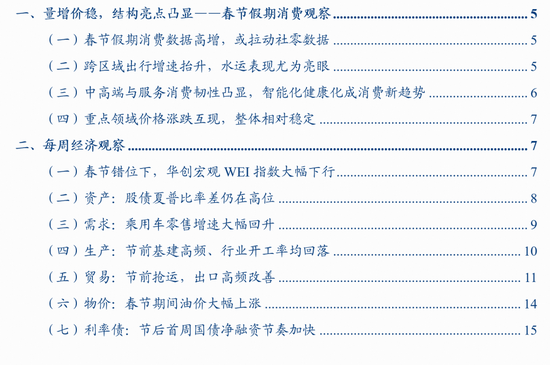
Group 1 - The core viewpoint of the article highlights a significant increase in retail and catering data during the Spring Festival holiday, with a year-on-year growth of 8.6% in the first four days, which is expected to boost the social retail data for the first two months of the year [1][2][52] - The increase in cross-regional travel during the holiday period saw an 8.7% rise compared to the previous year, with water transport showing remarkable growth of 28.5%, influenced by tourism demand and the reopening of Hainan [3][12][54] - Price stability was observed in key sectors, with high-end liquor and hotel prices in popular small cities increasing, while prices in first-tier cities and movie ticket prices saw declines [4][16][55] Group 2 - Structural highlights in consumption include a strong performance in mid-to-high-end products like gold and duty-free items, with gold consumption remaining robust and duty-free sales in Hainan increasing by 20.9% [5][14][56] - Domestic and cross-border travel maintained momentum, with hotel accommodation transaction values rising by 32.7% and a predicted double-digit growth in daily inbound and outbound travelers at national ports [5][14][57] - The trend towards smart and health-oriented consumption was evident, with significant sales growth in smart wearable devices and organic foods during the holiday period [5][14][57] Group 3 - Weekly economic observations indicate a rebound in durable goods consumption, with passenger car retail sales increasing by 54% year-on-year in early February, contrasting with a decline of 13.9% in January [6][24] - Real estate sales showed improvement, with a 5% year-on-year increase in residential sales area in 27 cities as of mid-February, compared to a decline of 16% in January [6][25] - Export activities showed signs of recovery, with a 32.3% increase in the number of outbound port calls compared to the previous year, indicating a positive trend in trade [6][30]
春节人民币强势升值至6.89区间 股债汇三市迎来正面支撑 大类资产如何配置?
Hua Xia Shi Bao· 2026-02-23 02:08
Core Viewpoint - The Chinese yuan has experienced a significant appreciation during the Spring Festival, driven by factors such as a weakening US dollar index, rising expectations of interest rate cuts by the Federal Reserve, steady domestic economic recovery, and a sustained trade surplus [1][3]. Currency Market - As of February 21, the yuan maintained a strong position around 6.89, with offshore yuan touching a low of 6.88 and onshore yuan rising to 6.885, marking the highest levels since April 2023 [1]. - The yuan's appreciation since February has been approximately 1.3% [1]. - The increase in the yuan's value is expected to enhance the international purchasing power of the currency, benefiting imports and stabilizing prices [1][3]. Economic Factors - The yuan's strength is attributed to a solid trade surplus, with expectations of a record merchandise trade surplus of over $1.076 trillion for 2025 [3]. - The demand for currency exchange during the pre-holiday period, driven by companies settling payments and bonuses, has temporarily boosted the yuan's value [3]. - Foreign exchange reserves reached $339.91 billion by the end of January, marking a $41.2 billion increase and remaining above 3.3 trillion yuan for six consecutive months [3]. Asset Market Implications - The appreciation of the yuan is expected to correct the undervaluation of Chinese assets, positively impacting the stock market and attracting foreign investment [3][4]. - Analysts predict that if the yuan continues to appreciate into 2026, the positive effects on the stock market will be even more pronounced [4]. - The bond market is expected to experience mixed influences, with potential downward pressure on short-term yields due to monetary policy easing, while upward pressure may arise from increased foreign capital inflow [4]. Investment Strategies - Investment firms suggest that the yuan's appreciation will necessitate a reevaluation of asset allocation strategies, with a focus on sectors benefiting from lower import costs and increased foreign investment [6][7]. - Key sectors to watch include aviation, chemicals, and industries reliant on imported raw materials, which may see cost reductions and improved profit margins [8]. - The report emphasizes the importance of monitoring the flow of northbound capital as a significant indicator for industry allocation [8]. Commodity Market Outlook - The outlook for industrial metals such as copper, aluminum, and nickel is positive, while other commodities may lack clear trends [9]. - Gold, traditionally viewed as a safe-haven asset, should be strategically allocated, though caution is advised for short-term speculative trading [9].